
The fastest return in warehouse artificial intelligence usually starts with a pair of shoes, not a robot. In many fulfillment operations, pickers spend 60–70% of their shift walking rather than picking, packing, or handling product directly.[1] Another industry estimate puts daily picker walking distance at 10–15 miles. That is not a side effect of warehouse work; it is often the work.
Dynamic slotting matters because it attacks that walk. Before a warehouse buys autonomous mobile robots, redesigns a building, or argues about a digital twin, it can ask a plainer question: are the SKUs people touch most often sitting where the feet actually need them? If the answer is no, AI-driven slotting is usually the first warehouse AI use case worth evaluating.
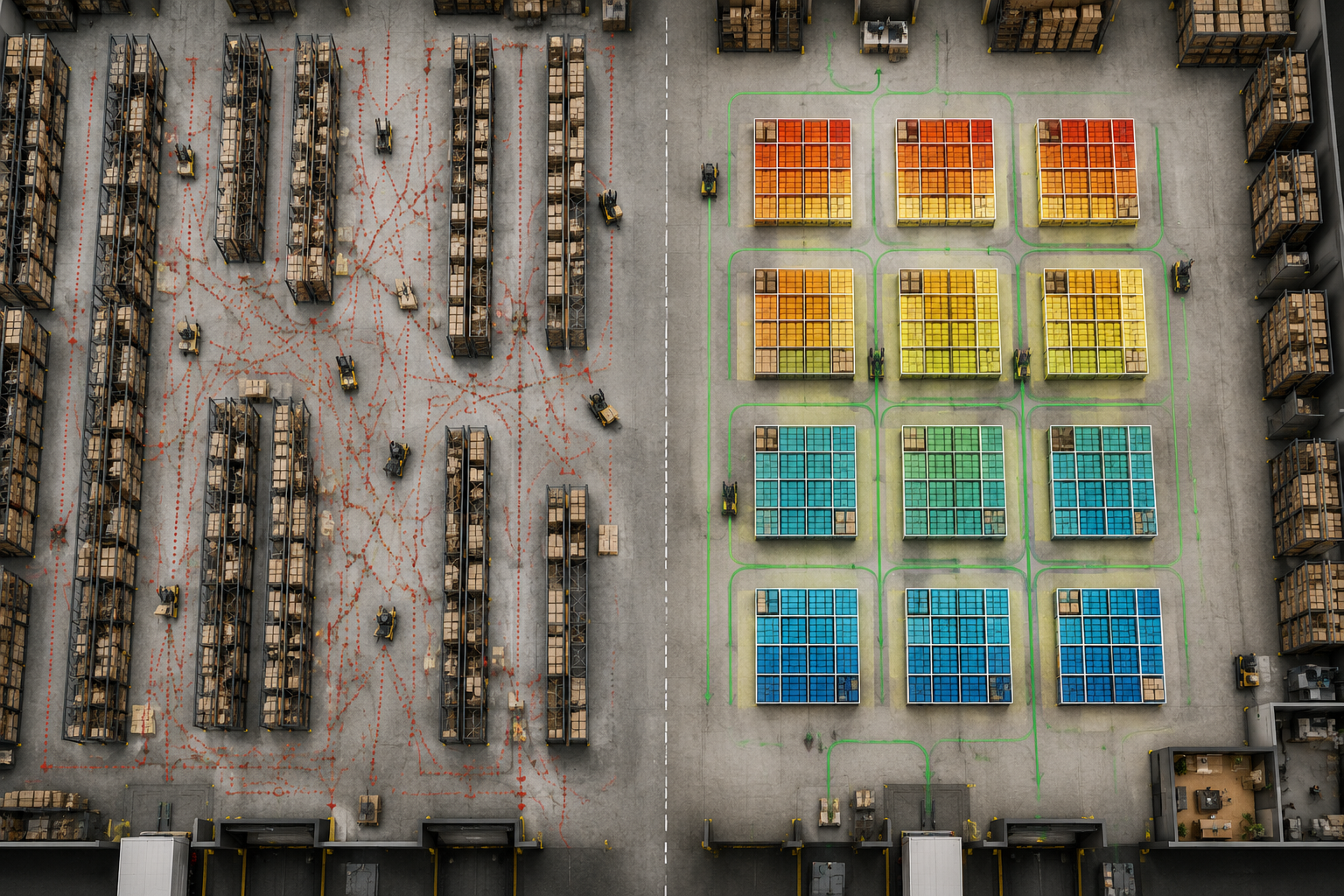
The case is not that slotting is glamorous. It is that picking consumes enough labor and operating cost for small physical decisions to become structural. Research cited by Xenoss attributes 55% of warehouse labor time and up to 75% of warehouse operational costs to picking.[2] When the largest activity in the building is also the activity most exposed to walking distance, the slotting file is not housekeeping. It is cost architecture.
Why Slotting Beats the Flashier First Bet
A warehouse leader looking for a first AI deployment normally has three constraints. Finance wants measurable payback. IT wants something that does not turn into a multi-year integration program. Operations wants to keep shipping while the change happens. Dynamic slotting fits that argument better than most warehouse AI because the mechanism is visible on the floor: fewer steps between picks, fewer long reaches into slow zones, fewer wasted replenishment and putaway decisions that later punish the picker.
The measurable prize is travel time. Slotting optimization benchmarks in the research base place picker travel-time reduction in a broad 20–50% range, with actual results depending on layout, SKU count, order volatility, and WMS support. That range should not be treated as a guarantee, but it is enough to explain why the use case gets attention. If a facility has high travel and changing demand, there is a direct line between better location decisions and labor productivity.
This is also why blended automation ROI claims need careful reading. SellersCommerce reports warehouse automation statistics including ROI above 250% with payback in about eight months for slotting-optimized AMR deployments, and it cites a Synkrato case with a 42% five-year OPEX reduction.[3] Those are useful signals that slotting can contribute to larger automation returns, but they combine slotting with robotics. They should not be presented to a CFO as pure software-slotting payback.
For a narrower ROI discussion, a detailed companion analysis on how quickly AI warehouse slotting pays off can carry the finance model. The operating point here is simpler: slotting is one of the few AI applications where the warehouse can measure the before-and-after without waiting for a new physical system to mature.
What AI Changes About Slotting
Traditional ABC slotting is not foolish. It became standard because it makes sense to put the fastest movers closer to the most efficient pick areas. The weakness is that it is usually backward-looking and periodic. It ranks SKUs from historical pick frequency, creates a layout, and then waits for the next review cycle while demand keeps moving.
Modern e-commerce punishes that delay. A promotion can distort demand for a week. Seasonal profiles can move faster than a quarterly slotting review. SKU proliferation can turn yesterday’s clean A/B/C ranking into a mess of small picks spread across too much aisle distance. The slotting plan may still look orderly in the WMS while the pick path has already gone stale.
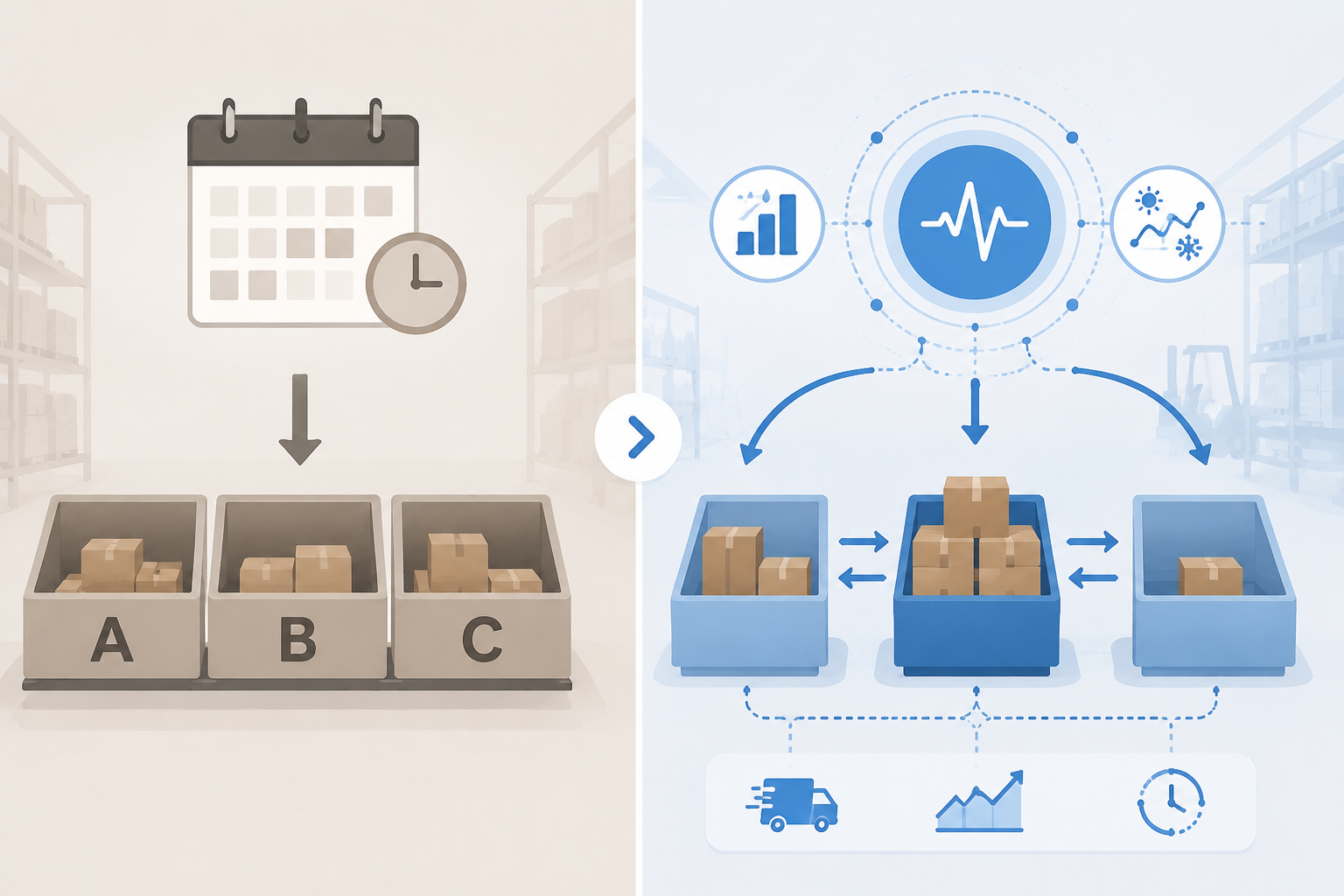
AI-driven dynamic slotting changes the cadence. Instead of treating SKU location as a periodic planning exercise, it uses current and predictive signals—velocity, order combinations, seasonality, promotions, directed putaway logic, and changing demand patterns—to keep recommending better locations.[1][2] The algorithm is not valuable because it sounds advanced. It is valuable when it keeps the pick face aligned with the orders actually arriving.
| Slotting approach | How it works | Where it breaks |
|---|---|---|
| Traditional ABC slotting | Ranks SKUs mainly from historical movement and reviews locations periodically | Demand changes faster than the review cycle |
| AI-driven dynamic slotting | Uses current and predictive demand signals to recommend ongoing location changes | Requires clean item, order, location, and movement data |
| Slotting plus robotics | Combines location optimization with AMRs or other automation flows | ROI is harder to attribute to slotting alone |
The important distinction is adoption versus effectiveness. A platform may offer AI slotting, and a warehouse may activate it, but the outcome still depends on whether supervisors can execute the recommended moves, whether the WMS can support location changes without confusion, and whether the data reflects what is really happening on the floor.
The Best Candidates Have Visible Travel Waste
Dynamic slotting is strongest when the pain is already visible. If supervisors know certain pickers are burning time across long aisles, if fast movers keep appearing in poor locations, or if promotions make the pick path feel different every week, the use case has something concrete to attack.
- High picker travel relative to actual pick handling time
- Large or changing SKU assortments
- E-commerce order variability, including small multi-line orders
- Seasonal demand swings or frequent promotions
- A WMS or execution layer that can support slot reassignment without breaking daily control
The weaker candidates are just as important to name. A warehouse with stable demand, low SKU churn, short travel paths, and already disciplined slotting may still benefit, but the return is less likely to be dramatic. A facility with poor item master data, unreliable location discipline, or frequent unrecorded moves may find that the first problem is data hygiene, not machine learning. For those cases, an implementation guide such as From Data Readiness to Scale belongs earlier in the investment conversation.
There is also a human execution test. Reslotting creates work before it removes work. Someone has to approve the moves, schedule them, communicate changed pick faces, and watch whether the change creates congestion somewhere else. The best AI slotting deployments do not pretend that the warehouse reorganizes itself. They reduce the number of bad location decisions supervisors have to live with.
The Market Is Real, but the Business Case Still Has to Be Local
Warehouse AI is no longer an exotic category. A MIT CTL and Mecalux study, reported by DCVelocity, found that 60% of warehouses in a survey of more than 2,000 professionals across 21 countries already integrate AI in some form.[4] Mecalux’s own release presents the same 60% adoption finding.[5] That context is useful, but it is still self-reported and vendor-associated. It shows that AI has entered the warehouse conversation; it does not prove that every AI use case returns money.
The vendor ecosystem around slotting is broad enough that buyers are not looking at a science project. Logiwa discusses AI-driven slotting inside a WMS platform, especially for small and mid-sized distribution operations.[1] Xenoss frames slotting in a value-complexity matrix as a high-value, low-complexity warehouse AI use case.[2] Lucas Systems connects AI with voice-directed picking and dynamic slotting, Synkrato combines slotting with AMR orchestration, and Optioryx focuses on slotting-specific optimization. Those examples show different routes into the problem, not interchangeable proof points.
Xenoss’s matrix is a useful prioritization lens because it asks the right first question: which AI use cases create enough value without demanding too much operational complexity?[2] Slotting often lands well on that test because it improves an existing process rather than replacing the operating model. But the matrix should still be treated as a framework from a commercially adjacent source, not neutral validation.
A broader use-case comparison can sit in a separate warehouse AI use-case library. Slotting deserves its own treatment because it has a cleaner operating chain than many alternatives: demand changes, SKU locations drift out of alignment, pickers walk too far, and better slot recommendations reduce that waste.
How to Judge the Investment
The first screen is not whether the software says “AI.” It is whether the warehouse can measure travel today. Baseline pick travel by zone, SKU family, order type, or shift. Identify where walking dominates. Then ask whether location changes are operationally feasible often enough to matter. A model that recommends daily moves is not useful if the building can only absorb monthly moves without disruption.
The second screen is system support. Dynamic slotting needs current order history, item dimensions, location constraints, replenishment logic, and WMS execution discipline. It also needs a way for supervisors to distinguish recommendations worth acting on from noise. If the WMS cannot handle frequent reassignment cleanly, the project can create the very confusion it is supposed to remove.
The third screen is attribution. If the project includes AMRs, new pick modules, labor management changes, or a major layout redesign, do not let the final ROI number be labeled as slotting. A risk-adjusted business case, such as an AI warehouse management ROI reality check, should separate software-driven travel reduction from capital automation returns.
The decision frame is practical. If the measurable pain is picker travel, the demand profile changes often, and the warehouse can execute slot moves without destabilizing throughput, dynamic slotting is the logical first warehouse artificial intelligence bet. It improves the existing building before asking for a new one, and it gives leadership a result they can see in the pick path rather than only in a dashboard.
References
- The quickest path to profit: AI-driven warehouse slotting optimization — Logiwa
- AI warehouse automation: technologies and cases that deliver ROI — Xenoss
- Warehouse Automation Statistics (2026) — SellersCommerce
- Study: AI now embedded in 60% of warehouses — DCVelocity
- A study by MIT and Mecalux reveals that 60% of warehouses already integrate AI — Mecalux
Comments
Join the discussion with an anonymous comment.