

Machine learning for warehouse management has moved past the novelty stage. The harder question now is whether a warehouse can absorb it without turning a promising pilot into another layer of operational drag. That question matters because the intent-to-readiness gap is already visible: Zebra’s 2024 Warehousing Vision Study found that 77% of companies view worker augmentation as the preferred entry point for automation, while only 35% have a clear starting strategy, as cited in Synkrato’s warehouse automation statistics roundup.[1] For leaders looking at that gap in more detail, the strategy-gap analysis is the right companion read.
The most useful warning is not a generic statistic about failed technology programs. It is McKinsey’s example of a consumer-goods company that spent more than $150 million on warehouse automation, only to see the assets become underutilized because forecasts were inaccurate and leadership lacked a cohesive vision for its needs.[2] That is the failure pattern this guide is built around: not a bad model in isolation, but a broken sequence of decisions. Capital arrived before the operating problem was tight enough. Automation choices outran forecasting discipline. Implementation assumed the floor would adapt after the fact.

The practical route is less glamorous and more demanding. A warehouse has to define the operational pain point, prove that the data can support the decision, choose a narrow entry point, test the workflow in a bounded pilot, then scale only after the work actually changes on the floor. Oracle’s implementation guidance for AI in warehouse management uses a similar five-step sequence: establish goals, identify technologies, run a pilot, develop a roadmap, and assess improvements.[3] In a live warehouse, that sequence needs sharper edges.
Start with the decision the warehouse needs to improve
The first implementation choice is not whether to use machine learning for slotting, labor planning, maintenance, inventory accuracy, or inspection. It is which recurring decision is currently expensive enough, frequent enough, and measurable enough to justify intervention.
A defensible objective sounds operational before it sounds technological. Reduce picker travel in a zone with unstable order profiles. Improve labor planning for daily volume swings. Detect inventory discrepancies earlier in a facility where cycle-count corrections arrive too late. Anticipate conveyor or equipment issues where downtime disrupts throughput. Improve inspection consistency where manual review is becoming a bottleneck. Each of those problems points to a different data requirement, workflow change, and success metric.
This is where many programs quietly become fragile. A senior team approves “AI for the warehouse,” a vendor demo shows elegant recommendations, and the actual site is left to translate that into wave planning, replenishment rules, exception handling, or supervisor routines. McKinsey’s automation guidance starts with clarifying business needs and establishing guiding principles for technology selection before capital is deployed.[2] That ordering is not administrative housekeeping; it is how the organization avoids buying capability before agreeing on the decision it expects that capability to improve.
| If the pain point is... | The ML decision is likely... | The success measure should be... |
|---|---|---|
| Excessive picker travel | Slotting or pick-path recommendation | Travel distance, lines picked per labor hour, congestion by zone |
| Labor mismatch by shift | Labor forecasting and schedule recommendation | Overtime, idle time, backlog, service-level adherence |
| Frequent inventory corrections | Anomaly detection or inventory-risk scoring | Inventory accuracy, adjustment frequency, stockout events |
| Unexpected equipment downtime | Predictive maintenance prioritization | Unplanned downtime, maintenance response time, repair cost |
| Slow or inconsistent inspection | Computer vision-assisted quality review | Inspection cycle time, exception rate, rework |
The table is deliberately narrow. It is not a ranking of warehouse AI use cases. Readers who need a broader prioritization view can use this structured guide to AI warehousing use cases. At implementation time, breadth is usually the enemy of evidence.
Treat data readiness as an operational test, not an IT checklist
Machine learning does not rescue a warehouse from weak operational history. It learns from it. If the WMS timestamps are inconsistent, item masters are stale, location data is unreliable, substitutions are handled outside the system, or exception codes are used casually, the model may still produce an output. The problem is that supervisors will not trust it, planners will override it, and the pilot will be judged as “interesting” rather than useful.
Modern WMS environments already generate the raw material for ML: inventory movement, receiving, putaway, picking, replenishment, packing, shipping, labor activity, and exception data. Generix describes AI and machine learning as increasingly embedded within WMS architecture rather than standing apart from it.[4] That positioning is important. A model that cannot exchange usable signals with the WMS, labor system, yard system, equipment layer, or reporting environment will become a sidecar tool, not an operating capability.
Data readiness should be tested against the decision selected in the first step. A slotting model needs reliable item dimensions, velocity history, order-line affinity, location constraints, replenishment patterns, and travel logic. A labor-planning model needs demand signals, historical workload, labor standards, absenteeism assumptions, shift rules, and cut-off times. A predictive maintenance model needs equipment history, usage intensity, fault logs, maintenance actions, and downtime records. A computer vision inspection pilot needs image quality, label consistency, defect definitions, and a path for human review.
- Can the warehouse identify the source system of record for each required data element?
- Are key timestamps captured at the operational moment, or reconstructed later?
- Are exception codes specific enough to teach the model what actually happened?
- Does the item, location, and order history cover enough seasonal or promotional variation for the intended use?
- Can recommendations flow back into the WMS or supervisor workflow without manual rekeying?
- Do operators and supervisors agree that the data reflects how the work is actually performed?
Forecasting deserves special attention because it often sits upstream of the warehouse decision while being owned elsewhere. The McKinsey consumer-goods example failed partly because forecasts were inaccurate.[2] That matters for ML warehouse programs because slotting, labor planning, automation capacity, replenishment logic, and network decisions all inherit demand assumptions. ToolsGroup reports that machine learning in demand planning can reduce forecast error by 30–50%, reduce stockouts by 65%, and reduce inventory by 20–50%, but those are demand-planning outcomes, not automatic warehouse outcomes.[5] The warehouse still has to prove that improved forecasts are available at the right level of granularity and early enough to change daily execution.
For a deeper readiness view on that upstream dependency, see AI demand forecasting challenges and readiness. The warehouse implementation team does not need to own every planning input, but it does need to know which assumptions it is inheriting.
Choose an entry point that workers can actually absorb
The safest first deployment is often not the one with the most impressive model. It is the one that improves a decision already made every day, with a clear human owner and a manageable exception path. Zebra’s finding that worker augmentation is the preferred entry point fits this reality.[1] In warehouses, augmentation is practical because many decisions remain supervisor-mediated: where to place fast movers, when to rebalance labor, which exceptions to inspect, which maintenance alerts deserve attention.
That does not mean the project should be timid. It means the first use case should have a clean feedback loop. If a model recommends slotting changes, someone needs to approve, execute, and observe the effect on travel and congestion. If it forecasts labor demand, someone needs to see whether the schedule changed and whether the shift performed better. If it flags maintenance risk, someone needs to close the loop after inspection or repair. Without that loop, the implementation team measures model output, not operational improvement.
Market growth can explain why executives are paying attention, but it cannot choose the entry point. Fortune Business Insights estimates the AI in warehousing market at $15.78 billion in 2026 and projects a 23.1% CAGR to $83.42 billion by 2034.[6] That is context, not a business case for any particular site. The business case still comes from a named constraint in the building.
Design the pilot so it can prove more than model accuracy
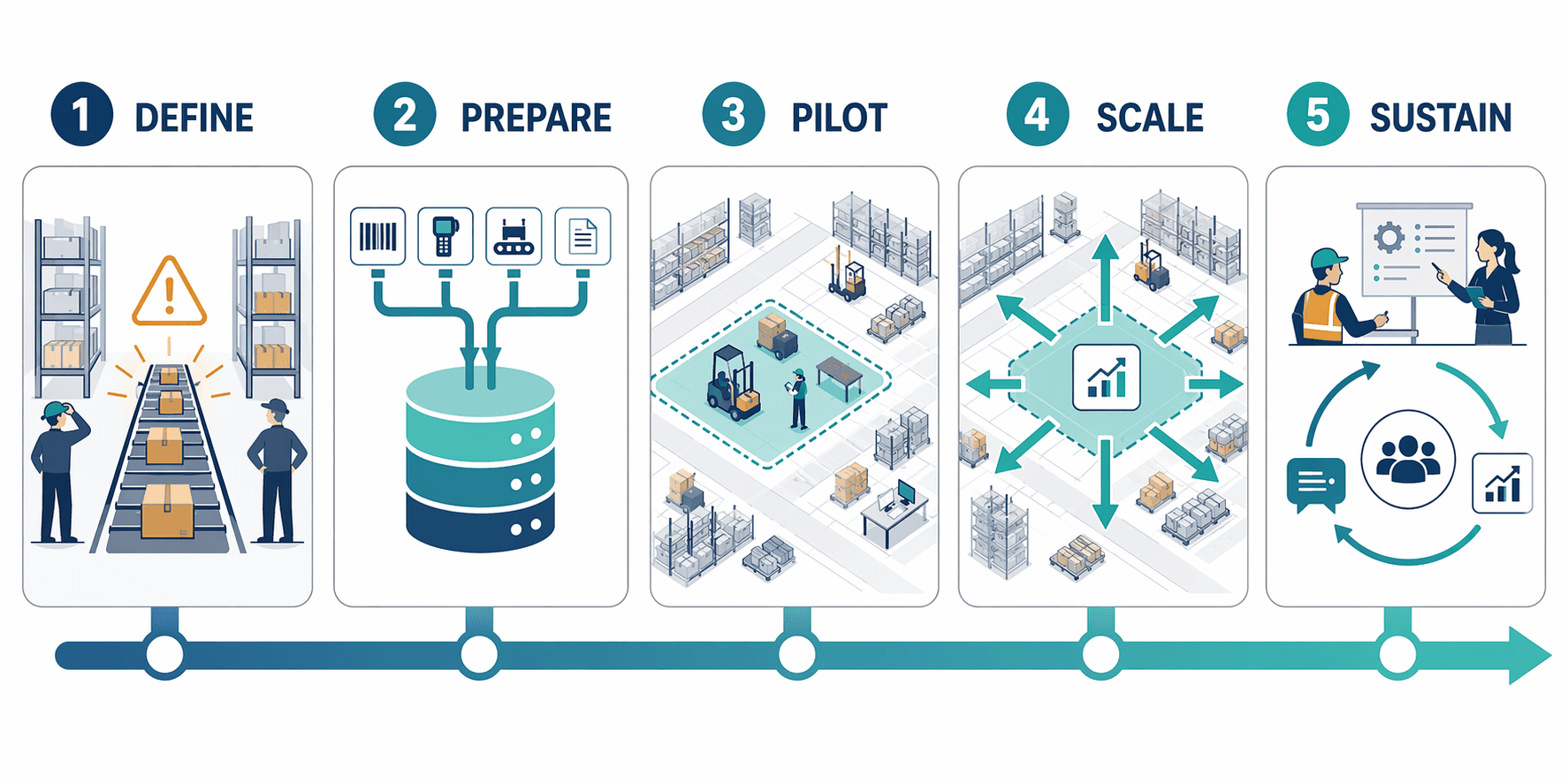
A warehouse ML pilot should be bounded, but not artificial. It needs enough operational exposure to reveal integration problems, supervisor workarounds, data gaps, and labor effects. A test that only proves the model can score historical data is not a pilot; it is a technical validation.
The pilot design should specify five things before the first recommendation reaches the floor:
- The operating boundary: one zone, process, equipment class, shift, customer profile, or product family.
- The control comparison: prior-period baseline, matched area, current-rule benchmark, or manual planning alternative.
- The decision rights: who sees the recommendation, who can override it, and who owns the result.
- The workflow insertion point: where the recommendation appears inside the WMS, dashboard, tasking system, maintenance queue, or supervisor routine.
- The stop-or-scale threshold: the operational result that justifies expansion, revision, or shutdown.
This is where Oracle’s “run a pilot” step needs warehouse-specific discipline.[3] The pilot has to test the model, the integration, the work instruction, and the managerial response at the same time. Otherwise the team can end the test with a technically sound model and no evidence that the building can use it during a real shift.
McKinsey’s guidance also argues for robust piloting and for evaluating diverse scenarios with future growth provisions.[2] In warehouse terms, that means the pilot should include enough variation to expose the next bottleneck. A slotting pilot that avoids promotional peaks may overstate stability. A labor-planning pilot that excludes weekend volatility may understate scheduling friction. A maintenance pilot that observes only low-utilization equipment may miss the very stress conditions that determine value.
Readers working through pilot governance may also want the companion phased machine learning implementation roadmap for warehouse management. The point here is narrower: do not call a pilot successful until the operational behavior changed and the result was measured.
What the pilot should measure
Model accuracy is only one line in the pilot report. The stronger pilot report shows what happened to labor hours, travel, backlog, downtime, inventory corrections, rework, inspection cycle time, or order flow. It also records adoption friction: how often supervisors overrode recommendations, why they did so, whether operators understood the changed task, and whether the data captured the result cleanly enough to retrain or tune the model.
Vendor-published benchmarks can be useful for setting ambition, but they should not become the pilot’s success definition. Deposco reports that unified AI warehouse platforms can deliver payback periods of 6–18 months, 40% improvement in order fulfillment speed, 95%+ inventory accuracy, and 30% reduction in operational costs.[7] Those figures describe what may be possible under favorable conditions; they do not remove the need to establish a baseline for the specific site, process, and starting data condition.
The same caution applies to application-specific gains. Appinventiv reports predictive maintenance benchmarks including 30–50% downtime reduction, 17–20% equipment lifespan extension, and 7–10% maintenance cost reduction, along with 40–60% faster inspection cycles for computer vision use cases.[8] Those are useful comparison points when building a case, but a warehouse should still ask whether it has enough maintenance history, inspection labels, and workflow integration to make those gains reachable.
For a broader benchmark view by application area, use machine learning logistics ROI benchmarks. In the pilot itself, the more important discipline is to measure the operational movement from the current baseline, not the distance from a vendor case study.
Build the scale plan before the pilot ends
The pilot-to-scale gap is where many warehouse ML programs lose momentum. The test works in one area, the team celebrates the result, and then the organization discovers that the next facility uses different location conventions, different labor rules, different equipment, different exception coding, or a different WMS configuration. Scaling was treated as a rollout activity when it should have been a design constraint from the beginning.
McKinsey’s warning to think network-wide rather than site-by-site is especially relevant here.[2] A warehouse pilot may start in one building, but the architecture, data model, and process design should anticipate the network. That does not mean forcing every site into the same operating template. It means knowing which elements must be standardized for the model to transfer and which elements can remain local.
| Scaling element | Standardize | Allow local variation |
|---|---|---|
| Data definitions | Item, location, order, labor, exception, and equipment fields used by the model | Local aliases or reporting labels |
| Decision workflow | Who approves, overrides, and records outcomes | Shift-level escalation paths |
| Performance metrics | Baseline method and primary KPI definitions | Site-specific secondary KPIs |
| Integration pattern | How recommendations enter the WMS or execution system | Screen layout, alert routing, or dashboard views |
| Training approach | Core explanation of the model-assisted decision | Examples based on local process conditions |
This is also the moment to make capital deployment more disciplined. The McKinsey case of underutilized automation after more than $150 million in spending is a reminder that capital can be consumed long before operating maturity catches up.[2] With ML, the equivalent mistake is funding a broad rollout before proving that the data pipeline, exception handling, retraining process, and workforce routine can survive beyond the pilot team.
Large automation programs can produce impressive operating results when the surrounding system is ready. Synkrato cites DHL and Locus Robotics reaching 500 million picks across 35 sites, Amazon’s Sequoia system improving inventory identification speed by 75% and order processing speed by 25%, and Decathlon with Exotec reducing daily walking distance from 10 km to 1 km.[1] SmartDev cites Amazon’s 750,000 robots and a $4 billion annual savings figure, along with DHL examples reporting 30% efficiency improvement and 99.7% accuracy.[9] These are scale stories, not shortcuts. They show what mature systems may achieve; they do not prove that a disconnected pilot will scale itself.
Make workforce adaptation part of the implementation, not the announcement
Warehouse machine learning changes work before it changes strategy decks. A supervisor may be asked to trust a labor recommendation that conflicts with habit. A planner may need to stop using a spreadsheet that has quietly carried the operation for years. A picker may see a changed slotting pattern and assume someone in the office has made the job harder. A maintenance lead may receive risk scores that compete with experience-based prioritization.
Workforce readiness is not solved by one training session. It requires role-specific changes:
- Operators need to know what task changed, what did not change, and how to report when a recommendation creates friction.
- Supervisors need override rules, escalation paths, and a way to compare recommendation quality against floor reality.
- Process owners need ownership of KPI movement, not just attendance at steering meetings.
- IT and WMS teams need support windows, integration monitoring, and change-control discipline.
- Executives need to understand which benefits are proven, which are still assumptions, and which require additional process change.
McKinsey’s guidance explicitly includes looking beyond technology to workforce readiness.[2] That advice is easy to agree with and easy to underfund. The practical test is whether the implementation plan gives supervisors time, authority, and materials to run the changed process. If the pilot team leaves and the floor reverts to old routines, the project did not scale; it merely visited.
Assess improvement with a bias toward evidence, not optimism
Assessment should separate adoption, effectiveness, and economics. Adoption means people are using the recommendation. Effectiveness means the recommendation improved the target operating measure. Economics means the improvement is large enough, durable enough, and cheap enough to justify the build, integration, training, and support burden. A project can pass the first test and fail the second. It can pass the second and still fail the third.
A disciplined assessment asks:
- Did the target KPI improve against the agreed baseline?
- Did the improvement persist beyond the initial pilot attention period?
- Were overrides low because recommendations were useful, or because users lacked a practical override path?
- Did the model create new work elsewhere, such as data cleansing, exception review, replenishment pressure, or supervisor intervention?
- Can the same result be reproduced in another zone, process, or site without heroic support?
- Is the next scale step limited by data, integration, workforce readiness, or the business case?
This assessment is also where stalled pilots should be diagnosed without defensiveness. Some pilots should stop. Some should return to data work. Some should shift to a narrower workflow. Some should expand only after a WMS integration gap is closed. The failure is not discovering a constraint; the failure is scaling as if the constraint does not exist.
The implementation order that keeps the program honest
For most warehouse teams, the workable sequence is straightforward, even if the execution is not:
- Name the operational pain point and the decision that needs to improve.
- Audit the data foundation against that decision, including WMS quality, forecasting inputs, inventory accuracy, operational history, and integration assumptions.
- Select an entry point that has a clear owner, visible baseline, and realistic worker-augmentation path.
- Run a bounded pilot that tests workflow adoption and operational impact, not just model performance.
- Design scale around network data standards, integration patterns, decision rights, and training.
- Assess adoption, effectiveness, and economics separately before expanding.
The order matters because each step exposes a different kind of risk. Objectives expose whether the program is solving a real warehouse constraint. Data readiness exposes whether the model can learn from reality. Pilot design exposes whether the work can absorb the recommendation. Workforce adaptation exposes whether the change survives outside the project room. Measurement exposes whether the result is worth scaling.
Not every warehouse needs every ML application. A facility with poor inventory discipline may get more value from anomaly detection and cycle-count prioritization than from advanced labor optimization. A high-throughput operation with stable item data may be ready for slotting recommendations before computer vision inspection. A network with uneven forecasting quality may need to fix planning inputs before making automation-capacity decisions. The mature move is often to narrow the first deployment, not broaden it.
Machine learning in warehouse operations scales when it is attached to a specific operational pain point, supported by usable data, tested in a bounded pilot, translated into workforce routines, and expanded only after results are measured. Skip one of those prerequisites, and the program starts to look uncomfortably like the automation investment that made sense in the approval deck but not on the floor.
References
- Warehouse Automation Statistics 2026, Synkrato.
- Getting warehouse automation right, McKinsey & Company.
- AI in Warehouse Management: Impacts and Use Cases, Oracle.
- The Role of AI and Machine Learning in Modern WMS, Generix Group.
- Machine Learning in Demand Planning, ToolsGroup.
- AI In Warehousing Market Report 2034, Fortune Business Insights.
- AI in Warehouse Management: How Smart Warehouses Deliver Real ROI in 2026, Deposco.
- AI in Warehouse Management: Use Cases, ROI & Risk Control, Appinventiv.
- AI Use Cases in Warehouse Management, SmartDev.
Comments
Join the discussion with an anonymous comment.