
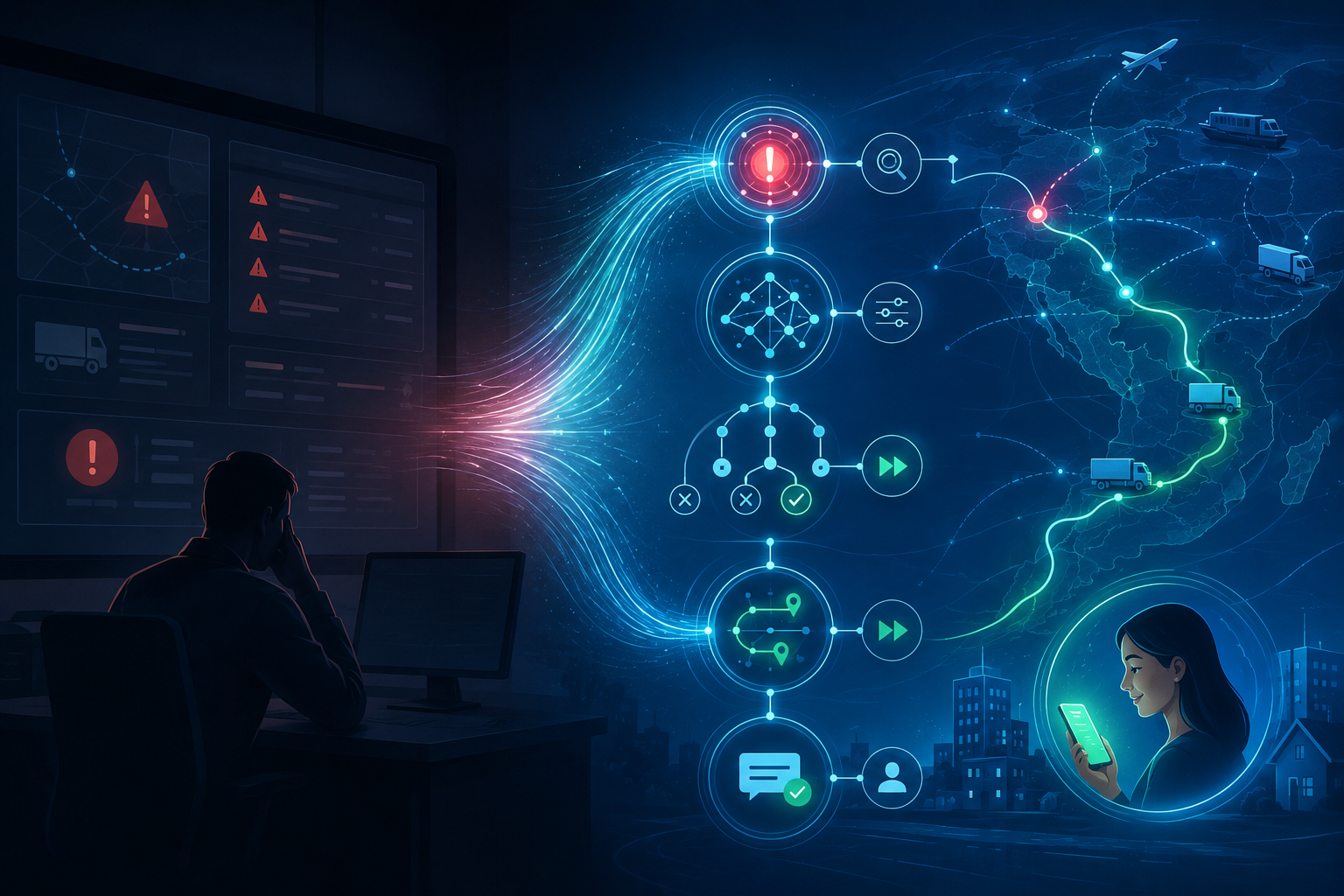
The weak point in the old logistics control tower promise shows up at 2:17 p.m., not in the software demo. A vehicle is running late, a delivery window is about to fail, the dashboard turns red, and a dispatcher still has to decide whether to reroute, reassign the load, notify the customer, call the carrier, or let the exception ride until the next scan. The system has visibility. The operation still has work.
That is the line agentic AI is now crossing. A 2026-grade logistics control tower is no longer valuable because it can show where freight, drivers, orders, and service risks sit on a map. Its value depends on whether it can detect an exception, evaluate the available responses, execute the selected action inside approved boundaries, and escalate only when the decision exceeds those boundaries.
IBM describes supply chain control towers as connected, personalized dashboards that provide end-to-end visibility across the supply chain, while Gartner has long argued that a control tower is not just a technology layer but a combination of people, process, data, organization, and technology.[1][2] That second point matters more in 2026 than the dashboard language does. If the people, process, data, and accountability model are not ready for automated decisions, adding AI agents simply gives the organization a faster way to create exceptions of its own.
The practical question for a logistics transformation lead is therefore narrow: can the logistics control tower remove work from the exception queue, or does it only decorate the queue with better alerts?
From Seeing the Network to Acting on It
The control tower evolution is easiest to understand as three operating states. They often coexist inside the same enterprise, but they do not produce the same ROI.
| Control tower stage | Primary question | Operational limit |
|---|---|---|
| Visibility | What happened, and what is happening now? | Humans still interpret and act on most exceptions. |
| Predictive | What is likely to happen next? | The system forecasts risk but usually hands remediation to planners or dispatchers. |
| Autonomous | What should be done, and can the system do it now? | Execution is allowed only inside explicit governance, financial, and service boundaries. |
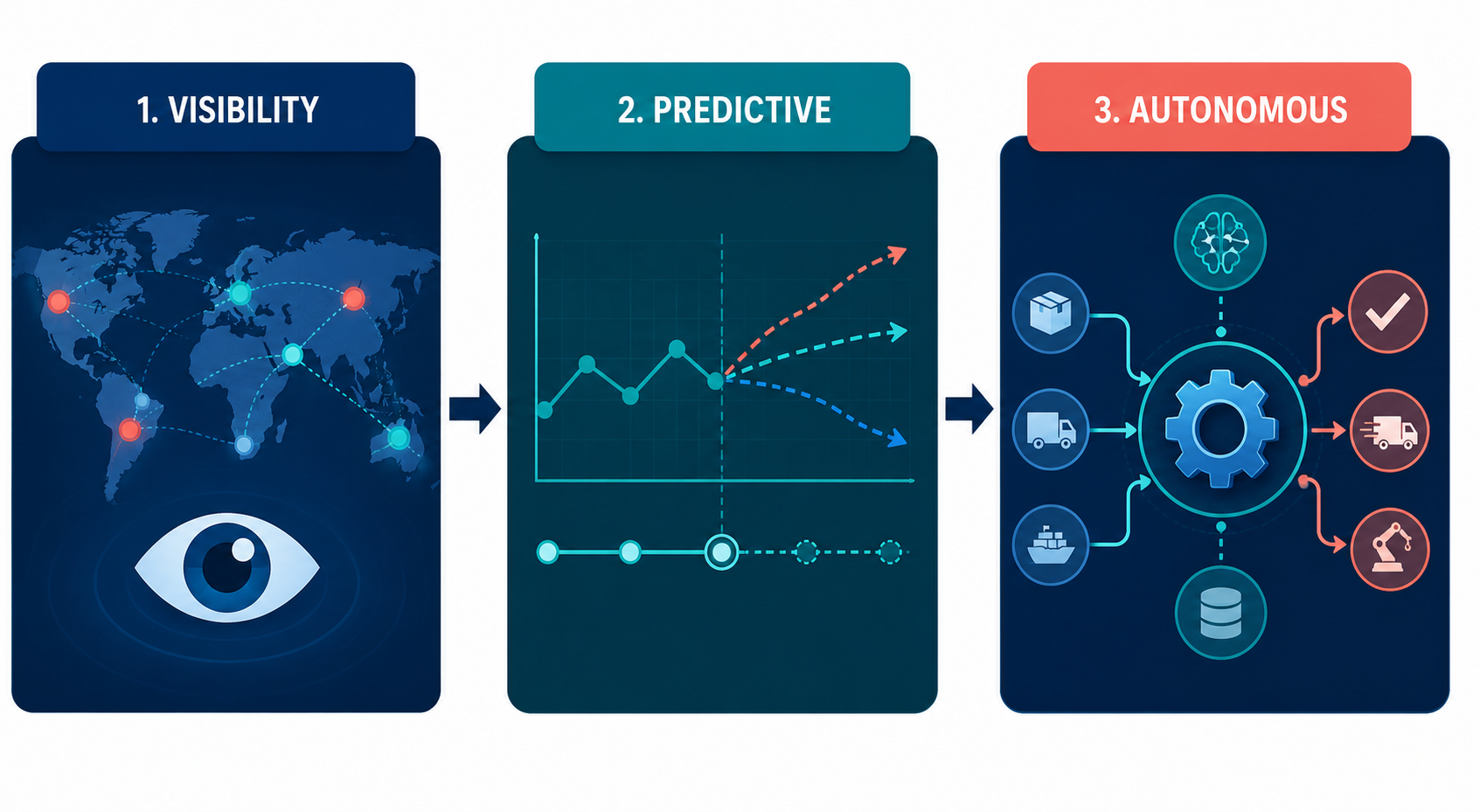
The first stage solved a real problem. Many logistics teams spent years working from fragmented carrier portals, warehouse updates, transportation management screens, customer service notes, and spreadsheet workarounds. A visibility-led tower gave them a common operating picture. That still has value, especially where transportation data is scattered or partner compliance is uneven.
The second stage made the picture more useful. Predictive ETA, delay probability, capacity risk, and service exposure helped teams move earlier. Instead of discovering a missed delivery after the customer called, dispatch could see the probability of failure forming in advance. Accenture’s 2023 control tower material belongs mostly to this pre-agentic baseline: visibility becomes more valuable when it is connected to analytics and decision support, but the center of gravity remains human-led execution.[3]
The third stage changes the labor model. An autonomous logistics control tower does not merely tell a dispatcher that a vehicle will miss a stop. It checks available vehicles, route constraints, delivery windows, driver hours, customer priority, cost exposure, and service thresholds. If the recommended action falls inside policy, the platform can reassign the stop, update the route, notify the customer, and log the decision without waiting for a human to clear the alert.
That is where the ROI equation starts to look different. Predictive visibility helps people make better decisions. Autonomous orchestration removes some decisions from the manual queue altogether.
The Market Pressure Is Real, but It Is Not the Proof
Executives are not imagining the shift. IBM’s Institute for Business Value reported in 2026 that 57% of executives expect agentic AI to make proactive recommendations, while 62% expect AI agents to make supply chain decisions autonomously.[4] Business Research Insights projects the global supply chain control tower market at USD 8.75 billion in 2026, and Inbound Logistics reports that 37% of organizations are prioritizing control tower investments in 2026, up six points year over year.[5][6]
Those figures explain why the conversation is back on budget agendas. They do not prove that a specific control tower will improve delivery density, service performance, or operating cost. Market size measures spending. Executive expectations measure appetite. Neither tells a dispatcher whether tomorrow’s failed delivery will be fixed automatically or passed to another inbox.
Kearney’s view that global logistics control towers can generate 10% to 20% cost savings is useful as a consulting benchmark, but the public material does not provide enough methodology detail to treat that range as a universal result.[7] The same caution applies in the other direction. Globalia’s 2026 critique of overhyped logistics control towers is a fair warning against visibility-led systems that promise control but stop at monitoring.[8] It does not mean control towers are structurally weak. It means the operating model underneath them matters.
What Actually Changes in Autonomous Execution
In a conventional exception workflow, the system detects a problem and creates human work. Someone opens the alert, checks the route, looks for a spare vehicle or alternate carrier, weighs cost against service exposure, updates the plan, informs the customer service team, and leaves a trail that finance or operations can later audit. Even with a good dashboard, the bottleneck sits in the handoff between detection and action.
An agentic control tower compresses that handoff. The execution layer has permission to move from signal to decision to action when the decision is low enough risk and the data confidence is high enough. A late vehicle can trigger an autonomous sequence: calculate revised ETA, identify impacted stops, compare reassignment options, select the least disruptive route change, update driver instructions, notify affected customers, and escalate only if the action would breach cost, contract, or service rules.
The difference is not that humans disappear. The difference is that humans stop being the default middleware between every exception and every corrective action. Dispatchers and fleet managers spend less time clearing routine disruptions and more time handling high-exposure decisions: a major account at risk, a costly expedite, a weather event that affects multiple routes, or a policy conflict the system is not authorized to resolve.
Locus reports customer deployment outcomes of 25% efficiency gains, 45% more deliveries per vehicle, and 8% SLA improvement through autonomous decisioning, with exception resolution compressed from hours to seconds through autonomous rerouting, load reassignment, and customer notification.[9] Those numbers are concrete enough to deserve attention because they are tied to execution, not just visibility. They also need to be read for what they are: vendor-reported customer data, not independently audited public benchmarks.
Still, the direction of the result is operationally plausible. More deliveries per vehicle is not a dashboard outcome. It implies tighter routing, better asset utilization, fewer wasted miles or idle gaps, and faster adjustment when the day starts to drift from plan. SLA improvement is not a map feature either. It comes from reducing the time between risk detection and corrective action.
For readers comparing this use case with broader agentic logistics deployments, the same pattern appears in disruption response: autonomy becomes valuable when the system is close enough to execution to change the plan, not merely describe the disruption. ChainSignal’s analysis of agentic AI for logistics disruptions covers that adjacent operating model in more detail.
The Architecture Has to Be Execution-Native
A logistics control tower cannot become autonomous by adding a conversational interface to a passive reporting layer. The platform needs live connectivity into the systems that actually change the plan: transportation management, order management, warehouse execution, yard operations, carrier networks, route optimization, customer notification, and billing or cost-control workflows.
That architecture requirement is where many visibility programs stall. If a tower receives delayed milestone updates, inconsistent carrier feeds, or incomplete order priority data, the agent may identify a risk correctly but choose from a distorted set of options. Stale location data can make a reassignment look feasible after the window has already closed. Missing cost data can make an expedite look acceptable until finance sees the invoice. Incomplete customer rules can produce a technically efficient route that violates a service commitment.
Execution-native architecture also requires write-back authority. It is not enough to calculate the best corrective action if the system cannot update the route, tender the load, change the appointment, trigger a customer notification, or document why the decision was made. Without write-back, the control tower remains an advisory layer, and the dispatcher remains the integration point.
That does not mean every action should be automated on day one. It means the platform has to be technically capable of execution before governance can decide which actions are allowed. Buyers comparing platform architecture can use ChainSignal’s AI supply chain software comparison to separate analytics-heavy tools from systems designed to participate in operational workflows.
Governance Is the Operating Model, Not the Legal Appendix
Autonomous logistics decisions need boundaries that are specific enough to run at dispatch speed. A vague instruction such as “optimize for service and cost” is not governance. It is a future dispute between operations, finance, sales, and the vendor workflow.
Useful boundaries look more like operating rules. The system may reassign a stop if the receiving vehicle has capacity, the route remains within driver-hour limits, the incremental cost stays below a defined threshold, and the action protects a priority SLA. It may notify customers automatically when ETA variance falls within an approved communication band. It may escalate when the cost of recovery exceeds the exposure limit, when two customer commitments conflict, or when the data confidence score drops below the level required for autonomous action.
- Financial exposure limits: how much incremental cost the system can authorize without human approval.
- SLA thresholds: which service commitments justify rerouting, reassignment, expedite, or escalation.
- Customer notification rules: when the platform can communicate directly and when account teams must review.
- Escalation paths: who receives exceptions that exceed policy, and how quickly they must respond.
- Audit requirements: what the system records about inputs, alternatives, decision logic, and final action.
This is where the Gartner five-element model becomes practical rather than theoretical. People decide accountability. Process defines the permissible actions. Data determines whether the decision is reliable. Organization decides who owns exceptions that cross functional boundaries. Technology executes and records the action.[2]
Graduated autonomy is usually the safer path. A company might begin by letting the system recommend actions, then allow autonomous customer notifications for low-risk ETA changes, then permit rerouting inside cost and SLA bands, and only later authorize carrier reassignment or expedite decisions. The important design choice is not whether autonomy is full or absent. It is whether each class of decision has a named owner, a threshold, a fallback path, and an audit trail.
For a deeper implementation pattern, ChainSignal’s Practitioner’s Guide to Graduated Autonomy lays out how to stage decision rights without turning every approval into another manual bottleneck.
Readiness Is the Constraint Buyers Should Take Seriously
The timing is awkward. More leaders want autonomous supply chain capabilities in 2026, but fewer believe their organizations are ready to absorb them. Blue Yonder’s vendor-commissioned 2026 survey reports that 66% of supply chain leaders believe their organizations are ready for the future, down from 73% in 2025.[10] The direction is more important than the headline: confidence is slipping while autonomy expectations are rising.
Some of that readiness gap is technical. Many enterprises still do not have clean transportation event data across carriers, business units, regions, and delivery modes. Others have route planning data in one system, customer promise data in another, and cost authorization rules in email or tribal knowledge. An agent can only orchestrate what the operating environment exposes to it.
Some of it is organizational. Dispatch teams may already have workarounds that keep the network moving despite system gaps. Fleet managers may override plans because they know a driver, a customer dock, or a local traffic pattern better than the tool does. Customer service may prefer to control notifications because a technically accurate ETA message can still damage a commercial relationship if it is sent without context.
Those realities do not make autonomy impossible. They define the first implementation backlog. Before a logistics control tower can execute corrective actions, the company has to identify where the real decision rights sit today. If the answer is “the dispatcher knows,” the project is not ready for broad autonomy. It is ready for process capture, policy definition, and data cleanup.
A Practical Readiness Test
A logistics team does not need a yearlong maturity assessment to spot the largest blockers. It needs to test whether routine exceptions can be described in executable terms.
- Can the team name the top recurring logistics exceptions by volume and service impact?
- Can it define the acceptable corrective actions for each exception without asking a senior dispatcher every time?
- Are route, order, customer priority, capacity, cost, and SLA data available in time for the system to act?
- Does the platform have write-back access to the systems that change routes, assignments, appointments, and notifications?
- Is there a clear escalation owner when the action exceeds cost, service, contractual, or data-confidence thresholds?
If the answer is no to several of those questions, an autonomous control tower business case should be narrowed. The company may still benefit from visibility and predictive analytics, but the stronger Locus-style outcome claims should not be used as if the organization is ready to reproduce them.
Where the Business Case Is Strongest in 2026
The best candidates are high-density networks where small decisions repeat at scale: last-mile delivery, store replenishment, field service logistics, parcel-heavy distribution, and regional fleet operations. In those environments, the same exception patterns show up often enough for automation to matter, and the cost of delay is visible in vehicle utilization, failed delivery, overtime, customer contacts, and SLA penalties.
The case is weaker where logistics is low-volume, highly bespoke, or dependent on relationship-heavy exception handling. If every disruption requires negotiation with a strategic customer, a port operator, a broker, or a production planner, the control tower may still assist with decision support. It should not be sold internally as an autonomous execution engine until repeatable action classes emerge.
The strongest 2026 investment case usually combines four conditions: recurring exceptions, measurable service exposure, reliable data feeds, and permission to execute at least some corrective actions. Without the fourth condition, the project slides back into dashboard economics. Better alerts may reduce firefighting, but they do not create the same structural compression as autonomous rerouting, reassignment, and notification.
This is also where vendor evaluation should become more uncomfortable. Buyers should ask vendors which actions the platform can execute without a human click, which systems it can write back to, how decision policies are configured, how escalations are routed, and how audit trails are exposed. A polished exception screen is not evidence of autonomous orchestration. A logged, policy-compliant corrective action is.
The 2026 Buyer Judgment
Agentic AI changes what a logistics control tower can be. It can move from a visibility layer to an autonomous orchestrator when it is connected to execution systems, allowed to act inside defined decision boundaries, and supported by data that operations teams trust enough to let the system move freight, routes, notifications, and exceptions without constant human clearance.
The measurable upside is no longer theoretical, but the public evidence is still uneven. Locus’s reported gains are operationally relevant and execution-native, yet vendor-reported. Consulting estimates point to savings potential, but methodology visibility is limited. Market growth shows urgency, not proof. The right conclusion is not that every enterprise should rush into autonomous control towers. It is that the investment category has split.
Companies with mature transportation data, clear exception policies, executable workflows, and accountable escalation paths can now evaluate the logistics control tower as an automation investment. Companies still fighting fragmented data, unclear decision rights, dispatcher workarounds, and manual carrier updates are buying something else for now: a more expensive alerting layer with an autonomy roadmap attached.
References
- What is a Supply Chain Control Tower? — IBM
- What supply chain managers should know about control towers — Supply Chain Dive
- Supply chain control tower — from visibility to value — Accenture, 2023
- IBM Institute for Business Value agentic AI expectations — IBM IBV, 2026
- Supply chain control tower market estimate — Business Research Insights, 2026
- Control tower investment prioritization — Inbound Logistics, 2026
- Global logistics control towers: boosting supply chain sustainability and resilience — Kearney
- Logistics control towers: Useful or overhyped? — Globalia Blog, January 28, 2026
- Locus customer deployment data — Locus
- Blue Yonder supply chain readiness survey — Blue Yonder, 2026
Comments
Join the discussion with an anonymous comment.