

The most uncomfortable number in machine learning supply chain management is not a forecast accuracy score. It is the share of organizations already deploying AI without a documented strategy: 77%, based on Gartner’s 2025 finding that only 23% of a self-selected sample of 120 supply chain leaders who had already deployed AI had a documented AI strategy in place.[1]
That caveat matters. This was not a random census of every supply chain organization, and the sample was already inside the AI-deployment population. But the narrowed reading is still bad enough. Among leaders far enough along to say they had deployed AI, most had not written down the plan that should govern what the system is for, who owns the result, what baseline it is meant to beat, and which work will change after launch.
The number also does not stand alone. BCG’s widely cited 2025 estimate that 85% of AI initiatives deliver near-zero measurable value is enterprise AI evidence, not supply chain-specific proof, so it should not be treated as a direct failure rate for planning, forecasting, logistics, or inventory projects. Deloitte’s 2025 finding that 84% of organizations have not redesigned roles or ways of working around AI points to a related organizational gap rather than a model-performance problem.[1]

Taken carefully, the evidence says something less dramatic and more useful than “AI fails.” It says many organizations are buying or building models faster than they are changing the operating system around them. That is a familiar failure mode in supply chain transformation: the tool arrives, the workflow remains untouched, the planner is expected to “trust the system,” and the value case quietly moves from a measurable commitment to a presentation theme.
This is why the strategy gap is not paperwork. A documented strategy is where the organization decides which decisions are being improved, which constraints are nonnegotiable, who can override the recommendation, how value will be measured, and what will happen when the model output conflicts with the old way of working. Without that, the deployment is not a transformation program. It is a model looking for a home.
The pattern behind the strategy gap
The weak strategy signal shows up in three places at once: absent documentation, thin measurable value, and unchanged roles. Those are not identical problems, but they tend to reinforce one another. If the initiative has no documented strategy, the value baseline is usually soft. If the baseline is soft, the business case can survive long after the operation has learned nothing. If roles and workflows are unchanged, even a useful recommendation can die in the handoff between system output and human action.
Supply chain is especially exposed because the work is decision-dense and exception-heavy. Demand planners, replenishment teams, transportation managers, store operations, procurement, finance, and commercial teams all touch the same flow of goods from different angles. A machine learning model may recommend a different forecast, order quantity, allocation, or exception priority. But the business still has to decide whether the recommendation changes a purchase order, a promotion plan, a warehouse labor plan, a supplier conversation, or nothing at all.
That is where the slide-deck version of AI starts to break. A model can be technically deployed while the organization still has no agreed answer to basic operating questions: Which team owns forecast overrides? Which exceptions are reviewed daily and which are ignored? Which KPI wins when service level and inventory conflict? Who decides that a machine recommendation was right for the wrong reason? Who has authority to pause, retrain, or narrow the system when performance drifts?
The answer is rarely “the data science team.” They may build or tune the model, but they do not own stockouts, waste, markdowns, expedited freight, supplier penalties, or planner adoption. In machine learning supply chain management, the bottleneck usually appears after the model exists: in the decision path, in the data handoff, in the approval loop, and in the credibility of the value baseline.
The failure sequence usually starts before the model
RELEX describes three recurring failure patterns from observed AI deployments: starting with technology before defining the problem, bypassing data foundations, and treating AI as a technology upgrade rather than an organizational change.[2] The order matters. These are not three unrelated mistakes. They are a sequence.
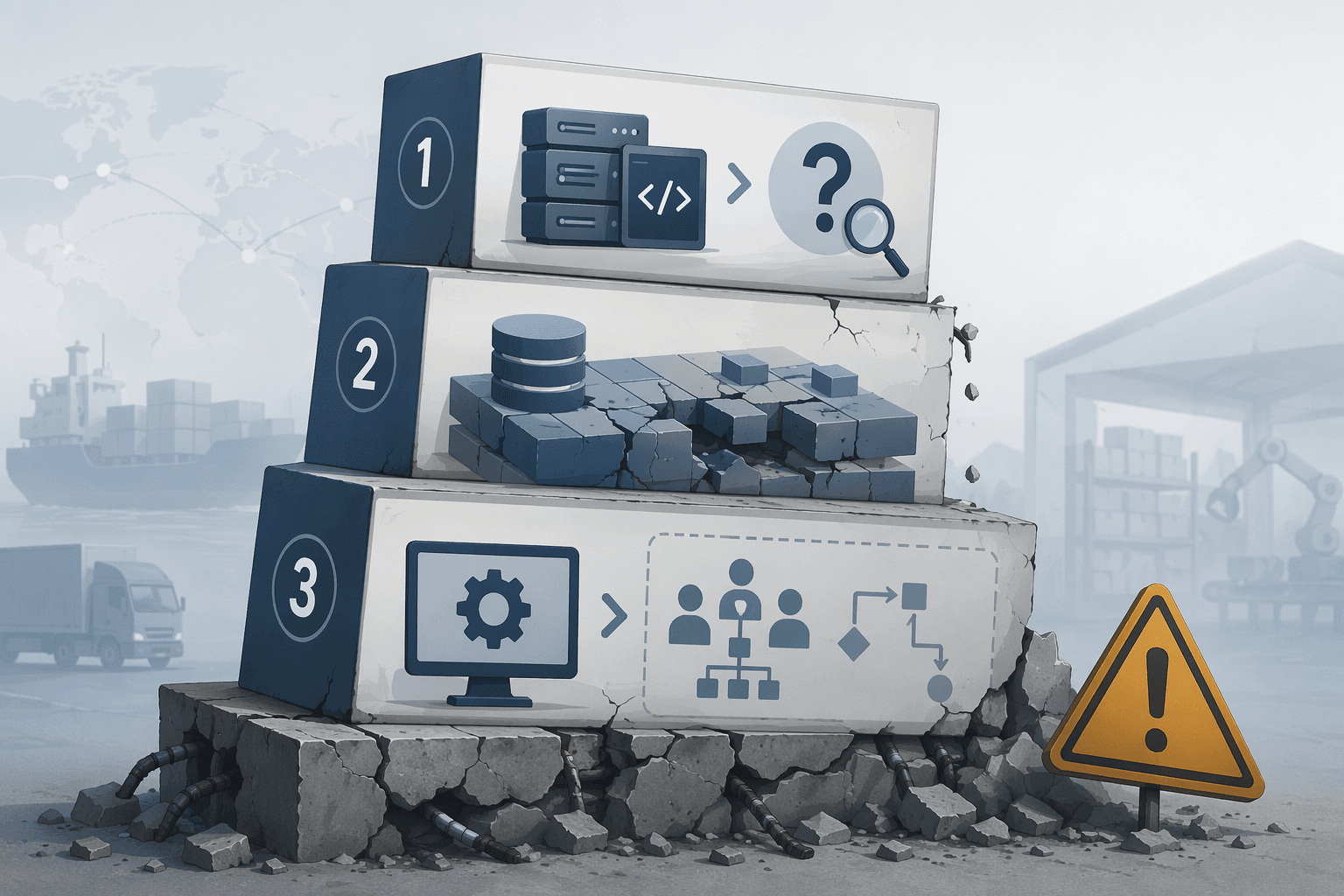
First, the team starts with technology and retrofits the use case
The first mistake is seductive because it looks like momentum. A team chooses a platform, launches a pilot, connects a few data feeds, and produces a demo that can identify risk, predict demand, optimize orders, or prioritize exceptions. The problem is that none of those verbs is specific enough to run an operation.
“Improve forecasting” is not a problem definition. “Reduce stockouts in volatile promotional items without raising total inventory above the current baseline” is closer. “Optimize inventory” is not a decision path. “Recommend daily replenishment quantities for a defined category, with planner review above a specific risk threshold and automatic execution below it” at least begins to describe who acts, when, and under what limits.
When the technology comes first, the metric often gets chosen after the fact. The initiative begins with a model capability and later hunts for a business problem large enough to justify it. That is backward. A supply chain AI project needs to begin with the operating pain: excess inventory, low availability, poor substitution handling, unstable supplier lead times, avoidable manual touches, forecast overrides that make accuracy worse, or exception queues so large that planners triage by habit.
This is also where many pilots become impossible to evaluate. If the team has not documented the decision being changed, the pre-AI baseline, the accountable owner, and the expected operational movement, a successful pilot can mean almost anything. A more accurate prediction may still fail to reduce inventory. A better exception score may still not change what planners review first. A planning assistant may save time for one team while creating reconciliation work for another.
The practical test is blunt: before selecting the model, can the business describe the decision that will be made differently next month? If not, the project is still in theater.
Then weak data foundations turn every recommendation into an argument
The second mistake is trying to skip the data work because it is slow, political, and unrewarding in steering committee meetings. Supply chain data is rarely a clean lake waiting for machine learning. It is item masters with inconsistent hierarchies, supplier lead times that reflect system defaults rather than reality, promotion histories that do not explain what actually happened, substitution rules trapped in local knowledge, and inventory records that may be accurate enough for finance but not granular enough for daily decision automation.
The result is not just lower model accuracy. It is operational mistrust. A planner who sees the system recommend the wrong quantity because pack size, shelf capacity, supplier constraint, or substitution logic is wrong does not usually file that observation under “data governance gap.” They decide the AI is not ready. After enough of those moments, adoption becomes a change-management problem created by a data-quality problem.
This is where the common “pilot first, foundations later” argument becomes expensive. Some experimentation is healthy. But if the pilot depends on data that the organization has not reconciled, the project may prove only that the company has unresolved master-data and process-ownership issues. That can be a useful finding, but it should not be sold as AI progress.
A more disciplined approach is to map the decision first and then identify the minimum data foundation required to support it. That may include product hierarchy, location hierarchy, inventory availability, lead time, order constraints, promotions, substitutions, service targets, and exception history. Not every use case needs every field perfected. But the fields that directly influence the recommendation need named owners and correction paths before the model becomes part of daily work.
This is why data-quality failure patterns in supply chain AI deserve more attention than feature comparisons. The organization that cannot maintain the inputs for a replenishment or forecasting decision should not expect a model to compensate indefinitely. For a deeper treatment of that failure mode, the ChainSignal article on supply chain AI data-quality failures covers the same issue from the project-failure side.
Finally, AI gets treated as a tech upgrade instead of a change in work
The third mistake arrives after the organization has something that looks deployable. The AI tool is added to the workflow, but the workflow is not redesigned. Planners still receive the same alerts. Managers still run the same meetings. Overrides still happen through the same habits. The only difference is that a model now produces another input that everyone can accept, ignore, or litigate.
That is how AI becomes extra work. If the system produces recommendations but no one has changed review thresholds, approval rights, escalation rules, or KPI ownership, users inherit a new obligation without losing an old one. They must check the AI, defend deviations, update spreadsheets, and still hit the same service, margin, inventory, and waste targets. Adoption drops because the supposed automation has created a second operating layer.
The hardest part is not convincing people that machine learning can find patterns. Most supply chain teams already believe software can improve decisions when the process is well designed. The harder question is whether leadership is willing to change the decision rights around the recommendation. If planners are still accountable for outcomes but cannot tune thresholds, challenge assumptions, or escalate bad inputs, the organization has moved risk downward while keeping control elsewhere.
The same issue is visible in AI agent pilots, where the demo can be impressive and the operating design can remain unfinished. ChainSignal’s piece on AI agent pilot failures in supply chain is useful because it separates technical possibility from production accountability.
The counterexamples are not magic; they are better sequencing
The useful counterexamples do not prove that every supply chain AI project will pay back quickly. They show that the failure sequence is avoidable when the problem and data base are taken seriously.
RELEX cites Rastelli Foods as a case where the company first defined the problem around inventory visibility and then saved $3.5 million in the first year.[2] The important detail is not just the dollar figure. It is the order of operations. Inventory visibility is not a fashionable AI label; it is an operational constraint. If the business cannot see inventory clearly enough, planning decisions degrade before any algorithm has a chance to help.
Bünting Group is the cleaner data-foundation example. RELEX reports a 43% reduction in balance errors and a 2% increase in sales value after the company fixed data foundations.[2] Again, the lesson is narrower than “AI increases sales.” The supported reading is that better data foundations contributed to measurable improvements in balance accuracy and sales value in this case. That is enough. The case works because it points to the dull work that usually decides whether the model gets trusted.
These examples should not be inflated into universal benchmarks. They are vendor-published cases, not independent controlled experiments across the whole market. But they are still operationally instructive. In both, the AI story is tied to a concrete constraint and a data condition, not to a generic ambition to “become AI-driven.”
A strategy has to assign owners, not just intentions
The corrective framework starts with roles because ownership is where many AI programs stay conveniently vague. RELEX identifies four required roles for AI transformation success: Business Owner, Technology Enabler, Change Champion, and Value Tracker.[2] Those labels only matter if they attach to real authority.
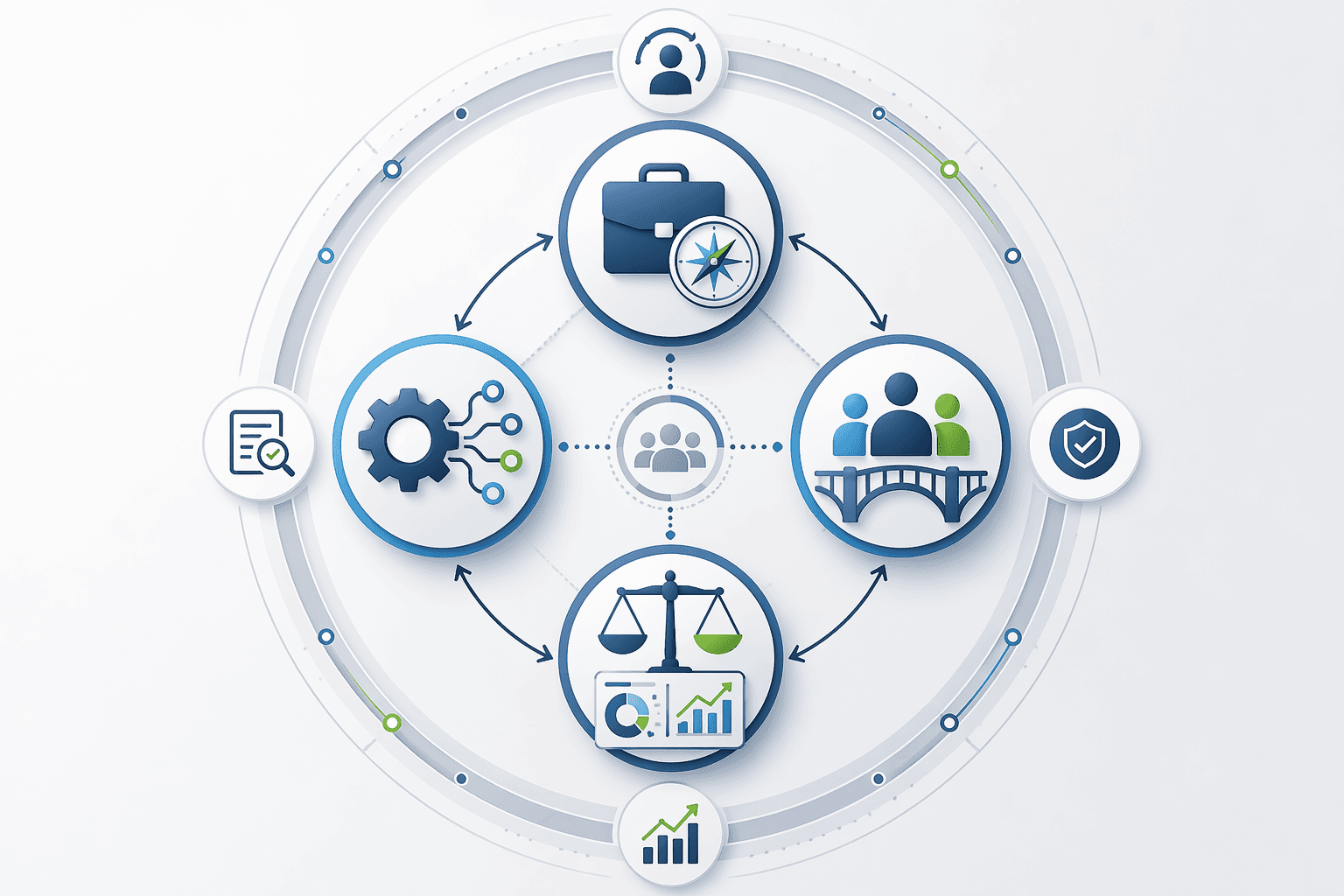
| Role | What the role must own | What goes wrong when it is missing |
|---|---|---|
| Business Owner | The business problem, decision scope, operating constraints, KPI tradeoffs, and go/no-go judgment. | The use case becomes a technology project with no accountable operational outcome. |
| Technology Enabler | Data pipelines, model integration, system performance, security, and technical feasibility. | The model may work in isolation but fail inside the actual planning and execution environment. |
| Change Champion | Workflow redesign, user adoption, training, exception handling, and feedback loops. | Users receive new outputs without a redesigned way to act on them. |
| Value Tracker | Baseline agreement, benefit measurement, value attribution, and reporting discipline. | The program cannot prove whether it created value or merely moved metrics around. |
The Business Owner should not be a ceremonial sponsor who appears at kickoff and returns for the success story. This person owns the problem definition and the tradeoffs. If the use case is replenishment, the Business Owner has to decide how service, inventory, waste, labor, and supplier constraints will be balanced. If the use case is demand forecasting, the Business Owner must decide how forecasts will be used downstream and which overrides are legitimate.
The Technology Enabler is necessary but should not be allowed to become the default owner of business value. Technical teams can say whether the data is available, whether the model can be integrated, whether latency is acceptable, and whether the system can be monitored. They cannot decide what level of inventory risk the business is willing to take or whether a planner should trust an automated recommendation for a specific category.
The Change Champion owns the uncomfortable middle: the place where the old process gets dismantled. That includes revising meeting routines, exception queues, approval paths, training material, and feedback mechanisms. If this role is weak, the company often ends up with AI output sitting beside the old spreadsheet, which is the fastest route to duplicate work and polite nonuse.
The Value Tracker is the role that prevents value claims from becoming folklore. This person or team should lock the baseline before the deployment, document the measurement window, separate adoption metrics from business outcomes, and flag when a claimed benefit may have come from a promotion, assortment change, supplier recovery, or market movement rather than the AI intervention itself.
These roles are not bureaucracy for its own sake. They connect directly to the governance mechanics that keep an AI initiative from drifting.
Governance is the operating model in miniature
The governance elements RELEX highlights—human-in-the-loop design, auditable decisions, KPI baselines, and a 30-day anchoring process—belong together because they answer three practical questions: who decides, how the decision is reviewed, and how value is measured before enthusiasm rewrites the story.[2]
Human-in-the-loop is a decision design, not a comfort phrase
Human-in-the-loop should not mean that every recommendation is manually checked forever. That defeats the point and usually burdens the planner. The useful version defines which decisions can be automated, which need review, and which require escalation. Low-risk, repeatable decisions may move toward automation. High-impact or low-confidence decisions may require human approval. Exceptions should be routed by business consequence, not by a generic fear of automation.
This is where the Business Owner and Change Champion have to work together. The Business Owner defines the risk thresholds and tradeoffs. The Change Champion makes sure the review process is actually usable. If the review queue contains too many items, planners will either ignore it or recreate their old prioritization logic outside the system.
Auditable decisions protect both trust and accountability
Auditable decisions matter because supply chain teams need to understand what happened when outcomes go wrong. If the system recommended a purchase quantity that later created excess inventory, the organization needs to see the inputs, constraints, confidence level, override history, and approval path. Without that trace, every bad outcome becomes a blame negotiation.
Auditability also protects good AI from being dismissed unfairly. A recommendation may look wrong after the fact because demand shifted, a supplier missed a shipment, or a commercial team changed a promotion. If the decision trail is visible, teams can distinguish model error from execution noise or business-plan changes. That distinction is essential if the organization wants learning rather than politics.
KPI baselines have to be signed before the launch
The KPI baseline is where optimism should go to be disciplined. Before deployment, the Value Tracker should document the current performance level, the measurement period, the target movement, the expected lag, and the factors that could contaminate attribution. A project that claims to reduce stockouts, for example, should specify whether it is measuring units, stores, orders, lost sales, service level, or some other agreed metric. Similar care is needed for inventory, waste, forecast accuracy, planner productivity, expedited freight, and sales value.
This is also where adoption and effectiveness must stay separate. A high percentage of users logging into a tool does not prove that the tool improved availability or reduced inventory. A model with better forecast accuracy does not automatically prove that downstream replenishment decisions improved. The baseline should track both usage and business outcome, but it should not confuse them.
The 30-day anchoring process is where the pilot either becomes work or fades
A 30-day anchoring process is useful because the first month after deployment exposes what the project team missed. Planners discover which alerts are noisy. Managers discover which meetings need different inputs. Data owners discover which fields break under daily use. The Technology Enabler discovers whether integrations behave under real operating cadence. The Value Tracker discovers whether the baseline was specific enough to survive contact with the business.
The point is not to declare victory in 30 days. It is to anchor the new decision path before people quietly return to the old one. That means reviewing exceptions, override patterns, user feedback, KPI movement, data defects, and workflow friction while the deployment is still malleable. If the team waits until the quarterly steering committee, the workaround economy may already be stronger than the official process.
For organizations building toward warehouse or execution use cases, this anchoring discipline matters as much as the rollout phasing. ChainSignal’s phased machine learning warehouse implementation roadmap is a useful companion because it treats implementation as a sequence of operating changes, not a single cutover.
What leaders should document before scaling
A documented strategy does not need to be a bloated transformation artifact. It does need to be explicit enough that a business leader, planner, technologist, and finance reviewer can tell whether the initiative is still on course.
- The decision being changed: forecast adjustment, replenishment quantity, allocation, exception priority, labor plan, transportation choice, supplier-risk response, or another specific decision.
- The business problem: the measurable pain the decision is meant to improve, such as availability, excess inventory, waste, markdowns, manual touches, expedited freight, or planning cycle time.
- The baseline: the current KPI level, measurement window, data source, and owner who signs off before deployment.
- The data foundation: the inputs required, known defects, data owners, correction processes, and fields that are not yet reliable enough for automation.
- The human-in-the-loop design: what is automated, what is reviewed, what is escalated, and who has authority to override.
- The workflow change: which meetings, approvals, exception queues, planner tasks, and management routines will be removed or redesigned.
- The value-tracking method: how the team will separate adoption, model performance, operational outcomes, and external business effects.
- The first-month anchoring routine: who reviews defects, overrides, user feedback, and KPI movement during the first 30 days after deployment.
This kind of document is not glamorous, which is precisely why it is useful. It makes it harder for a project to hide behind “AI transformation” language while leaving the operating model unchanged. It also gives executives a cleaner way to challenge vendor claims. The relevant question is not whether a system has machine learning inside it. The question is whether the organization has defined the decision path that will let the machine learning matter.
Vendor selection still matters, especially when comparing AI-native and AI-enhanced supply chain systems. But that distinction does not rescue an unclear use case. A strong platform plugged into a weak operating design will still create weak results. For leaders sorting through that market language, the ChainSignal guide to AI-native vs. AI-enhanced supply chain companies is best read after the business problem and governance model are already clear.
The real bottleneck is managerial
Machine learning can improve supply chain decisions, but it does not absolve the organization from deciding how work changes. The evidence available does not support a lazy universal claim that supply chain AI always fails, or that algorithm quality is irrelevant. It supports a more operationally useful conclusion: many deployments are structurally underprepared before the model is judged.
The 77% strategy gap is the warning label. The near-zero enterprise AI value statistic is a broader caution, not a supply chain-specific verdict. The role-redesign figure explains why adoption can stall even when the technology is real. RELEX’s observed failure patterns show how the damage happens in sequence: technology first, data foundations skipped, work left unchanged.[1][2]
Supply chain machine learning fails most often when organizations treat it as a model purchase instead of an operating-model change. The remedy is not another abstract AI ambition. It is a documented strategy, named owners, repaired data foundations, auditable human-in-the-loop decisions, signed KPI baselines, and redesigned work before the company expects scale.
References
- Supply Chain AI Statistics 2026, OpenSky Group
- AI-to-ROI framework, RELEX Solutions
Comments
Join the discussion with an anonymous comment.