
Warehouse labor planning AI earns attention for a simple reason: labor is usually where the warehouse budget gets hurt first. Labor accounts for roughly 65% of total warehouse operating costs, according to an MHI/Deloitte industry figure cited by Extensiv.[1] When demand moves late, SKU mix changes, or a customer promotion lands harder than expected, the consequence is not theoretical. Someone adds overtime, borrows people from another zone, misses a cutoff, or sends trained associates into work they are not actually certified to do.
The value of warehouse labor planning AI is not that it makes a prettier staffing chart. Its useful version turns operating data into a shift-level plan: how many pickers, packers, replenishment workers, receivers, loaders, and trained problem-solvers are needed, where they should be placed, and when that plan should change. The hard part is not naming the algorithm. The hard part is giving the system enough current warehouse context that its recommendation is better than a supervisor’s spreadsheet rebuilt from yesterday’s exports.

Why spreadsheet labor planning breaks down
Most manual labor plans start with familiar inputs: recent order volume, last year’s comparable week, open orders, known promotions, absenteeism assumptions, and a supervisor’s memory of which customers always create extra touches. That can work in a stable operation. It weakens when the order profile shifts faster than the planning rhythm.
The spreadsheet usually sees volume before it sees work content. A day with 20,000 units is not one labor problem. It can mean single-line e-commerce orders, heavy case picking, replenishment-heavy demand, returns processing, value-added services, or a wave plan that jams the packing area after lunch. If the plan treats those situations as equal because the unit count is equal, the schedule may balance on paper and still fail on the floor.
AI-driven operations forecasting can reduce forecasting error by 20–50% compared with spreadsheet baselines, according to McKinsey analysis.[2] That does not mean every warehouse immediately gets that range. It means the planning method can improve when it moves from static, backward-looking summaries to models that read demand patterns, calendars, order profiles, and operating constraints together.
The planning workflow starts with five data layers
A credible warehouse labor planning AI system does not begin with “optimize the schedule.” It begins by assembling the operating picture that a good floor lead already tries to build manually. The difference is that the system can keep the picture current across more variables than a person can track in a pre-shift meeting.
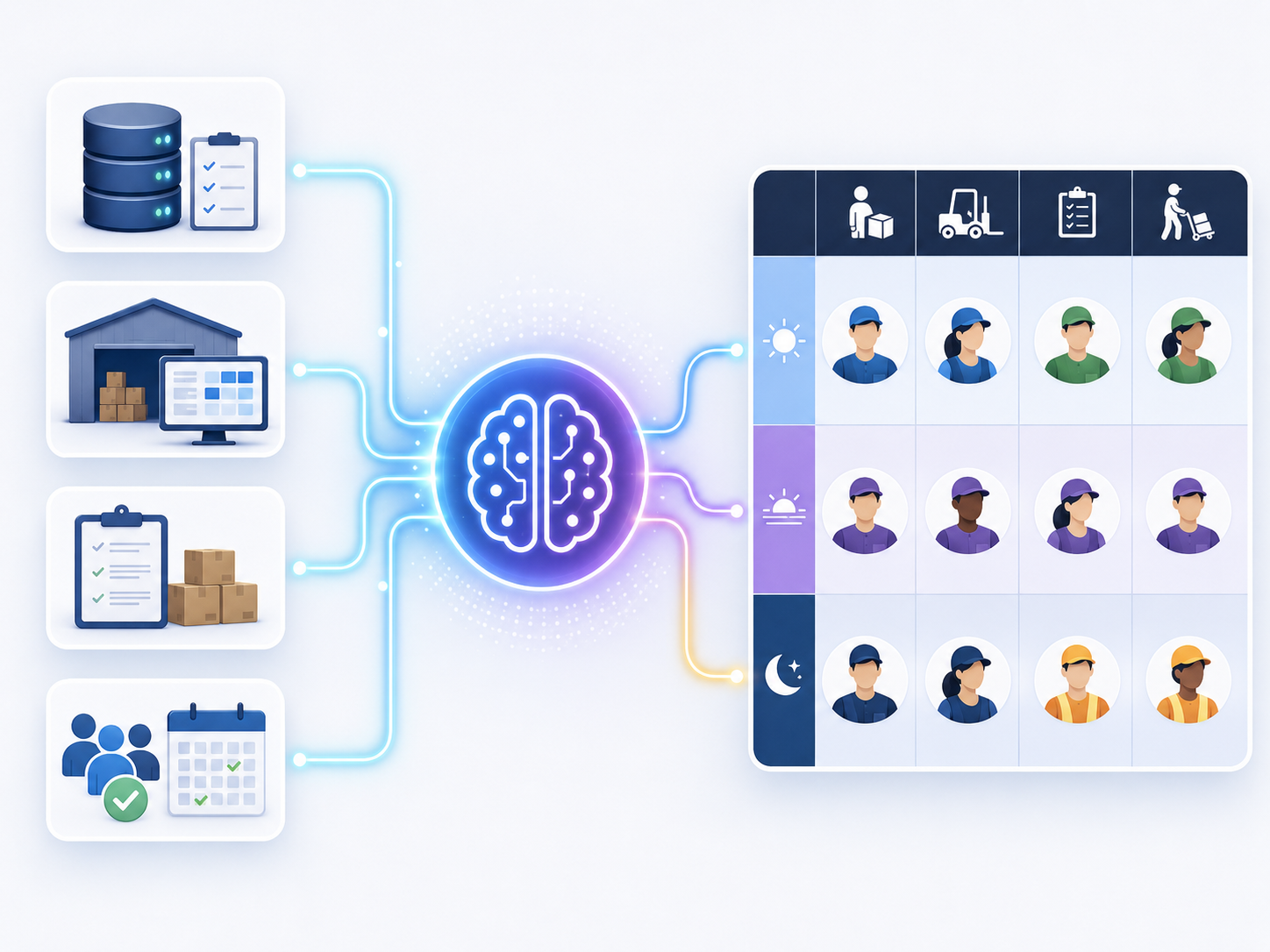
| Data layer | What it tells the planning model | Why it matters for staffing |
|---|---|---|
| Order history | Volume patterns by day, hour, customer, channel, order type, and service promise | Separates normal demand from recurring spikes and cutoff-driven pressure |
| Throughput baselines | Actual pick, pack, receive, replenish, load, and exception-handling rates | Converts forecasted work into labor hours instead of treating all volume alike |
| Client and calendar signals | Promotions, launches, holidays, inbound schedules, carrier pickups, and customer-specific events | Prevents the model from missing demand that is visible to the business but not obvious in past transactions |
| SKU profiles | Cube, weight, velocity, handling requirements, storage location, and value-added service needs | Shows when the same order count creates more travel, touches, or trained work |
| Workforce attributes | Availability, role eligibility, certifications, experience, productivity patterns, and restrictions | Stops the schedule from assuming every associate can perform every task |
Order history gives the model its demand memory, but it is only the first layer. A planning system needs to know whether Monday mornings always carry unfinished weekend volume, whether a particular customer releases work late in the day, and whether a channel produces more one-line orders than bulk replenishment orders. Without that shape, the forecast is only a count.
Throughput baselines turn that count into work. If a facility knows that each process has a measured historical rate, the model can estimate labor hours by activity. If the baseline is wrong, old, or averaged across unlike work, the staffing plan inherits the error. A pick rate from fast-moving pallet locations should not quietly stand in for slow case picking across distant aisles.
Calendars are where many warehouse plans get ambushed. Promotions, customer launches, holiday cutoffs, labor rules, carrier schedules, and inbound appointment patterns may live outside the WMS. If those signals sit in email, a customer portal, or someone’s calendar, the model cannot account for them unless they are connected or deliberately entered into the planning workflow.
SKU profiles matter because labor is driven by touches, travel, handling, and exceptions as much as by units. Heavy items, fragile items, kitting work, temperature-sensitive goods, high-velocity SKUs, and value-added service requirements change the work content of an order. A model that sees SKU mix can notice that tomorrow’s volume may be flat while packing labor rises.
The workforce layer is where the plan becomes usable rather than merely balanced. A warehouse may have enough total people on the schedule and still be short of forklift-certified workers, experienced packers, returns processors, or associates cleared for a specific customer process. AI labor planning has to respect those differences, or it produces the same fiction that weak spreadsheets produce: total headcount without executable coverage.
From forecast to headcount
The modeling layer usually combines forecasting with labor standards. Time-series forecasting estimates future workload from past patterns and current signals. Engineered or observed labor standards translate that workload into expected minutes or hours by task. Confidence intervals help planners see whether the system is dealing with a normal operating day or a wider range of possible outcomes.
The practical output is not “orders will rise tomorrow.” It is closer to: the early shift needs more replenishment before picking starts; packing will need extra labor after the first wave; receiving can release one person after the inbound appointment window closes; a trained associate should be held for exceptions rather than assigned to standard picking. That is the difference between predictive planning and prescriptive planning. Predictive planning estimates what is likely to happen. Prescriptive planning recommends what to do with people, time, and constraints.
A simplified workflow looks like this:
- Ingest current orders, open demand, historical patterns, inventory status, SKU attributes, calendar signals, and workforce availability.
- Forecast workload by time window, area, customer, order type, and task category.
- Apply throughput assumptions or labor standards to estimate required labor hours.
- Convert labor hours into headcount by shift, role, zone, and skill tier.
- Compare required labor with scheduled labor, then flag gaps, excess capacity, and redeployment options.
- Update recommendations as actual order flow, absenteeism, inventory exceptions, and throughput diverge from the plan.
The last step is often where the value shows up during the shift. A static plan can tell the supervisor what should have happened. A connected planning system can see that picking is ahead, packing is behind, or replenishment is about to starve a fast-moving zone. It can then recommend moving people before the backlog becomes visible at the dock.
What the system actually gives the operation
The best outputs are concrete enough to use before the shift starts and flexible enough to update during the day. A warehouse labor planning AI tool may produce a staffing view by hour, role, zone, customer, and skill requirement. It may show where overtime is likely, where scheduled labor exceeds expected demand, and where moving two trained associates earlier prevents a later bottleneck.
Skill-based assignment is not a nice extra. In many operations, it is the difference between a plan that works and a plan that simply counts bodies. If only some associates can operate certain equipment, process hazardous material, handle returns, perform quality checks, or work a customer-specific value-added service, the model has to treat those qualifications as constraints.
That is also why labor planning should not be evaluated only by whether the total headcount forecast was close. A plan can be accurate in total and wrong by role. It can be right for the day and wrong by hour. It can meet budget and still miss cutoffs because it placed capacity in the wrong process. The useful question is whether the recommendation improves the decisions supervisors actually make: call-ins, overtime approval, cross-training deployment, zone coverage, wave timing, and task reassignment.
Reported savings are meaningful, but not automatic
Published deployments show why the use case keeps getting budget attention. In an Extensiv case study, Averitt reported a 25% labor cost reduction and 60 picking hours saved per day.[3] Logiwa reported that its AI Job Optimization reduced labor hours by 39.8% in an eight-day pilot, from 1,500 hours to 902 hours.[4] CognitOps says its customers report 10–34% labor cost reductions without replacing the WMS.[5]
Those figures are strong, but they are vendor-published outcomes. They should be read as evidence that savings are possible under favorable deployment conditions, not as a general guarantee. The facility baseline matters. A warehouse with poor visibility, high manual planning effort, and frequent labor misallocation has more room to improve than a tightly engineered operation with clean data and disciplined daily management.
A fair evaluation also separates labor-hour reduction from labor-cost reduction. Cutting wasted picking time, reducing overtime, smoothing shift coverage, and redeploying workers can all improve the labor picture, but they do not show up identically in the P&L. Organizations that struggle to define and communicate AI value should connect the labor planning case to specific operating metrics, such as overtime hours, temporary labor spend, missed cutoffs, idle time, pick-to-pack imbalance, or supervisor planning time. That measurement discipline is the same issue discussed in ChainSignal’s article on AI logistics ROI clarity.
Why adoption is still uneven
The market is not waiting because the math is mysterious. It is waiting because many warehouses still lack the operating infrastructure that makes labor planning AI practical. In a 2024 McKinsey survey of more than 80 North American distributors, only 20% of warehouses had adopted any form of automation, and nearly half lacked a WMS or APS.[6] That does not make AI labor planning premature everywhere. It means the readiness question has to be asked facility by facility.
A warehouse with current WMS transactions, reliable order data, clean SKU attributes, usable labor standards, and an accurate skills matrix can start a serious evaluation. A warehouse planning from stale exports, incomplete inventory views, and tribal knowledge may need integration work before it needs a model selection meeting. The limiting factor is often whether the system can see enough of the operation to make a responsible recommendation.
This is the same data-readiness problem that shows up across supply chain AI projects. If order management, WMS, ERP, inventory, billing, and workforce systems do not agree with each other, the model receives a fractured version of reality. ChainSignal’s data readiness crisis analysis is a useful companion because labor planning is one of the places where fragmented data becomes visible quickly: the plan is either usable on the floor, or it is not.
Where vendors fit
The vendor landscape includes several different starting points. CognitOps is positioned as a prescriptive AI layer that can sit above existing warehouse systems. Blue Yonder LMS and Manhattan Active Labor Management come from the labor management and supply chain execution side. Logiwa IO brings the use case into warehouse execution for high-volume fulfillment environments. Takt focuses on planning and orchestration. OneTrack AI agents point toward task-level operational assistance rather than traditional labor planning alone.
That list should not be treated as a ranking. The more important distinction is architectural. Some tools depend heavily on an existing WMS and labor management foundation. Some aim to add a planning layer without replacing the WMS. Some emphasize real-time orchestration, while others are stronger in engineered standards, workforce visibility, or exception handling. The right evaluation starts with the warehouse’s data path, not the vendor demo sequence.
The main failure mode is partial visibility
Data fragmentation is the central implementation risk. If orders live in one system, inventory in another, labor availability in a spreadsheet, customer calendars in email, and billing rules somewhere else, the model cannot see the whole operating problem. It may still produce a forecast, but the forecast is being built from partial evidence.
Stale export data creates a quieter version of the same failure. A nightly file may be enough for monthly reporting, but it is weak material for shift-level planning when orders, inventory exceptions, absenteeism, and throughput can change before lunch. The user interface may say “AI,” but the recommendation is only as current as the data feeding it.
Supervisor adoption still matters. A floor lead who has been burned by bad forecasts will not trust a recommendation because it came from a model. The system has to show why it is recommending extra packers, fewer pickers, or a mid-shift move from receiving to replenishment. It also has to leave room for local judgment when a conveyor goes down, a large customer calls, or a group of new associates performs below the historical standard.
But adoption problems are easier to solve when the plan is visibly useful. Supervisors do not need a lecture on AI. They need a schedule that stops collapsing at 3 p.m. because the morning plan missed the SKU mix, the replenishment load, or the skill constraint.
What to evaluate before buying
A warehouse labor planning AI evaluation should begin with operational visibility. Before asking which model is most advanced, ask whether the tool can connect to the systems that define the work: WMS transactions, order demand, inventory status, SKU attributes, labor standards, workforce availability, skills, calendars, and real-time exceptions.
- Can the system forecast workload by shift, hour, process, role, and customer rather than only total volume?
- Does it translate order profiles and SKU mix into labor hours using credible throughput assumptions?
- Can it distinguish trained labor from general labor and respect certifications or task eligibility?
- Does it update recommendations when actual orders, inventory, attendance, or throughput diverge from the plan?
- Can supervisors see the reason for a recommendation clearly enough to act before the shift is already in trouble?
- Are the savings measured against specific baselines such as overtime, temporary labor, idle time, missed cutoffs, or planning hours?
AI warehouse labor planning can deliver meaningful savings where the operating data is connected, current, and detailed enough to support shift-level decisions. Where the data is fragmented, the first project is not algorithm selection. It is making the warehouse visible enough that any algorithm can plan labor reliably.
References
- MHI/Deloitte Industry Report, as cited by Extensiv
- McKinsey analysis on AI-driven operations forecasting, McKinsey
- Averitt case study, Extensiv
- AI Job Optimization pilot, Logiwa
- Customer labor cost reduction claims, CognitOps
- 2024 survey of 80+ North American distributors, McKinsey
Comments
Join the discussion with an anonymous comment.