
A control tower in supply chain work earns its budget when it changes what happens after an alert appears. That distinction matters because many teams already have visibility: map views, carrier feeds, SKU dashboards, risk signals, and a growing queue of exceptions. The harder question is whether the system helps a planner or logistics manager decide sooner, resolve faster, and prove that the intervention reduced detention, OTIF penalties, inventory, or manual rework.
That is where the current evidence starts to get useful. FourKites reports that only 22% of shippers with more than $1 billion in revenue consider their current control tower highly effective at driving action, while AI-powered deployments are being credited with 4-to-8-month payback periods in selected implementations rather than the 18-to-24-month window associated with traditional visibility solutions.[1] Locus and FourKites also point to AI-enabled towers detecting disruptions 2–4 hours before customer impact, which is the kind of lead time that can move an issue from apology management into exception management.[1][2]
The market numbers are less helpful as proof of operating value, but they explain why budgets are under pressure. Business Research Insights projects the control tower market at USD 8.75 billion in 2026 with roughly 21% CAGR, while Grand View Research is cited with a USD 13.6 billion estimate for the same year.[3][4] That spread should not be read as a mystery in demand. It is a scope warning: some estimates count a narrower supply chain control tower category, while others appear to include broader visibility, analytics, or enterprise command-center capabilities. For a buyer, the definition gap is exactly the point. Paying for a larger category does not guarantee a shorter exception cycle.
Inbound Logistics reports that 37% of organizations are prioritizing control tower investments, up 6 percentage points year over year.[5] The better procurement question is not whether control towers are popular. It is which AI layer inside the tower is tied to a measurable workflow change.
The Useful Split: What Decision Does the AI Improve?
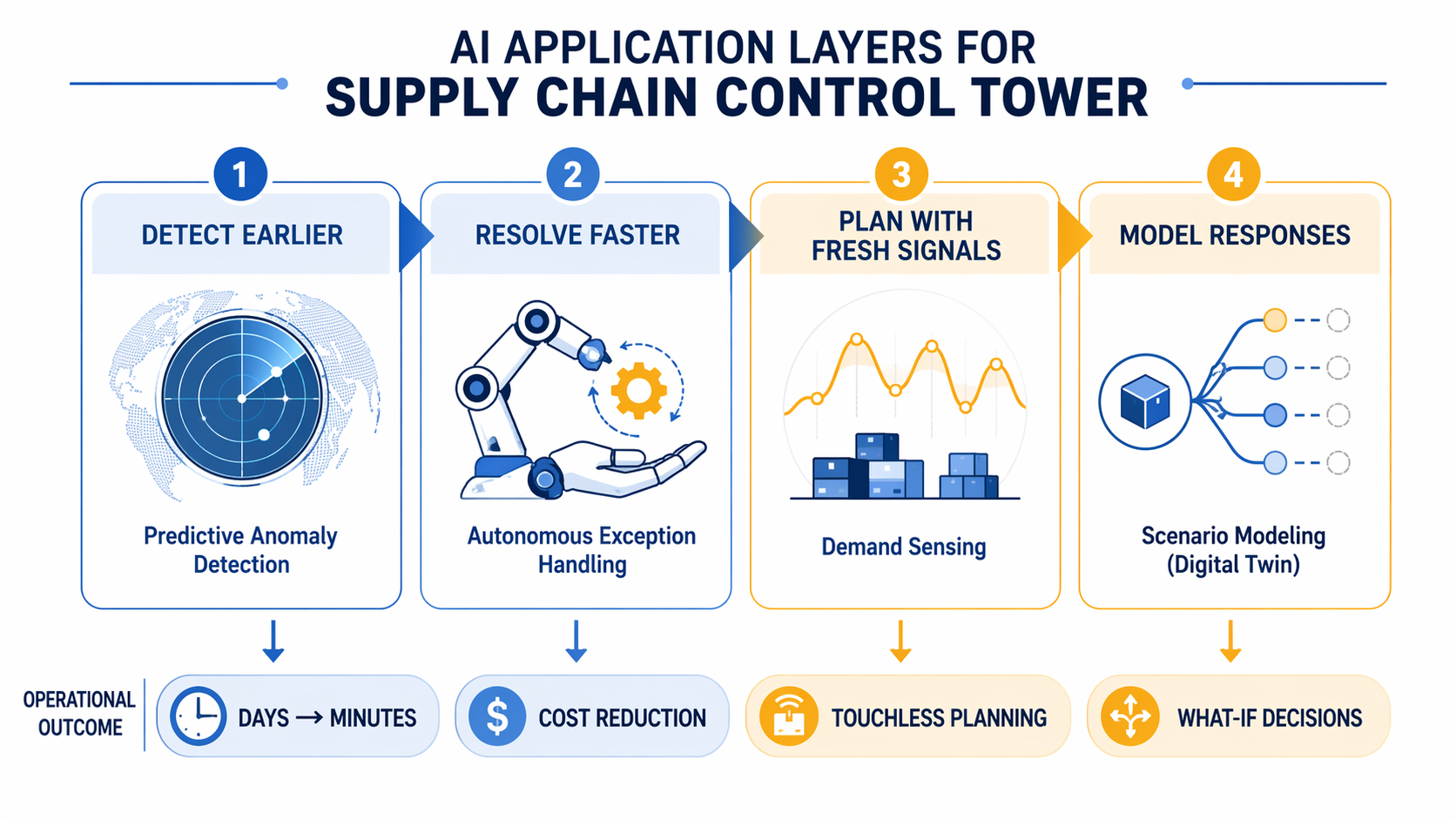
Most control tower language blurs together four different jobs. Visibility says something is happening. Prediction says what is likely to happen next. Automation decides whether a response can be executed without waiting for a person. Planning intelligence updates allocation, order, or inventory decisions when the demand picture changes. Scenario modeling tests alternatives before the team commits capacity, stock, or service promises.
| AI application inside the control tower | Operational decision it improves | Best evidence to look for |
|---|---|---|
| Predictive ETA and anomaly detection | Which shipment, order, or lane needs intervention before customer impact | Lead time before impact, reduction in manual tracking, avoided service failures |
| Autonomous exception handling | Which exceptions can be resolved within policy without human review | Cost avoided, productivity gain, resolution time, escalation accuracy |
| Demand sensing and inventory allocation | How order planning, replenishment, or allocation changes as demand signals refresh | Touchless planning rate, inventory reduction, service-level protection |
| Scenario modeling and digital twin integration | Which response option is least damaging under disruption or demand uncertainty | Forecast accuracy, delay reduction, decision latency, quality of trade-off analysis |
This split keeps the ROI discussion honest. A 2-hour disruption warning, a 35% productivity gain, and a 7% inventory reduction are not interchangeable metrics. They come from different processes, different baselines, and different levels of organizational control.
Predictive ETA and Anomaly Detection: Turning Visibility into Lead Time
Predictive anomaly detection is usually the cleanest first test of whether a control tower has moved beyond passive visibility. The mechanism is straightforward: combine shipment status, route, carrier, facility, order, inventory, and risk signals, then flag the exception before it reaches the customer, production schedule, or dock appointment. The business value depends on what the team can still change during that window.
Locus describes AI-powered control towers detecting disruptions 2–4 hours before customer impact and connecting those predictions to proactive resolution.[2] FourKites makes a similar case in the context of control towers that move from tracking events to recommending or initiating action.[1] That time window is not magical by itself. It matters when a logistics team can still resequence a dock, notify a customer-service team before the promise is broken, reroute a shipment, assign backup capacity, or protect a temperature-sensitive load from waiting too long at the wrong point in the network.
The practical test is whether the model reduces the number of exceptions that humans have to inspect. A control tower that detects every late-risk shipment but cannot rank severity simply moves the burden from email to dashboard. A useful predictive layer narrows the queue: this load is likely to miss the appointment, this customer has an OTIF exposure, this lane has a pattern of detention risk, this inbound component threatens production, and this exception is noise unless the status changes again.
For teams building this capability, the baseline should be operational rather than cosmetic. Measure how long before impact the team learns about an exception, how often the prediction is actionable, how many manual status checks disappear, and how often intervention changes the outcome. A model that is 2 hours earlier but wrong too often will lose planner trust quickly. A model that is less dramatic but reliably filters the morning exception queue may produce more usable ROI.
This is also where foundational visibility still matters. Predictive analytics in supply chain management depends on timely, connected signals; the best model cannot infer a carrier delay from data that never arrives. Teams that want more context on the technique can use a glossary-level reference to predictive analytics in supply chain management, but the control tower buying decision should stay grounded in exception outcomes, not model vocabulary.
Autonomous Exception Handling: The Strongest ROI Claim, with the Sharpest Governance Caveat
Autonomous exception handling is where AI control tower claims become most interesting and easiest to overstate. The value is not that an agent spots an issue. The value is that it can execute a bounded response: send a carrier instruction, trigger an appointment change, escalate to the right planner, update a customer-service workflow, or recommend a trade-off that stays inside approved policy.
FourKites documents a top-15 global food and beverage manufacturer using an AI-powered control tower to reduce detention costs by more than USD 500,000, cut OTIF penalties by nearly USD 800,000, and improve logistics team productivity by 35%.[1] Those are vendor-published results, so they should not be treated as an average deployment benchmark. They are still valuable because the metrics are tied to consequences that operators recognize: detention charges, OTIF penalties, and the productivity of the logistics team that would otherwise chase exceptions manually.
The likely condition behind those numbers is not simply “AI.” Food and beverage logistics has recurring appointment, dwell, temperature, and service-level constraints. If the control tower has reliable shipment data, clear penalty exposure, defined escalation paths, and enough historical patterns to rank exceptions, the system can focus human attention where it changes cost. Without those conditions, automation may accelerate bad decisions or flood teams with low-confidence recommendations.
Gartner’s prediction that 60% of supply chain disruptions will be resolved without human intervention by 2031 is useful as a directional marker, not proof of today’s average capability.[2] “Resolved without human intervention” depends on what counts as a disruption, which policies the agent can act on, how exceptions are classified, and where the organization draws the line between recommendation and execution. A carrier appointment reschedule inside a contracted window is not the same governance problem as reallocating scarce inventory away from one strategic customer to another.
The best current implementations treat agentic digital workers as constrained operators, not free-floating decision engines. They need permissions, audit trails, confidence thresholds, rollback rules, and escalation triggers. A practical design might let the agent handle low-risk detention prevention steps automatically, require review for customer-facing promise changes, and block autonomous action when financial trade-offs cross a defined threshold. The control tower then becomes an action layer with governance, rather than a dashboard with a chatbot attached.
For a broader view of how vendors are packaging these capabilities, the Q2 2026 market context on supply chain AI agentic automation is useful. For validation, however, the more important artifact is the exception policy. If nobody can explain what the agent is allowed to do on Tuesday morning when a high-value shipment is at risk, the autonomy claim is still a demo script.
Demand Sensing and Inventory Allocation: When the Tower Changes the Plan
A control tower becomes more valuable when it connects execution signals back into planning decisions. Demand sensing and inventory allocation use cases are not always branded as control tower work, but they belong in the ROI discussion when the same operating layer helps decide which orders can be planned touchlessly, where inventory should sit, and when a planner should intervene.
o9 Solutions reports an implemented control tower achieving 93% touchless order planning and a 7% inventory reduction for a manufacturer processing 8,000 daily orders.[6] That result is useful because “touchless order planning” is a workflow metric. It says the system was trusted to move a large share of orders through planning without manual handling, while inventory reduction indicates that the process did not simply buy service performance with excess stock.
Again, the attribution needs discipline. A 93% touchless rate suggests that order rules, data quality, exception thresholds, and planner governance were mature enough for automation. It does not mean any enterprise can attach AI to an order book and remove planners from the process. It means that in a bounded environment with 8,000 daily orders, the control tower supported a planning workflow where most orders did not require human correction.[6]
This use case also changes who benefits. Predictive ETA work often helps logistics and customer service first. Demand sensing and allocation work reaches supply planning, inventory management, sales operations, and finance. If fresh demand signals show that one node is overstocked while another will miss service, the tower’s value comes from changing the allocation decision before the network pays for both expediting and excess inventory.
For companies evaluating this layer, the baseline should include manual order touches, planner overrides, inventory position, service levels, and the reason codes behind exceptions. If the team cannot separate preventable planning touches from necessary commercial judgment, a touchless target may create pressure to automate the wrong work. If inventory reduction is the goal, the relationship to service protection should be explicit. Multi-echelon decisions are especially sensitive to local optimization, so teams may want to pair control tower intelligence with multi-echelon inventory optimization methods rather than treating every node-level alert as a planning instruction.
Scenario Modeling and Digital Twins: Useful, but Harder to Attribute to the Tower Alone
Scenario modeling sits one step away from the immediate exception queue. Instead of asking only “What is late?” it asks “What happens if we expedite, substitute, reroute, delay, split, or reallocate?” That is where digital twin language enters the control tower conversation. A digital representation of the network can help teams compare response options before committing scarce capacity or inventory.
The magnitude claims around this area are promising but broader than control towers alone. BCG has been cited for early digital-twin adopters reaching 20–30% better forecast accuracy and 50–80% fewer delays.[7] McKinsey has reported AI-driven forecasting reducing errors by 20–50%.[8] Those figures support the potential of AI-enabled modeling and forecasting, but they should not be read as proof that a control tower screen by itself creates those outcomes.
The stronger case is narrower: scenario modeling improves the quality and speed of trade-off decisions when the organization has a model of constraints it actually uses. A transportation team can compare rerouting options. A supply planner can test whether reallocating inventory protects more revenue than expediting production. A customer-service leader can see which accounts will be affected under each response. The control tower is valuable when it brings those alternatives into the same decision workflow as the live exception.
This is also where knowledge representation matters. Many enterprises still struggle to see beyond direct suppliers or immediate logistics partners, which limits the quality of any what-if model. The related discussion of multi-tier supply chain visibility through knowledge graphs is relevant because scenario quality depends on connected entities: suppliers, sites, lanes, orders, materials, inventory, customers, and constraints. A digital twin with weak relationships is just a prettier spreadsheet.
What Makes the ROI Believable
The best evidence in this category has three traits. First, it names the workflow: exception handling, order planning, detention prevention, allocation, or forecasting. Second, it names the measurable consequence: cost avoided, penalty reduced, inventory lowered, productivity improved, or errors decreased. Third, it makes the boundary visible enough that a buyer can judge whether the result might transfer.
- For predictive detection, ask how many hours of lead time the model creates and what percentage of alerts lead to a changed outcome.
- For autonomous exception handling, ask which actions are executed without review, which require approval, and which are blocked by policy.
- For demand sensing, ask whether touchless planning reduces manual work while maintaining service and inventory targets.
- For scenario modeling, ask whether users compare real response options inside the operating workflow or export analysis into a separate planning exercise.
- For any vendor-published ROI case, ask what the baseline was before implementation and whether savings are annualized, one-time, avoided, or directly captured.
Vendor-documented results are not useless because they come from vendors. In enterprise supply chain technology, public independent ROI studies are often sparse, and buyers frequently have to triangulate from case studies, pilots, references, and internal baselines. The mistake is treating the best public case as a default forecast. FourKites’ food and beverage results, o9’s touchless planning example, and Locus’s detection window are most useful as evidence that the workflows can produce measurable value under the right conditions, not as guarantees.
A credible business case should show the current exception volume, manual handling time, penalty exposure, service failure cost, inventory baseline, and decision rights. It should also show where the AI sits in the operating process. If the model predicts a disruption but the team still waits for a spreadsheet approval cycle, the control tower has not compressed the path from signal to response. If the agent can act but nobody owns escalation rules, the organization has created automation risk rather than operational leverage.
Implementation depth matters as much as software category. Teams comparing logistics deployments can cross-check adjacent evidence in real-world AI logistics company deployments, but the same rule applies: the useful cases identify the operational process that changed. Visibility is the input. The ROI comes from fewer manual touches, fewer avoidable charges, better promise protection, faster trade-off decisions, or lower inventory for the same service ambition.
Buying Around Bounded Workflows
The most defensible control tower AI investments start with a bounded workflow and a measurable baseline. “Improve supply chain visibility” is too broad to validate. “Reduce detention on priority lanes by detecting appointment risk earlier and automating approved rescheduling steps” is testable. So is “increase touchless order planning while reducing inventory without degrading service.”
That framing also protects teams from overbuying autonomy. Some exceptions should be resolved automatically. Some should be recommended with explanation. Some should be escalated quickly to a person with commercial context. The control tower should make those boundaries easier to enforce, not hide them under a generic AI layer.
The strongest documented use cases today are predictive anomaly detection and autonomous exception handling, especially when the metric is tied to detention, OTIF, productivity, or response time. Demand sensing and inventory allocation become compelling when the tower changes order planning and stock decisions, as in o9’s touchless planning example. Scenario modeling and digital twin integration can support large improvements, but the attribution is broader and should be validated against the specific decision workflow.
A useful control tower is not the one that displays the most disruption signals. It is the one that shortens the path from signal to decision to executed response, with enough governance that operators trust the action before lunch.
References
- Why Supply Chain Control Towers Didn't Deliver on Their Promise, FourKites.
- Supply Chain Control Tower: How to Build Real-Time Logistics Visibility That Delivers ROI, Locus.
- Control Tower Market 2026, Business Research Insights.
- Control Tower Market 2026, Grand View Research.
- Control Tower Investment Data, Inbound Logistics.
- What Is a Supply Chain Control Tower?, o9 Solutions.
- Digital twin forecast accuracy and delay reduction benchmarks, BCG.
- AI-driven forecasting error reduction benchmarks, McKinsey.
Comments
Join the discussion with an anonymous comment.