
What Is Predictive Analytics in Supply Chain Management?
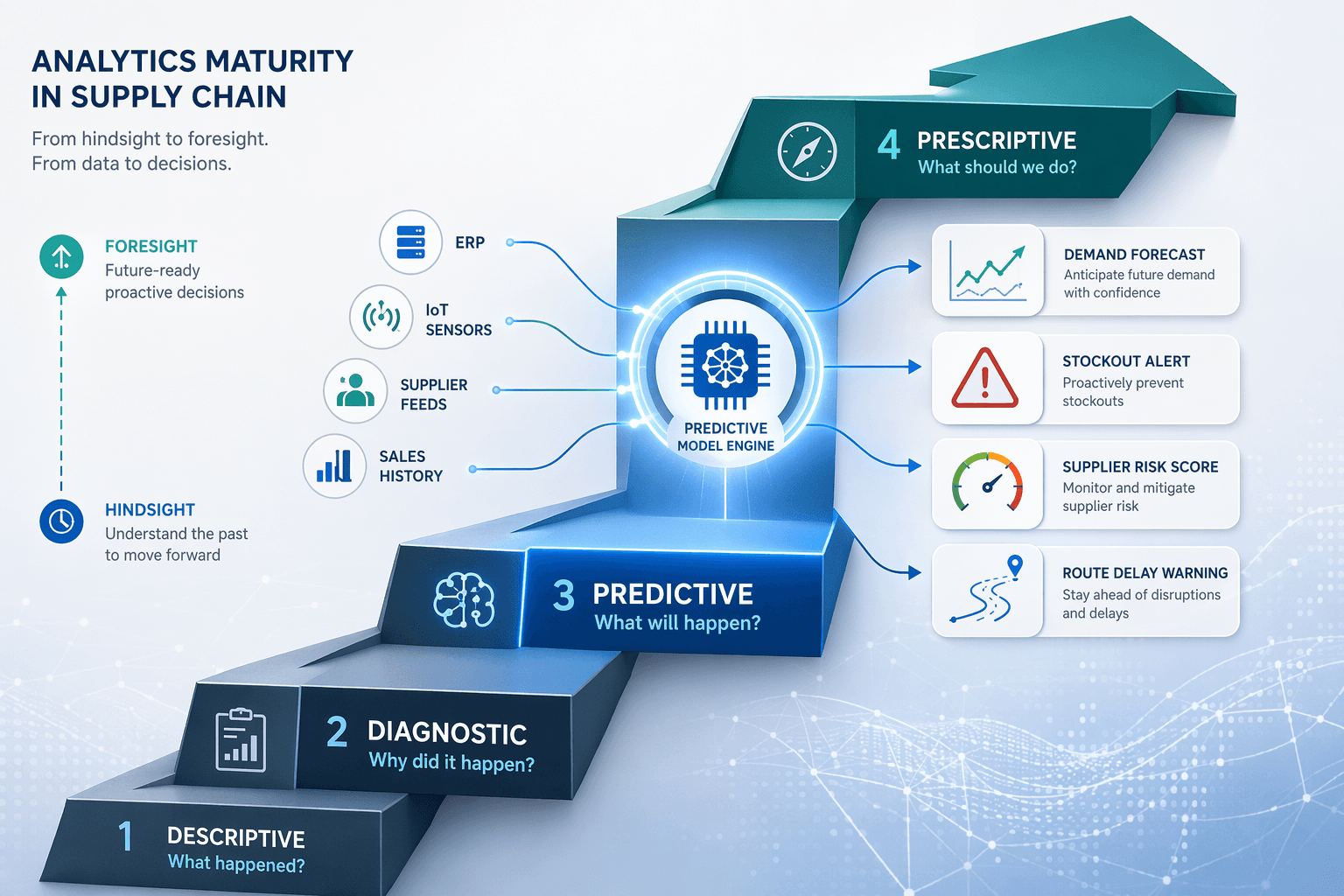
Predictive analytics in supply chain management is the application of historical data, statistical modeling, and machine learning to forecast future supply chain outcomes. It answers the question "What will happen?" — moving beyond descriptive analytics ("What happened?") and diagnostic analytics ("Why did it happen?") toward prescriptive analytics ("What should we do?"). For supply chain teams, this means shifting from reactive firefighting — scrambling to respond to stockouts, delays, or supplier failures after they occur — to proactive decision-making grounded in data-driven forecasts.
The core thesis is straightforward: supply chains generate enormous volumes of data — past transactions, seasonal patterns, supplier performance records, IoT sensor readings, GPS tracking feeds, and customer demand signals. Predictive analytics extracts forward-looking signals from this data, enabling teams to anticipate demand fluctuations, optimize inventory levels, assess supplier risk, predict logistics delays, and schedule maintenance before equipment fails. According to a 2026 survey by Tradeverifyd, 48.7% of organizations have already transitioned away from manual data management to adopt AI-powered predictive analytics for daily workflows, signaling that this capability is moving from early adopter territory into mainstream supply chain operations.
The KNIME guide (April 2026) provides a useful framing: descriptive analytics might tell you that last quarter's stockout rate was 12%; predictive analytics tells you that the stockout risk for SKU-X is 78% next month; prescriptive analytics then recommends reordering 5,000 units from Supplier B by March 15. Predictive analytics is the critical middle layer — it provides the foresight that makes prescriptive optimization possible.
How Predictive Analytics Works in Practice
Deploying predictive analytics in a supply chain environment follows a structured end-to-end process. Understanding this pipeline is essential for practitioners evaluating tools or planning implementations, because the most common failure points occur in the early stages — not in model selection.
- Data collection. Predictive models draw on multiple data sources: ERP transaction histories, WMS inventory records, supplier performance databases, IoT sensor streams, GPS tracking feeds, sales history from POS systems, and external data such as weather patterns or economic indicators. The breadth and quality of these inputs directly determine what the model can predict.
- Data cleaning and integration. Raw supply chain data is notoriously messy — inconsistent units, missing values, duplicate records, and incompatible formats across legacy systems. The KNIME guide recommends spending approximately 60% of total project time on connecting and cleaning data. This is where most projects stall or fail. The Tradeverifyd survey found that 67% of enterprises report that despite increasing financial commitment to visibility tools, ROI has stalled due to fragmented legacy systems.
- Model selection and training. Once clean, integrated data is available, teams select a modeling approach suited to the specific forecasting problem — time series methods for demand patterns, regression for cost driver analysis, tree-based models for complex nonlinear relationships. The model is trained on historical data, validated against holdout periods, and tuned for accuracy.
- Deployment into operational workflows. A model that sits in a data scientist's notebook delivers no value. Deployment means integrating predictions into the systems that planners, buyers, and logistics analysts use daily — ERP dashboards, S&OP workflows, procurement platforms, or control tower interfaces. This step requires IT collaboration and often triggers change management challenges.
- Ongoing monitoring and retraining. Supply chain patterns shift — seasonality changes, new products launch, suppliers change, market conditions evolve. Models must be monitored for drift and periodically retrained. A MAPE (Mean Absolute Percentage Error) under 15% is a reasonable target for most supply chain categories; above 20%, the KNIME guide advises revisiting feature engineering.
Key Predictive Analytics Techniques Compared
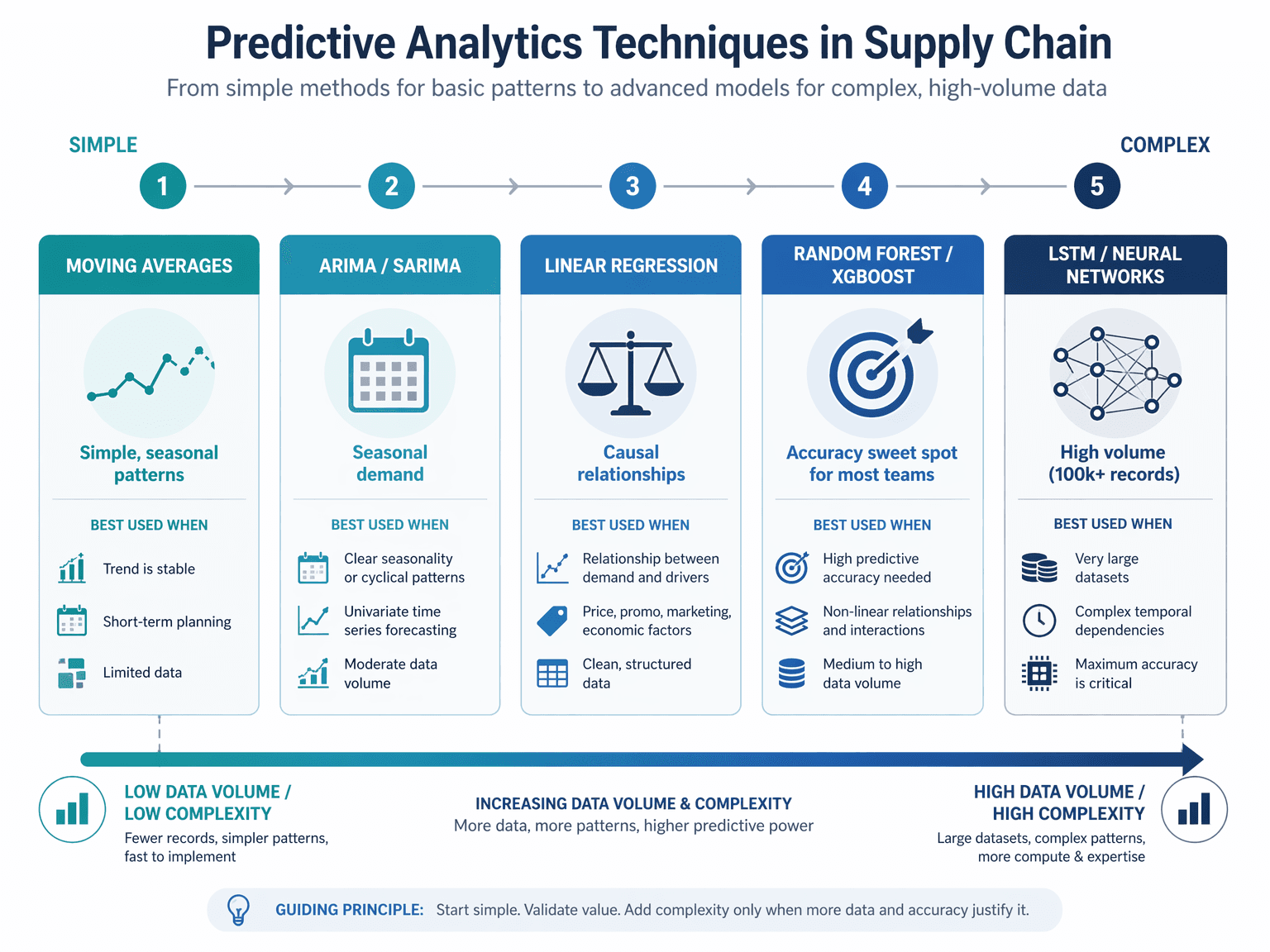
Different supply chain forecasting problems call for different modeling approaches. The table below compares the five most relevant techniques, drawing on the KNIME guide's framework and practical guidance. The key insight for practitioners: start simple, validate with a baseline, and increase complexity only when the data volume and business value justify it.
| Technique | Best For | Data Requirements | Complexity | Practical Guidance |
|---|---|---|---|---|
| Moving Averages | Stable demand patterns with minimal trend or seasonality | 12+ months of historical data | Low | Use as a baseline benchmark; rarely sufficient for production forecasting alone |
| ARIMA / SARIMA | Seasonal demand patterns (e.g., retail, CPG, fashion) | 2+ years with clear seasonality | Low–Medium | Gets 80% of the way for most seasonal forecasting problems; start here |
| Linear Regression | Understanding cost/demand drivers and causal relationships | Structured tabular data with relevant features | Low | Good for explanatory analysis; limited for complex nonlinear patterns |
| Random Forest / XGBoost | Complex, nonlinear patterns with multiple interacting variables | Moderate structured data with feature engineering | Medium | The accuracy sweet spot for most supply chain teams; handles mixed data types well |
| LSTM / Neural Networks | Large-scale, real-time signal processing (IoT streams, high-frequency data) | Large datasets (100k+ records) and/or IoT streams | High | Only justify complexity at high volume; avoid for fewer than 100,000 records or when real-time predictions aren't needed |
The decision framework is pragmatic: ARIMA/SARIMA handles seasonal demand well and should be the starting point for most teams. Tree-based models like XGBoost represent the accuracy sweet spot — they capture complex interactions without the data volume requirements of neural networks. LSTM and deep learning approaches only justify their complexity at high volume (fewer than 100,000 records and no real-time need, avoid). For readers who want a deeper treatment of these techniques, see the Machine Learning in Supply Chain Management glossary entry, which covers ML model types in greater detail. For a full disambiguation of forecasting terminology — including the differences between statistical, probabilistic, deterministic, and point forecasts — refer to the forecasting terminology reference.
Primary Use Cases Across the Supply Chain
Predictive analytics touches every major supply chain function. The five application areas below represent the highest-impact opportunities based on documented deployments and industry adoption patterns.
- Demand forecasting. The most mature application. Predictive models ingest historical sales, promotional calendars, seasonality, and external factors (weather, economic indicators) to generate forward-looking demand estimates. For a deep dive into CPG and retail applications, see the AI Demand Forecasting in CPG and Retail use case entry.
- Inventory optimization. Predictive models identify stockout and excess inventory risks before they materialize, enabling dynamic safety stock adjustments and reorder point optimization. For multi-echelon inventory techniques, see the Multi-Echelon Inventory Optimization (MEIO) glossary entry.
- Supplier risk scoring. Models analyze supplier performance history, financial health indicators, geopolitical risk factors, and lead time variability to predict which suppliers are likely to fail or delay. The E2open framework notes that predictive analytics can forecast supplier risk and lead time variability, while prescriptive analytics recommends supplier switching or order splitting.
- Logistics and transportation prediction. Predictive models estimate ETA accuracy, identify delay risk on specific routes, and forecast freight rate movements. Inputs include GPS tracking data, weather patterns, port congestion reports, and historical carrier performance. For detailed ROI data specific to logistics, see the companion piece The ROI of Predictive Analytics in Logistics.
- Predictive maintenance. IoT sensor data from warehouse equipment, conveyor systems, and fleet vehicles feeds models that predict equipment failure before it occurs, reducing unplanned downtime and extending asset life.
Measured ROI: What Real Deployments Show
For B2B evaluators building a business case, concrete ROI data from real deployments carries more weight than vendor claims. The following figures are sourced from documented implementations and industry research.
- P&G reduced supply chain response time from 2+ hours daily to instantaneous by integrating real-time predictive data across 5,000 products and 22,000+ components (KNIME guide, April 2026).
- Karcher achieved a 15% reduction in inventory value while maintaining high service levels using a data-driven stock recommendation engine (KNIME guide, April 2026).
- AWS and Kearney report that algorithmic intelligence delivers 10–20% improvement in forecast accuracy and 5–10% inventory reduction (cited in the KNIME guide; original Kearney publication not independently verified).
- Volkswagen eliminated approximately 500 hours of manual work and achieved a 15% improvement in German supplier data quality through automated data integration and predictive analytics (KNIME guide, April 2026).
- A national grocery chain cut food waste on fresh produce by 15% over one year using SAP IBP, though data standardization took four extra months (LatentView).
- A mid-size apparel retailer reduced stockout incidents by 20% and improved online order fulfillment after nine months using Microsoft Azure ML (LatentView).
These results align with broader industry expectations. The Tradeverifyd 2026 survey found that 59% of executives expect measurable ROI from AI within 12 months, and 86% of supply chain executives plan AI and analytics investments specifically for cost reduction. Most organizations see initial results within 6 to 12 months of deployment, according to LatentView.
Implementation Challenges and Common Pitfalls
Predictive analytics projects fail far more often from organizational and data problems than from model performance issues. Practitioners evaluating these tools should go in with eyes open about the real difficulty.
- Poor data quality and fragmented legacy systems. The Tradeverifyd survey found that 67% of enterprises report stalled ROI due to fragmented legacy systems, despite increasing financial commitment to visibility tools. Data lives in silos — ERP, WMS, TMS, supplier portals, spreadsheets — and integrating these sources is the single biggest time sink. The KNIME guide recommends spending 60% of project time on data connection and cleaning.
- Integration complexity with existing ERP/WMS. Predictive models must feed predictions into the systems that planners actually use. This requires API integrations, data pipeline engineering, and often IT architecture changes. The LatentView guide notes that SAP IBP, while powerful for large enterprises on SAP, takes months to implement and is expensive.
- Skill gaps in data science and ML. Many supply chain organizations lack in-house data science talent. Tools like Alteryx and Microsoft Azure ML reduce the barrier, but they still require teams who understand both supply chain operations and statistical modeling. Python and open-source tools offer low software cost but need skilled programmers.
- Change management resistance. Planners and buyers who have relied on intuition and spreadsheets for years may resist model-driven recommendations. The KNIME guide identifies skipping change management as a common pitfall — building the model in a silo without involving the end users who will act on its predictions.
- Overfitting to historical patterns. Supply chain conditions change — new competitors, supply disruptions, demand shocks. Models trained too tightly on historical data fail when the environment shifts. The KNIME guide warns against overfitting and recommends monitoring for model drift with periodic retraining.
Predictive vs. Prescriptive Analytics: A Critical Distinction
A common point of confusion for practitioners evaluating analytics platforms is the boundary between predictive and prescriptive analytics. The E2open framework (March 2026) provides a clear delineation that is essential for tool selection and deployment planning.
| Dimension | Predictive Analytics | Prescriptive Analytics |
|---|---|---|
| Question answered | What is likely to happen? | What should we do? |
| Outputs | Forecasts, probabilities, risk signals | Recommended actions, optimized plans |
| Purpose | Anticipate future conditions | Determine the best response |
| Methods | Statistical models, ML forecasting | Optimization, simulation, decision engines |
| Success metric | Forecast accuracy (e.g., MAPE) | Cost/service/efficiency improvements |
| Best for | Early warning, planning confidence | Executing decisions under constraints |
The practical guidance from E2open: use predictive analytics when the primary goal is forecasting and decisions are made manually by planners; use prescriptive analytics when decisions need to be repeated at scale under constraints — such as automated inventory replenishment across thousands of SKUs or dynamic route optimization across a fleet. In demand planning, predictive analytics forecasts demand; prescriptive analytics recommends production plans and safety stock levels. In logistics, predictive analytics forecasts ETAs and delay risk; prescriptive analytics recommends route changes and load consolidation.
Future Trends: Where Predictive Analytics Is Heading
Several emerging developments will shape predictive analytics in supply chain over the next 2–3 years. These trends are grounded in current technology trajectories and operational needs, not speculative hype.
- LLM-augmented forecasting. Large language models are beginning to complement traditional forecasting by ingesting unstructured data — news reports, supplier communications, social media signals — and incorporating qualitative insights into quantitative predictions. The KNIME guide identifies this as an emerging trend.
- Digital twins. Digital twin technology creates virtual replicas of supply chain networks that can run predictive simulations — testing the impact of a supplier failure, a port closure, or a demand spike before it happens. For a full definition, see the Digital Twin Supply Chain glossary entry.
- Real-time data integration and demand sensing. The shift from batch forecasting to real-time demand sensing — using point-of-sale data, IoT signals, and streaming analytics — enables faster response to demand changes. For the terminology hierarchy, see the Demand Sensing vs. Demand Forecasting vs. Demand Planning glossary entry.
- Agentic AI for autonomous decision-making. The next frontier is AI agents that not only predict outcomes but also execute decisions autonomously within defined guardrails — automatically adjusting safety stock levels, rerouting shipments, or reordering from alternative suppliers when risk thresholds are triggered.
- AI-powered control towers. Control towers are evolving from visualization dashboards into predictive and prescriptive platforms that aggregate data across the end-to-end supply chain, predict disruptions, and recommend or execute responses. For a detailed capability spectrum, see the Supply Chain Control Tower AI glossary entry.
These trends share a common direction: predictive analytics is moving from periodic, batch-oriented forecasting toward continuous, real-time, and increasingly autonomous decision support. Organizations that invest now in data quality, integration infrastructure, and cross-functional analytics capability will be best positioned to adopt these advances as they mature.