
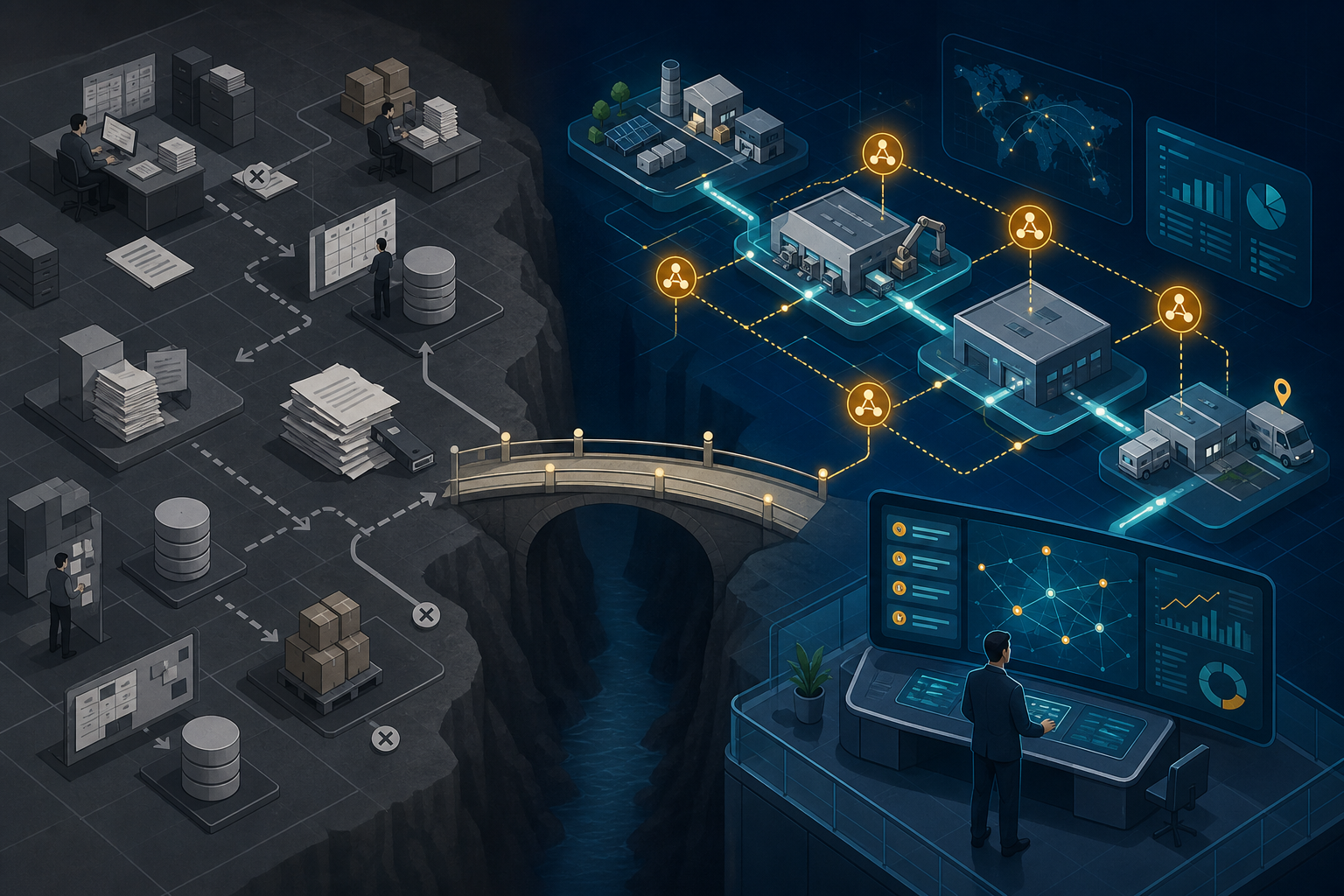
What Agentic AI Is — and Why It Matters for Supply Chain
The term "agentic AI" has moved rapidly from research labs into supply chain strategy decks, but its operational meaning is often blurred with adjacent technologies. For a supply chain leader evaluating this technology, the distinction matters because it determines what the system can actually do — and what it cannot.
Traditional automation operates on deterministic rules: if inventory drops below a threshold, generate a purchase order. Generative AI, by contrast, produces content or completes patterns — it can draft a supplier email or summarize a disruption report, but it does not act on that output. Agentic AI sits between these two: it perceives changes in its environment (a shipment delay, a demand spike), reasons about the appropriate response using models and data, executes an action within defined boundaries (reroute a shipment, adjust a safety stock parameter), and learns from the outcome to improve future decisions.
This perception-reasoning-action-learning loop is what makes agentic AI distinct. A traditional demand planning system can flag a forecast error. A generative AI assistant can draft a memo explaining the error. An agentic AI system can investigate the root cause, adjust the forecast model parameters, update the inventory plan, and notify the planner — all without human intervention, unless the decision exceeds its authority threshold.
The operational relevance of this distinction is straightforward. Supply chain environments generate constant, low-to-medium complexity decisions — exception handling, inventory rebalancing, carrier selection, order prioritization — that are too numerous for humans to handle individually but too context-dependent for simple rules. Agentic AI fills this gap. It does not replace the strategic judgment of a supply chain director, but it absorbs the volume of tactical decisions that currently consume planning teams and create latency in response times.
The 2026 Adoption Reality: Data Behind the Hype
Agentic AI is not a future concept — it is already embedded in production systems at measurable scale. But the gap between early adopters and the broader market remains wide, and the data reveals both momentum and caution.
According to BCG data cited by Dataiku, agentic systems accounted for 17% of total AI value in 2025 and are projected to reach 29% by 2028. Gartner, cited by Deloitte in its March 2026 analysis, predicts that 40% of enterprise applications will integrate task-specific AI agents by the end of 2026, up from less than 5% today. Looking further ahead, Gartner forecasts that 15% of daily logistics decisions will be made autonomously by AI agents by 2028, and that 60% of disruptions will be resolved without human intervention by 2031.
| Metric | Source | Timeframe |
|---|---|---|
| Agentic systems: 17% of total AI value → projected 29% | BCG (via Dataiku) | 2025 → 2028 |
| Enterprise apps integrating task-specific AI agents: <5% → 40% | Gartner (via Deloitte) | Today → end of 2026 |
| Daily logistics decisions made autonomously by AI agents | Gartner (via Inbound Logistics) | 15% by 2028 |
| Disruptions resolved without human intervention | Gartner (via Inbound Logistics) | 60% by 2031 |
| Supply chain leaders deploying AI agents to automate workflows | Deloitte survey | More than half (2026) |
| Supply chain leaders who trust AI for critical decisions without human review | RELEX 2026 State of Supply Chain (n=500+) | Only 10% |
| Supply chain leaders more confident in AI than last year | RELEX 2026 State of Supply Chain (n=500+) | 67% |
| Supply chain leaders who prefer human-in-the-loop AI | RELEX 2026 State of Supply Chain (n=500+) | 54% |
| Supply chain leaders anticipating disruptions to intensify | DP World survey (via Dataiku) | 78% |
| Supply chain leaders who feel prepared for disruptions | DP World survey (via Dataiku) | Only 25% |
The RELEX 2026 State of Supply Chain report, based on a survey of more than 500 supply chain leaders, reveals a nuanced trust landscape. While 67% of respondents are more confident in AI than they were a year ago, only 10% trust AI to make critical decisions without human review. A full 54% prefer a hybrid human-in-the-loop approach. This trust gap is the single most important factor shaping how agentic AI is deployed today — not technology readiness, but organizational confidence.
The urgency to close this gap is underscored by the DP World survey data cited by Dataiku: 78% of supply chain leaders anticipate disruptions to intensify, but only 25% feel prepared. Agentic AI's promise — faster, more consistent response to disruptions — directly addresses this preparedness deficit, but only if organizations can build the trust and governance structures to deploy it safely.
Where Agentic AI Delivers Today: Use Cases With Verified ROI
The most credible evidence for agentic AI comes not from vendor roadmaps but from documented deployments with measurable outcomes. The following use cases represent the current frontier of production-grade agentic AI in supply chain, each addressing a specific operational problem with a defined agentic approach.
Purchase Optimization Across Fragmented Data Sources
RELEX identifies purchase optimization as a natural fit for agentic AI because it requires coordination across multiple parties — suppliers, logistics providers, internal stakeholders — and relies on data that is typically scattered across systems. An agentic system can continuously monitor demand signals, inventory positions, supplier lead times, and cost data, then autonomously adjust purchase quantities and timing within predefined parameters. The agent does not replace the procurement team's strategic negotiations; it handles the high-volume, data-intensive tactical decisions that currently consume planner hours.
Always-On Integrated Business Planning (IBP)
Traditional IBP operates on a monthly or quarterly cycle — a cadence that is increasingly misaligned with the speed of market changes. RELEX describes an agentic approach to IBP where continuous reconciliation replaces periodic reviews. An agentic system monitors demand, supply, inventory, and financial plans in near real-time, flagging misalignments and proposing adjustments as they emerge. This shifts IBP from a retrospective review process to a forward-looking, always-on planning function.
Autonomous Root Cause Analysis
When a forecast error exceeds a threshold or a service level drops unexpectedly, identifying the root cause can consume hours of analyst time. RELEX's agentic use case for autonomous root cause analysis describes an agent that traces the chain of events — from demand signal changes to supplier delays to inventory policy interactions — and presents the most likely causes with supporting evidence. This does not eliminate the need for human judgment, but it compresses the investigation time from hours to minutes.
Logistics Exception Management and Autonomous Brokerage
Deloitte's March 2026 analysis details how agentic AI is being applied to logistics exception management — the high-volume, time-sensitive decisions that arise when shipments are delayed, carriers cancel, or routes become unavailable. An agentic system can evaluate alternative carriers, renegotiate rates within limits, and update delivery schedules without human intervention. Deloitte also describes autonomous trucking brokerage as an emerging use case, where agents match loads to carriers, negotiate rates, and execute contracts within defined parameters.
The Virtual Dispatcher: $30–35 Million in Documented Savings
McKinsey's April 2025 analysis provides one of the most concrete ROI examples available. A last-mile operator with a fleet of more than 10,000 vehicles implemented virtual dispatcher agents at a cost of approximately $2 million. The result: $30–35 million in savings. The agents autonomously handled dispatch decisions — assigning drivers, optimizing routes, and managing exceptions — that previously required a team of human dispatchers. McKinsey also reports that generative AI can reduce documentation lead time by up to 60% and reduce logistics coordinator workloads by 10–20%.
| Use Case | Operational Problem | Agentic Approach | Documented Outcome |
|---|---|---|---|
| Purchase optimization | Scattered data, multi-party coordination | Continuous monitoring and autonomous adjustment of purchase quantities | Reduced planner hours on tactical decisions (RELEX) |
| Always-on IBP | Monthly cycles misaligned with market speed | Near real-time reconciliation of demand, supply, and financial plans | Faster response to market changes (RELEX) |
| Autonomous root cause analysis | Hours of analyst time per forecast error | Trace chain of events and present likely causes | Investigation time compressed from hours to minutes (RELEX) |
| Logistics exception management | High-volume, time-sensitive disruption responses | Autonomous carrier selection, rate negotiation, schedule updates | Reduced manual exception handling (Deloitte) |
| Virtual dispatcher | Manual dispatch decisions for large fleets | Autonomous driver assignment, route optimization, exception handling | $30–35M savings on $2M investment (McKinsey) |
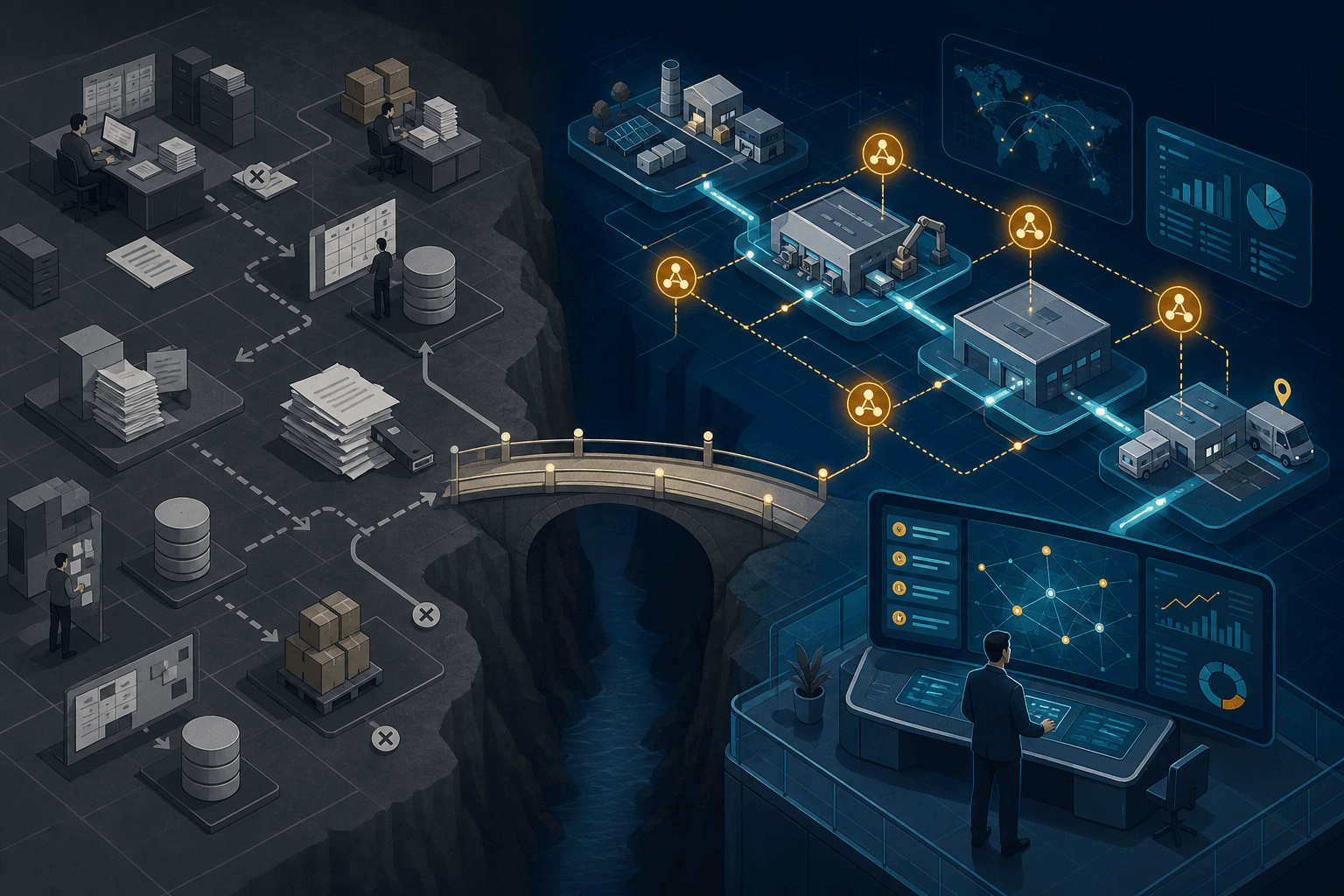
Architecture Requirements: Data Fabric, Knowledge Graphs, and Multi-Agent Orchestration
Agentic AI cannot be bolted onto existing supply chain systems. It requires a foundational architecture that supports perception, reasoning, and action across disconnected data sources and functional domains. Deloitte's framework identifies three essential layers.
Data Fabric as the Integration Layer
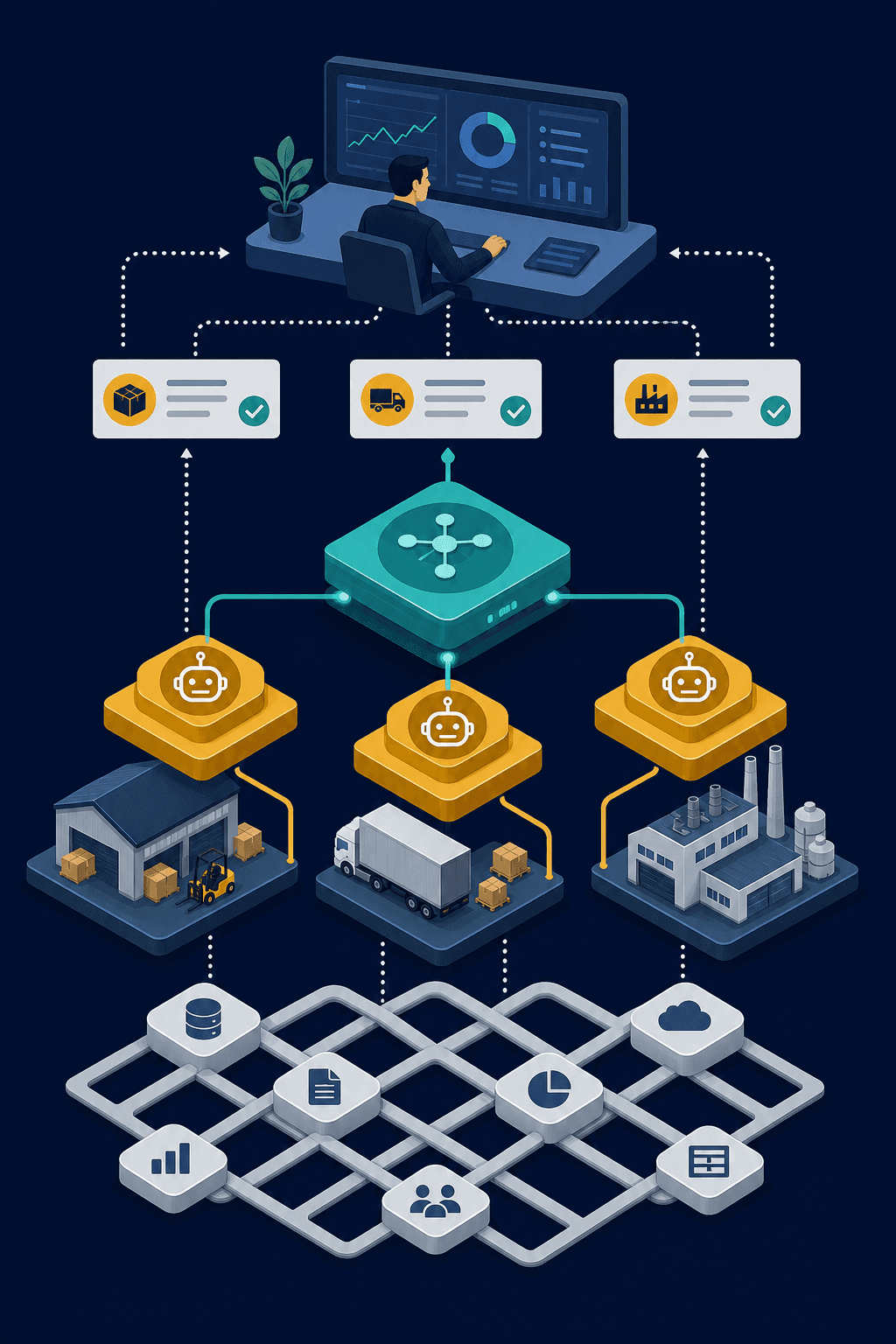
A data fabric provides a unified, virtualized layer over the organization's disparate data sources — ERP, WMS, TMS, supplier portals, IoT feeds, external market data. It handles data ingestion, transformation, and governance without requiring physical consolidation. For agentic AI, the data fabric is the perceptual layer: it feeds the agents with the real-time, high-quality data they need to detect changes and make decisions. Without it, agents operate on stale or incomplete information, which undermines trust before the system even makes a decision.
Knowledge Graphs for Semantic Understanding
A knowledge graph maps the entities in a supply chain — suppliers, products, warehouses, customers, contracts, shipments — and the relationships between them. This semantic layer enables agents to understand context: that a specific supplier's plant in Vietnam is the sole source for a critical component, or that a particular customer's contract includes a service-level agreement that triggers penalties if violated. Deloitte emphasizes that a common data ontology — a shared vocabulary for supply chain entities and relationships — is a prerequisite for multi-agent systems to coordinate effectively.
Multi-Agent Orchestration: Domain-Specialized Agents and Coordination
Deloitte's framework organizes agentic AI around domain-specialized agents, each responsible for a specific functional area, coordinated by cross-functional agents that manage interdependencies. The domain agents include:
- Inventory Agent: Monitors stock levels, safety stock policies, and inventory targets across locations. Makes autonomous replenishment decisions within defined parameters.
- Logistics Agent: Handles shipment routing, carrier selection, exception management, and delivery scheduling. Coordinates with carriers and internal teams.
- Procurement Agent: Manages purchase order generation, supplier communication, and contract compliance. Escalates strategic sourcing decisions to humans.
- Supply Risk and Resilience Agent: Monitors external signals — weather, geopolitical events, supplier financial health — and assesses impact on supply continuity.
- Data and Governance Agent: Ensures data quality, model performance, and compliance with governance policies across all agents.
Cross-functional agents sit above these domain agents, managing conflicts and trade-offs. For example, when the Procurement Agent wants to source from a lower-cost supplier but the Supply Risk Agent flags that supplier as high-risk, the cross-functional agent evaluates the trade-off against business rules and either makes the call or escalates to a human.
Guardrails and Governance: Making Autonomous Decisions Safe
The RELEX data showing that only 10% of supply chain leaders trust AI for unsupervised critical decisions is not a problem to be solved by better marketing — it is a design requirement. Governance is not an afterthought for agentic AI; it is the foundation that makes autonomous decision-making viable in production environments.
The Agent Resume Model
Deloitte introduces the concept of an "agent resume" — a formal definition for each agent that specifies its scope, authority level, and escalation path. Every agent has a clearly documented boundary: what decisions it can make autonomously, what decisions require human approval, and what conditions trigger an escalation. This is not a technical specification alone; it is an organizational contract that defines accountability.
For example, a Logistics Exception Agent might have authority to reroute shipments within a 10% cost increase threshold, but any change exceeding that threshold must be escalated to a human logistics manager. The agent resume makes this boundary explicit and auditable.
Escalation Thresholds and Confidence Scoring
Every autonomous decision should be accompanied by a confidence score. When an agent's confidence in its recommended action falls below a defined threshold — or when the decision's potential impact exceeds a predefined risk boundary — the system escalates to a human. This is not a failure mode; it is a designed behavior that preserves human control over high-stakes decisions while allowing the agent to handle the volume of low-risk, high-frequency decisions.
Zero-Trust Security for Inter-Agent Communication
In a multi-agent system, agents communicate with each other — the Inventory Agent requests a replenishment from the Procurement Agent, the Logistics Agent notifies the Inventory Agent of a delay. Deloitte emphasizes that this inter-agent communication must follow zero-trust principles: every message is authenticated, authorized, and encrypted, regardless of the source. An agent should not be able to exceed its authority by exploiting another agent's permissions.
Audit Trails and Model Drift Monitoring
Every autonomous action must be logged with sufficient context to reconstruct the decision — what data the agent perceived, what reasoning it applied, what action it took, and what outcome resulted. This audit trail serves two purposes: it enables post-hoc review when something goes wrong, and it provides the training data for the agent to learn and improve. Model drift monitoring is equally critical: as supply chain conditions change, the agent's decision-making models may become less accurate. Continuous monitoring ensures that drift is detected before it leads to poor decisions.
The Human Factor: Human-in-the-Loop Design and the Knowledge Capture Imperative
The most sophisticated agentic AI architecture will fail if the humans who interact with it do not trust it. The RELEX survey data is instructive here: 54% of supply chain leaders prefer a human-in-the-loop approach, and only 10% trust AI for unsupervised critical decisions. These numbers reflect a rational caution, not Luddism. Supply chain professionals have spent years developing intuition about their networks — patterns that are not captured in any dataset. Agentic AI must be designed to complement this expertise, not override it.
The Retirement Cliff and Knowledge Capture
Dataiku's 2026 analysis highlights a demographic reality that is reshaping the urgency of AI adoption: record baby boomer retirements continue through 2026, taking decades of supply chain expertise out of organizations. This "retirement cliff" is driving the concept of the "augmented connected workforce" — where AI agents capture and replicate the decision-making patterns of senior planners before they leave. An agentic system that learns from a veteran planner's exception handling decisions can preserve that institutional knowledge and make it available to less experienced team members.
From Human-as-Doer to Human-as-Supervisor
The most successful agentic AI deployments do not eliminate human roles — they transform them. The human shifts from executing tactical decisions (rerouting a shipment, adjusting a safety stock level) to supervising agent performance, handling escalations, and focusing on strategic exceptions. This is not a reduction in responsibility; it is an elevation. The human becomes the person who decides when to override the agent, when to update its authority boundaries, and when to retrain its models.
Dataiku emphasizes a critical design principle for this transition: reducing nuisance alerts. If an agent floods a human supervisor with low-value notifications, trust erodes quickly. The agent must learn to distinguish between decisions that genuinely require human judgment and those it can handle autonomously. This is not just a technical optimization — it is a trust-building mechanism.
"The human role becomes more strategic, not less important. The question is not whether AI will replace supply chain planners, but whether planners who work with AI will replace those who don't."
Starting Small: A Pathway From Pilot to Production
The data from Deloitte — more than half of surveyed supply chain executives are already deploying AI agents — suggests that the risk for most organizations is not being too early, but being too late. However, the path from pilot to production requires discipline. Agentic AI is not a technology to be deployed wholesale; it is a capability to be grown organically.
Selecting the First Agent Use Case
The ideal first agent use case has four characteristics:
- Bounded scope: The decision domain is narrow enough that the agent's authority boundaries can be clearly defined. Logistics exception management for a single region, for example, rather than global supply chain optimization.
- Clear success metrics: The outcome of the agent's decisions can be measured objectively — cost per shipment, on-time delivery rate, time to resolve exceptions.
- Currently manual and repetitive: The decisions are being made by humans today, but they follow recognizable patterns. This ensures that the agent has training data and that its impact can be compared against a baseline.
- Available data: The data required for the agent to perceive and reason is already accessible, even if it is scattered across systems. The data fabric layer can be built incrementally around the first use case.
A Staged Deployment Approach
Rather than attempting a multi-agent system from the start, organizations should follow a staged progression:
- Bounded pilot: Deploy a single domain-specialized agent (e.g., a Logistics Exception Agent for one region) in a monitored environment. The agent makes recommendations only; all decisions are executed by humans. Measure baseline performance and build trust.
- Limited production with human-in-the-loop: Grant the agent authority to execute decisions within narrow boundaries, but require human approval for any action above a defined threshold. Continue measuring performance against the baseline.
- Expanded authority with escalation thresholds: Increase the agent's autonomy as trust builds, but maintain clear escalation paths for decisions that exceed confidence or risk boundaries. Add a second domain agent and test cross-agent coordination.
- Multi-agent coordination: Deploy the full multi-agent system with cross-functional coordination. Humans shift to supervisory roles, handling escalations and strategic exceptions.
This staged approach does more than reduce risk — it builds the organizational muscle for agentic AI. Each stage generates the audit trail data, trust relationships, and governance patterns that the next stage requires.
Agentic AI is not a technology trend that supply chain leaders can afford to observe from the sidelines. The data is clear: adoption is accelerating, the ROI is documented, and the competitive gap between early adopters and laggards is widening. But the path to production requires more than technology investment — it requires a deliberate approach to architecture, governance, and human-centered design. Organizations that invest in all three will be the ones that turn agentic AI from a pilot project into a durable competitive advantage.
Comments
Join the discussion with an anonymous comment.