
An offshore wind maintenance campaign starts spending money before the first technician clips onto a ladder. The vessel is booked, the crew is rostered, spares are staged, port slots are lined up, and then the sea decides whether the plan survives contact with Monday morning. That is why AI for offshore wind energy supply chain planning is not an abstract digital-transformation topic. In this use case, the question is narrower and more useful: can AI reduce the vessel miles, waiting-on-weather hours, and missed turbine visits that make offshore O&M expensive?
The cost pool is large enough to matter. Shoreline Wind states that logistics and vessel operations represent 25–30% of an offshore wind project’s total cost and more than 70% of O&M expenditure.[1] iFactory adds two operational details that any marine coordinator will recognize: vessel mobilization alone can cost $50,000–$150,000 per campaign, and North Sea weather windows allow turbine access only 50–60% of the year.[2] A schedule that wastes a weather window is not just untidy. It can turn a planned maintenance week into a chain of idle vessel time, deferred work orders, and turbine availability pressure.
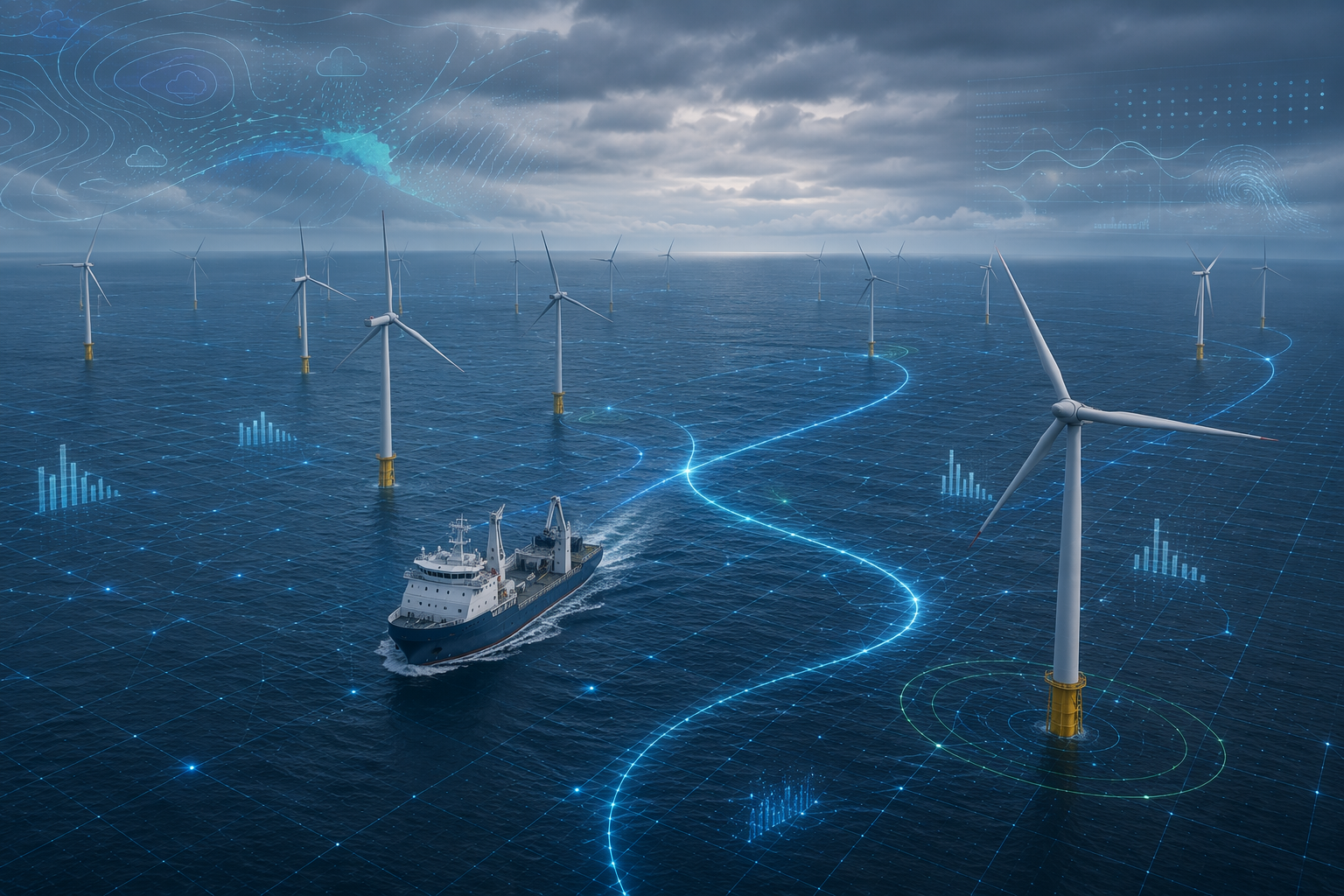
The strongest evidence now points to a practical conclusion: AI-optimized vessel scheduling, weather-window prediction, and multi-stop routing are already cutting offshore wind logistics costs by roughly 10–36% in vendor-attributed deployments. That is not the same as saying every operator will get the same result. It does mean the use case has moved beyond slideware, especially where the operator can feed the system clean metocean, vessel, work-order, and asset data.
The Reported Savings, in One Place
| Source | What was optimized | Reported result | How to read it |
|---|---|---|---|
| iFactory | Maintenance logistics, vessel scheduling, AI weather-window optimization for a 20-turbine fleet | 36% fuel reduction; 41% fewer waiting-on-weather hours; 25–36% less vessel distance; 97.1% turbine availability [2] | The most operationally complete case, but still one vendor-published deployment rather than an industry benchmark |
| GE Vernova | AI/ML digital twin for wind turbine logistics and installation planning | 10% reduction in logistics costs; projected $1.7–$2.6 billion in annual industry savings by 2030 [3] | Useful support for the cost-reduction range, with projections tied to GE Vernova’s stated model |
| Shoreline Wind | Simulation-led project and O&M logistics planning | Approximately 2 million simulations across 465 GW of global wind projects in 2025; up to $300,000 per day in transport-cost reductions; 10% OPEX reduction through predictive maintenance workflows [1] | Good evidence of scale and planning ambition, but the figures come from a vendor white paper cited by trade media |
Those numbers do not all measure the same thing. GE Vernova’s 10% figure is a logistics-cost reduction tied to an AI/ML digital twin.[3] iFactory’s case is more granular: fuel, waiting-on-weather hours, vessel distance, and turbine availability on a 20-turbine fleet.[2] Shoreline Wind’s figures describe simulation volume, transport-cost potential, and OPEX reduction through predictive maintenance workflows.[1] The pattern is consistent enough to support the business case, but the details should not be blended into one universal ROI claim.
For readers comparing offshore wind with other categories of AI logistics, the useful distinction is that this is not mainly a warehouse-routing or trucking problem. The same broad ROI discipline applies across real-world AI logistics deployments, but offshore wind adds a hard metocean gate: the best route on paper is worthless if the transfer window closes before the vessel arrives.
Where the Savings Actually Come From
The useful software does not simply draw a shorter line between the port and a turbine. It keeps rebuilding the work week as conditions move. A static plan might assign a crew transfer vessel to turbines in sequence, assume the first weather forecast holds, and leave the planner to manually recover when a transfer is no longer safe. An AI-assisted plan continuously weighs the work orders, vessel capabilities, technician availability, port constraints, spare-part readiness, and forecast access windows.
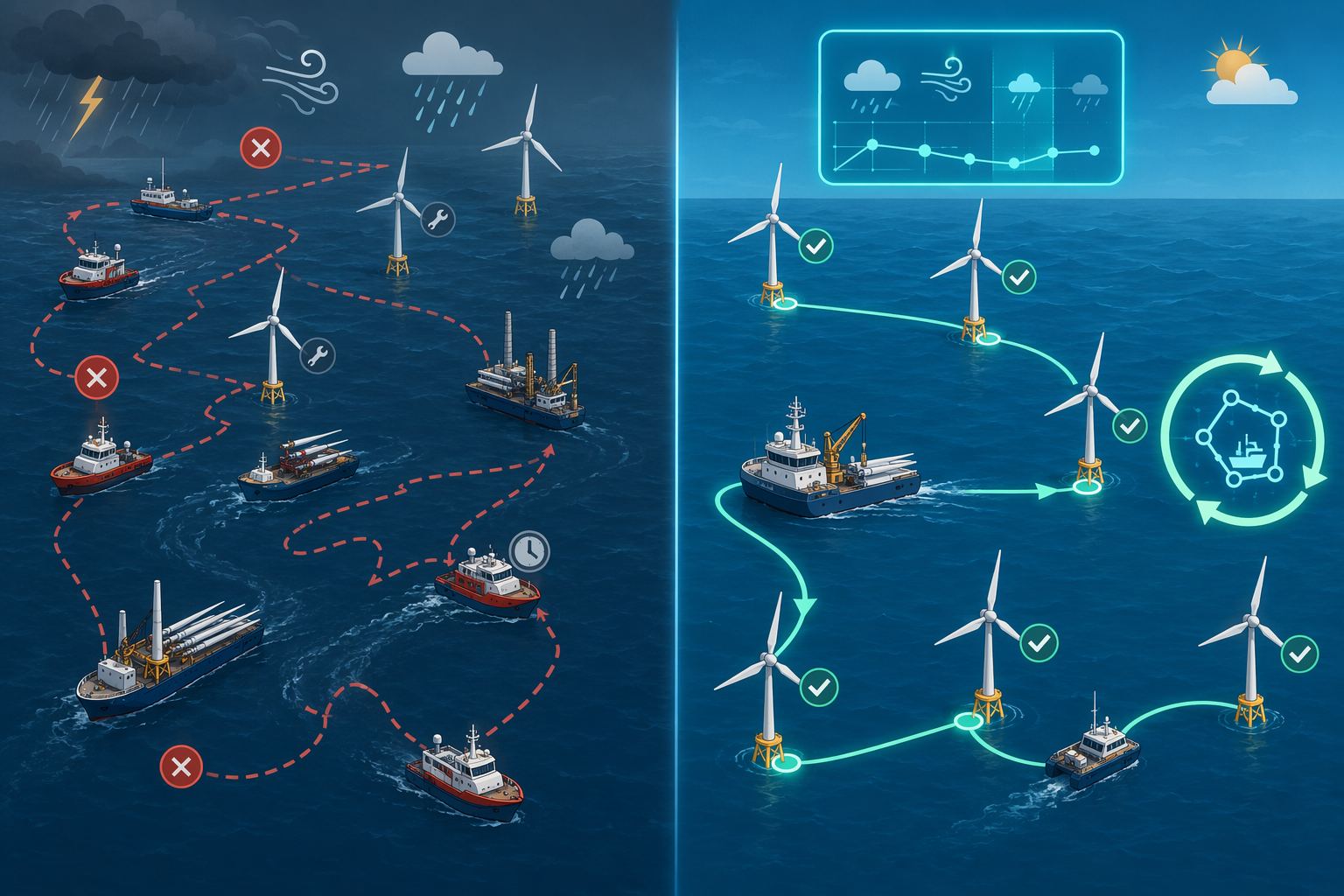
The mechanism has several moving parts, and they matter in different ways:
- Weather-window prediction estimates when a turbine can actually be accessed, not merely when the calendar says a vessel is free.
- Clustered multi-stop routing groups turbine visits so a vessel completes more useful work per sailing day.
- Task bundling combines compatible inspections, corrective tasks, and preventive work where crew skills, spares, and access conditions line up.
- Dynamic rescheduling revises the dispatch plan when weather, vessel availability, or work-order priority changes.
- Constraint-aware planning avoids recommendations that look efficient but fail because a port slot, technician certificate, spare part, or vessel capability is missing.
iFactory’s 20-turbine deployment is the cleanest example because the outcome metrics map directly to these mechanisms. A 25–36% reduction in vessel distance suggests that routing and clustering changed the sailing pattern. A 41% reduction in waiting-on-weather hours suggests the plan was better aligned with access windows. A 36% fuel reduction follows from fewer miles and less idle or inefficient vessel time. The 97.1% turbine availability figure is attractive, but it should stay tied to that reported deployment unless more multi-operator evidence appears.[2]
This is where the distinction between predictive and prescriptive analytics becomes operational. A forecast that says a transfer window is likely to open is predictive. A system that recommends moving a corrective-maintenance task ahead of a routine inspection, assigning a different vessel, and bundling two nearby turbine visits is prescriptive. That distinction is also central to predictive analytics in supply chain management: the value appears when a forecast changes an executable decision.
Why Dynamic Vessel Plans Beat Better Spreadsheets
Offshore wind planners already optimize. They know which turbines are down, which technicians are offshore-certified, which vessel has the right transfer limits, and which spare has not yet arrived. The problem is not lack of human judgment. It is that the inputs change faster than a manual plan can be rebuilt without dropping something important.
Consider a hypothetical maintenance week. A vessel is due to visit four turbines, two with corrective work and two with inspections. A forecast update narrows the safe access window. A spare for one corrective job misses the morning truck to port. The old plan can still be forced through, but it may burn vessel time waiting for a part or reach the final turbine after the transfer limit has closed. A dynamic system can propose a different order, drop the unready task, pull forward a nearby inspection, and preserve the scarce weather window for work that can actually be completed.
That kind of replanning is the offshore version of an execution-led control tower. The point is not a prettier dashboard; it is coordination across weather, assets, inventory, vessel schedules, and work orders. The same idea appears in control tower models built around execution ROI, but offshore wind makes the penalty for late coordination unusually visible: the boat either sails productively or waits.
GE Vernova’s AI/ML digital twin supports this broader logic. Its reported 10% logistics-cost reduction is smaller than iFactory’s top-end vessel-distance result, but it sits in the same operational family: model the system, test alternatives digitally, and reduce avoidable logistics expense before the field team is locked into a poor plan.[3]
The Vendor Landscape Is Real, but Not Yet an Independent Benchmark
Several vendors now address offshore wind logistics from different angles. iFactory focuses on maintenance logistics, vessel scheduling, and AI weather-window optimization.[2] GE Vernova frames the problem through AI/ML digital twins for wind turbine logistics and installation costs.[3] Shoreline Wind emphasizes simulation-led planning across project and O&M workflows, with large-scale simulation claims reported through Wind Systems Magazine.[1]
IBS Software positions its offshore wind supply chain module around planning and execution for energy and resources logistics.[4] MarineAI presents offshore energy and renewables capabilities around autonomous and intelligent marine operations.[5] Those two are relevant to the landscape, but the research base supplied here does not provide the same quantified offshore wind savings metrics for them as it does for iFactory, GE Vernova, and Shoreline Wind.
That distinction matters for procurement. A vendor can be solving a real workflow problem without having a public, comparable, quantified case study. Conversely, a strong published number can still reflect a favorable deployment: good data, cooperative operations teams, mature weather inputs, and a fleet profile with enough inefficiency left to remove.
The Conditions That Decide Whether 10–36% Is Transferable
The savings are real enough to evaluate seriously, but they are conditional. Offshore wind logistics AI needs more than a scheduling interface. It needs reliable feeds from the systems that describe the operating day.
| Condition | Why it affects ROI |
|---|---|
| Metocean data quality | Weather-window optimization depends on forecast quality, local sea-state behavior, and usable access thresholds. |
| Vessel data quality | The model needs accurate vessel capabilities, speed assumptions, fuel behavior, charter constraints, and availability. |
| Work-order and CMMS quality | Task bundling fails if work orders are incomplete, priorities are stale, or technician and spare-part requirements are poorly coded. |
| SCADA and asset connectivity | Turbine condition data helps the planner decide which work should be advanced, deferred, or combined. |
| Port and inventory visibility | A route recommendation is weak if it ignores spare-part readiness, quayside constraints, or port-call timing. |
| Regional weather-model maturity | North Sea operating areas generally benefit from richer historical and forecasting data than newer frontier zones. |
Regional transferability deserves special caution. The North Sea is not a generic ocean. It has deep operating history, dense offshore activity, and relatively mature weather and access-window data compared with many Asia-Pacific or U.S. Atlantic frontier zones. A model tuned and validated in a data-rich region may still be useful elsewhere, but buyers should expect a calibration period rather than immediate replication of the best published results.
The data-integration burden can also be larger than the software demo suggests. Work orders may live in a CMMS, turbine signals in SCADA, inventory in an ERP or warehouse tool, vessel schedules in a marine planning system, and port constraints in email or spreadsheets. Offshore wind logistics optimization starts to resemble a supply chain visibility and knowledge graph problem when the system must connect components, vessels, technicians, ports, and turbines before it can recommend a credible plan.
How to Build the Business Case Without Overstating It
A sensible investment case should start with the vessel-driven cost base, not with generic AI adoption. Identify the annual spend exposed to dispatch inefficiency: crew transfer vessels, service operation vessels, fuel, mobilization, port calls, standby time, and missed or deferred turbine visits. Then separate what the AI system can plausibly influence from what it cannot. A tool may reduce vessel distance, waiting time, and rescheduling waste; it will not make a closed sea state safe or eliminate the need for a missing spare.
The benchmark range should also be tiered. GE Vernova’s 10% logistics-cost reduction is a defensible lower anchor for a mature but still broad logistics claim.[3] iFactory’s 25–36% vessel-distance reduction and 36% fuel reduction show what can happen in a more directly vessel-optimized maintenance setting.[2] Shoreline Wind’s 10% OPEX reduction through predictive maintenance workflows supports the idea that savings can extend beyond routing alone, but its simulation and cost-reduction claims should remain labeled as vendor-reported.[1]
A procurement team can pressure-test the case with a few practical questions:
- Which cost line is the promised percentage applied to: total project cost, logistics cost, O&M cost, fuel, vessel distance, or waiting-on-weather hours?
- Was the result produced in live operations, simulation, or a planning study?
- Does the vendor have evidence from the same sea area, vessel class, turbine generation, and maintenance model?
- What integrations are required before recommendations are trusted by marine coordinators and O&M planners?
- How will the operator compare AI-assisted plans against historical dispatch performance without cherry-picking easy weeks?
The right pilot design is usually a shadow or controlled comparison across a representative operating period. Run the AI plan beside the existing planning process, record what it would have changed, and measure vessel distance, fuel use, canceled visits, waiting-on-weather hours, completed work orders, and turbine availability. If the system only performs well during calm periods or on clean preventive-maintenance routes, the investment case should say so.
For a broader ROI comparison, offshore wind logistics now belongs beside the more mature supply chain AI use cases rather than in a speculative bucket. It is worth comparing against other categories in an AI supply chain ROI comparison, but with one caveat: offshore wind’s upside often comes from reducing high-cost waiting and vessel waste, not from shaving small unit costs across millions of transactions.
What the Evidence Supports in 2026
AI logistics optimization is one of the more credible near-term applications of AI in offshore wind because the operating problem is constrained, expensive, and measurable. The planner needs to know which vessel should sail, which turbines should be visited together, which work should be bundled, and whether the weather window will hold long enough to make the trip worthwhile.
The available evidence supports vendor-attributed savings of 10–36% and downtime reductions above 40%, with iFactory’s 41% fewer waiting-on-weather hours standing out because it connects directly to offshore execution rather than a broad digital-efficiency claim.[2] Buyers can use those figures as serious business-case inputs, but not as guaranteed outcomes. The benchmark should be reset against the operator’s own region, fleet data, weather-model maturity, CMMS and SCADA connectivity, port constraints, and willingness to let planners act on revised recommendations.
References
- Shoreline Wind report: AI on rise in wind projects, Wind Systems Magazine
- Offshore Wind Farm Maintenance — Logistics, Vessel Scheduling & AI Weather Window Optimization, iFactory
- GE Using AI/ML to Reduce Wind Turbine Logistics and Installation Costs, GE Vernova
- Offshore Wind Supply Chain, IBS Software
- Energy and Renewables, MarineAI
Comments
Join the discussion with an anonymous comment.