
The S&OP team does not usually run out of intelligence. It runs out of time. Demand has missed the forecast, a tariff assumption has changed, a supplier constraint has moved from possible to likely, and finance wants a number it can defend before the Friday close. In the traditional cycle, scenario updates can take two to four weeks; AI-driven scenario planning is now being positioned by vendors as a way to generate alternatives in minutes rather than waiting for the next planning pass.[1][2]
That speed difference matters only if it changes the decision while the decision is still alive. A model that produces a beautiful answer after the executive meeting is just another late deck. The serious question for S&OP AI scenario planning in 2026 is narrower and more useful: what changes when scenario creation becomes continuous enough for the organization to compare options before assumptions expire?

The need is not theoretical. Acterys cites Grant Thornton Q2 2025 data that only 42% of CFOs conduct high-frequency proactive scenario planning, and Gartner 2025 data that 82% of CFOs were exposed to trade-policy disruption while only 29% were confident in their models.[2] Those figures describe a familiar operating gap: disruption is being detected faster than planning teams can translate it into governed choices.
The Real Break Is the Operating Rhythm
Manual scenario planning has always been selective. A strong team might maintain three to five live scenarios in a cycle because each scenario has to be built, reconciled, reviewed, explained, and defended. That is not laziness; it is workload physics. When demand, supply, cost, capacity, inventory, service, and cash assumptions all move at once, the practical limit is reached quickly.
AI changes the feasible unit of work. The planning team can move from asking for one rebuilt spreadsheet to asking for a governed search across many combinations of assumptions. The SC Exchange describes a scenario process that starts with issue identification, moves through mitigation scenarios, feeds those scenarios into an AI system, evaluates outcomes, and then scores and selects options.[3] That sequence is not glamorous, but it is where the operating model changes.
The best line from the current practitioner literature is Acterys’ framing: “The shift is from debating whose forecast is correct to discussing organizational readiness across multiple futures.”[2] That is a meeting behavior change. The demand lead, operations VP, finance partner, and commercial owner are no longer spending the first half of the meeting arguing over whether one scenario was the right one to build. They can spend more of the meeting on tolerances, trade-offs, and decision rights.
What the AI-Enabled Scenario Flow Actually Changes
The useful way to look at AI in S&OP scenario planning is not as a feature list. It is a change in where planner time is spent. The work does not disappear. It shifts from manual model rebuilding toward assumption design, exception review, impact interpretation, and governance.
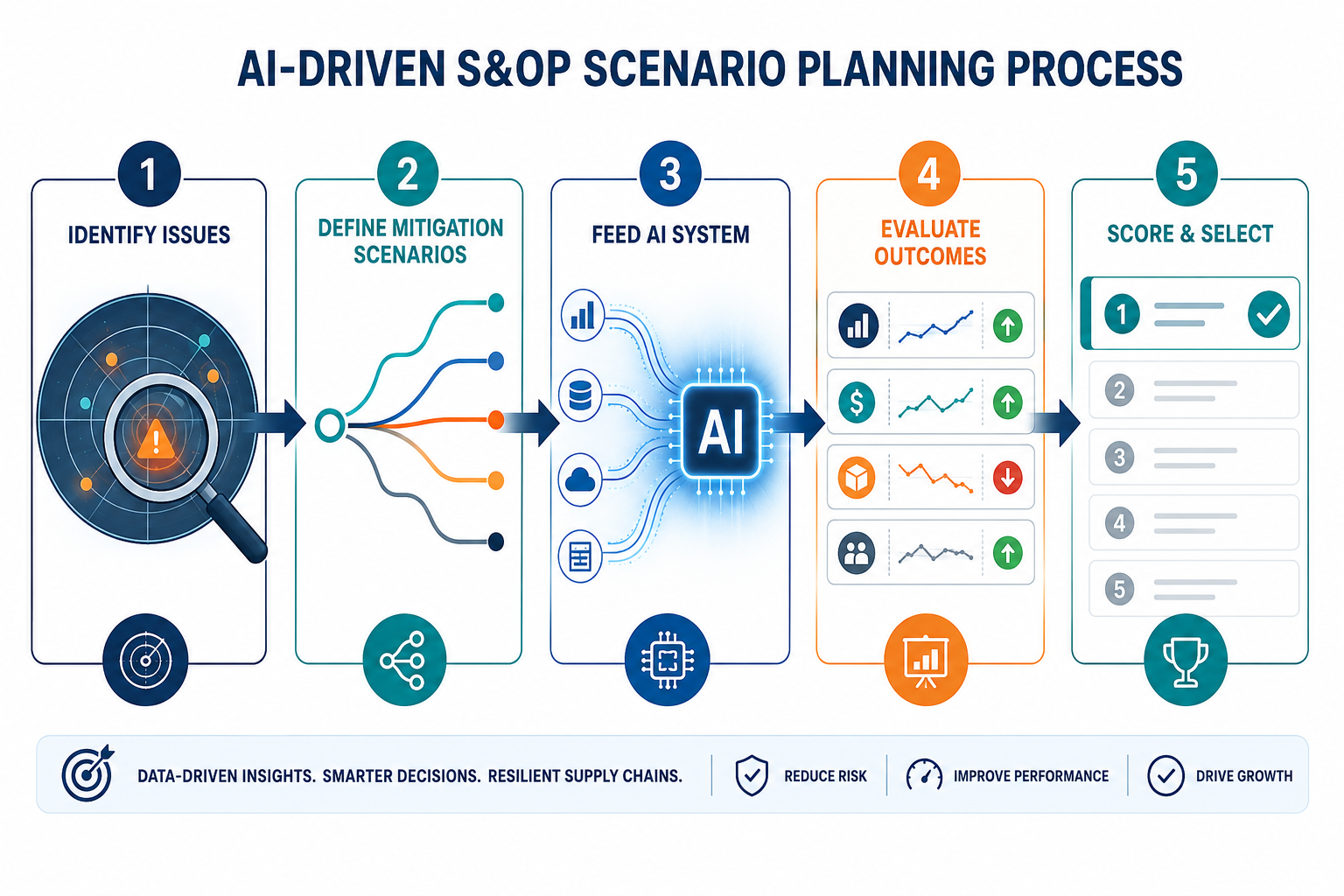
| Scenario step | Manual planning bottleneck | AI-enabled change |
|---|---|---|
| Identify issues | Signals arrive from separate demand, supply, cost, and finance reviews | Exception signals can be monitored more continuously and grouped into planning questions |
| Define mitigation scenarios | Teams choose a small number of scenarios they have time to build | Planners can define ranges, constraints, and policy choices instead of single-point cases |
| Feed the AI system | Data preparation and model rebuilding consume much of the cycle | Approved assumptions, constraints, and historical relationships become reusable scenario inputs |
| Evaluate outcomes | Each scenario waits for manual reconciliation across functions | Many scenarios can be evaluated against service, margin, inventory, capacity, and cash measures |
| Score and select | The meeting often adjudicates both the math and the recommendation | The meeting can focus on ranked options, assumptions, risks, and decision ownership |
1. Identify the issue before it becomes the meeting
In a monthly cadence, issue identification is often disguised as pre-work. A planner notices a demand miss. Procurement flags a tariff exposure. Manufacturing reports a line constraint. Finance asks why the margin bridge no longer agrees with the operating plan. By the time the issue is formal enough to enter the S&OP deck, the organization may already be reacting.
AI does not remove the need to decide what matters. It can, however, help planning teams keep a live watch on the types of signals that normally trigger a late-cycle scramble: forecast bias, supplier delays, inventory imbalance, capacity overload, price movement, order volatility, and policy shocks. The planning question becomes more specific: which risks deserve a scenario run now, and which are still noise?
That distinction is important. If every exception becomes a scenario, the process drowns in outputs. The first governance rule is therefore not technical. It is a threshold: define what size of demand variance, cost exposure, service risk, or cash impact is material enough to trigger scenario generation.
2. Define mitigation scenarios as ranges, not heroic one-offs
Traditional S&OP scenarios often become named stories: upside demand, downside demand, supplier disruption, cost increase, capacity shortfall. Those stories are useful, but they hide a lot of variation. A 5% demand miss and a 15% demand miss do not require the same decision. A tariff that applies to one category is not the same as a tariff that changes the economics of a full sourcing lane.
An AI-supported process lets the team define the decision space more honestly. Instead of building one tariff scenario, the team can specify affected product groups, timing windows, pass-through assumptions, alternate sourcing options, inventory buffers, and margin thresholds. Instead of building one capacity scenario, it can test demand ranges, overtime rules, changeover constraints, subcontracting limits, and service-level priorities.
This is where scale starts to matter. Current vendor and practitioner materials repeatedly contrast a best-practice manual process that maintains only a handful of scenarios with AI environments that can evaluate hundreds. OMP says Evonik runs hundreds of scenarios weekly using OMP Unison Planning, a concrete example of scenario scale moving from special exercise to recurring planning behavior.[4]
3. Feed the system with assumptions people can audit
The weakest AI scenario process is the one that produces a recommendation nobody can trace. S&OP is already political enough when assumptions are visible. If the model behaves like a black box, the meeting reverts to distrust: sales challenges the demand response, operations challenges the capacity logic, and finance challenges the margin impact.
For planning leaders, the implementation question is not simply whether the engine can run scenarios. It is whether the assumptions are named, versioned, and reviewable. Which demand signal was used? Which lead time was assumed? Which supplier constraint was binding? Which price, tariff, or freight assumption changed? Which inventory policy did the model preserve, relax, or violate?
This is also where digital twin language can become either helpful or vague. A digital representation of the supply chain is useful when it gives the AI system structured constraints and relationships to test against. It is less useful as a label on top of disconnected master data, stale lead times, and undocumented planning overrides.
4. Evaluate outcomes against the measures that decide the plan
Scenario velocity is not the same thing as decision quality. Running hundreds of cases is useful only if the outputs are compared against the measures that actually govern the business: revenue, margin, service, inventory, capacity utilization, working capital, cash, risk exposure, and execution feasibility.
This is where many planning rooms get stuck. The commercial team optimizes for service and revenue protection. Operations protects feasibility. Finance protects margin and cash. Procurement may be trying to reduce supplier exposure. If the AI system simply returns the mathematically best plan on one measure, it has not solved the S&OP problem. It has only chosen a side.
A stronger setup evaluates each scenario across agreed measures and makes trade-offs visible. One option may preserve service but consume inventory. Another may protect cash but reduce availability. A third may avoid tariff exposure but introduce qualification risk or capacity pressure elsewhere. The value is not that the model eliminates judgment. The value is that judgment starts from a broader, faster, and more consistent comparison set.
5. Score, select, and hand off to governance
The last step is where AI scenario planning either becomes an operating capability or stays a planning experiment. A ranked scenario list is not a decision. Someone still has to approve the trade-off, communicate the plan, assign actions, and monitor whether the chosen path is holding.
A practical S&OP handoff should make four items explicit: the recommended option, the assumptions that would invalidate it, the owner of each execution action, and the date or signal that triggers review. Without that handoff, AI-generated scenarios can create a larger backlog of interesting alternatives without increasing organizational follow-through.
This is also the point where planners need protection from a familiar failure mode: being praised for emergency modeling instead of being given a repeatable operating system. If the process still depends on a small group rebuilding models overnight, the organization has not transformed scenario planning. It has digitized the stress.
Where the Benchmark Claims Help, and Where They Do Not
The benchmark story is promising, but it needs careful handling. Logility reports 70% faster scenario cycles for AI-driven S&OP, but that is vendor-reported rather than independently audited in the materials available here.[1] OMP also discusses scenario scale and AI-enabled decision support through its own platform materials.[4] These figures are useful as directional evidence of what platforms are trying to accomplish, not as universal guarantees.
Acterys cites Analytic Partners’ finding that organizations using formal scenario planning achieved 32% higher returns during market turbulence, and it cites Deloitte research that 80% of companies simulating scenarios recover faster from disruptions than those relying on single forecasts.[2] Those are broader scenario-planning claims, not proof that any specific AI S&OP platform will deliver the same result. The distinction matters because adoption, scenario discipline, and business impact are not the same measurement.
The safest conclusion is still a meaningful one: AI can materially reduce scenario cycle time and expand the number of feasible cases, while business value depends on whether the organization uses those cases to make earlier, clearer, and better-governed decisions.
Start With a Recurring Decision, Not the Whole Enterprise
The most credible implementation path is bounded. Start with a recurring decision that already has pain, cadence, owners, and consequences. Cash flow. Rolling forecast. Tariff exposure. A constrained production network. A volatile category with frequent demand misses. A supplier lane where lead time, duty, and service risk keep changing.
That starting point should be narrow enough that the team can define the inputs, outputs, governance, and success measures without pretending to model the entire enterprise. Logility and The SC Exchange both emphasize practical, bounded adoption rather than exhaustive enterprise modeling as the first move.[1][3]
- Pick a decision that recurs often enough for learning to compound.
- Name the business owner who will accept or reject the recommendation.
- Define the scenario triggers before the model starts generating outputs.
- Limit the first scorecard to measures the S&OP team already uses to decide.
- Track whether decisions move earlier, not only whether scenarios run faster.
A tariff-impact use case is a good example because it has visible assumptions and real governance pressure. The team can test affected SKUs, supplier alternatives, price pass-through, inventory pre-build, service exposure, and margin impact. Finance can see the cash and P&L consequences. Procurement can see supplier exposure. Operations can see feasibility. Commercial can see service and customer risk. The AI system expands the option set, but the decision is still owned by the business.
A rolling forecast use case works differently. The value is less about one dramatic shock and more about reducing the lag between signal and plan adjustment. If the process can refresh scenario views weekly instead of waiting for the next full S&OP cycle, leaders can see whether a demand miss is isolated, spreading, or interacting with capacity and cash constraints.
Agentic AI Is a Horizon, Not the 2026 Center of Gravity
Agentic AI is entering the supply chain planning conversation, and OMP frames it as a shift toward systems that can support decision-making through more autonomous intelligence.[4] That is worth watching. It is not the same as saying most S&OP organizations are ready to let autonomous agents redesign the operating plan without human governance.
For most planning leaders in 2026, the practical maturity level is AI-assisted scenario planning: generate more options, refresh them faster, expose assumptions, compare impacts, and bring a better-prepared recommendation into the decision forum. That is already a significant change. It does not require pretending the enterprise planning model can suddenly simulate every dependency with equal confidence.
The Practical Judgment
S&OP AI scenario planning is most credible when it is treated as a continuous decision capability, not as a faster spreadsheet factory. The point is not to admire hundreds of scenarios. The point is to enter the planning meeting with the important futures already tested, the trade-offs visible, and the governance question ready: which option are we prepared to execute, and what signal will make us change course?
The organizations that get value will start with bounded, recurring decisions where speed changes the outcome. They will insist on traceable assumptions and decision ownership. They will measure whether scenario work moved earlier and became more actionable. That is the real transformation from manual what-if analysis to continuous intelligence.
References
- AI-Driven S&OP: A Strategic Imperative for Supply Chain Leaders — Logility
- AI Scenario Planning: Why Speed Matters More Than Precision — Acterys
- Scenario creation and evaluation: the next big thing in S&OP — The SC Exchange
- The agentic AI breakthrough: transforming supply chain decision-making with UnisonIQ — OMP
Comments
Join the discussion with an anonymous comment.