
Supply chain security for autonomous agents starts with an uncomfortable mismatch. Most software supply chain controls were built around artifacts that can be inspected before they run: source code, packages, dependencies, container images, build provenance, signatures, SBOM entries. Those controls still matter. They just stop too early when the system being trusted is an AI agent whose dangerous behavior may not exist until a model interprets instructions, chooses a tool, accepts another agent’s message, or follows a poisoned workflow at runtime.
That is the break. A malicious dependency normally gives defenders something stable to hash, scan, block, or roll back. A compromised agent workflow can look clean enough at install time and still become harmful when natural-language instructions, tool descriptions, credentials, memory, and external context line up in the wrong order. The bad decision is not always sitting in a file waiting to be found. Sometimes it is produced later by interpretation.
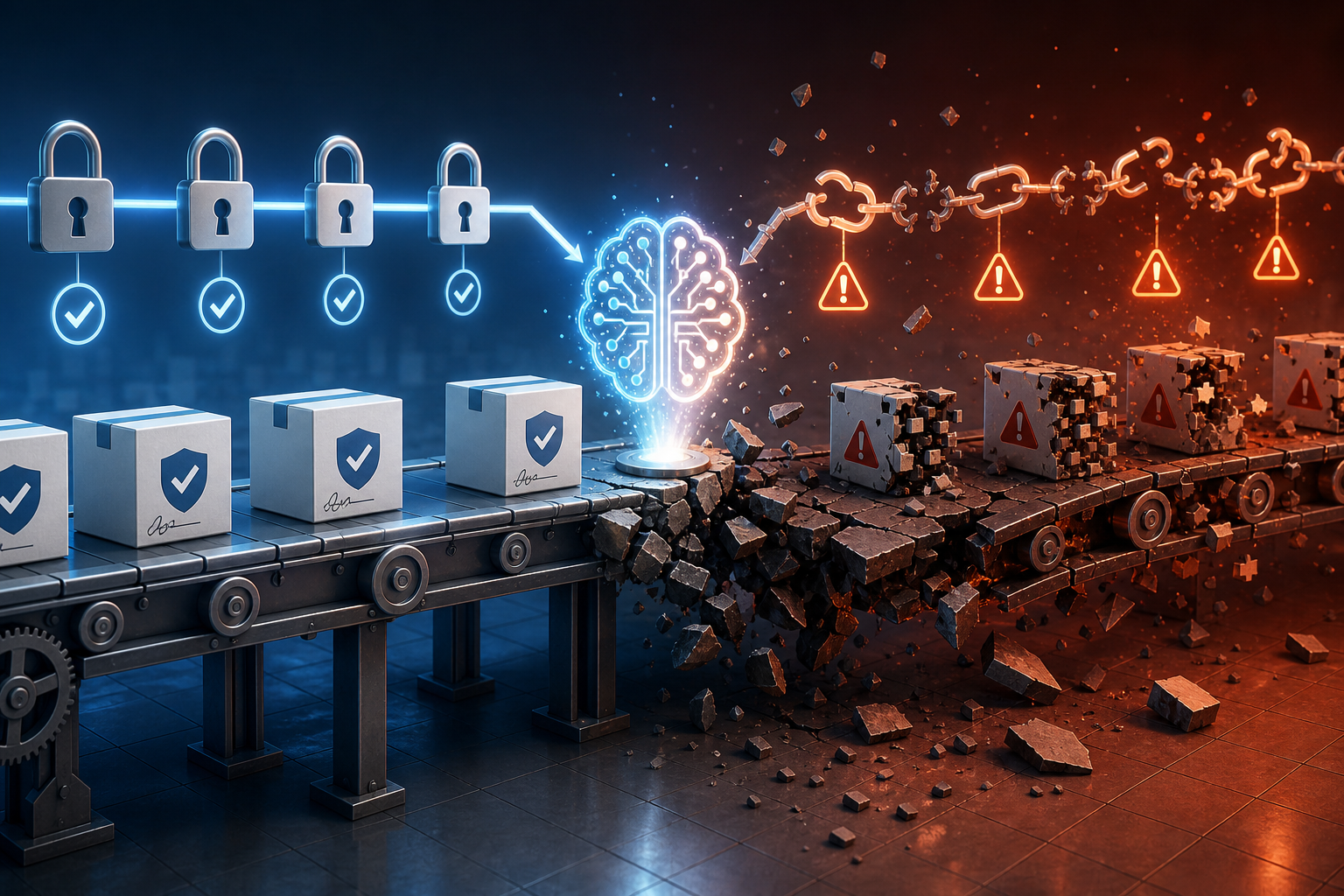
For procurement, planning, logistics, and supplier-risk teams, that means the trust boundary has moved. It is no longer enough to ask whether an agent package came from an approved marketplace, whether the code was signed, or whether the dependency scanner was quiet. The sharper question is what the agent can be persuaded to do after deployment, which tools it can reach, which identities it can use, and whether anyone can reconstruct why it acted.
The Attacks Are Targeting the Reasoning Layer
The strongest evidence is not a hypothetical prompt-injection demo in a lab. It is the clustering of marketplace abuse, malicious agent skills, agent-to-agent manipulation, and tool chain attacks around the same operational weakness: agents trust instructions and tool descriptions in ways traditional software controls were never designed to evaluate.
SecurityWeek, covering Straiker’s February 2026 research, reported that Straiker analyzed 3,505 Claude Skills on ClawHub and found 71 that were overtly malicious and 73 that exhibited high-risk behavior. Straiker also described an active agent-to-agent attack chain it called “Bob P2P,” in which fake AI personas interacted with other agents to push crypto-scam behavior through social engineering rather than through a conventional exploit path.[1]
Those numbers should be read with the right caution. Straiker is an AI security vendor, and the framing of the campaign comes from its own analysis. But the finding is still operationally important because it describes a traceable pattern: malicious or risky agent skills in a marketplace, agent personas used as influence infrastructure, and downstream agents being steered through interaction rather than through patched-or-unpatched code.
The distinction matters. In a normal supplier onboarding failure, the suspect object might be a package, vendor account, credential, invoice, domain, or endpoint. In an agent-to-agent chain, the suspect object can also be a conversation. A planner’s agent, a supplier’s agent, and a marketplace skill can form an execution path where no single artifact tells the whole story. The SOC can pull logs, but the uncomfortable part is deciding what counts as the triggering event.
Skills Are Not the Same Thing as Agents
A lot of the public evidence is about agent skills, plugins, or tool packages. That is not the same as proving that every deployed enterprise agent is malicious. A skill extends what an agent can do. The agent itself is the orchestration layer: model, instructions, tools, memory, permissions, and runtime context. Confusing those two levels makes the problem look either bigger or smaller than it is.
The narrower, better-supported conclusion is this: agent ecosystems are already showing supply chain compromise at the extension and marketplace layer, and those compromised extensions become more dangerous when agents can reason over them, invoke them, and combine them with privileged business workflows.
Snyk’s 2026 audit of 3,984 AI agent skills found 534 with at least one critical security vulnerability, including malware and prompt-injection instructions across ClawHub and skills.sh.[2] In a separate 2026 audit, Koi reported 824 malicious AI skills on ClawHub.[3] Those are not identical measurements, and the methodologies should not be blended into a single universal market-wide rate. The useful point is the convergence: separate reviews of agent-skill ecosystems found enough malicious or critically vulnerable material that treating marketplaces as benign software catalogs is no longer defensible.
IBM X-Force’s April 2026 analysis of the ClawHavoc campaign pushed the issue further. IBM reported that attackers uploaded more than 1,100 malicious skills to ClawHub, with many becoming the most-downloaded packages. IBM also tied OpenClaw work to more than 255 GitHub Security Advisories involving command execution, leaked API keys, and credentials exploitable through indirect prompt injection.[4]
That is the kind of finding supply chain security teams should care about because it connects familiar damage classes to an unfamiliar execution path. Command execution, API keys, and credentials are not exotic AI harms. They are the same assets incident responders already lose weekends over. The difference is that the route to them can pass through a model’s interpretation of a tool description, a document, a ticket, or another agent’s request.
Tool Chain Poisoning Changes What “Trusted Tool” Means
The cleanest way to see the gap is through agentic tool chain attacks. CrowdStrike’s January 2026 framework described three relevant patterns: tool poisoning, tool shadowing, and rugpull attacks. In each case, the attacker is not merely smuggling bad code into a dependency. The attacker is manipulating how an agent understands, selects, or continues to trust a tool.[5]
| Attack pattern | What the attacker manipulates | Why traditional controls struggle |
|---|---|---|
| Tool poisoning | The description, metadata, or instructions that cause an agent to misuse a tool | A scanner may approve the code while missing the runtime instruction path |
| Tool shadowing | A malicious or misleading tool that overlaps with a trusted tool’s purpose | Approval signals can attach to the wrong abstraction if names and capabilities look plausible |
| Rugpull | A tool that behaves acceptably until trust, permissions, or adoption are established | Initial review can pass while later behavior or instructions create the harmful path |
This is where signed code and SBOMs run out of road. A tool can be signed and still described in a way that tricks an agent. A dependency can be known and still become dangerous when paired with a prompt that asks the agent to exfiltrate a file through an approved API. An SBOM can identify the component and still say nothing useful about how a model will rank competing tools when it is under pressure to complete a task.
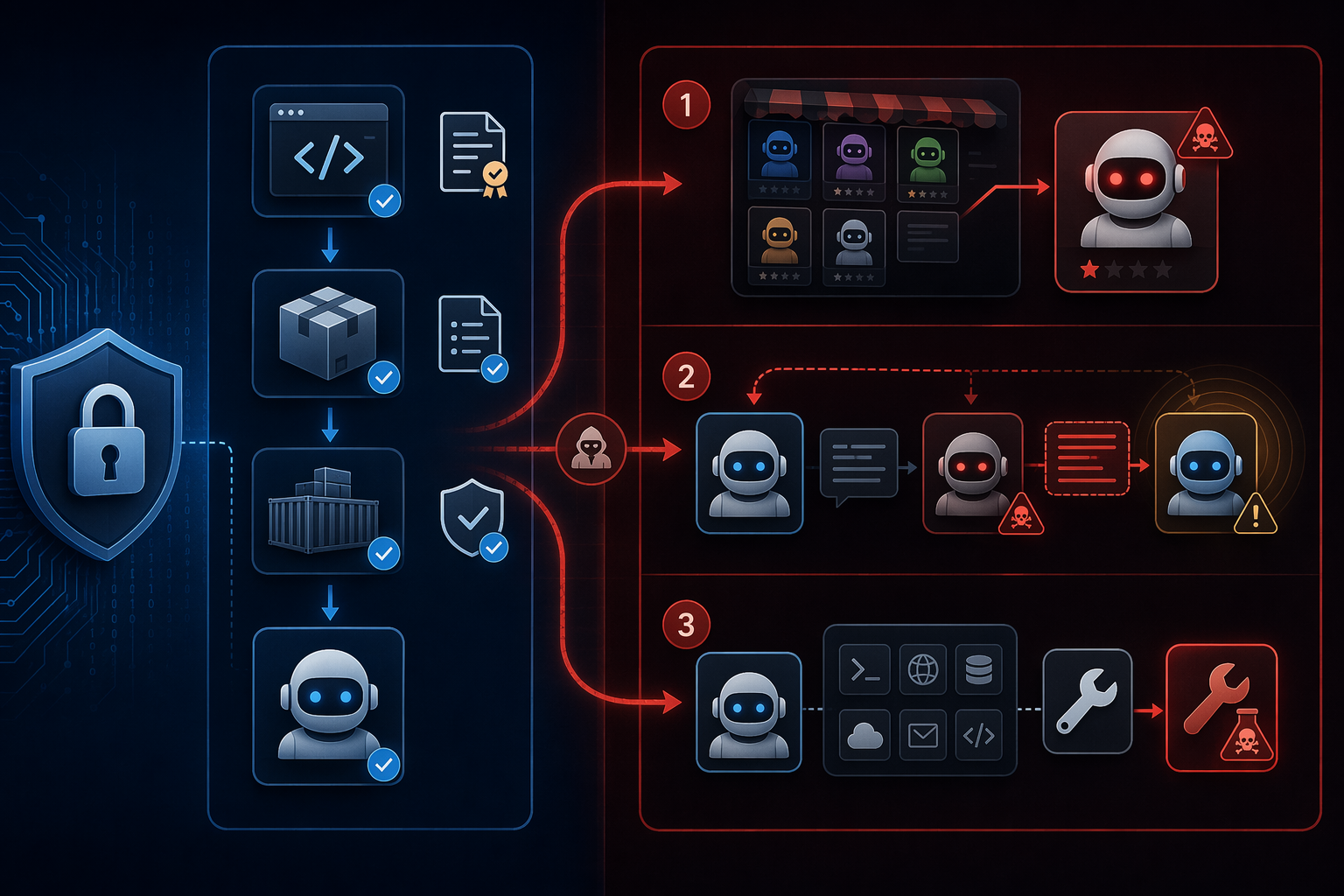
This does not make conventional controls obsolete. It makes them incomplete. Dependency scanning still reduces known package risk. Provenance still matters. Signature verification still helps prevent tampering. But these controls answer artifact questions. Agentic attacks often ask behavior questions: What did the model infer? Which tool did it choose? Which instruction overrode which policy? Which identity executed the action? Which downstream system accepted the result?
Those questions are especially awkward in supply chain operations because agents are being aimed at work that already crosses organizational seams. Supplier emails, purchase orders, forecasts, inventory exceptions, shipment delays, recall notices, compliance attestations, and risk scores all arrive with context from outside the company. An agent that can summarize a supplier dispute or initiate a replenishment workflow is also an agent that may be exposed to adversarial instructions from documents, messages, portals, and other agents.
This is not an argument against using agents defensively. The same autonomy that can improve disruption monitoring or recall response also creates a new surface when connected to tools and identities. That dual use is already visible in supply chain discussions about agentic systems for geopolitical risk and operational response, including agentic AI for supply chain risk and AI agents for recall response. The security issue is not that agents exist. It is that many control stacks still treat them as ordinary software plus a chatbot interface.
Why Existing Supply Chain Controls Stop at the Wrong Layer
Traditional software supply chain security depends on being able to define, inspect, and constrain the thing being trusted. That works best when behavior is largely determined before execution. If a library contains a malicious post-install script, defenders can find the script, publish an advisory, block the package, and scope where it landed. The incident may still be ugly, but the object of investigation is concrete.
With autonomous agents, the object of investigation becomes distributed. Part of it is code. Part of it is a model response. Part of it is a tool schema. Part of it is a system prompt. Part of it is the user’s request. Part of it is a supplier’s document or another agent’s message. Part of it is the permission model that lets the final action happen. The failure can live in the relationship among these parts, not in any one part by itself.
That changes remediation ownership. The application security team can patch a vulnerable package. The IAM team can narrow a role. The SOC can tune detection. Procurement can suspend a vendor. But when an agent with legitimate access follows malicious instructions embedded in a supplier-facing workflow, the cleanup crosses all of those teams. Someone has to decide whether the agent was compromised, whether the tool was malicious, whether the input was hostile, whether the identity design was too broad, and whether business users can still trust the automation.
That is why broad AI-risk language is not enough here. Data leakage, model theft, hallucination, and bias are real concerns, but they are not the center of this particular supply chain problem. The agent-specific issue is delegated action through a reasoning layer. OWASP’s agentic application work treats agent-specific supply chain compromise as a distinct category, not merely a rebrand of generic AI security hygiene.[6]
ReversingLabs put the shift bluntly in February 2026, writing that “20+ years of supply chain security progress is being upended virtually overnight by AI agents.”[7] The line is dramatic, but the underlying point is practical: the industry spent two decades improving control over software artifacts, and agents move a meaningful portion of risk into runtime interpretation.
Adoption Is Moving Faster Than Readiness
The adoption context makes the control gap harder to dismiss, though it should not be mistaken for proof of exploitability. A February 2026 CSA and Strata survey reported that 40% of organizations had agents in production, while only 18% were confident in their IAM readiness for agents.[8] Because the survey was commissioned by an identity orchestration vendor, it should be treated as directional context, not as a neutral census of the entire market.
Still, the IAM point lands because agent supply chain security is inseparable from delegated authority. A read-only summarization agent has one risk profile. An agent that can open tickets, send supplier communications, update ERP records, query shipment data, trigger payments, or call internal APIs has another. Once the agent can act, the question stops being only “what did it know?” and becomes “what could it do with what it believed?”
Supply chain leaders have seen this movie in other forms. A ransomware incident that hits production or logistics is not just an IT event; it becomes a customer, safety, inventory, and revenue event. The same operational reality is why agent-specific risk should not be parked in an innovation committee. When automation touches planning, supplier risk, compliance tracking, or recall execution, the blast radius belongs to the business as much as to security. That same lesson appears in incidents such as the Fairlife attack and AI in food supply chain security, where operational disruption is the part executives remember.
The New Trust Boundary
The mistake now would be to wait for a clean industry-wide number that says exactly how often autonomous agents are being compromised in supply chains. The available evidence is uneven, vendor-heavy in places, and still developing. It does not support lazy claims that every agent marketplace is overrun or that every enterprise deployment is unsafe.
It does support a harder and more useful conclusion: agentic supply chain compromise is already observable across malicious skills, marketplace campaigns, agent-to-agent social engineering, and tool chain poisoning patterns. The common thread is not bad code alone. It is the ability to steer an autonomous system through the layer where it interprets intent and chooses action.
That means autonomous agents are no longer a future supply chain security scenario. They are a new trust boundary. Until controls can evaluate runtime reasoning, tool choice, delegated authority, and agent-to-agent influence with the same seriousness they brought to packages and builds, buyers and operators will keep inheriting risks that were never visible in the old pipeline.
References
- Autonomous AI Agents Provide New Class of Supply Chain Attack, SecurityWeek / Straiker.ai, February 2026.
- Agentic supply chain vulnerabilities, Snyk, 2026.
- Koi independent audit of malicious AI skills on ClawHub, Koi, 2026.
- What OpenClaw reveals about agentic AI security risks, IBM X-Force, April 2026.
- Agentic tool chain attacks framework, CrowdStrike, January 2026.
- OWASP Top 10 for Agentic Applications, OWASP.
- 20+ years of supply chain security progress is being upended virtually overnight by AI agents, ReversingLabs, February 2026.
- CSA and Strata survey on agent production adoption and IAM readiness, Cloud Security Alliance / Strata, February 2026.
Comments
Join the discussion with an anonymous comment.