
AI for supply chain cybersecurity is starting to matter less as a slogan and more as a question of perimeter reality. A 2026 supply-chain statistics roundup puts third-party breach involvement at 30% after 15% the year before, and cites supply chain compromise as the costliest breach vector at $4.91 million on average and the slowest to detect at 267 days [1]. SecurityScorecard adds the governance gap: leaders rank AI-driven threats as their top supply chain risk, yet 67% still rely on static security audits [2].
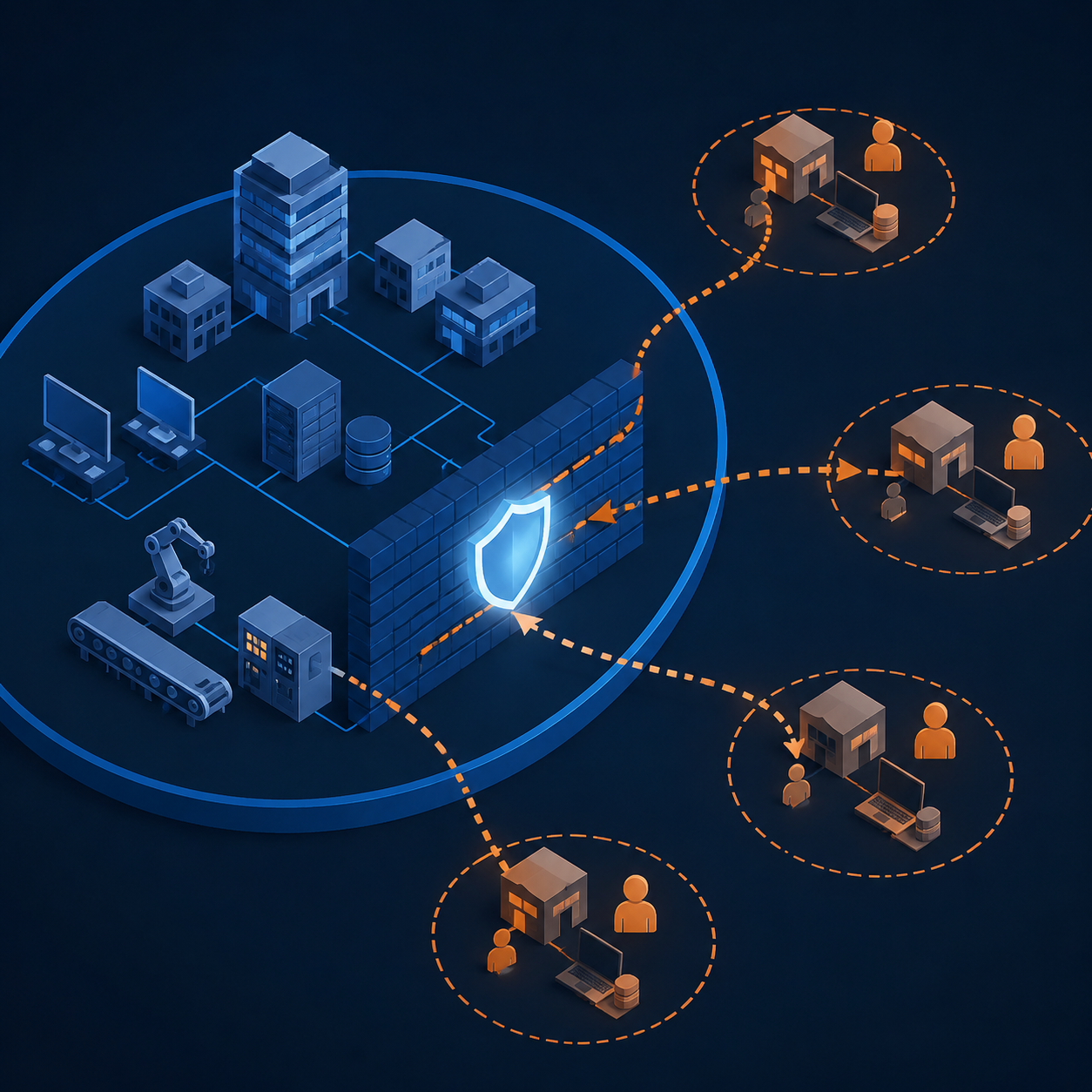
The perimeter has moved into the supplier network
That is the real reason static questionnaires keep disappointing people who run factories, ports, warehouses, and contract manufacturing relationships. The vendor is no longer just a dependency outside the fence; it is often part of the access path. Once a supplier account is abused, the compromise can look ordinary at first: remote support, shared credentials, scheduling tools, file exchange, or an integration that nobody wants to break because operations still have to move. In SCADA, ICS, and PLC environments, endpoint agents are often not the clean answer anyway, so network-based visibility has to do the first useful work [3].
That distinction matters because this article is about defensive AI applied to supply chain threats, not the separate problem of securing the AI model supply chain. The first problem is operational: seeing compromised vendor behavior, lateral movement, and OT-adjacent intrusion before they become production disruption. The second is important too, but it is a different perimeter.
Reactive investigation usually arrives after the damage is already spreading
The attacker side now has more help than old incident-response playbooks assume. AI is being used for automated reconnaissance, polymorphic malware, and deepfake vendor impersonation, which makes the early stages of intrusion faster to stage and harder to sort from ordinary noise [4][5]. That does not mean every breach is now a machine-made spectacle. It does mean the defender cannot wait for a neat narrative to emerge from a weekly audit cycle when the compromise path may already have moved through third-party identity, remote access, and OT adjacency.
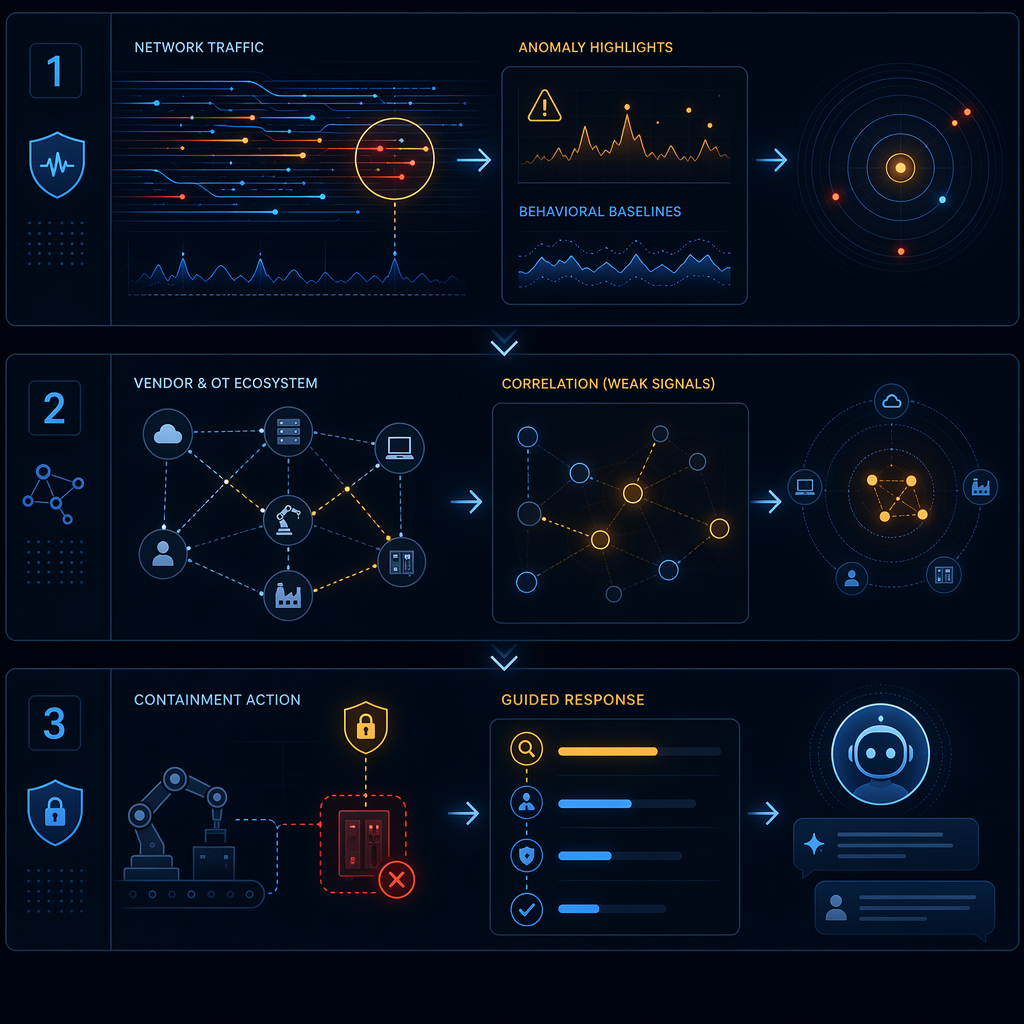
What layered AI actually does
- ML behavioral anomaly detection watches network metadata for changes in timing, peer relationships, access patterns, and device talk paths. It is the first pass that reduces the haystack, especially where endpoint software is absent or inappropriate [3].
- Graph-ML correlation then connects weak signals across vendor accounts, remote sessions, applications, and OT assets. One odd login, one unusual connection, or one device speaking to a new peer may not mean much alone; the graph makes the relationship visible [3].
- LLM-guided or agentic response turns that correlated picture into a containment sequence: explain the alert, propose the next action, isolate the segment, revoke the credential, or escalate to a human reviewer with context already assembled [3].
The sequence matters. ML narrows the stream, graph-ML gives it structure, and LLM or agentic tools shorten the path from structure to action. Skip the first two layers and the response layer has to guess. Keep all three and the system can work the way supply chain security actually works: across messy, vendor-extended environments where the important question is not whether an alert exists, but whether it can be turned into containment before operations feel it.
The procurement test is still operational
The useful question for supply chain leaders is not whether a platform says AI. It is whether the system can see across supplier-extended paths, work when endpoint software is not an option, and preserve a clear human chain of command when containment starts to affect production. That is why layered AI should be treated as an emerging architecture, not a settled industry standard. The buying decision should reward correlation depth, OT-safe visibility, and bounded response, not dashboard theatrics.
References
- SWIF, Supply Chain Attack Statistics for 2026
- SecurityScorecard, 2026 Supply Chain Cybersecurity Trends Report
- SCMR, Why a secure industrial supply chain depends on layered AI, March 2026
- NeuralTrust, AI-Driven Supply Chain Attacks: The New Cyber Risk in 2026
- Chuck Brooks, Forbes, The Growing Cybersecurity Risks To The Supply Chain In The AI Era, May 22, 2026
Comments
Join the discussion with an anonymous comment.