
The hard question for AI outbreak detection in supply chain resilience is not whether a model can notice an unusual cluster of disease reports before an official bulletin. Some systems can. The harder test is whether that earlier signal arrives with enough geography, confidence, and operational context for someone to change a purchase order, protect scarce inventory, call an alternate supplier, or reroute freight before disruption becomes visible in the usual planning cycle.
That distinction matters because outbreak detection and supply chain resilience are adjacent problems, not the same problem. A health alert says something may be happening in a place. A supply chain decision asks which part numbers, suppliers, contract manufacturers, lanes, warehouses, customers, and service commitments are exposed if that place slows down.
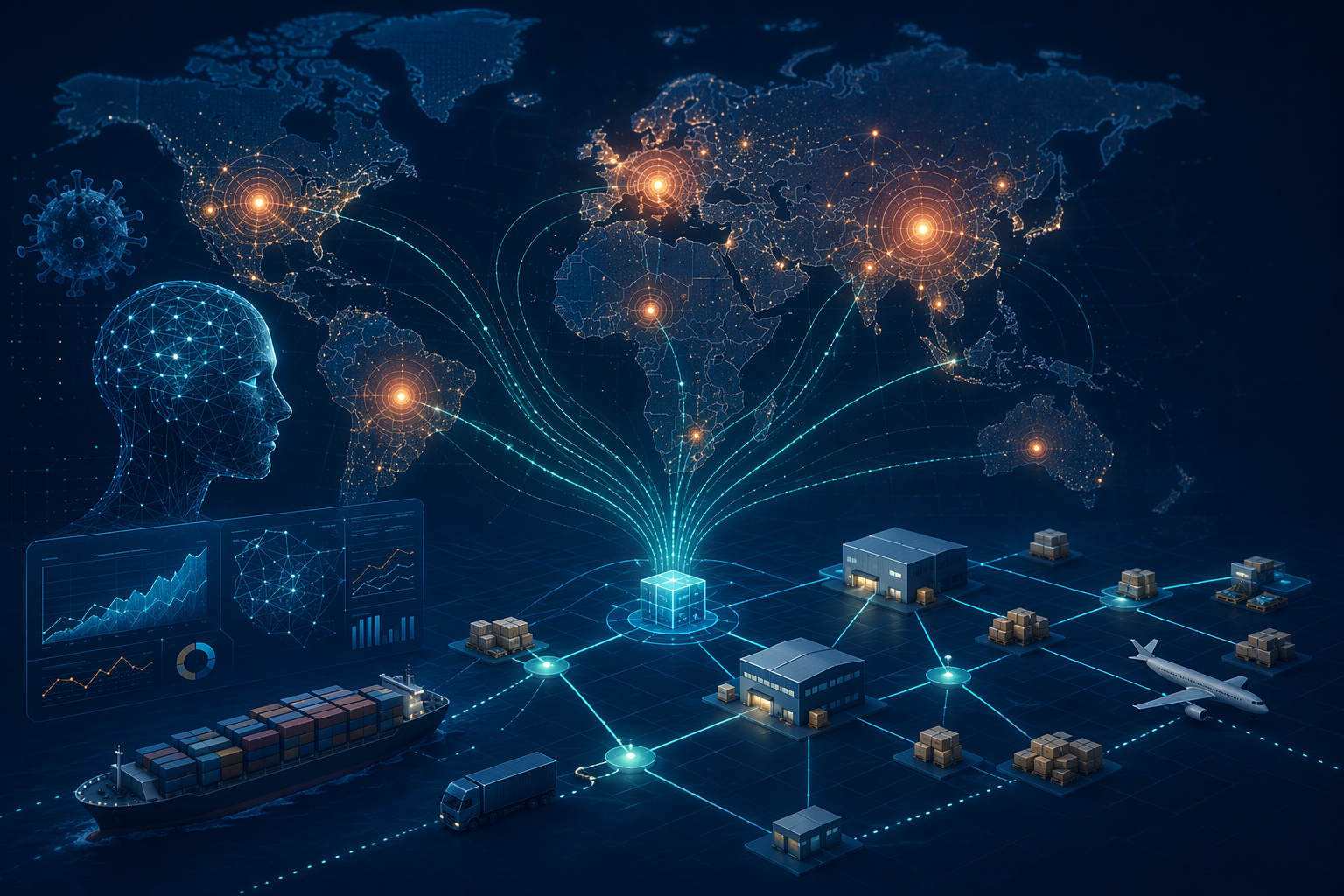
Earlier Awareness Is Real, But It Is Not Yet Resilience
BlueDot’s best-known claim is that it detected and alerted clients to COVID-19 five days before the World Health Organization made its public declaration, using systems that monitor more than 190 infectious diseases and syndromes across global data sources.[1] For a supply chain team, five days is not a slogan. It can be the difference between placing an expedited order while capacity still exists and joining the same queue as every other buyer after the disruption is public.
The claim still needs careful handling. The five-day lead time is BlueDot’s own published timeline; an independent academic paper discussing EPIWATCH and related epidemic intelligence systems describes BlueDot’s COVID-19 detection as occurring on the same day as the WHO alert.[2] That discrepancy does not make the early-warning case useless, but it does prevent a clean, uncontested headline that “AI predicted COVID.” The supported point is narrower: AI-enabled epidemic intelligence has produced earlier or at least very rapid signals during real outbreaks, but exact lead-time claims depend on source, definition, and alert threshold.
The supply chain stakes were not theoretical. A widely cited Fortune and Resilinc estimate from February 2020 reported that 94% of Fortune 1000 companies experienced coronavirus-driven supply chain disruptions.[3] Dun & Bradstreet also found that more than 51,000 companies had direct tier-1 suppliers in Wuhan, while at least 5 million had tier-2 suppliers there.[4] Those figures turn outbreak geography into something more concrete than a red dot on a public health map. If the affected city sits inside a hidden tier-2 dependency, the first official shutdown notice may arrive too late for procurement to do much more than explain the shortage.
What The Detection Systems Actually Do
Epidemic intelligence platforms widen the sensing perimeter beyond official health channels. BlueDot, EPIWATCH, HealthMap, and related systems analyze open-source and structured signals such as news reports, social media, travel-related data, and environmental indicators, then flag patterns that may indicate an outbreak before the signal has moved through slower institutional reporting channels.[1][5]
The recent evidence is strongest at the surveillance layer. EPIWATCH’s peer-reviewed benchmark reports that a BERT-based natural language processing classifier achieved 88.2% accuracy in identifying outbreak-relevant articles, drawing from more than 4,000 daily search terms across 42 languages.[2] That is useful evidence because it concerns a measurable task: separating outbreak-relevant reporting from the mass of global text that would otherwise overwhelm analysts.
It is not evidence that the system predicts the severity of an outbreak, the probability of port congestion, or the date a supplier will miss a shipment. Article classification accuracy is not supply chain impact accuracy. A classifier can be good at identifying a relevant disease report and still leave the resilience team with several unresolved questions: Is the report credible? Is the affected region material to our bill of materials? Are local authorities restricting movement? Is labor availability affected? Are substitute suppliers already constrained?
That is why older discussions of HealthMap and newer claims from enterprise platforms should be read as part of a surveillance lineage, not as proof that response has been automated. The sensing layer has matured. The action layer still depends on how well each company has mapped exposure and assigned decision rights.
When An Alert Becomes Usable
For a supply chain team, a useful outbreak alert has to answer more than “what happened?” It has to narrow where to look and how quickly to act. The minimum useful alert gives a location, disease or syndrome category, confidence level, freshness of source material, and some indication of whether the event is isolated, spreading, or being repeated across multiple sources.
| Alert element | Why it matters for supply chain action |
|---|---|
| Location granularity | Determines whether the team checks a country-level footprint, a province, a city, or a specific supplier cluster. |
| Signal confidence | Helps decide whether to monitor quietly, escalate to risk leadership, or trigger supplier outreach. |
| Source freshness | Affects whether the alert still creates lead time or simply confirms a disruption already moving through the network. |
| Supplier-tier mapping | Connects the health event to exposed materials, subassemblies, contract manufacturers, and logistics lanes. |
| Decision threshold | Prevents every alert from becoming a meeting while making sure high-consequence exposures are not ignored. |
This is where many organizations lose the value of early detection. The alert may be early, but the internal investigation starts from scratch: procurement asks who buys from the region, planning asks which finished goods depend on those parts, logistics asks whether ports or airports are affected, and finance asks whether the cost of pre-buying is justified. If those questions take a week, a five-day signal has already been spent.
The teams most likely to benefit are not necessarily the ones with the most elaborate outbreak dashboard. They are the ones that can immediately connect a health signal to a supplier graph, inventory position, allocation policy, and escalation path. Readers comparing broader supplier-risk systems may find it useful to place outbreak monitoring beside AI supplier risk monitoring tools, because disease surveillance only becomes operational when it joins the same workflow as financial distress, cyber incidents, sanctions, weather, and infrastructure disruption.
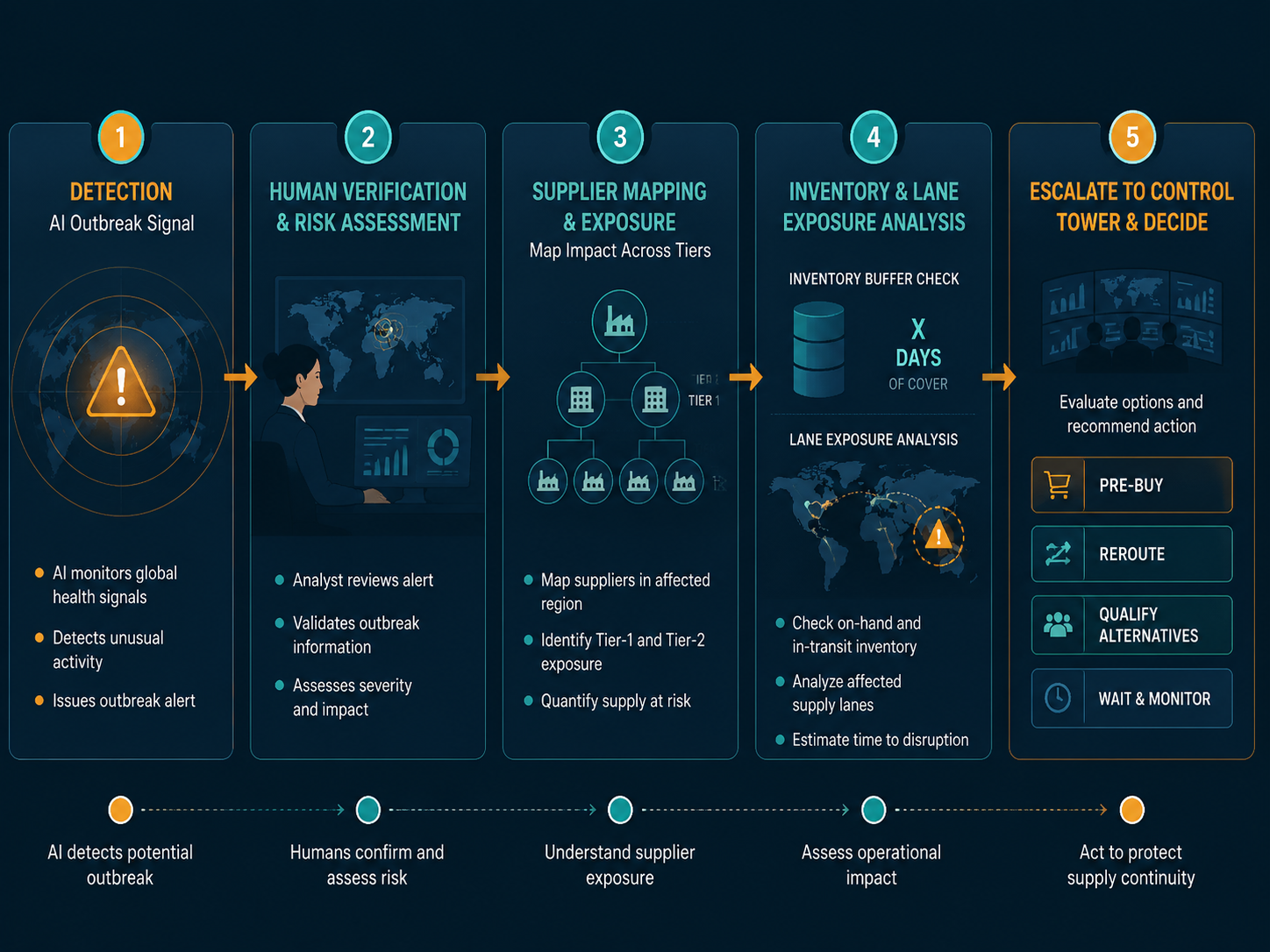
The Workflow After Detection
A practical response starts with verification, not automation. Open-source outbreak signals can include duplicate reports, rumors, translated fragments, and low-signal local items. Human review still matters, especially when the consequence of a false escalation is expensive inventory movement or supplier panic.
Once verified, the alert needs to move through the same operational spine used for other disruptions:
- Map the affected location against tier-1 and tier-2 suppliers, not just owned facilities.
- Identify exposed part numbers, approved alternates, tooling constraints, and customer commitments.
- Check on-hand inventory, in-transit inventory, safety stock, and near-term production consumption.
- Review logistics lanes for airport, port, border, or local trucking exposure.
- Escalate only when exposure and consequence cross a pre-agreed threshold.
That sequence sounds ordinary, which is the point. Resilience is often won or lost in ordinary handoffs. A resilience manager receiving a credible Thursday alert does not need a cinematic AI recommendation. They need to know whether Monday’s production plan depends on a single-source component from the affected region, whether supplier outreach should happen before the weekend, and who has authority to approve a pre-buy or lane change.
Control towers can help if they are wired for decisions rather than display. The outbreak alert should create a case, attach exposed suppliers and lanes, show inventory runout, assign owners, and record whether the team chose to wait, pre-buy, reroute, qualify alternatives, or communicate with customers. A dashboard that only plots disease reports beside a map of suppliers still leaves the hard work outside the system. For that reason, outbreak intelligence belongs in the same conversation as control tower operating models and multi-tier supply chain visibility, not just public health monitoring.
Where The Evidence Is Strong, And Where It Thins Out
The strongest evidence supports three claims. First, AI-enabled epidemic intelligence can ingest more signals than official reporting channels alone. Second, systems have demonstrated measurable performance on outbreak-relevant signal classification, as in the EPIWATCH benchmark.[2] Third, at least some vendors have delivered rapid outbreak alerts to enterprise clients, with BlueDot naming customers such as NATO, Air Canada, and Reckitt and positioning its programs for sectors including pharmaceuticals and supply chain resilience.[1]
The weaker evidence begins where procurement leaders usually want the business case to begin. The available material does not provide an independent study showing that AI outbreak alerts reduced stockouts, lowered expedite costs, improved service levels, or shortened recovery time for supply chain users. BlueDot says its platform protects more than 840 million people and saves users more than three months annually through curated alerting, but those are vendor disclosures, not independent supply chain ROI results.[1]
That does not make the tool category speculative. It means the business case has to be built around plausible operational mechanisms and measured internally. If an outbreak alert gives earlier awareness, the company still has to prove that earlier awareness changes decisions: fewer late supplier escalations, faster exposure assessment, earlier alternate sourcing, better inventory placement, or more disciplined decisions to wait when exposure is low.
There are also surveillance limitations that cannot be solved by enthusiasm. Open-source systems depend on reporting velocity, language coverage, internet availability, local media freedom, and the severity required for an event to become visible. A multilingual classifier reduces some blind spots; it does not eliminate underreporting. In regions where signals are slow or politically constrained, AI may still detect late.
What To Have In Place Before Buying The Alert
The cleanest implementation question is not “Which platform has the most signals?” It is “What happens inside the company during the first 24 hours after a credible alert?” If the answer is unclear, the organization may buy earlier awareness without buying resilience.
- Supplier exposure: the company can connect locations to tier-1 and critical tier-2 suppliers.
- Material criticality: planners know which parts have low substitutability, long lead times, or single-source constraints.
- Inventory visibility: teams can see on-hand, in-transit, allocated, and constrained stock before calling suppliers.
- Escalation rules: risk, procurement, planning, logistics, and commercial teams know when an outbreak alert becomes a business incident.
- Decision rights: someone can approve a pre-buy, alternate qualification, lane change, or customer communication without waiting for a full crisis meeting.
A company without those foundations can still use epidemic intelligence for situational awareness. It may brief executives earlier, monitor a region more closely, or prepare supplier questionnaires. But the resilience value will be modest until the alert can shorten an existing decision path.
The same pattern appears in other hazard-monitoring use cases. Wildfire smoke, hurricanes, floods, infrastructure attacks, and disease outbreaks all reward early sensing only when the signal is tied to exposed assets and executable options. The hazard changes; the operating discipline does not.
The 2026 Answer
AI outbreak detection can make supply chains more resilient, but the mechanism is narrower than the hype suggests. The technology is credible at surveillance and alert generation. It can widen monitoring beyond official channels, process multilingual open-source material at scale, and in some documented cases provide rapid or earlier warning of real outbreak threats.
What remains immature is the automatic conversion of that warning into supply chain response. No alert, however early, knows by itself whether a buyer should pre-buy, whether a supplier can ship before restrictions tighten, whether an alternate is truly qualified, or whether rerouting freight creates a worse bottleneck elsewhere. Those choices still require supplier-tier visibility, inventory context, human verification, and clear authority.
The organizations most likely to benefit in 2026 are the ones that already treat risk signals as inputs to planning decisions rather than as dashboard events. For them, AI epidemic intelligence can add meaningful lead time. For everyone else, it will mostly add earlier awareness of a problem they are not yet organized to act on.
References
- BlueDot, BlueDot.
- EPIWATCH: artificial intelligence-based detection and early warning of epidemics, MacIntyre et al., 2023.
- Fortune / Resilinc coronavirus supply chain disruption estimate, Fortune / Resilinc, February 2020.
- Artificial intelligence-based early warning systems for infectious diseases: a systematic review, Frontiers in Public Health, 2025.
- AI-driven epidemic intelligence overview, Frontiers in Artificial Intelligence, 2025.
Comments
Join the discussion with an anonymous comment.