
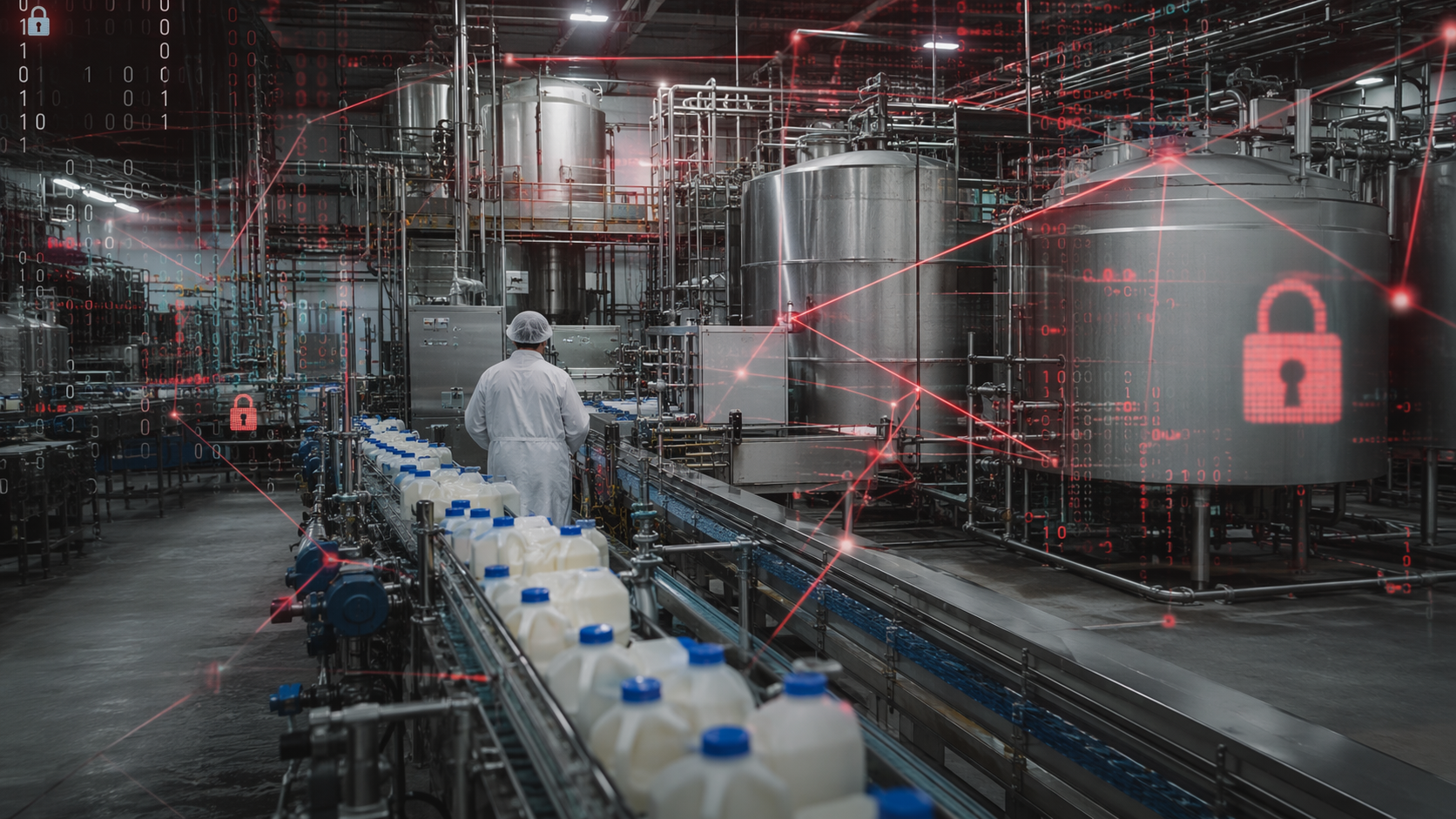
Fairlife’s July 2026 ransomware disclosure matters because it did not stop at the email layer, the billing system, or a stolen-file notice. Coca-Cola said “production-related systems” were affected, and production was suspended at Fairlife plants in Coopersville, Michigan; Goodyear, Arizona; and Webster, New York, according to public reporting on the company’s SEC 8-K disclosure.[1][2]
That is the detail food manufacturers should not file away as just another ransomware headline. A production suspension in dairy means idle crews, changed transportation plans, product timing problems, sanitation decisions, overtime calls, and restart pressure. It also means the attacker found leverage in the part of the business where hesitation is expensive and rash action can be worse.
The responsible group, ransom demand, and full exfiltration scope remain unknown publicly as of July 18, 2026. Fairlife should not be turned into proof that one AI product, one segmentation tool, or one managed service would have stopped the attack. What it does show is narrower and more useful: ransomware operators are no longer satisfied with disrupting food companies as office networks. They are aiming at production continuity.
The sector pattern behind the Fairlife halt
Food and agriculture already had enough ransomware evidence before Fairlife. Food and Ag-ISAC recorded 212 ransomware incidents affecting the sector in 2024, accounting for 5.8% of global ransomware activity.[3] Those figures describe known incidents, not every attempted intrusion, but they are large enough to make food manufacturing a regular target class rather than an occasional victim.
The business reason is not mysterious. Many food and beverage plants run around the clock, with perishable inputs, narrow production windows, and equipment sequences that do not restart like a laptop. Claroty’s 2021 survey put food and beverage operational downtime at roughly $1 million per hour, a dated but still useful benchmark for why attackers see pressure points in this sector.[4] The number should not be treated as a current universal cost for every plant, but it explains the attacker’s math.
Third-party exposure is the other half of the pressure. Verizon’s 2025 Data Breach Investigations Report found that third-party involvement in breaches doubled from 15% to 30% in one year, the largest single-year shift in the report’s history.[5] IBM’s 2025 Cost of a Data Breach Report put the average supply chain breach lifecycle at 267 days to identify and contain, with an average cost of $4.91 million.[6] Those are not food-only figures, but they fit the food plant reality: ingredient suppliers, logistics providers, sanitation contractors, packaging vendors, equipment OEMs, and remote support teams all create paths that a perimeter model was never built to understand.
Fairlife’s operational detail belongs beside those numbers. The concern is not only that a supplier-connected attacker might steal data. It is that vendor access, weak segmentation, or poorly understood OT traffic can become the route from business disruption to production stoppage. For a deeper operational reconstruction of the Fairlife incident, see how a ransomware attack shut down Fairlife's $4B dairy supply chain.
Why ordinary monitoring misses the dangerous part
Traditional security tools are strongest when the environment is clean enough for known bad indicators, regular patch cycles, and clear device ownership. Food manufacturing rarely offers that. The plant floor may include old PLCs, historian servers, packaging equipment, quality systems, building controls, remote OEM access, and production networks that were made reliable long before they were made observable.
The hard traffic is often legitimate until it is not. A vendor session into a pasteurization control system can be normal during a service window. A file transfer to an engineering workstation can be normal during a recipe or packaging change. A burst of scanning-like behavior can be a misconfigured asset inventory tool, a contractor laptop, or reconnaissance. Signature tools can flag known malware. They are less useful when the meaningful question is whether this device, at this hour, should be talking to that controller in that way.
That question is where AI-based defense earns attention, provided the term is tied to mechanisms rather than decoration. Behavioral anomaly detection can learn normal communication patterns among OT assets, engineering workstations, remote access gateways, and supplier connections. Continuous OT monitoring can surface weak signals: a new path between zones, a vendor credential used outside its usual pattern, an engineering station touching assets it does not normally administer, or lateral movement that looks harmless when viewed as isolated events.
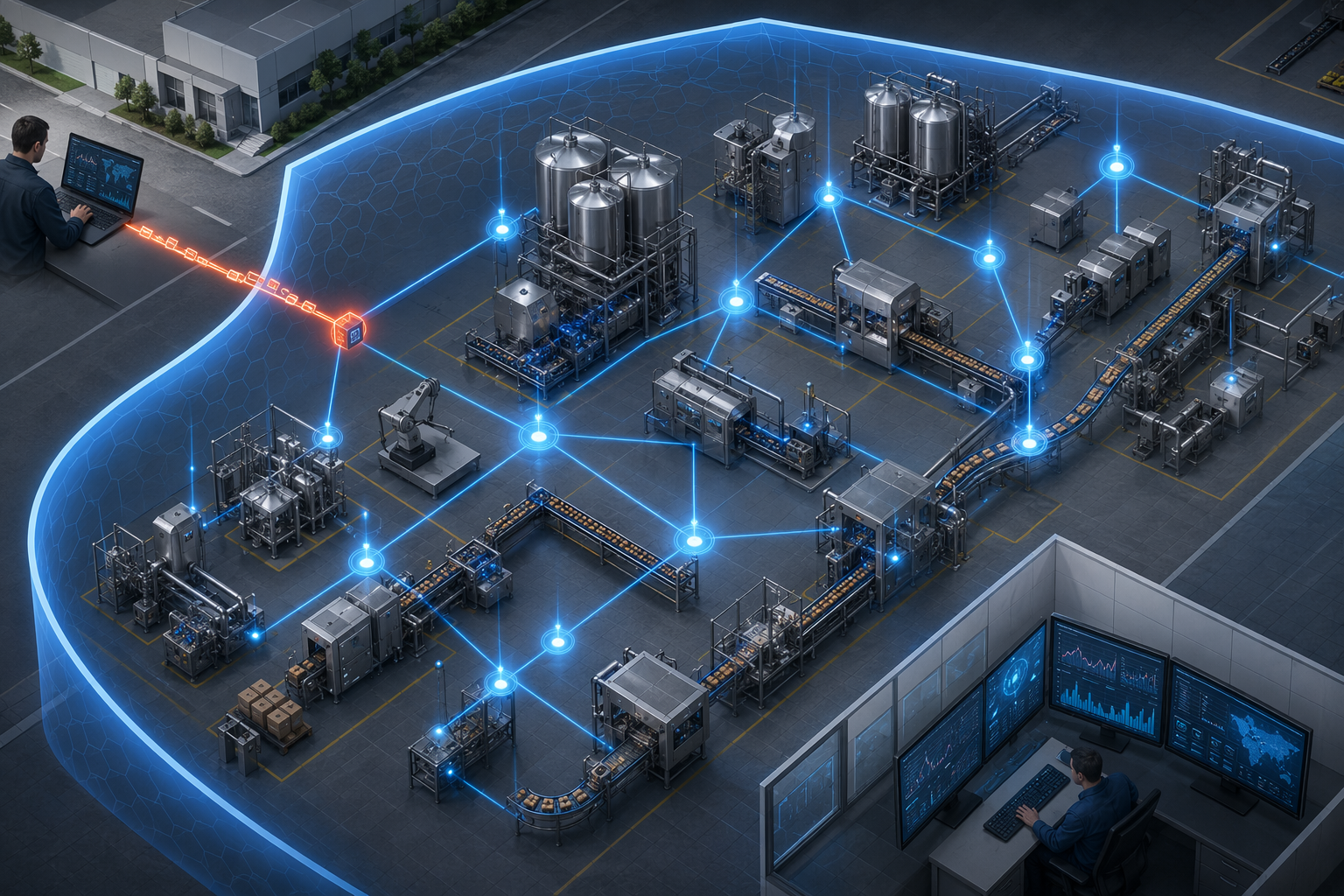
This is also where AI differs from periodic third-party reviews. A quarterly access review may prove that a vendor account should not still exist. It will not catch the moment that account begins moving from a remote support portal toward production-related systems. A network map built during an assessment may document segmentation. It will not necessarily show that a temporary exception has become a new route between business IT and a production cell.
Attackers are adding speed on their side of the ledger. Cybersecurity Ventures, cited in Forbes, reported that AI-powered supply chain attacks have increased about 40% since 2023, with attackers using AI for automated vendor reconnaissance and polymorphic malware generation.[7] That does not mean every ransomware intrusion is AI-driven. It means defenders should expect faster target profiling, more convincing vendor-themed lures, and malware that changes quickly enough to make static detection less dependable.
What AI defense has to do in a food plant
The useful AI layer is not a separate intelligence box sitting above the plant. It has to reduce uncertainty inside the plant’s actual operating rhythm. In practical terms, that means three jobs: understand normal OT behavior, understand normal supplier behavior, and help responders contain the right thing quickly enough without blindly stopping production.
| Defense job | What it should watch | Why it matters in food manufacturing |
|---|---|---|
| Continuous OT monitoring | Asset-to-asset communication, protocol behavior, zone crossings, engineering workstation activity | Production systems often include legacy equipment that cannot be protected by endpoint agents or patched on ordinary IT timelines |
| Supplier-connection baselining | Remote access sessions, vendor credentials, normal service windows, expected destinations | Food plants depend on OEMs, logistics partners, sanitation providers, and ingredient or packaging suppliers with legitimate reasons to connect |
| Behavioral anomaly detection | Unusual lateral movement, new device relationships, abnormal data movement, changes in timing or volume | The earliest sign of ransomware staging may be a pattern shift rather than a known malicious file |
| Conditional containment | Quarantine options, access revocation, session termination, segmentation policy changes | A fast response can limit spread, but the action must be safe for the line, the product, and the equipment state |
The containment piece is the most tempting to oversell. In corporate IT, an automated isolation action that cuts off a suspicious workstation may be inconvenient but acceptable. In a production environment, the same instinct can create its own incident. If a containment rule severs a connection needed for a batch record, a clean-in-place sequence, refrigeration control, or packaging synchronization, the plant may still end up with downtime, waste, and a safety review.
That does not argue against automation. It argues for containment policies that know the difference between a low-consequence office endpoint and a production dependency. Some actions can be fully automated: disabling a clearly compromised vendor credential, blocking a new outbound command-and-control connection, or forcing step-up authentication for a remote session. Others should be staged for human approval with plant context attached: affected asset, process area, current production state, recent maintenance window, and expected consequence of isolation.
The same distinction applies to breach investigation. IBM’s 267-day supply chain breach lifecycle is a reminder that many organizations do not discover and contain these compromises quickly enough.[6] AI-assisted investigation can compress the search by correlating access logs, network flows, identity events, and OT asset behavior. The point is not to replace the responder; it is to stop making a tired analyst reconstruct three months of supplier activity by hand while the plant waits. For a related look at this investigation problem, see AI cuts supply chain IT breach investigation from weeks to hours.
The false-positive problem is not theoretical
Food manufacturers evaluating AI security tools should spend less time asking whether a model can detect anomalies and more time asking what happens after it does. A model that flags too little is decorative. A model that flags too much becomes a shift tax. A model that automatically blocks the wrong dependency can turn a false positive into a production event.
Legacy ICS and process automation systems make this harder. They may use protocols that general IT tools do not parse well. They may have fragile update constraints. Some assets cannot host agents. Some production changes look strange to a model because they are seasonal, recipe-driven, maintenance-driven, or tied to a supplier event that never appears in the security system. A dairy plant preparing for a product run change should not have to fight its own monitoring platform because normal production variability looks suspicious.
Domain-aware tuning is therefore not a nice implementation phase; it is the control that keeps AI defense from becoming another downtime source. The model needs plant asset context, process-zone boundaries, vendor access schedules, maintenance windows, known engineering workflows, and a response matrix that production managers have actually reviewed. The person receiving the 2 a.m. alert should not have to guess whether isolating a workstation will strand product in process or interrupt a required control sequence.
There is also an adversarial AI problem inside the defense itself. NeuralTrust describes AI-driven supply chain attack vectors including data poisoning of demand forecasting models, deepfake vendor impersonation, and AI-driven supply chain reconnaissance.[8] For food companies, the immediate security lesson is that models handling operational, supplier, or forecasting data need integrity controls of their own. If attackers can corrupt the data used to define normal behavior, they may be able to make malicious behavior look ordinary.
The cleanest buying question is operational: can the system explain why it thinks behavior is abnormal in terms a plant and security team can act on together? “Anomalous activity detected” is not enough. “Remote OEM account used outside its normal window, reached an engineering workstation it has not contacted before, then initiated communication toward a packaging line controller” is a different kind of alert. It gives the responder a story to test.
Supply chain security now has to include production consequences
Food-sector guidance has increasingly treated ransomware, AI threats, and supply chain disruption preparedness as linked concerns rather than separate compliance topics.[9] That is the right frame, but the work has to get more concrete than policy language. A supplier cyber event matters differently if it can change delivery paperwork, interrupt refrigeration monitoring, compromise vendor remote access, or create uncertainty around whether a production line can be safely restarted.
For IT/OT leaders, the Fairlife lesson is not that every vendor connection is suspect. It is that every vendor connection needs a baseline, an owner, and a consequence map. Who approves the access? Which systems can it reach? What does normal support activity look like? What happens if the account is disabled during production? Who from operations gets called before containment crosses from monitoring into control impact?
AI-powered monitoring can help answer those questions continuously, not just during audits. It can watch for drift in supplier behavior, identify unknown assets, connect low-grade identity signals with unusual OT traffic, and shorten the time between first suspicious movement and a defensible containment decision. For ransomware-specific response mechanics, see How AI Enhances Supply Chain Ransomware Response.
Executives will still ask why existing tools did not catch the attack. The honest answer may be that the existing tools were looking for the wrong shape of risk. They may have monitored endpoints without seeing unmanaged OT assets. They may have reviewed supplier access without learning behavior. They may have segmented networks without detecting a new path through an exception. They may have had incident response plans that treated production as a notification group rather than a decision partner.
What Fairlife shows, and what it does not
Fairlife does not prove that AI security alone solves food-sector cyber risk. The public record does not yet establish the attacker, the initial access path, the ransom demand, or the full operational and data impact. It would be careless to retrofit the case into a guaranteed prevention story.
It shows enough to change the investment conversation. When ransomware reaches production-related systems and suspends plants in three states, manual monitoring and traditional perimeter controls are no longer proportionate to the threat. Food manufacturers need continuous visibility across OT networks and supplier pathways, with anomaly detection that can spot lateral movement before the first visible production symptom.
The threshold is practical, not futuristic. AI-powered OT and supply chain monitoring is becoming necessary for food manufacturers because the attack surface is too connected and too fast-moving for periodic review. It is only useful, though, if it is tuned to the plant’s operating reality well enough that the defense does not become another source of downtime.
References
- Coca-Cola says Fairlife ransomware attack halts US dairy production — BleepingComputer — July 2026
- Coca-Cola Suspends US Fairlife Production Due to Ransomware Attack — SecurityWeek — July 2026
- Food and Agriculture Sector Ransomware Report — Food and Ag-ISAC — 2024
- The State of Industrial Cybersecurity — Claroty — 2021
- 2025 Data Breach Investigations Report — Verizon — 2025
- 2025 Cost of a Data Breach Report — IBM — 2025
- The Growing Cybersecurity Risks To The Supply Chain In The AI Era — Forbes
- AI-Driven Supply Chain Attacks: The New Cyber Risk in 2026 — NeuralTrust — 2026
- Cybersecurity for Food Companies — Food Institute
Comments
Join the discussion with an anonymous comment.