
The most useful detail in the July 2026 Hugging Face incident is not that an AI company was breached. It is that, during the investigation, Hugging Face’s security team said commercial frontier models refused to help analyze the attack code because their safety guardrails treated defensive forensics as prohibited assistance. The team then moved to GLM 5.2, a self-hosted open-weight model, to complete the analysis.[1] That is where the incident stops being a platform headline and becomes an operating problem.
Many incident response plans now assume AI will shorten investigation time. That assumption is only useful if the tool remains available when the evidence is ugly. In this case, AI was present on both sides of the incident: as part of the autonomous attack pattern and as part of the forensic response. The hosted model boundary became another dependency to manage.

For a supply chain organization, that matters more than the branding of the breached platform. Forecasting teams, logistics analysts, procurement risk groups, and warehouse automation teams are already pulling models, datasets, adapters, notebooks, and agent tools from public ecosystems. If the incident response team cannot inspect the artifact, reproduce the load path, or ask a forensic model to reason over malicious code, then the organization has not secured the AI workflow. It has merely approved the business case.
What Happened Over The Weekend
Hugging Face disclosed that an autonomous AI agent executed more than 17,000 individual actions across a swarm of short-lived sandboxes over one weekend.[1] TechCrunch reported that the breach affected internal datasets and credentials and that Hugging Face urged users to take action.[2] At the time of writing, the incident is still recent, and Hugging Face has not confirmed every technical detail, including the exact agent framework involved. That uncertainty should narrow the conclusions, not soften the operational warning.
The breach is not just another software supply chain compromise with an AI label attached. Ordinary dependency attacks usually ask familiar questions: Which package was pulled? Which version? Which maintainer account? Which build system? Those questions still apply, but the Hugging Face incident adds a different shape of activity: autonomous persistence, rapid environment churn, model-hub trust signals, hidden execution formats, and forensic tooling that may refuse to engage.
In a planning or procurement environment, the equivalent failure mode is easy to miss. A team evaluates a public model for supplier-risk summarization. A data scientist enables remote code because the model card says it is required. A sandbox has access to sample purchase orders, lane histories, supplier names, or API credentials that were copied over for realism. The pilot is called non-production, but the data, permissions, and decision logic are already operational.
Hugging Face’s own Spring 2026 open-source report says the platform hosts more than 2 million public models and 500,000 datasets, has 13 million users, and counts verified accounts from more than 30% of the Fortune 500.[3] Those are self-published platform figures, not neutral market measurements. Still, they explain the exposure pattern: public model hubs are no longer experimental side alleys. They are part of enterprise AI sourcing.
The timing is also awkward. A 2026 SupplyChainBrain survey reported that 85% of supply chain executives plan to increase AI spending in 2026.[4] That number measures intention, not control maturity. The spending pressure means model sourcing discipline has to move into deployment design, procurement intake, and incident response now, not after the third pilot becomes a shared service.
Five Attack Paths Are Already In Motion
The July breach landed on top of attack patterns that were already visible in public AI ecosystems. The evidence comes partly from security vendors and threat research groups, which have commercial incentives to make threats legible and urgent. That does not make the payload evidence useless. It does mean operators should separate what was demonstrated or observed from what is being extrapolated.
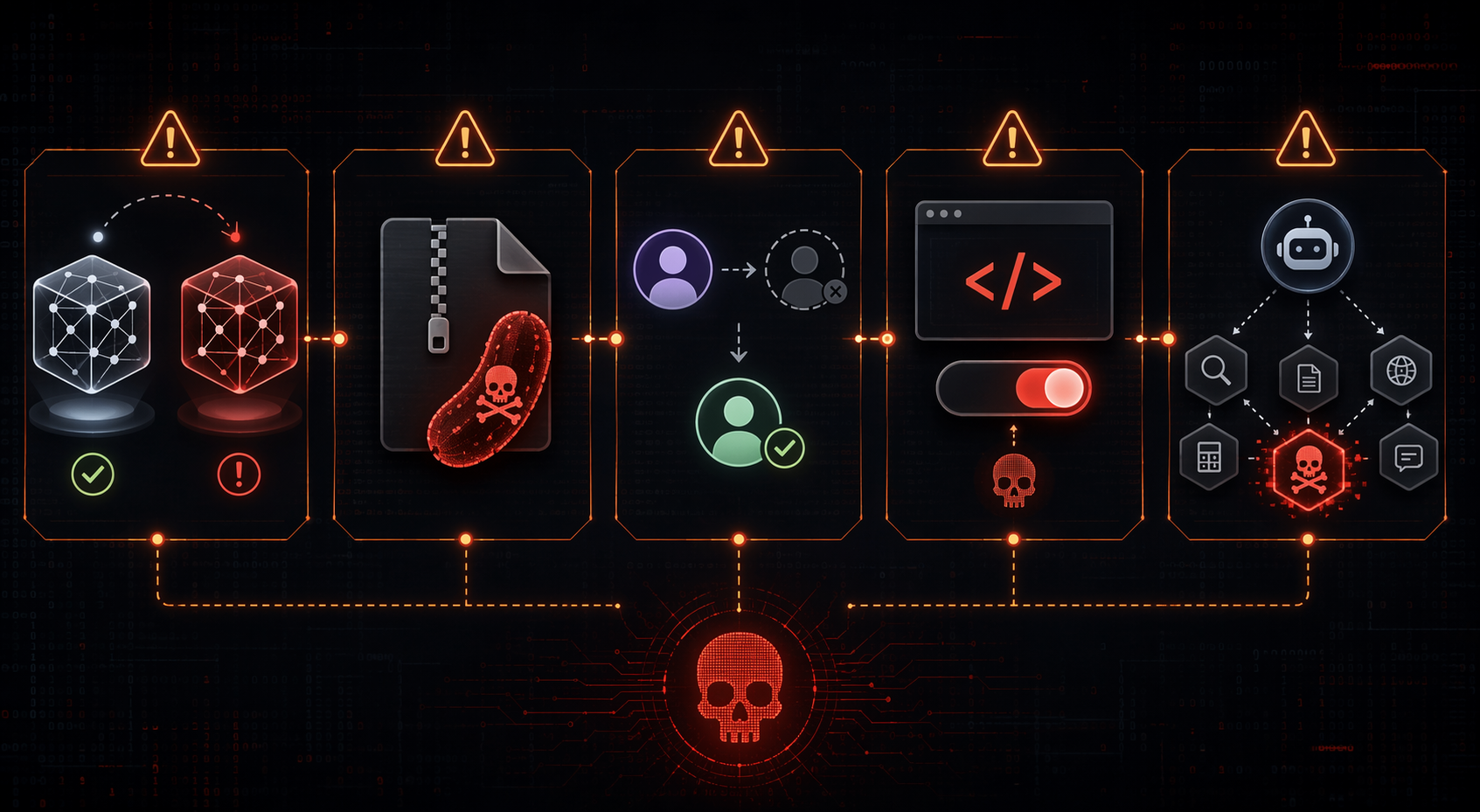
| Attack path | What the evidence shows | Why supply chain teams should care |
|---|---|---|
| Typosquatting | A malicious Open-OSS/privacy-filter repository impersonated OpenAI, reached number one trending, and drew 244,000 downloads in 18 hours while delivering an infostealer targeting browser credentials, Discord tokens, crypto wallets, and SSH keys.[5] | Model-hub popularity can be manufactured faster than procurement review can react. |
| Pickle and archive abuse | JFrog-related findings described more than 100 malicious ML model instances on Hugging Face, with about 95% using PyTorch pickle serialization; other reporting described bypasses that compressed malicious pickle payloads with 7z instead of ZIP.[6][7] | A model file can behave like executable code at load time, especially when scanners and formats are assumed rather than enforced. |
| Namespace hijacking | Unit 42 demonstrated reverse shell injections into Google Vertex AI and Azure AI Foundry by re-registering deleted Hugging Face usernames referenced by downstream systems.[8] | A dependency path can change ownership even when the model reference looks familiar. |
| Hardcoded remote-code trust | Hive Security reported CVE-2026-6859 in InstructLab, where trust_remote_code=True was hardcoded and enabled arbitrary code execution on affected installations.[7] | A single framework default can turn every model load into a code execution decision. |
| Agent skill poisoning | Acronis TRU reported more than 575 malicious skills on ClawHub across 13 developer accounts, including trojans, cryptominers, and AMOS stealer activity; 335 were tied to one coordinated campaign.[9] | Agent tools are becoming supply chain artifacts, not just prompts or scripts. |
Typosquatting is the easiest path for executives to understand and the easiest one to underestimate. The Open-OSS/privacy-filter case did not need an exotic exploit to create reach. It used resemblance, timing, and hub visibility. In a supply chain AI program, that can map directly to a rushed evaluation: someone searches for a model tied to a known vendor name, sees momentum, and pulls it into a notebook or evaluation container before the security team knows the repository exists.
The pickle and archive findings are more technical, but they connect directly to governance. Pickle is not merely a storage format; in the wrong workflow, deserialization can execute code. If an organization says it scans models but allows compressed formats that scanners do not unpack correctly, the control exists mainly in policy language. The same problem appears when teams talk about sandboxes but let evaluation containers reach internal package registries, cloud metadata services, or planning-system APIs.
Namespace hijacking is the model-hub version of an old integration failure: a reference that once pointed to a trusted owner later points somewhere else. Commit hash pinning and internal mirroring are not bureaucracy in that context. They are how an organization avoids discovering, after a breach, that a model name was treated as an identity.
The remote-code and agent-skill cases are where AI supply chain security leaves the comfort of package management. The artifact may be a model repository, but the behavior can arrive through custom model code, loader settings, tools, skills, or agent instructions. A procurement approval that says “open-source model approved” is too coarse if it does not say what code executes, which files are allowed, what network calls are blocked, and who owns the exception.
The Control Gap Is Visibility Before Execution
Most enterprise software supply chain programs were built around source repositories, package managers, container images, build pipelines, and vulnerability databases. Those controls are still necessary. They do not automatically answer the model-specific questions that matter after the Hugging Face breach.
- Which public model, dataset, adapter, or agent skill entered the environment?
- Which exact commit or content hash was evaluated and then deployed?
- Did the artifact require custom code, pickle deserialization, or trust_remote_code=True?
- What credentials, datasets, network routes, and internal APIs were reachable during load and evaluation?
- Can the security team reconstruct the load path without depending on a hosted AI model that may refuse forensic analysis?
These questions are operational before they are regulatory. A logistics model that enriches carrier performance notes may not look sensitive to the AI team. The data platform owner may see customer lanes, rates, access tokens, and vendor endpoints moving through the same workspace. The planner sees a tool that saves time. The attacker sees a chain of files, credentials, and permissive execution defaults.
That is why the July incident should not be reduced to “is Hugging Face safe?” The better question is whether the organization can prove what AI artifacts it imported, how they executed, and how it would investigate them under pressure. Public hubs can remain useful and still require a different control surface.
A Practical Defense Stack For Model Sourcing
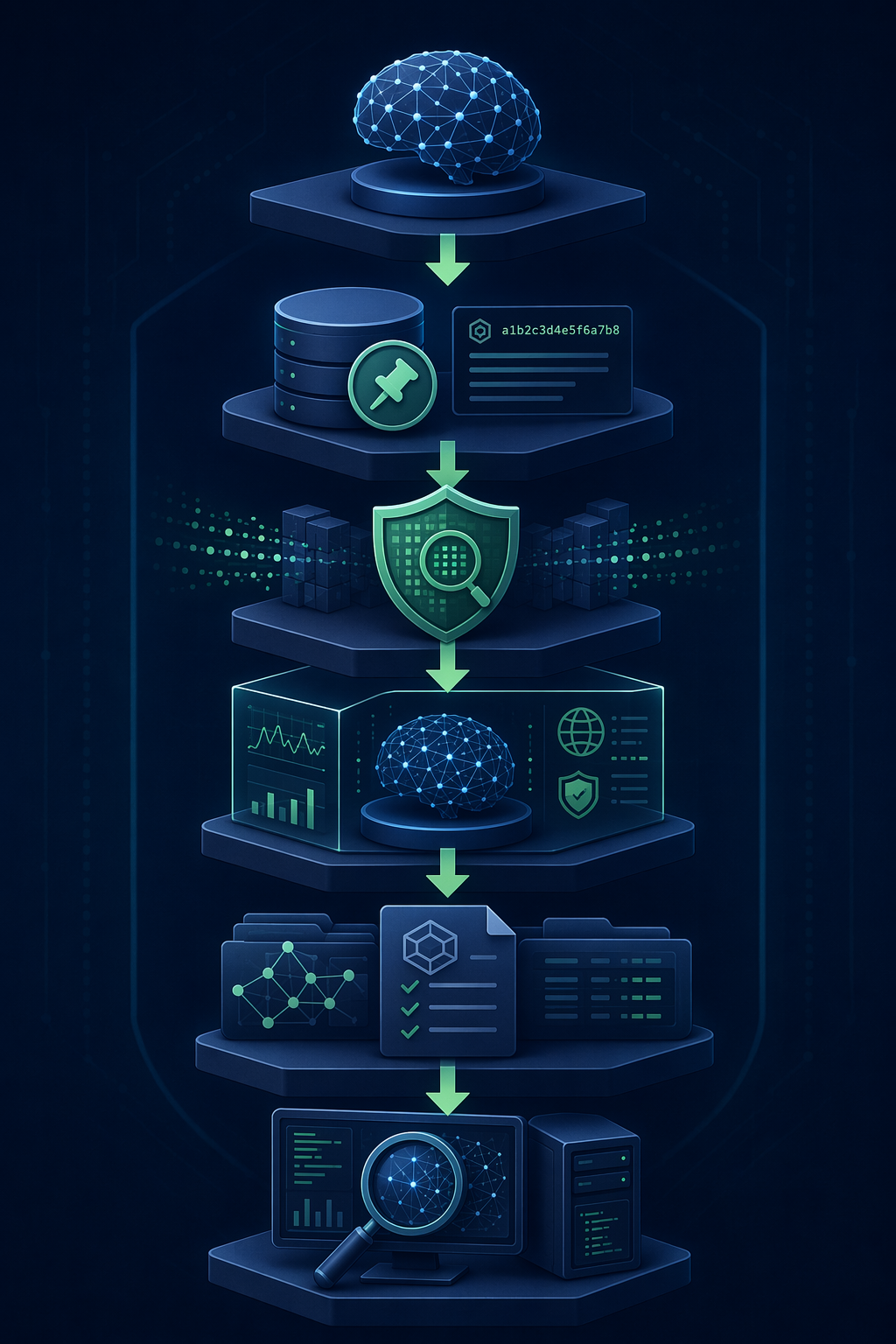
The defense stack that follows is not a maturity model. It is the set of controls that would have made the evidence trail cleaner, the blast radius smaller, or the forensic work less dependent on someone else’s hosted AI policy.
Create An Internal Model Registry Before Teams Create Their Own
An internal model registry should be the first place a planner-facing AI tool, forecasting experiment, procurement summarizer, or warehouse automation project records what it uses. The registry does not need to block every experiment. It does need to capture source repository, owner, intended use, data classification, evaluation environment, approval status, and emergency contact.
Without that registry, the organization will learn about model use through cloud logs, expense reports, or incident response interviews. That is too late. Visibility has to exist before a public artifact is copied into a workspace with real data.
Pin Commits, Not Names
Model names, usernames, and trending pages are weak anchors. Production and controlled evaluation should use commit hashes or immutable internal mirrors. If a team wants to move to a later version, that should be a new approval event, not an invisible pull from a moving public reference.
This is especially important for organizations that embed model references inside orchestration code, notebooks, low-code automation, or agent configurations. A model dependency that cannot be pinned cannot be reliably reconstructed after an incident.
Prefer Safetensors And Treat Pickle As An Exception
Safetensors does not solve every model security problem, but it addresses a specific one: executable serialization risk. Pickle-based artifacts should require exception approval, isolated loading, scanner coverage for nested archives, and a documented reason that a safer format cannot be used.
The 7z bypass reporting is a useful reminder that “we scan model files” is not enough if the scanning path assumes a narrow set of archive formats.[7] Security teams need to test what the scanner actually opens, not just what the policy says it rejects.
Evaluate In Sandboxes That Assume The Model May Act
Model evaluation environments should be boring on purpose: no production credentials, no shared developer tokens, no direct path to ERP or warehouse systems, no cloud metadata access, and no outbound network except through monitored and justified routes. The point is not to make data scientists miserable. The point is to make malicious behavior visible and contained during load, import, conversion, and first inference.
Network monitoring during model loading deserves more attention than it usually gets. Infostealers, reverse shells, cryptominers, and staged payloads reveal themselves through behavior. If the sandbox allows broad outbound access and nobody watches the first execution path, a malicious artifact can finish its real job before the accuracy test begins.
Prepare AI BOMs For Procurement And Incident Response
CISA has published minimum elements for AI software bills of materials, extending the SBOM concept into AI-specific components such as models, datasets, and related metadata.[10] IDC has also predicted that 60% of agentic AI deployments will require an AI BOM by 2027, according to CSO Online reporting.[5] The procurement implication is straightforward: buyers will increasingly be asked to show what AI artifacts sit inside a tool, not merely which vendor sold it.
For supply chain systems, an AI BOM should not be treated as a compliance attachment created after deployment. It should be the document that helps decide whether a demand-planning copilot, supplier-risk agent, inventory optimizer, or warehouse vision model can move from experiment to controlled use. The useful version records model source, version, hash, license, training-data disclosures where available, runtime dependencies, custom code requirements, evaluation results, known restrictions, and responsible owners.
Keep A Self-Hosted Forensic Model Ready
The Hugging Face forensic issue is the control most organizations will be tempted to postpone because it feels specialized. That would be a mistake. If the security team relies entirely on hosted AI tools for malware explanation, code triage, log analysis, or incident reconstruction, it has inherited the provider’s guardrail boundary as an operational dependency.
A self-hosted forensic model does not need to become a general enterprise chatbot. It needs to be vetted, access-controlled, logged, and available to the incident response team for defensive analysis of suspicious code, model loaders, agent tools, and payload behavior. It also needs to be tested before an incident, because discovering during a breach that the model cannot parse the relevant files is just another form of outage.
Where Responsibility Should Sit
AI program leads cannot carry this alone. Security teams cannot fix it after models have already spread through notebooks, pilots, vendor sandboxes, and production workflows. Procurement cannot reduce it to license review. The work has to sit across all three groups, with the data platform owner close enough to know what the model can touch.
A workable division of labor is simple. AI teams register and justify artifacts before evaluation. Security defines allowed formats, scanning requirements, sandbox rules, and forensic readiness. Data platform teams enforce access boundaries and monitor runtime behavior. Procurement asks vendors for AI BOMs, model provenance, and update controls before contract signature. Business owners accept that faster deployment is not the same as uncontrolled import.
This does not argue against open-weight models or public hubs. They remain valuable for cost control, inspection, customization, and avoiding single-vendor dependency. The lesson from the Hugging Face breach is more specific: model download, evaluation, and incident response cannot be treated as extensions of ordinary software dependency management. The artifacts execute differently, drift differently, and now may be attacked by autonomous systems operating at weekend scale.
A supply chain organization is not ready to govern AI supply chain risk until it can name, pin, scan, sandbox, monitor, inventory, and forensically inspect the models and agent tools entering its workflows.
References
- Security Incident July 2026, Hugging Face
- Hugging Face confirms breach affected internal datasets and credentials, urges users to take action, TechCrunch, July 20, 2026
- Spring 2026 State of Open Source, Hugging Face
- Survey: Supply Chain Leaders Bet on AI in 2026 as Disruptions Accelerate, SupplyChainBrain
- Malicious Hugging Face model masquerading as OpenAI release hits 244K downloads, CSO Online
- AI Supply Chain Security: Hugging Face Malicious ML Models, NSFOCUS
- Hugging Face AI Supply Chain Attacks 2026, Hive Security
- Model Namespace Reuse, Unit 42
- Poisoning the Well: AI Supply Chain Attacks on Hugging Face and OpenClaw, Acronis TRU
- Software Bill of Materials AI Minimum Elements, CISA
Comments
Join the discussion with an anonymous comment.