
Flood disruption planning has outgrown the spreadsheet. That is not because spreadsheets are useless; it is because the question has changed. A continuity team is no longer asking whether one named supplier sits near a floodplain. It is asking what happens if a river basin floods, two tier-2 suppliers lose capacity in the same week, a port route slows, finished-goods inventory is already committed, and the sales region with the highest margin is next in line for allocation.
The volume of disruption signals is moving in the same direction. Resilinc reported that supply chain disruption notifications rose 38% year over year in 2025, while flood-related notifications rose 34%; it also described floods as the most-tracked disruption event type in its EventWatchAI data.[1] That does not prove every company needs an AI flood scenario platform. It does mean that manual planning methods are being asked to evaluate more simultaneous exposures than they were designed to handle.
The strongest case for AI for flood impact supply chain disruption planning is therefore practical, not futuristic. Vendor-cited MIT Center for Transportation & Logistics research, published by Trax Technologies, reports 35% faster disruption response times and 23% lower associated costs for AI-powered scenario planning.[2] Everstream Analytics reports that its clients have achieved a 30% reduction in revenue losses from disruption and 50% to 70% faster time to identify and assess disruption impact.[3] Those are meaningful figures, but they only become plausible when the system has enough supplier, logistics, inventory, and facility data to simulate the network rather than decorate a map.
Scenario planning is not flood monitoring
Flood monitoring tells a team that water, rainfall, river levels, or storm conditions are changing. Static risk mapping tells a team which sites appear exposed under a predefined view of hazard and location. Scenario planning starts after those signals enter the planning problem. It asks what the business should do before the disruption becomes a scramble.
That distinction matters because many executive dashboards stop at visibility. They can show a red zone around a supplier site, but they cannot always answer which purchase orders are affected, which alternate supplier is already qualified, how much inventory can be moved without starving another region, or whether expediting will cost less than waiting. A flood alert becomes a planning capability only when it is connected to the operating network.
For readers who need the adjacent prediction layer, the broader flood-risk discussion belongs in AI flood risk management for supply chains. Here, the center of gravity is different: using AI and simulation to rehearse business consequences while there is still time to change sourcing, routing, production, inventory, or escalation decisions.
What the measurable gains mean operationally
A 35% faster response time is not just a prettier alert queue. In a flood scenario, response time usually includes the interval between recognizing a threat and understanding which orders, suppliers, facilities, lanes, customers, and financial exposures require action. If that interval shrinks, planners can spend less of the first day reconciling data and more of it making decisions: whether to pull inventory forward, split allocation, authorize an alternate lane, or escalate supplier recovery.
The 23% lower associated cost reported in the vendor-cited MIT CTL statistic should be read with the same operational lens.[2] It may reflect avoided premium freight, fewer production stops, better inventory placement, reduced manual effort, or a cleaner choice among bad options. The article source does not give enough detail to assign the saving to one mechanism, and the original MIT publication was not independently retrieved in the research set. The responsible conclusion is narrower: the statistic supports a serious ROI hypothesis for AI scenario planning, not a universal cost-reduction guarantee.
Everstream’s reported results point to the same pressure point from another angle. A 50% to 70% faster disruption impact assessment is valuable because impact assessment is often where continuity teams lose the most time: confirming whether a site is relevant, tracing parts or materials through supplier tiers, checking inventory coverage, and estimating customer or revenue exposure.[3] The reported 30% reduction in revenue losses from disruption is also important, but it should be treated as a client-reported outcome shaped by network design, product margins, geography, and how much authority planners had to act on the analysis.[3]
This is the difference between a system that notices a flood and a system that changes the plan. The first may notify more people faster. The second helps decide which trade-off is least damaging.
The workflow that turns flood exposure into decisions
An AI scenario planning workflow for flood disruption usually has a recognizable shape. The individual tools vary, but the planning logic is consistent: bring in risk signals, connect them to the supply network, simulate alternatives, quantify business impact, and prepare actions before the crisis meeting starts.
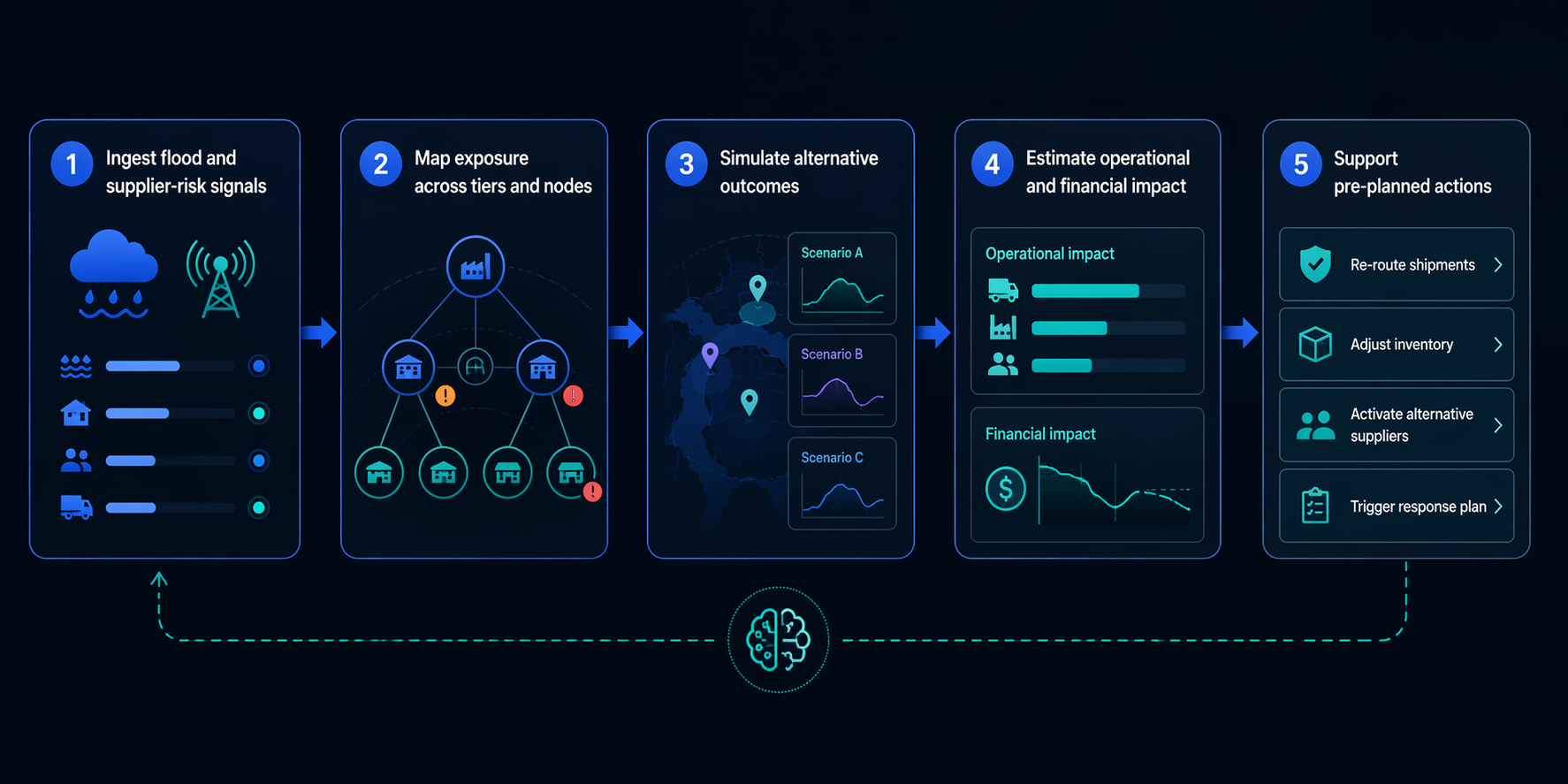
| Planning stage | What the system must connect | Decision it supports |
|---|---|---|
| Ingest flood and supplier-risk signals | Flood alerts, weather or climate inputs, supplier events, facility locations, shipment status | Which threats deserve planning attention now |
| Map exposure across tiers and nodes | Tier-1 through deeper-tier suppliers, plants, ports, warehouses, lanes, materials, purchase orders | Which parts of the network are actually exposed |
| Simulate alternative outcomes | Capacity loss assumptions, delay windows, inventory coverage, alternate sourcing, rerouting options | What changes if multiple disruptions occur together |
| Estimate operational and financial impact | Service risk, production risk, revenue exposure, recovery cost, expedite cost | Which scenario is most damaging and which response is affordable |
| Support pre-planned actions | Playbooks, escalation paths, supplier contacts, allocation rules, transportation options | Who acts, when, and with what authority |
The table is simple because the hard parts are not the labels. Most organizations can describe this flow in a workshop. Fewer can run it repeatedly under time pressure because two sections of the workflow are expensive to make real: supplier-depth and simulation design.
Supplier depth is where many flood plans break
Flood risk often enters through a site the buying company does not transact with directly. Marsh reports that 65% of companies face at least one supply chain bottleneck and states that AI tools can help map tier 2-4 suppliers, where it says 85% of risks reside.[4] Whether a company accepts that exact distribution for its own network or not, the planning implication is hard to avoid: a tier-1 supplier list is usually too shallow for serious flood scenario planning.
Consider a hypothetical electronics manufacturer that has mapped its finished-goods plants and tier-1 contract manufacturers, but not the sub-suppliers providing a specialty resin. A flood warning near one contract manufacturer might look manageable if the direct supplier has inventory. The same event looks different if a second flood scenario affects a tier-2 resin supplier that supports multiple contract manufacturers. The planning question is no longer “Which site is wet?” It is “Which shared dependency quietly removes optionality?”
This is why multi-tier mapping cannot be treated as an optional enrichment layer. For flood scenario planning, the useful object is not just a supplier record. It is the relationship between supplier sites, components, bills of material, inventory positions, transportation lanes, qualifications, contracts, and customers. If those relationships are missing, AI can still generate scenarios, but the scenarios will be thin: exposed locations without enough decision context.
Tools such as NQC MINEAI indicate where the implementation market is moving: using AI to mine and expand supplier intelligence rather than waiting for manual surveys to complete every node. That does not remove validation work. It changes the bottleneck from finding every clue manually to governing which inferred relationships are trusted enough to drive continuity decisions.
Simulation design matters as much as data volume
Once the supply network is mapped, the next failure mode is a scenario engine that only tests one disruption at a time. Flood events rarely respect the neat boundaries of planning exercises. A river basin can affect suppliers, warehouses, workers, roads, ports, and power at the same time. The value of AI scenario planning is the ability to compare many combinations quickly enough that planners can see which assumptions change the decision.
A digital twin is one way to make that comparison usable. A peer-reviewed digital twin framework published in Supply Chain Analytics in March 2025 describes integration between digital twins and flood prediction models for supply chain risk management.[5] The importance is not the label “digital twin” by itself. It is the maintained representation of network behavior: where material flows, where capacity can flex, where inventory buffers exist, and which constraints bind first under stress.
A weak simulation asks, “What if Supplier A is unavailable?” A more useful one asks what happens if Supplier A loses capacity, Supplier B is delayed by the same flood system, the lowest-cost lane is unavailable, the alternate source has longer lead time, and customer demand cannot be deferred. From there, the system can compare response options: pre-position inventory, split demand, approve a substitute material, reroute through another port, or protect a specific customer segment.
Sophus, with its digital twin and quantum-solver positioning, is an example of the kind of implementation signal to watch: scenario planning is increasingly being sold around complex optimization, not only event visibility. The buying question is not whether the mathematics sounds advanced. It is whether the tool can represent the company’s actual constraints closely enough that the recommended action survives review by planning, procurement, logistics, finance, and operations.
Vendor examples are useful, but not as guarantees
Vendor examples help because they show what the market is building. They become misleading when treated as portable proof that every deployment will produce the same results.
Resilinc’s Disruption Agent is positioned around shrinking response from days to minutes, which fits the operational need created by rising disruption notifications.[1] Everstream’s published AI discussion emphasizes faster identification and impact assessment, aligning with the 50% to 70% faster impact-assessment figure it reports for clients.[3] ClimateAi’s ClimateLens appears in this landscape as a climate and weather scenario tool; its published case material includes a hurricane pre-positioning outcome with $15 million in incremental sales.[6] That case is hurricane-specific rather than flood-specific, so it is best read as an example of climate scenario planning influencing commercial preparation, not as direct evidence for flood supply chain performance.
The right use of these examples is to sharpen diligence. If a provider claims faster response, ask what counted as response time. If it claims revenue-loss reduction, ask which losses were included and whether the baseline was modeled or observed. If it claims minutes instead of days, ask what data had already been connected before the clock started. The impressive metric is less useful than the architecture that made it possible.
What has to be in place before the numbers are believable
The investment case for AI-powered flood scenario planning should start with the work required, not the demo. The following capabilities are the difference between an analytical system and resilience theater:
- Multi-tier supplier mapping that reaches beyond direct suppliers and links sites to materials, parts, products, and customers.
- Facility, warehouse, port, and lane data that lets flood exposure be translated into operational disruption rather than location risk alone.
- Inventory and capacity data current enough to test whether a mitigation action is feasible when the scenario runs.
- Simulation logic that can evaluate concurrent events, shared dependencies, alternate sourcing constraints, rerouting options, and recovery timing.
- Decision rights and playbooks that specify who can approve expediting, allocation changes, substitute suppliers, or customer escalation.
The last item is easy to underfund because it is not a data feature. It is also where many planning systems lose their value. If the tool identifies a preferred action but no one has authority to move inventory, activate an alternate supplier, or pay for a different lane, the organization still behaves reactively. AI has shortened the analysis, but not the decision.
For teams comparing this investment with other disruption-planning capabilities, the selection logic should sit inside a broader AI roadmap rather than a one-off flood tool purchase. The useful comparison is not “Which platform has the best map?” but “Which capability changes the next planning decision?” That same question applies in other scenario-planning contexts, including commodity and route shocks, hurricane planning, and other disruption types where the core task is to rehearse consequences before commitments harden.
Where AI scenario planning should be evaluated first
The strongest candidates are not necessarily the companies with the most dramatic flood maps. They are the companies where flood exposure intersects with supplier complexity and high continuity stakes. A single exposed warehouse may justify a conventional contingency plan. A network with flood-exposed sub-suppliers, constrained materials, long qualification cycles, high-margin customer commitments, and limited substitute capacity is a better candidate for AI-powered simulation.
A practical evaluation should test whether the system can answer several questions with company-specific data:
- Which tier-2 or tier-3 suppliers become critical if two flood events occur in the same region or season?
- Which finished products and customers are affected first when those suppliers lose capacity?
- Which mitigation option reduces service or revenue exposure most without creating a larger constraint elsewhere?
- How much time does the organization save in impact assessment compared with its current process?
- Which required data elements are missing, stale, inferred, or owned by another function?
This is also where buyer comparisons should be grounded. A tool shortlist can include risk-intelligence platforms, digital twin providers, supplier-mapping tools, and broader planning systems; the useful filter is whether they can support the company’s actual flood scenarios. A generic AI supply chain tools comparison can help organize the market, but the proof belongs in a scenario using the company’s suppliers, lanes, inventory, and decision rules.
Limits that should shape the business case
No AI system eliminates flood uncertainty. Flood severity varies by geography, infrastructure, watershed conditions, local drainage, asset elevation, and emergency response. Historical data may not contain a close analogue for a black swan event, especially when physical disruption combines with power failure, labor constraints, port congestion, or simultaneous supplier outages. Scenario planning can widen the rehearsal space; it cannot make every future event predictable.
That limitation should make the business case more disciplined, not weaker. AI scenario planning is worth evaluating when the cost of being late is high enough to justify the data work: multi-tier mapping, digital twin maintenance, scenario governance, and cross-functional decision routines. Without those foundations, the promised response-time and cost improvements are unlikely to materialize. With them, the quantified evidence from MIT CTL via Trax, Everstream, and Resilinc is strong enough to justify serious evaluation.[1][2][3]
The final question is not whether AI can make a flood dashboard more impressive. It is whether the organization can connect enough of its network for the system to answer, before the water arrives, what should change now.
References
- Supply Chain Disruption is Accelerating and Why 2026 Demands a New Response — Resilinc
- AI-Powered Scenario Planning — Trax Technologies
- Artificial Intelligence's Role in Supply Chain Risk Management — Everstream Analytics
- Supply Chain Trends in 2026 — Marsh
- Supply Chain Analytics digital twin framework — Supply Chain Analytics, March 2025
- ClimateLens — ClimateAi
Comments
Join the discussion with an anonymous comment.