
The useful question in AI-supported tropical storm disruption planning is not whether a model can draw a cleaner storm cone. It is whether planners get enough defensible lead time to move inventory, reserve transport, change allocation rules, or warn sales teams before the warehouse is already choosing which orders to disappoint.
The most concrete version of that shift shows up in a ClimateAi case involving a roofing materials producer ahead of Hurricane Ian. The company used ClimateAi hurricane forecasts more than three weeks before landfall to pre-position inventory in regions expected to see demand, and ClimateAi reports that the producer captured $15 million in additional sales as a result.[1]
That case is useful because it has a physical consequence: product moved before the storm, demand arrived after the storm, and the company was not trying to improvise after capacity had tightened. It should not be treated as a universal return-on-investment benchmark. It is one vendor-reported client outcome, not an independent study across many hurricane seasons, product categories, or network designs.
Why the Use Case Matters in 2026
Extreme weather has become harder to leave outside the supply chain planning calendar. BCI Horizon Scan 2025, as reported by Tradeverifyd, found that extreme weather became the top supply chain disruption cause in 2025 for the first time in nearly a decade, surpassing cyber incidents.[2] Gallagher Re data reported by Yale Climate Connections counted 55 billion-dollar weather disasters globally in 2025, including 28 in the United States with total losses of $92.9 billion.[3]
The operational footprint is not abstract. Hurricane Ian caused a 75% drop in shipments and extended shipping times by 2.5 days, according to disruption data cited by Everstream and Economist Impact.[4] Weather causes 23% of U.S. road delays and costs trucking an estimated $2.2 billion to $3.5 billion annually, according to FHWA figures cited in Everstream and Geotab material.[4]
NOAA’s 2026 Atlantic hurricane outlook predicted a below-normal season, with 8 to 14 named storms, 3 to 6 hurricanes, and 1 to 3 major hurricanes.[5] That does not make tropical storm planning optional in Q3 2026. A below-normal seasonal forecast still leaves enough events to test whether a company can identify exposed suppliers, ports, lanes, inventory, and customers before the first alert becomes a late-night escalation.
The Integrated Stack
A tropical storm disruption workflow rarely succeeds because one model is clever. It succeeds when four layers share enough context to turn weather probability into supply chain choices: weather intelligence, impact translation, response automation, and scenario testing.
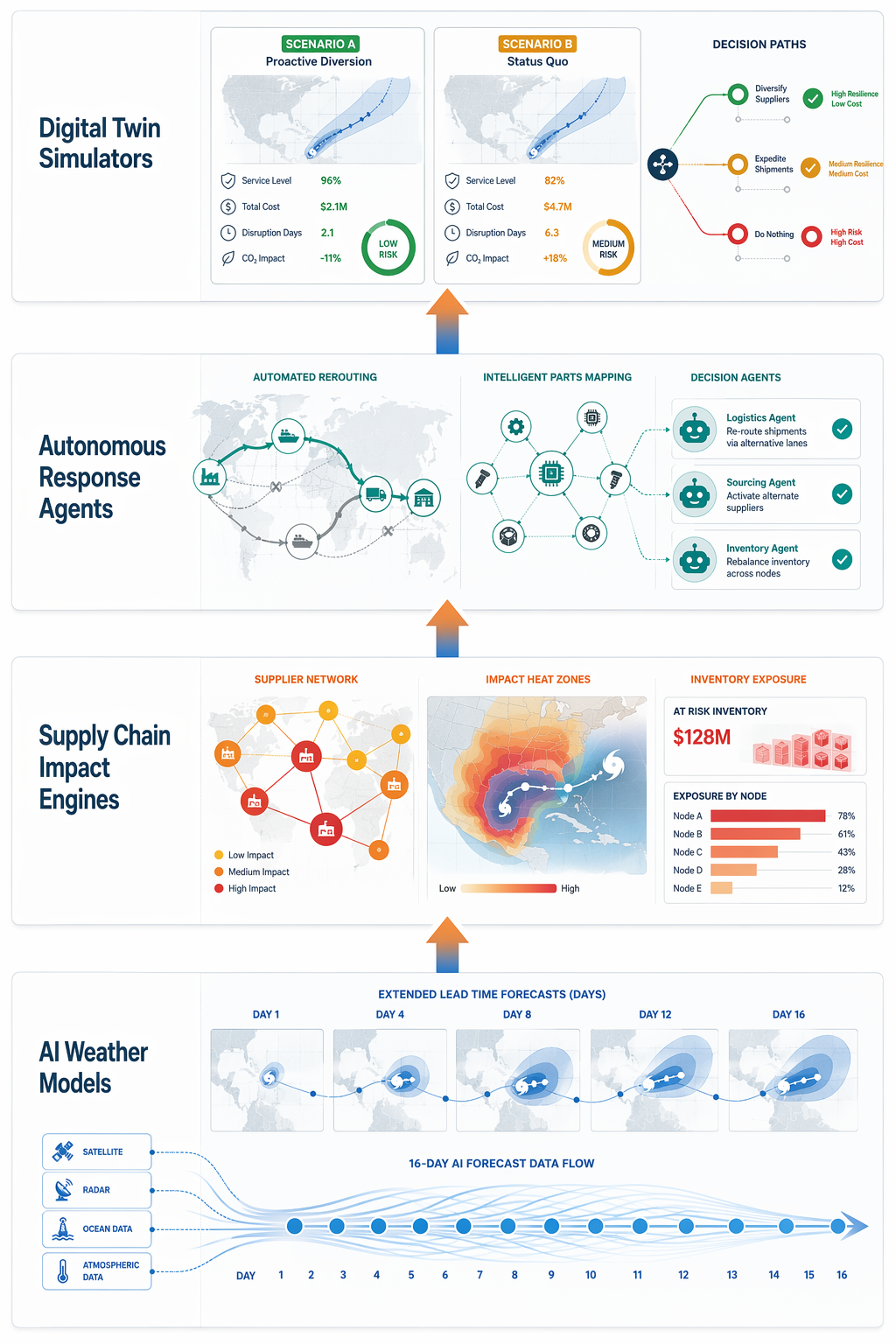
| Layer | What it adds to storm planning | Decision it can move earlier |
|---|---|---|
| AI weather models | Longer-lead probabilistic guidance on storm track, timing, and possible affected regions | Which facilities, ports, lanes, and supplier regions deserve attention before a storm is locked in |
| Supply chain impact engines | Translation of weather exposure into demand, inventory, procurement, and logistics risk | Where to stage stock, which SKUs to protect, and which customer commitments may need review |
| Autonomous response agents | Continuous scanning of parts, suppliers, lead times, and alternative supply or routing options | Which mitigations to prepare before planners are overloaded |
| Digital twin simulators | Comparison of contingency plans against service, cost, capacity, and timing constraints | Which plan is worth approving before carriers and inventory become scarce |
Weather Models: Better Lead Time, Not Perfect Certainty
NOAA’s AI weather model deployment is important because it changes the economics of producing forecasts. NOAA deployed AIGFS in December 2025 and reported that it uses 99.7% fewer computing resources than the traditional Global Forecast System, completes a 16-day forecast in about 40 minutes, and improves tropical cyclone track forecasts at longer lead times.[6]
That is the kind of improvement a planner can use: more runs, faster comparison, earlier attention on exposed nodes. But the limitation belongs in the same paragraph as the promise. NOAA also reported that AIGFS version 1.0 showed degraded intensity forecasts.[6] Track helps identify who may be in the path. Intensity affects how much capacity disappears, how long facilities may stay down, and whether a lane is merely delayed or effectively unusable.
NOAA’s broader AI model set, including AIGFS, AIGEFS, and HGEFS, points toward more forecast ensembles entering operational planning. For a supply chain team, the valuable output is not a single confident answer. It is a changing probability field that can be joined to supplier locations, inventory positions, lane options, and customer demand.
Impact Engines: Turning a Storm Path Into Exposure
A weather model does not know whether a two-day delay at a Gulf Coast warehouse matters more than a supplier outage inland. Impact engines do that translation. ClimateAi’s FICE capability is presented as a way to quantify the timing, duration, and magnitude of demand spikes tied to weather disruption.[1] In the Hurricane Ian roofing materials case, that meant seeing potential post-storm demand early enough to move inventory before the scramble.
Everstream describes a different but related role: combining NOAA GFS and GEFS data with proprietary models to produce 14-day cargo impact forecasts while processing more than 20 billion data points daily.[7] Everstream also reports that its risk-optimized procurement programs have seen a 30% reduction in revenue losses and 50% to 70% faster impact assessment.[7] Those are vendor-stated capability and outcome claims, not independently verified cross-market averages.
The practical test is whether the impact engine can rank exposure in language the business can act on. A planner does not need every supplier on a red map. She needs to know which suppliers affect constrained SKUs, which ports or lanes have no easy substitute, where inventory policy leaves no buffer, and which customer commitments are now sitting inside the storm’s uncertainty band.
Response Agents: Useful Only If They Know the Network
The next layer is where agentic AI becomes interesting, and also where it can become theatrical if it is not grounded in clean supply chain data. Z2Data describes an AI agent that maps every part manufactured in a storm’s path, estimates lead time impact such as a six-week delay, and surfaces buffer stock options while the storm is still forming.[8]
That kind of agent does not replace the planner’s judgment. It compresses the first ugly hours of analysis: which parts are exposed, which assemblies depend on them, how long substitutes may take, and whether available buffer stock changes the priority. Similar disruption-agent patterns from vendors such as Resilinc are most credible when they can explain what they found, what data they used, and which assumptions are driving the recommendation.
For related operational patterns, the same logic shows up in narrower logistics use cases such as AI highway closure detection and fleet rerouting. The difference in hurricane planning is that the better decisions often happen before closure alerts, not after them.
Digital Twins: Where Early Action Gets Defended
Digital twin simulators matter because early action has a credibility problem. Moving inventory, changing allocations, or booking alternative transport before a storm track is certain can look wasteful if the storm misses. Waiting until the forecast is obvious can leave the team competing for the same capacity everyone else now wants.
A useful digital twin lets planners compare contingency plans before making the expensive move. One plan might pre-position finished goods near likely demand. Another might protect scarce components upstream. Another might reserve alternate lanes but hold inventory in place. The simulator’s job is not to declare the future. It should show the service, cost, capacity, and recovery trade-offs under plausible storm paths.
This is where finance and operations have to meet. A forecast may give permission to ask the question earlier, but someone still has to approve inventory carrying cost, expedite premiums, carrier commitments, or customer allocation changes. The model has to be trusted enough to trigger a governed decision, not merely admired on a dashboard.
What Becomes Available Earlier
The real value of the stack is a longer decision window. In a weak workflow, the sequence is familiar: a tropical system forms, weather alerts intensify, operations asks for exposure, procurement starts calling suppliers, logistics discovers capacity is tight, and customer service inherits the apology list.
In a stronger workflow, the system starts assembling exposure before certainty arrives. A 16-day weather run can flag possible regions of concern. A 14-day cargo impact forecast can identify ports, terminals, lanes, and facilities that deserve review. A supplier-mapping agent can surface parts or sub-tier nodes inside the path. An inventory engine can show which locations have buffer and which customers will feel a shortage first. A digital twin can test whether pre-positioning, rerouting, alternate sourcing, or allocation changes reduce the expected damage enough to justify action.
- Inventory can move before post-storm demand and carrier scarcity peak.
- Procurement can identify exposed components before suppliers are already offline or unreachable.
- Logistics can reserve or evaluate alternate lanes before rerouting becomes a spot-market emergency.
- Customer teams can review allocation rules before service failures become individual escalations.
- Risk officers can document why the company acted early, waited, or chose a partial hedge.
McKinsey has estimated that AI can reduce supply chain errors by 20% to 50% and mitigate lost-sales risk by up to 65%.[9] That estimate is directionally relevant to disruption planning, but it should not be read as a hurricane-specific controlled result. For tropical storm use cases, the stronger evidence is narrower: named deployments, public model performance disclosures, shipping disruption measurements, and vendor-stated improvements in assessment speed.
The Evidence Is Promising, But Uneven
The strongest public-sector evidence in the current material is NOAA’s compute and forecast-performance disclosure. A 99.7% compute reduction and a 16-day forecast completed in about 40 minutes are measurable technical changes.[6] The improved longer-lead tropical cyclone track forecasts are directly relevant to earlier exposure mapping.[6] The degraded intensity forecasts are just as relevant because intensity influences damage, closure duration, and recovery assumptions.[6]
The strongest operational case is the ClimateAi Hurricane Ian example because it ties a pre-storm forecast to inventory action and a reported commercial outcome.[1] Its weakness is also clear: one client, one storm, one product context, and vendor reporting. It proves that the pattern is possible, not that every company will find $15 million by buying a forecast.
The Everstream material is useful for understanding the impact-engine layer because it gives a concrete claimed forecast horizon, data-processing scale, and assessment-speed improvement.[7] Its claims should remain attributed to Everstream. A planner can still use them to shape vendor questions: what data points matter, how the cargo forecast is validated, how often false positives trigger action, and how quickly exposure scoring updates when a storm path changes.
The disruption statistics explain why leadership is paying attention, but they should not be stretched into proof of AI effectiveness. A 75% shipment drop during Hurricane Ian and a 2.5-day increase in shipping time describe disruption severity.[4] They do not prove that a specific AI workflow would have prevented the losses. The value of those figures is to set the cost of late awareness.
Implementation Constraints That Decide Whether It Works
The hardest part is usually not getting another forecast. It is connecting the forecast to the data that determines action: supplier sites, sub-tier dependencies, bills of material, inventory by location, open orders, customer priority rules, contracted carrier capacity, lane alternatives, and recovery-time assumptions.
If those data sets live in separate systems, the AI workflow becomes another alert stream. A tropical storm path appears on one screen, supplier exposure on another, inventory in an ERP report, and transportation options in emails or a TMS queue. By the time someone joins the picture manually, the claimed lead time has already been spent.
- Model governance: teams need rules for acting on probabilistic forecasts, especially when track confidence improves faster than intensity confidence.
- Data readiness: supplier locations, part mappings, inventory records, and logistics constraints must be current enough to support automated exposure scoring.
- Decision rights: planners need pre-approved thresholds for staging inventory, reserving transport, changing allocations, or escalating procurement.
- False-alarm tolerance: finance and operations need to agree how much protective action is acceptable when a storm changes direction.
- Post-event review: every storm should update assumptions about lead times, supplier recovery, carrier behavior, and customer demand.
A cautious pilot can be narrow. Pick a hurricane-exposed product family, map the critical suppliers and lanes, define inventory and service thresholds, and run the AI workflow through storm scenarios before using it during live season. The goal is not to automate heroics. It is to make earlier action boring enough to approve.
AI-powered tropical storm disruption planning is credible when weather intelligence, supplier exposure, inventory policy, and logistics execution are integrated. It remains probabilistic planning. Track can improve while intensity remains weaker. Vendor outcomes can be real without being universal. The teams that get value will be the ones that govern those trade-offs explicitly and give planners a defensible reason to act before the storm has already made the decision for them.
References
- Accurate Hurricane Forecasting Helps Roofing Materials Producer Come Out on Top, ClimateAi
- BCI Horizon Scan 2025 reporting, Tradeverifyd
- Earth was hit by 55 billion-dollar weather disasters in 2025, Yale Climate Connections
- The impact of hurricanes on supply chain and transportation, Everstream and Geotab
- NOAA predicts below-normal 2026 Atlantic hurricane season, NOAA
- NOAA deploys new generation of AI-driven global weather models, NOAA, December 2025
- Applying NOAA and AI Weather Forecasting Models to Supply Chains, Everstream
- How to monitor supply chain exposure to climate events with AI, Z2Data
- AI supply chain performance estimates, McKinsey & Company
Comments
Join the discussion with an anonymous comment.