
A naval drill near a maritime chokepoint does not have to close the waterway to damage a supply plan. The narrowing starts earlier: a carrier pauses a service, another announces a longer route, schedules are revised, insurers reprice the lane, and inventory owners discover that the booking they were saving as a fallback has become everyone else's fallback too.
That is the planning problem this use case has to solve. The question is not whether an AI system can declare that a strait will close. It is whether scenario simulation can show when the usable option set is being consumed while the chokepoint is still technically open.
The readiness gap is real but not especially mysterious. DP World reported that 82% of supply chain leaders see geopolitical disruption as a major risk, while only 25% feel prepared for it.[1] The uncomfortable part is that many contingency plans still wait for a formal trigger: port closed, lane closed, sanctions imposed, route unavailable. Naval exercises do not always move that cleanly. They create pressure before they create closure.
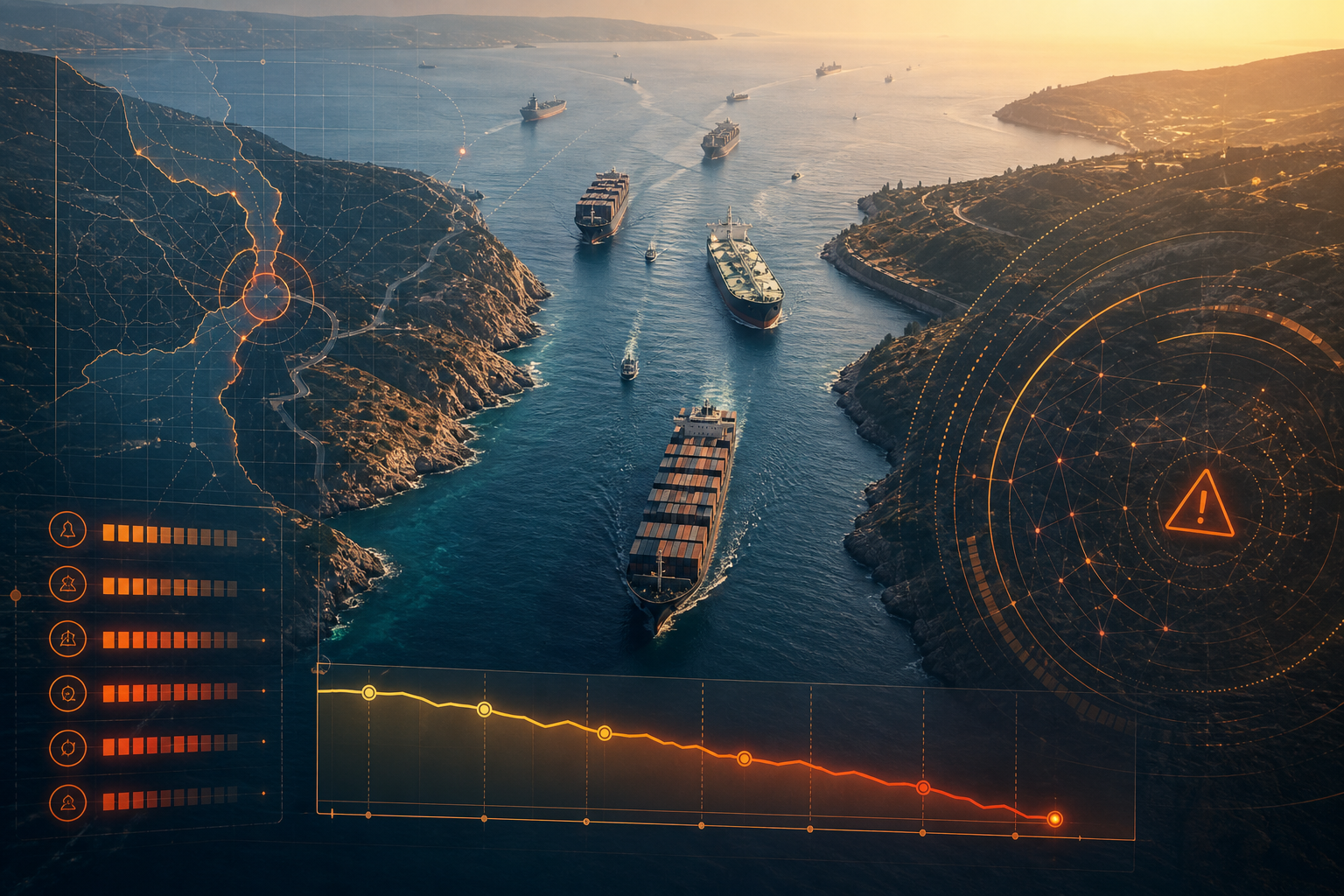
The Event Is Open; the Plan Is Already Narrowing
A binary plan treats the chokepoint as available until it is not. That sounds disciplined, but it hides the handoffs that actually make freight move: vessel assignment, booking release, insurance approval, terminal window, customs timing, inventory allocation, customer promise. When one of those handoffs stretches, the next one inherits less room.
The first visible change may be a service suspension rather than a military incident. A carrier may avoid a call for a week, or a forwarder may stop offering a quoted transit time with confidence. The next change is often a rerouting announcement. That shifts demand onto alternate lanes, which are not empty reservoirs waiting for disciplined planners. They have vessel space, port capacity, rail slots, driver availability, and contract priorities of their own.
Schedule revisions then turn the pressure into operating cost. A shipment that was late but manageable now misses a production window. Safety stock is pulled forward. A replenishment order competes with expedited freight from teams that waited longer. Insurance cost spikes are not just a finance issue; they become an approval delay, a margin decision, and sometimes a reason to hold cargo until leadership decides who absorbs the premium.
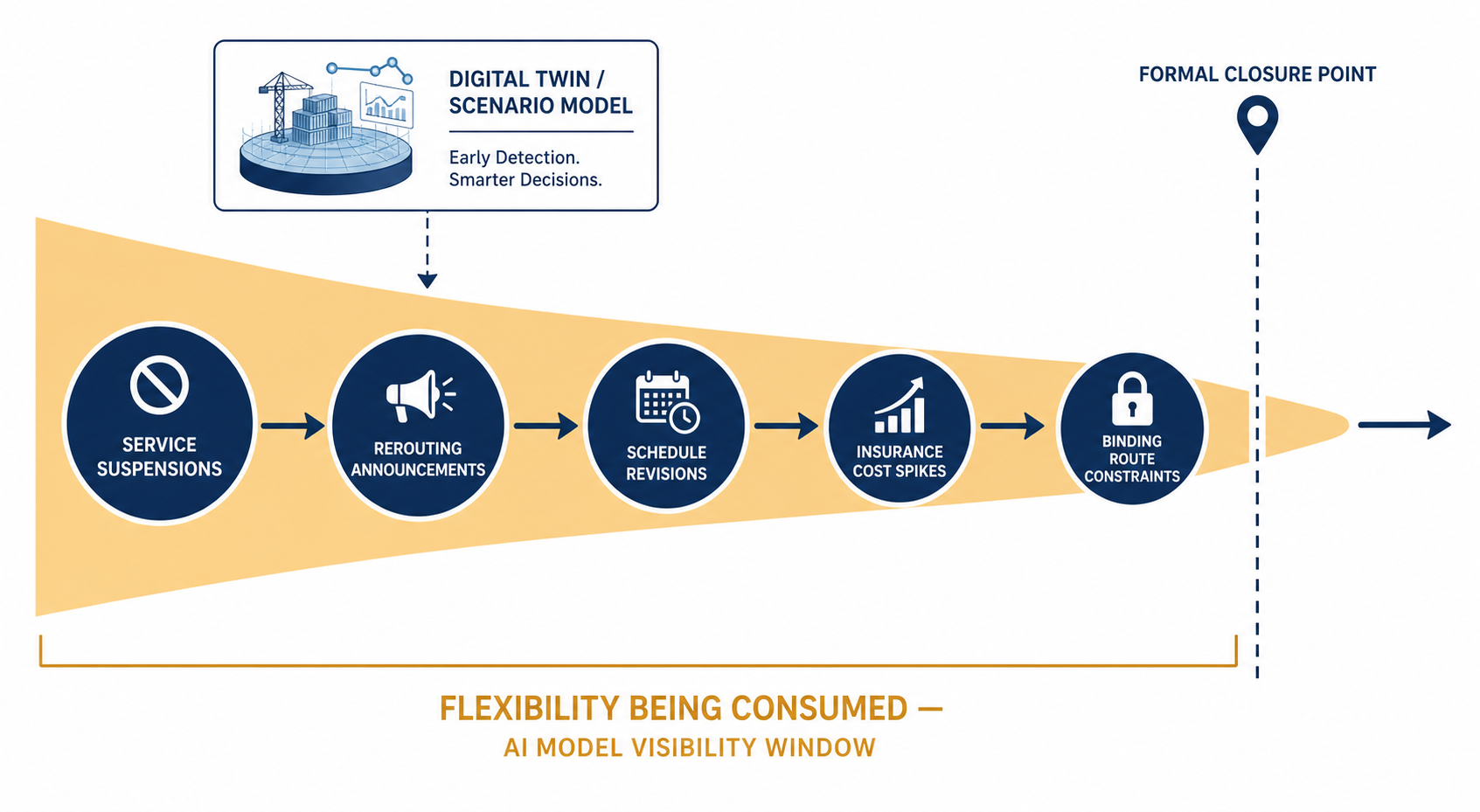
The binding moment is easy to miss. It may not be the day a navy announces an exclusion zone or the day a strait is declared closed. It may be the day the last commercially acceptable alternate sailing is booked, the day an insurer will only quote at a level the business will not approve, or the day a plant consumes the inventory that made delay survivable. Once that happens, the planner is no longer choosing among options. The planner is explaining consequences.
What the Scenario Model Has to Represent
A useful digital twin for this use case is not a glossy map with vessel icons. It is a working representation of routes, lead times, booking cutoffs, carrier capacity, port and transshipment constraints, insurance assumptions, inventory positions, production dependencies, customer promise dates, and the commercial rules that decide when a workaround is acceptable.
The model needs to degrade those variables together. If a carrier suspends a service, the simulation should not only move the shipment to a longer route. It should also test whether the alternate route has space, whether the new arrival misses a plant schedule, whether the added transit time consumes safety stock, whether the margin can tolerate a higher premium, and whether the procurement team has authority to split volume across another supplier or port pair.
| Pressure signal | Operational variable the model should update | Decision it brings forward |
|---|---|---|
| Service suspension | Available sailings, contract priority, capacity by lane | Book alternate space before it becomes scarce |
| Rerouting announcement | Transit time, port congestion, transshipment reliability | Move high-priority cargo first instead of spreading delay evenly |
| Schedule revision | ETA confidence, production window, customer commitment | Decide which orders need inventory substitution or expedite approval |
| Insurance cost spike | Landed cost, approval threshold, cargo value exposure | Pre-approve premium limits or hold rules before finance becomes the bottleneck |
| Binding route constraint | Remaining feasible paths and time-to-failure by node | Execute the pre-positioned response rather than restart analysis |
This is where AI changes Tuesday's work. A planner who sees only a lane status update can say, accurately, that the chokepoint remains open. A planner using scenario simulation can say something more useful: if one more carrier withdraws capacity, these purchase orders lose their last route that protects the production date; if insurance rises beyond this approval band, these cargoes will sit unless finance has already authorized the exception; if the alternate port absorbs this much extra volume, the rail leg becomes the constraint rather than the ocean leg.
The model is not predicting a single future. It is ranking the futures that matter operationally because they consume flexibility. That distinction matters when the evidence is noisy, the military signals are incomplete, and commercial actors are changing behavior before there is a public crisis.
Scale Matters, but Exposure Is Not a Stopwatch
The global stakes justify the modeling effort, though they should not be turned into theatrical certainty. Verschuur et al. estimate annual expected trade disruption of $191.5 billion across 24 maritime chokepoints, with uncertainty bands around that modeled value.[2] The study also identifies geopolitical conflict as the dominant hazard driver at the Taiwan Strait, the Strait of Hormuz, and the Bab el-Mandeb Strait.[2]
For a planner, the important lesson is not simply that a large amount of trade is exposed. It is that chokepoint risk is uneven, multi-causal, and not always isolated. The same study finds that 40% of cyclone events affect more than one chokepoint simultaneously, which is a reminder that a fallback lane can be compromised by a different hazard at the same time the primary lane is under geopolitical pressure.[2]
That is why single-threat playbooks age badly. A naval drill scenario near one strait can collide with port congestion, weather, piracy risk, labor constraints, or a demand surge on the alternate route. AI scenario engines are useful when they test combinations rather than asking one sterile question: what if the chokepoint closes?
This article sits beside, rather than replaces, commodity-specific work such as How AI Predicts Oil Supply Disruptions at the Strait of Hormuz. Oil has its own price transmission, storage, and substitution logic. The broader planning pattern here applies across cargo categories: the drill creates a pressure cascade, and the model helps decide which options must be protected before they disappear.
From Signals to Options to Adaptation
MIT Sloan Management Review frames geopolitical supply chain resilience around understanding signals through scenario planning, anticipating risks by creating flexible options, and adapting quickly as conditions change.[3] That sequence is useful as long as it stays tied to operating decisions rather than becoming a workshop diagram.
Signals: Separate Noise From Capacity Loss
A naval exercise produces more signals than a planning team can manually weigh: AIS irregularities, carrier advisories, port notices, war-risk premium movement, bunker cost changes, news reports, customs updates, customer escalations, and supplier emails that say very little while implying quite a lot. The model's first job is not to dramatize those signals. It is to translate them into variables the operating plan can use.
A carrier advisory matters if it removes capacity from a lane where the company has time-sensitive cargo. A premium increase matters if it crosses an approval threshold or changes the landed-cost case for one supplier over another. A schedule revision matters if it moves arrival past a production gate, not merely because the ETA changed. Scenario simulation gives those signals a consequence chain.
Options: Keep Workarounds Commercially Real
An alternate route is only an option if someone can book it, afford it, insure it, receive it, and still use the goods when they arrive. AI planning tools should therefore attach constraints to every workaround. A route that adds time may be acceptable for replenishment stock but useless for a plant-critical component. Air freight may protect a launch order but destroy margin on a low-value SKU. A second supplier may be approved for emergency sourcing but not qualified for regulated production.
The better output is not a ranked list of clever alternatives. It is a set of pre-positioned choices with expiry clocks: reserve this capacity by this date; move this inventory before this cutoff; request this insurance approval before the premium band changes; split this purchase order before the supplier's allocation is committed elsewhere.
Adaptation: Let Humans Decide With Fewer Surprises
Agentic decision support can monitor the scenario state and surface actions when thresholds are crossed: move certain SKUs from regional stock, convert a booking from ocean to air-sea, advance a supplier release, reserve capacity through a secondary forwarder, or trigger a finance approval for war-risk premiums. The system can draft the recommended move, show the assumption set, and identify the consequence of waiting.
It should not silently execute the most expensive or customer-visible decisions. Human-in-the-loop review is not ceremonial here. The model may see a feasible route, but a logistics lead may know that the receiving warehouse is already labor-constrained, or that a customer will accept a delay on one order but not another. The point is to move the review earlier, while the answer can still change the outcome.
The DLA Example Shows the Pattern and the Caveat
The Defense Logistics Agency's AI Center of Excellence describes using AI simulation for Defense Fuel Support Points, modeling equipment failure, environmental hazards, and supply chain interruptions so teams can pre-position mitigation strategies instead of reacting after a disruption occurs.[4] That is the same operating logic a commercial maritime planner needs: rehearse pressure, identify the weak handoff, and place the mitigation before the system is forced into triage.
The case is useful because fuel logistics in contested environments has little patience for decorative dashboards. A missed handoff can become a mission constraint. The planning value lies in testing how failures compound: equipment outage plus weather exposure plus supply interruption, rather than one tidy risk at a time.
It is still a government case study about a government AI program, so its positive framing should be read with that gravity in mind. The same DLA article cites independent Government Accountability Office findings that data model gaps affected about 40% of strategic materials.[4] That limitation is not a footnote for commercial teams. If a model lacks clean data on inventory, supplier qualification, route feasibility, or cost thresholds, its recommendations may look confident precisely where the planner needs provenance.
What to Demand From a Naval Drill Scenario Model
The buying question is not whether the platform has AI. It is whether the platform can preserve optionality under a creeping disruption. A useful evaluation should make the vendor walk through the handoffs, not just the map.
- Data provenance: The tool should distinguish verified operational data from industry reporting, expert estimates, and inferred signals.
- Scenario calibration: The model should show how assumptions were set for rare naval-drill conditions, especially when historical examples are sparse.
- Constraint realism: Alternate routes should include capacity, time, cost, insurance, inventory, receiving, and contractual limits.
- Decision thresholds: Recommendations should connect to approval rules, service commitments, production gates, and margin limits.
- Human override: Planners should be able to accept, reject, edit, and document recommendations before action is taken.
- Time-to-option-loss: The system should show when each workaround expires, not only the estimated delay if nothing changes.
The last point is often the one that changes behavior. A dashboard that says "moderate risk" invites debate. A scenario output that says "secondary capacity must be reserved within 36 hours or these orders lose the production window" gives the logistics lead something defensible to take to procurement, finance, and sales. The precise threshold in any real deployment should come from the company's own contracts and operating data, but the format of the decision is the same: act before the formal trigger because the option has an earlier expiration date.
For teams still deciding which AI capabilities belong in disruption planning more broadly, Which AI Capabilities Should You Invest in for Disruption Planning? is the wider investment frame. Naval drill planning is a narrower use case, but it is a revealing one because the value depends less on prediction theater and more on earlier, better-justified action.
Where the Model Can Mislead
Rare geopolitical scenarios are hard to calibrate. Naval drills near chokepoints do not provide a large, clean training set, and a future exercise may involve tactics, commercial reactions, or diplomatic signals that the model has not seen. AI can rehearse plausible pressure sequences; it cannot guarantee that the next sequence will stay inside its learned distribution.
This matters most when the model blends data types. Verified AIS data, carrier advisories, insurance quotes, expert estimates, port notices, and media reporting do not carry the same evidentiary weight. A system that treats them as interchangeable may produce a clean recommendation from uneven inputs. The planner needs to see confidence, source type, timestamp, and what changed since the last run.
Modeled trade disruption also should not be read as precise loss. Verschuur et al.'s $191.5 billion figure is an expected annual value from a global modeling exercise, not a stopwatch for the next naval drill or a guaranteed commercial loss for any one company.[2] The right use of that evidence is to justify multi-chokepoint scenario planning, not to pretend the model has priced tomorrow's event to the dollar.
A similar caution applies to operational case studies. The DLA example shows how simulation can support pre-positioned mitigation in a contested-logistics environment, but the cited data gaps show why the plumbing matters.[4] A commercial tool that cannot reconcile purchase orders, in-transit stock, supplier constraints, and lane capacity will struggle just as much, even if its interface looks more modern.
The Practical Judgment
AI earns its place in naval drill supply chain disruption planning when it changes the timing of action. It should help a planner defend an early reroute, inventory move, capacity reservation, or approval request while the chokepoint is still open and the evidence is still incomplete.
That is a narrower claim than saying AI predicts geopolitical disruption. It is also more useful. The value is not knowing whether a chokepoint will close. The value is seeing when flexibility is being consumed, which decisions are about to become binding, and which mitigations must be placed before the formal trigger arrives.
References
- DPW Study Finds Supply Chains Underprepared for Geopolitical Risks, DP World.
- Global maritime trade is at risk from disruptions at key chokepoints, Nature Communications, 2025.
- Stay Ahead of Geopolitical Supply Chain Risks, MIT Sloan Management Review.
- Utilization of Artificial Intelligence (AI) to Illuminate Supply Chain Risk, Defense Logistics Agency.
Comments
Join the discussion with an anonymous comment.