
A tornado warning is useful because it is early, imperfect, and specific enough to make people move before the sky proves the model right. The supply chain version has to clear the same bar. An alert that arrives after the port is closed, the supplier has missed the ship date, or the cyber rumor has become a carrier embargo is not a warning. It is an explanation for the expedite bill.
That is why the tornado-warning metaphor fits supply chain disruption planning. Weather tornado warnings are often discussed in minutes; one current supply chain framing compares an average weather warning of about 13 minutes with the ambition for AI systems to give planners several days of notice before disruption impact.[1] The useful question is not whether AI can predict every disruption. It cannot. The question is whether a multi-signal system can give a planner enough time to make one calm decision before every function joins the emergency call.
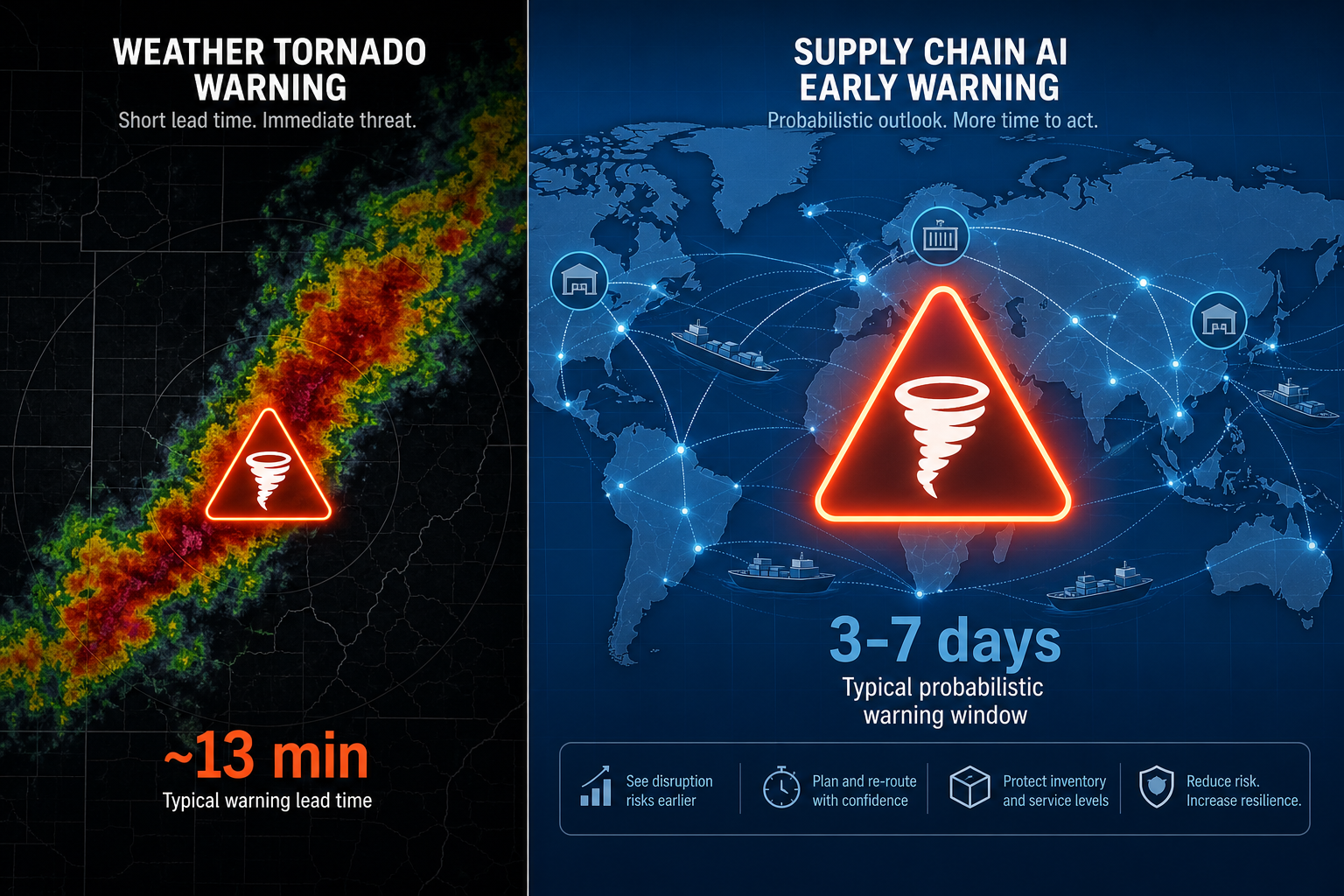
In Q3 2026, the answer is cautiously yes. AI early-warning systems are real enough to change planning behavior, and the strongest evidence points to notice windows in the three-to-seven-day range for certain disruption classes. The boldest figure in the current material is a secondary-source claim that Johnson & Johnson’s AI system detects 85% of major disruptions about seven days before impact.[2] That is a serious claim, but it should be read with the brake pedal covered: the figure is attributed through the World Certification Institute, not verified here against a direct Johnson & Johnson publication.
The market has a reason to listen. In a 2026 Dataiku and DP World report, 78% of supply chain leaders said they expect disruptions to intensify, while only 25% said they feel prepared.[3] Those numbers describe anxiety, not capability. They do explain why a warning layer that turns scattered signals into a usable planning interval is getting attention.
What Counts as a Supply Chain Tornado Warning
A credible warning is not a red icon on a dashboard. It has to say what may be affected, how soon, how confident the system is, and what assumption the planner should reconsider. The useful version might flag that a supplier region has escalating flood risk, a logistics lane is showing abnormal carrier behavior, a contract manufacturer has changed shipment language, or a cyber incident is beginning to touch a freight node.
That is a different job from conventional exception management. Exception management waits for a missed milestone or a threshold breach. Early warning tries to detect the pattern before the missed milestone appears. It works best when several weak signals point in the same direction: weather forecasts, vessel movement, port congestion, supplier emails, news, sanctions, cyber chatter, purchase order changes, and inventory exposure.

The planner does not need prophecy. She needs a decision window. Three reliable days may be enough to resequence inventory, warn sales about constrained promise dates, ask procurement to validate alternate supply, or change transport assumptions before the first bad update arrives. Seven days can be better, but only if the signal is strong enough that the organization is willing to act on it.
The Lead-Time Evidence Is Promising, but Uneven
The Johnson & Johnson figure is the closest thing in the current evidence set to a load-bearing deployment claim: 85% of major disruptions detected roughly seven days before impact.[2] If accurate, that is meaningful because it connects detection to a planning horizon. It does not merely say AI classified historical incidents correctly; it says the system reportedly found most major events early enough for people to respond.
The caveat matters. Secondary attribution is not the same as a direct operating disclosure. The article citing the figure does not let a reader inspect the event set, definition of “major disruption,” false-positive rate, action thresholds, or what counted as “impact.” For a planner, those missing details are not academic. They determine whether an alert triggers a supplier escalation, a transport backup, a finance conversation, or no action at all.
Other evidence supports a narrower but still useful conclusion. TrellisSoft describes AI systems that analyze unstructured supplier communications and provide three-to-seven days of disruption notice before production stalls.[4] That window is plausible for the kind of language drift planners recognize: a supplier stops confirming exact quantities, changes tone around a shipment, delays a response, or adds qualifiers to a date. Natural language processing can scan at a scale no category lead can match, but it still depends on access to the communication stream and on knowing which phrases are normal for that supplier.
Weather signals are often cleaner than supplier-intent signals because the event has an external physical model. A heavy-rain forecast, storm track, or flood probability can be mapped against facilities, ports, and lanes. ChainSignal’s AI heavy rain logistics disruption prediction use case is a good example of weather as one signal class inside a broader warning model. Weather alone is not supply chain risk. Weather plus lane exposure, supplier location, inventory position, and customer priority starts to become planning information.
The most technically striking result comes from a January 2026 arXiv pre-print on agentic AI for disruption monitoring. The framework reported mean end-to-end analysis time of 3.83 minutes against an approximately five-day industry benchmark, with F1 scores from 0.962 to 0.991 and a cost of $0.084 per scenario.[5] That is an architecture signal, not a procurement-ready promise. It shows how fast AI agents may be able to collect, reason, classify, and produce a disruption assessment. It does not prove that every company can deploy the same capability safely across its own supplier network next quarter.
| Evidence type | What it supports | What it does not prove |
|---|---|---|
| Secondary deployment claim | 85% of major disruptions detected around seven days ahead in the cited Johnson & Johnson example | Directly verified operating performance, false-positive rate, or transferability to other networks |
| Supplier-communication NLP | Three-to-seven-day notice may be possible when supplier language changes before failure | Reliable warning when supplier data is missing, delayed, or not representative |
| Weather-linked detection | Physical hazard signals can be mapped to exposed lanes, sites, and inventory | Full disruption impact without network and inventory context |
| Agentic research benchmark | AI analysis can move from days to minutes in a controlled research setting | Commercial readiness or organizational willingness to automate response |
The practical reading is that “seven days” should not be sold as a universal entitlement. Early warning has a reliability cone. A seven-day signal may be faint but worth watching. A three-day signal may be strong enough to move inventory. A same-day signal may still matter if it keeps the team from discovering the problem through a customer miss. Lead time is only valuable when paired with confidence, exposure, and a pre-agreed response threshold.
The Warning Gets Weaker When the Network Is Invisible
Most disruption-warning programs run into a basic visibility problem: the event that hurts you may not begin with the supplier you monitor directly. CETaS and the Alan Turing Institute report that at least one-third of disruptions originate beyond Tier 1.[6] That is where many companies still have the thinnest data.
A Tier-1-only system can still be useful. It can flag late confirmations, abnormal order behavior, weather exposure at a named site, or logistics disruptions on contracted lanes. But it may miss the sub-tier factory that makes a critical resin, chip, packaging component, or specialized input. By the time the Tier-1 supplier admits the problem, the clean warning window may already be gone.
This is where multi-signal fusion earns its keep. If the system cannot see every supplier relationship directly, it can still watch external signals around regions, commodities, ports, cyber incidents, weather, and news. That does not replace mapped supplier data. It gives the planner a wider perimeter. The alert should make clear whether it is based on confirmed supplier exposure or inferred exposure, because those two warnings deserve different responses.
Cyber risk shows why unstructured monitoring matters. Everstream Analytics reported that cyberattacks on logistics surged 965% from 2021 to 2025.[7] A cyber event may surface first as local news, dark-web chatter, carrier portal outages, customer-service delays, or odd shipment status patterns. No planner wants a model inventing drama from internet noise. But ignoring those weak signals until a logistics provider sends a formal service bulletin is also a choice, and usually not a cheap one.
The Real Bottleneck Is Trusting the Alert Enough to Act
A warning system fails quietly when people admire the dashboard and keep running the old meeting. That is why the organizational data matters as much as the model data. In RELEX’s 2026 survey, 67% of respondents said they were more confident in AI, but only 10% trusted autonomous decisions, and 54% preferred a human-in-the-loop approach.[8]
Those numbers do not say companies reject AI. They say most companies are not ready for AI to issue commands without a person accountable for the tradeoff. That is a reasonable posture in disruption planning. An alert can reduce one risk while creating another: excess inventory, premium freight, supplier fatigue, customer allocation tension, or a finance challenge over working capital. Someone has to decide whether the warning is strong enough to spend money before the disruption is visible.
The best design, for now, is not an autonomous panic button. It is a decision aid with visible reasoning. A usable alert tells the planner:
- Which products, suppliers, lanes, sites, or customers may be affected
- What signal classes contributed to the warning
- How confidence has changed since the previous refresh
- What operational actions are available within the remaining lead time
- Which action requires cross-functional approval before execution
That last point is where many systems disappoint. They detect a risk but do not know the company’s response muscle. A seven-day warning is useful if procurement can validate alternate supply in two days, planning can rerun allocation scenarios, logistics can price backup capacity, and finance can tolerate a pre-buy. If all of those approvals take longer than the warning window, the model may be early and the company may still be late.
What Planners Can Actually Do With Three to Seven Days
The value of an early-warning system is easiest to see through the actions it makes possible. A weak seven-day alert might justify quiet preparation: check inventory by node, identify open purchase orders, ask the supplier for a status confirmation, and line up an alternate transportation assumption without committing spend. A stronger five-day alert might trigger constrained supply review, customer prioritization scenarios, or pre-booked capacity. A high-confidence three-day alert may justify moving stock, changing production sequence, or escalating allocation decisions.
This is where probabilistic warning has to be operationalized. If every orange signal gets treated as a crisis, the organization will stop listening. If every early signal gets treated as speculation, the warning layer becomes decorative. The system needs tiers that map uncertainty to action, not just severity labels.
| Warning condition | Likely planning response | Why it matters |
|---|---|---|
| Early signal, uncertain exposure | Monitor, validate supplier or lane exposure, prepare scenario options | Keeps the team from spending too early while preserving attention |
| Moderate confidence, known exposure | Rerun supply plan, test inventory buffers, alert procurement and logistics | Turns warning time into executable alternatives |
| High confidence, material customer or production impact | Escalate decision rights, commit mitigation spend, communicate constraints | Prevents the first formal response from happening after impact |
The model can help set those tiers, but the thresholds are business decisions. A medical device shortage, a seasonal retail miss, a commodity input delay, and a low-margin consumer product stockout do not deserve the same trigger. The same probability can justify different actions depending on customer obligation, substitution options, inventory position, and cost to reverse the decision.
Seven Days Is Plausible, Not Portable
A good AI disruption-warning system in 2026 can look a lot like a supply chain tornado warning. It can fuse signals faster than a human team, detect patterns across messy external and internal data, and give planners time to act before impact. The evidence supports multiple-day notice in leading cases and certain signal classes, with the strongest current deployment claim pointing to 85% major-disruption detection about seven days ahead.[2]
But the number does not travel by itself. Seven days depends on data access, signal quality, multi-tier visibility, clear exposure mapping, and a company culture willing to take measured action before proof is complete. A weak seven-day alert may only deserve monitoring. A reliable three-day alert with explainable exposure may be worth money.
The practical frontier is no longer whether AI can see more than a planner watching email, weather maps, and carrier updates at 6 a.m. It can. The frontier is calibrating when an early probabilistic alert deserves operational action, and designing the warning so the human team can defend that action when finance, sales, procurement, and logistics all ask how sure the system really is.
References
- What is an AI Tornado Warning System? — Frank Underdown, LinkedIn
- From Reactive to Proactive: How AI-Driven Supply Chains Weather Every Storm — World Certification Institute
- Supply chain AI trends 2026: building resilient operations — Dataiku
- Early Warning System: Using AI to Detect Supply Chain Risks Before Production Stalls — TrellisSoft
- Automating Supply Chain Disruption Monitoring via an Agentic AI Approach — arXiv, January 2026
- Mitigating Supply Chain Threats: Building resilience through AI-enabled early warning systems — CETaS / The Alan Turing Institute
- Are You Prepared for the Supply Chain Disruptions of 2026? — Everstream Analytics
- Supply chain AI in 2026: The numbers behind the hype — RELEX
Comments
Join the discussion with an anonymous comment.