
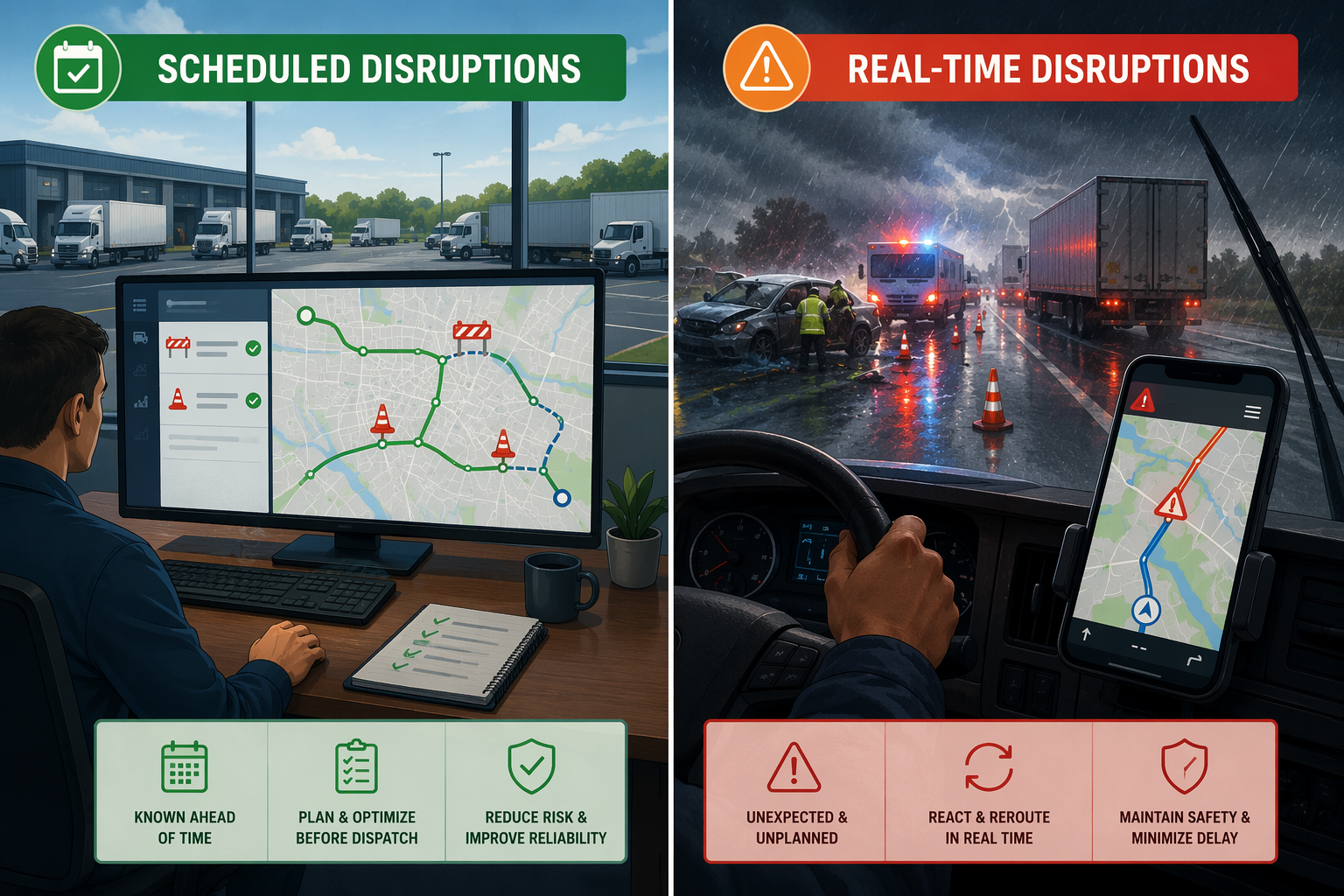
A road closure schedule is not a traffic incident. If a bridge repair, downtown street closure, stadium event, or permit-based restriction was published before the routing run, the right question for AI supply chain planning is not how fast the system can panic after departure. It is whether the closure reached the plan before the driver received the route.
That distinction matters in 2026 because routing teams are asking for both reactive and predictive capabilities at the same time. Trimble’s Transportation Pulse Report 2026 found that 54% of carriers prioritize real-time rerouting, while 53% prioritize predictive route and load planning. It also found that 31% of carriers already use AI for routing and 44% of shippers use AI in transportation planning, with inconsistent data cited as the top barrier to AI success.[1]
Those figures point to a useful maturity line. The market is ready to talk about AI route optimization, but the road closure schedule use case succeeds or fails in the less glamorous layer: whether published closure data is complete, normalized, map-matched, time-bound, and delivered into the planning system early enough to change the route.

Scheduled Closures Belong Before Dispatch
The category error is treating every disruption as if it appears on the windshield. Accidents, emergency closures, flash flooding, and fast-moving storms may require real-time detection and rerouting. Scheduled construction closures, planned civic events, lane restrictions, and permit-based movements are different. They usually exist as calendar and geography problems before they become driver problems.
EnrouteAI’s founder makes the point with city events: “a ball game schedule is published months in advance,” yet many carriers still treat the resulting disruption as a surprise. The company frames the problem as learning a city’s operational “fingerprint” from granular data rather than merely reacting to traffic after it forms.[2]
That does not mean every closure can be planned away cleanly. A posted closure may change, field crews may miss a timestamp, and a road name in one feed may not match the road segment in a routing graph. But when the closure is knowable before dispatch, the planning workflow should start with ingestion, not incident response.
Weather sits on the other side of the disruption spectrum. Forecasting can move some weather risk earlier in the planning cycle, but severe weather still carries uncertainty that scheduled roadwork usually does not. ChainSignal’s analysis of AI route planning ROI in severe weather and AI weather forecasting for supply chain logistics covers that less deterministic side of routing risk. Road closure schedules deserve their own treatment because they are often structured, time-bound, and available before the route is built.
The Data Path From Closure Schedule to Route
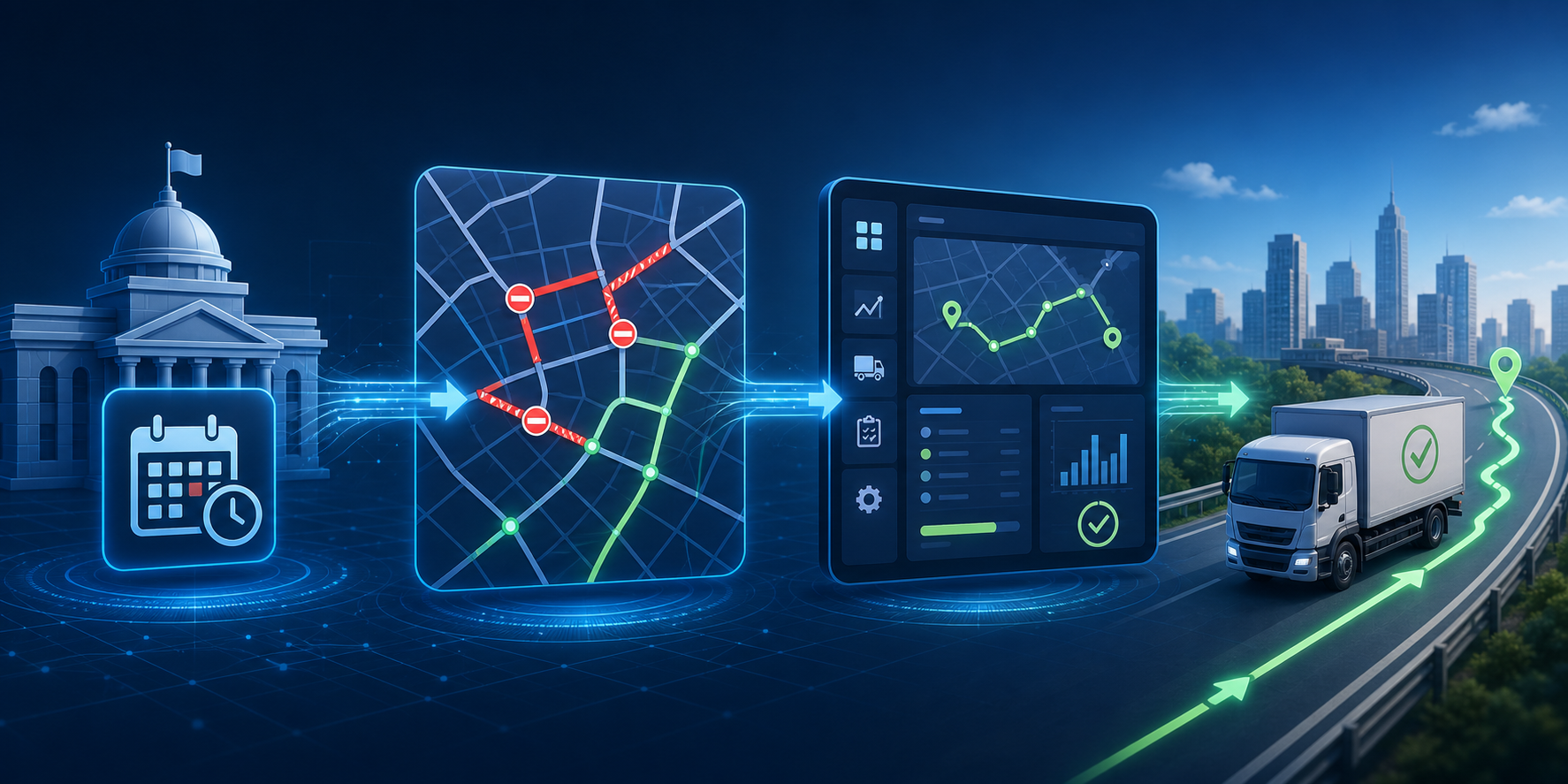
A useful workflow for AI supply chain planning with road closure schedules is not mysterious. It is a chain of handoffs. The system has to receive the schedule, understand where the closure sits on the road network, know when it applies, test the route options, and send the selected plan into the transportation management workflow before dispatch.
| Planning step | What has to be usable |
|---|---|
| Published closure feed | Start and end times, affected road names, directionality, restriction type, source reliability |
| Geometry standardization | Polyline or segment geometry that can be compared with the routing network |
| Road-network matching | Closure location matched to the correct road segment, not just a text description |
| Planning-system ingestion | Closure data loaded into the routing engine or TMS before the route run |
| Alternative route computation | Candidate routes evaluated against delivery windows, miles, drive time, service sequence, and constraints |
| Dispatch execution | Drivers receive routes that already avoid the scheduled closure, with exceptions flagged for review |
The hard work is in the middle rows. A calendar entry saying “Main Street closed Saturday” is not enough for a route optimizer. The system needs the segment, the direction if only one side is restricted, the effective time window, and a clean match between the closure feed and the map used by the routing engine. Otherwise the AI may be optimizing around a closure that is misplaced, expired, duplicated, or invisible.
Why the NCDOT and Waze Case Is Useful
The North Carolina Department of Transportation and Waze automated road closure case is not a commercial carrier ROI study. It is still one of the more useful examples because it shows what has to happen before a closure becomes usable routing data.
NCDOT’s automated closure feed reduced data-entry time from about 20 minutes to about 5 minutes per closure. Getting there took more than two years of development and included polyline geometry formatting, road-name matching through a reverse geocoding API, and training roughly 500 staff.[3]
That is the unglamorous pattern logistics teams should notice. The improvement was not magic prediction. It was automation around closure capture, formatting, matching, and publication. Commercial logistics systems need a similar chain, even if the feed sources and TMS endpoints differ.
For a carrier, the equivalent workflow may combine state DOT feeds, municipal construction notices, event calendars, toll authority restrictions, customer site access rules, and internal delivery constraints. AI can help rank alternatives and learn which detours work better in practice, but it cannot compensate for a closure feed that arrives after routes have already been locked.
Where AI Adds Value After the Feed Is Clean
Once closures are represented as reliable planning inputs, AI has a more concrete job than “be dynamic.” It can compare route candidates, service sequences, driver hours, customer time windows, historical congestion patterns, vehicle restrictions, and depot cutoffs under the known closure schedule. The planning system can then surface an alternate route before the dispatcher starts the morning rebuild.
In practice, the useful output may be modest and operational: a delivery stop moves earlier because its usual access road closes at noon; a downtown route is resequenced around an event perimeter; a driver is assigned a slightly longer first leg to avoid a closure that would otherwise break a delivery window later in the day. None of that requires a dramatic in-cab alert. It requires the closure to be in the optimization model while the plan is still editable.
- Pre-dispatch constraint handling: closures are treated like time-window and access constraints during route generation.
- Alternative route scoring: candidate routes are compared on drive time, miles, stops protected, service risk, and fuel exposure.
- Exception triage: planners see which routes cannot be repaired automatically and need manual review.
- Learning from outcomes: actual transit times and driver feedback improve future choices where the same closure pattern recurs.
The same routing discipline applies across modes, though the constraints differ. Readers comparing this use case with network optimization beyond trucking may also find ChainSignal’s piece on AI route optimization for air cargo useful as a companion example.
Benchmarks Are Directional, Not Guarantees
Commercial benchmarks make the business case plausible, but they should be read against the mechanism. EnrouteAI reports a 15% to 30% route efficiency improvement benchmark for AI route optimization.[2] FleetRabbit cites 15% to 25% transportation cost reduction, 10% to 20% fuel savings, and ROI within 3 to 6 months for AI route optimization compared with traditional methods.[4]
Those ranges are not a promise that adding a closure feed will cut fuel by a fixed amount. A fleet that already plans tightly, operates mostly on rural lanes, or faces few scheduled disruptions will not see the same benefit profile as a dense urban delivery operation with frequent construction, events, access restrictions, and narrow appointment windows.
Fuel savings also depend on what the system is avoiding. A detour around a closure may add miles but protect a delivery window, reduce idling, or prevent a driver from entering a congested perimeter. For fleets modeling fuel-cost exposure more broadly, ChainSignal’s article on AI supply chain planning and rising oil prices covers the larger cost context.
The safer reading is this: closure-aware route planning can contribute to the same efficiency and cost categories that AI route optimization vendors report, but its realized value depends on closure frequency, stop density, data quality, planning lead time, and baseline dispatch maturity.
The Integration Gap Is the Main Constraint
AI adoption headlines can make the routing problem sound more solved than it is. SupplyChainBrain reported that 96% of transportation leaders use AI in some form and that 49% said AI had a significant impact on peak-season volatility.[5] Innovecs, looking at supply chain planning more broadly, reported that only 12% of companies had fully integrated AI into supply chain operations.[6]
Both can be true. A company may use AI for forecasting, document handling, customer service, or spot-rate intelligence while its routing run still depends on stale map data and manual closure checks. For scheduled closures, partial AI adoption is less important than whether the closure data crosses the last mile into the TMS and routing engine.
This is where the Trimble finding on inconsistent data deserves more attention than another dashboard demo. A planner does not need a beautiful alert saying a known street closure has disrupted six stops. The planner needs the closure represented correctly in the route plan before the route is released.[1]
What to Validate Before Shortlisting Vendors
A vendor conversation should quickly leave the vocabulary of “dynamic optimization” and enter the mechanics of scheduled data. The most relevant questions are practical:
- Which road closure feeds can the system ingest, and how are source conflicts handled?
- Does the platform preserve start time, end time, directionality, vehicle restriction, and confidence level?
- How does it match closure geometry to the routing network when road names differ across sources?
- Can the TMS receive updated constraints before batch route planning and dispatch release?
- Which exceptions go to a planner instead of being silently optimized?
- How are route outcomes measured after the closure period ends?
Route deviation detection and driver alerts still matter, especially when a driver misses a turn, a closure changes in the field, or a security-sensitive route is breached. That is adjacent to, not a substitute for, scheduled closure planning. ChainSignal’s analysis of AI shipping safety analytics addresses that monitoring layer more directly.
A Practical Standard for 2026
This use case is viable and increasingly relevant in 2026 because the ingredients exist: carriers want rerouting and predictive planning, many shippers and carriers already use AI in transportation workflows, and public-sector closure feeds show that closure data can be automated into routing ecosystems.[1][3]
The limiting factor is not whether the model can sound intelligent about traffic. It is whether the organization can wire published disruption data into planning early enough to matter. Geometry, timestamps, road-name matching, feed reliability, and TMS integration are the work.
If the closure becomes known only after the truck leaves, real-time rerouting has to take over. If the closure was known before dispatch, the measure of the AI system is simpler: did it plan around the closure before the driver left the yard?
References
- Transportation Pulse Report 2026, Trimble
- AI Route Optimization Leverages AI, But Not How You Think, American Journal of Transportation
- NCDOT & Waze Automated Road Closures, National Operations Center of Excellence
- AI Route Optimization vs Traditional Methods, FleetRabbit
- How AI Adoption Will Mature for Transportation in 2026, SupplyChainBrain
- AI Supply Chain Planning Guide, Innovecs
Comments
Join the discussion with an anonymous comment.