
The hard part of Cyclospora control in produce is not that the industry lacks food safety rules. It is that the usual rhythm of prevention, verification, and response breaks at several points at once. In the 2026 U.S. outbreak, the CDC reported more than 1,645 confirmed cases across 34 states, with more than 5,100 additional cases still under analysis as of its July 14 Health Alert Network advisory. The same advisory described 1,644 illnesses in five states linked to Taco Bell, with 90% of interviewed cases reporting iceberg lettuce consumption before illness. FDA traceback ultimately narrowed toward Taylor Farms de Mexico after weeks of investigation, not at the moment product was moving through the supply chain. [1]
That delay matters operationally. Cyclospora typically has a 1–2 week incubation period, so by the time enough people are sick enough to be interviewed, buyers, distributors, restaurants, and regulators are reconstructing harvest, packing, shipping, and menu decisions already made. CIDRAP also noted that CDC’s parasitic disease branch has less outbreak investigation experience than bacterial and foodborne disease branches, a reminder that Cyclospora does not sit inside the most practiced outbreak playbook. [2]
Nor is there a convenient reset step. The CDC advisory states that standard washing procedures are ineffective against Cyclospora, and the organism cannot be cultured using routine methods. FDA’s relevant method is BAM Chapter 19b PCR testing, updated in May 2026. During the 2026 investigation, CIDRAP also reported FDA concern about false-positive risk in a lettuce sample. Those details make a simple “test more product” answer less reassuring than it sounds. [1][2]
Why a Uniform Program Misses an Uneven Hazard
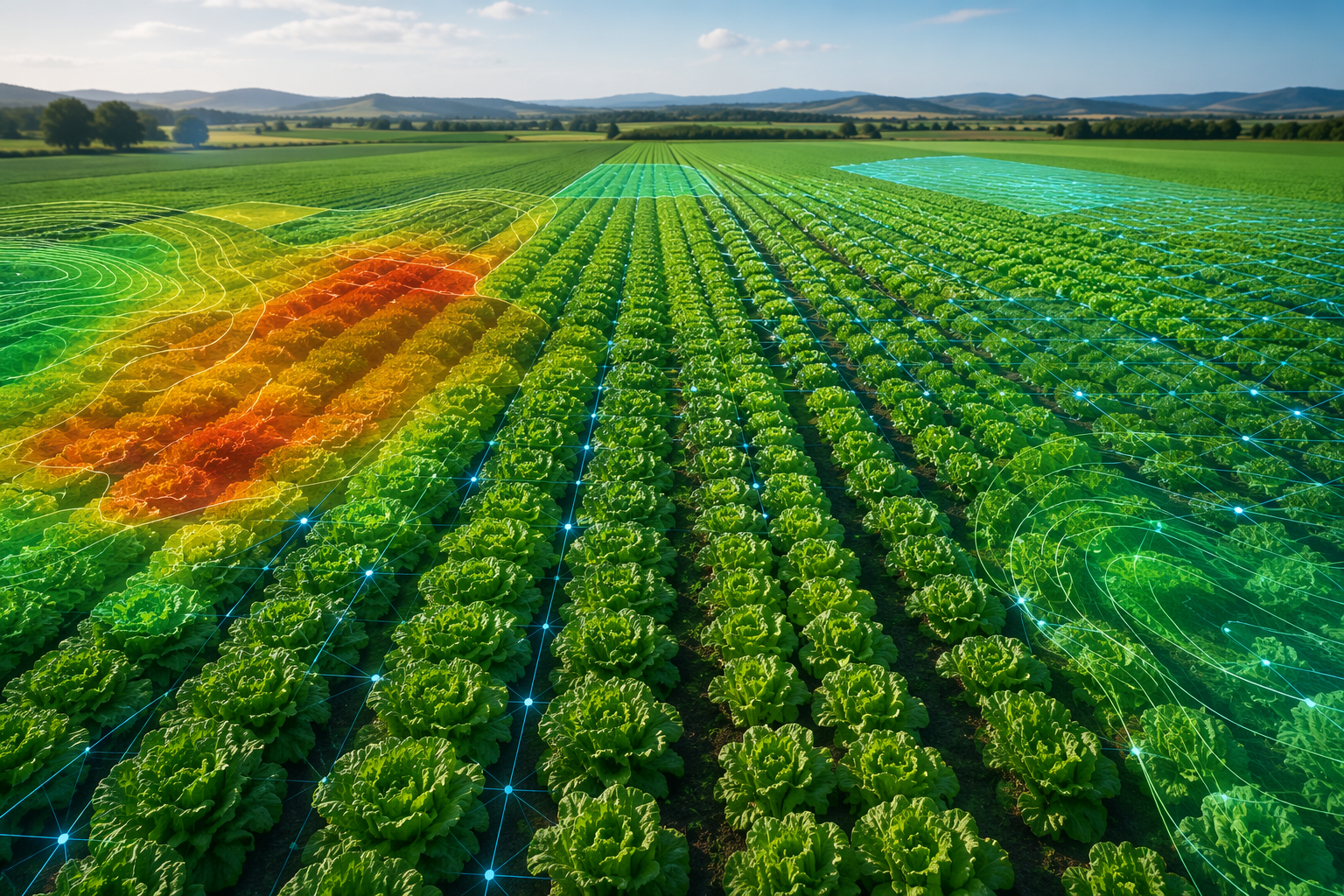
A uniform sampling plan treats risk as if every field, supplier, irrigation event, weather window, and harvest week deserves roughly the same surveillance intensity unless a known exception appears. That can be a defensible baseline for many hazards. It is a weak posture when the hazard is environmentally mediated, difficult to detect directly, and visible to the public only after an incubation lag.
Cyclospora pushes decision-makers into the worst part of the risk spectrum: enough evidence to worry, not enough evidence to act surgically. A food safety VP may be looking at case interviews, supplier lists, harvest dates, lab results, water histories, and regulator statements that are all moving at different speeds. A procurement lead may be asked whether to continue sourcing from a region, hold inbound lots, divert product, or impose extra scrutiny on a supplier whose product has not been directly implicated.
The category-level communication problem is not a side issue. Sylvain Charlebois argued in July 2026 that broad “leafy greens” warnings can trigger consumer avoidance across an entire category, damaging producers who may not be connected to the source. His piece is an opinion essay, not an outbreak analysis, but it captures a real supply-chain consequence: when traceback is slow and warnings are broad, economic harm spreads faster than attribution. [3]
That is the practical opening for AI in Cyclospora risk management across produce supply chains. The value is not a model that declares a lot “safe.” The value is a system that helps teams decide where scarce attention should go before illnesses, interviews, and traceback force a public response.
What an AI Risk Model Would Actually Fuse
For Cyclospora, a useful predictive model would not begin with a single lab result. It would combine signals that are individually incomplete but operationally meaningful together: weather patterns, water-quality telemetry, remotely sensed growing conditions, field-level audit findings, supplier histories, harvest timing, regional outbreak records, and prior regulatory or customer findings. The output should be a changing risk priority by region, field, supplier, commodity, or time window, not a decorative dashboard score.
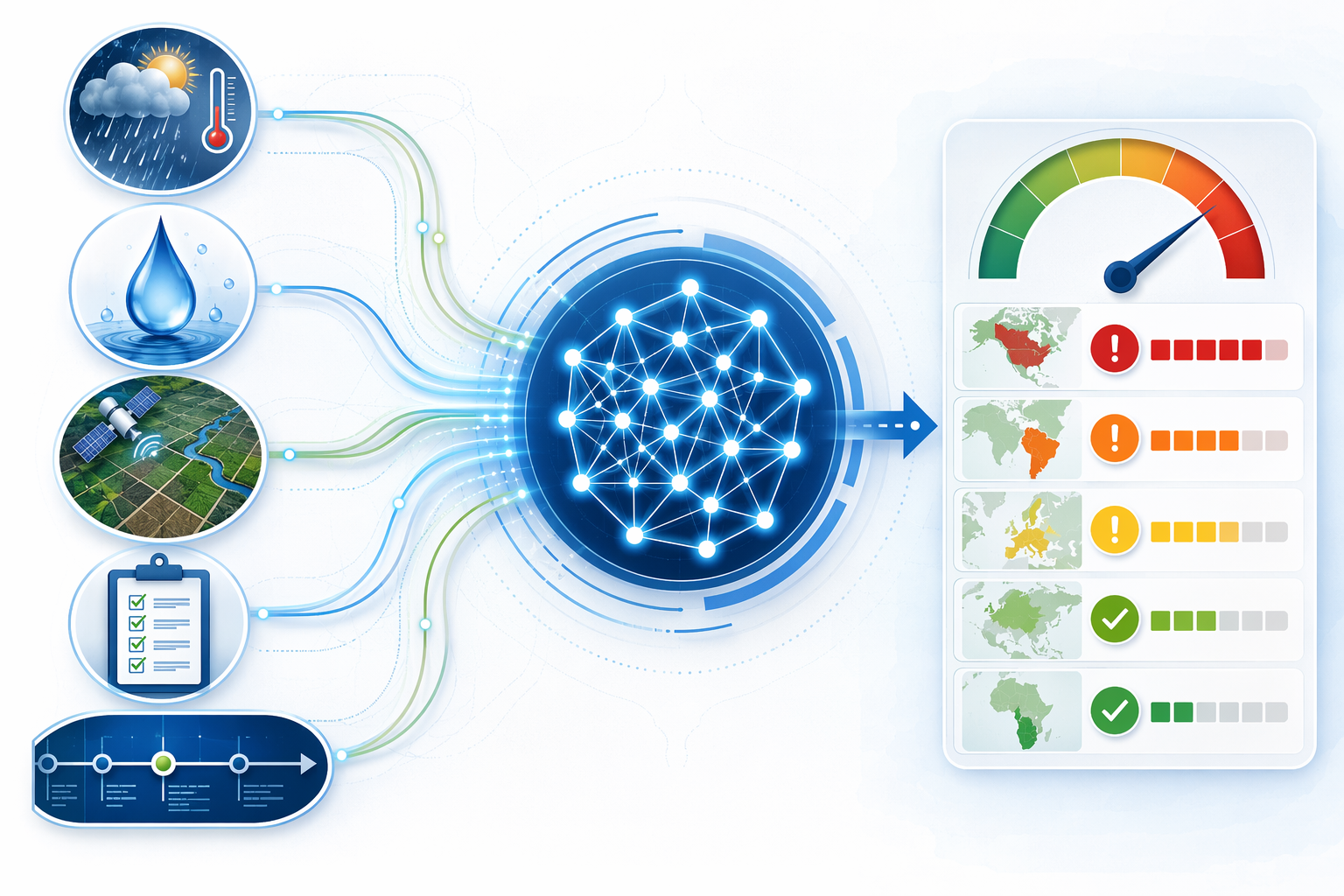
The operating question changes from “Did this sample test positive?” to “Which sourcing decisions deserve more friction this week?” A high-risk signal might trigger additional supplier documentation review, targeted water-history checks, intensified lot sampling where appropriate, temporary sourcing limits, field visits, or narrower product holds. A lower-risk signal would not prove absence of Cyclospora, but it could keep teams from spreading the same effort thinly across all sources.
| Signal type | Why it matters operationally | How it could change a decision |
|---|---|---|
| Weather and agro-ecological data | Conditions can shift risk by region and week rather than by commodity alone | Move surveillance toward a specific growing window |
| Water-quality telemetry | Irrigation and water exposure histories can concentrate concern before product ships | Escalate review of fields tied to concerning water signals |
| Remote sensing | Field conditions can be monitored continuously across large acreage | Rank fields for added scrutiny when ground teams cannot inspect everything |
| Audit and supplier history | Past performance can help separate persistent control weaknesses from one-off uncertainty | Adjust procurement confidence and documentation requirements |
| Historical outbreak and notification data | Past clustering can reveal patterns that are hard to see in single events | Prioritize commodities, origins, or routes for closer monitoring |
This is where AI differs from a static checklist. A checklist can confirm whether required actions were completed. A model can update the relative importance of those actions as field conditions, supplier information, and external signals change. That distinction matters when the hazard is not evenly distributed and the consequences of delay are measured in weeks.
The Evidence Supports Capability, Not Cyclospora-Specific Proof
The strongest directly relevant evidence for food-safety risk prediction comes from work on historical notification data. Nogales et al. applied neural and non-neural machine learning models to EU Rapid Alert System for Food and Feed data and reported 86.81% accuracy in predicting product categories at risk and 88.94% accuracy in predicting recall dispositions. The important point is not that European RASFF results automatically transfer to U.S. produce or to Cyclospora. They do not. The point is narrower: historical food safety notification data can be modeled into risk signals that have operational value. [4]
Adjacent food safety and agricultural AI research shows why the technical ambition is plausible. A 2025 review by Yin et al. reported transformer-based models achieving 98.4% accuracy for pesticide residue classification on food surfaces and CNN-based plant disease detection reaching 93% accuracy in reviewed studies. The same review noted that edge computing is helping push detection equipment costs below USD 1,500. These are not Cyclospora prediction results, and they should not be sold as if they were. They do show that machine learning can classify food-safety-relevant or crop-health-relevant conditions with high performance in study-specific settings. [5]
That distinction is more than academic caution. A model trained to classify pesticide residue on surfaces, plant disease symptoms, or recall dispositions is answering a different question from “Which lettuce-growing region presents elevated Cyclospora risk before illness reports accumulate?” The architecture may be useful. The data discipline may be transferable. The benchmark is not a validation claim for Cyclospora.
Field-intelligence platforms are beginning to describe the connective layer such models would need. IFT’s Food Technology Magazine has described systems that integrate real-time field observations with historical performance data for dynamic growing-region risk assessment, along with IoT and AI monitoring systems that estimate remaining shelf life and flag recurring equipment deviations. Those capabilities matter because prediction is only as useful as the timeliness and cleanliness of the signals feeding it. [6]
Traceability infrastructure matters for the same reason. Alfian et al. reported that XGBoost models achieved 93.59% accuracy for RFID direction recognition in perishable food supply chains. That finding does not address Cyclospora. It supports a narrower but necessary point: machine learning can improve the reliability of supply-chain movement data, which becomes crucial when a team is trying to reconstruct or preempt exposure pathways. [7]
From Batch Verification to Dynamic Risk Allocation
A conventional program often allocates effort by rule: sample this many lots, audit this often, review this documentation, apply the same supplier status until a major event changes it. A dynamic risk model reallocates effort when conditions change. That does not remove the need for supplier programs, GAPs, sanitation controls, audits, testing, or traceback. It changes when and where those tools are applied most aggressively.
In practice, the model should help answer several uncomfortable questions before a regulator or outbreak team answers them later:
- Which growing regions deserve heightened surveillance this week, even if they passed the last routine review?
- Which suppliers should face added documentation, water-history, or field-condition checks before orders are expanded?
- Which harvest windows should be separated operationally so traceback does not collapse into a broad commodity warning?
- Which inbound lots should be held, tested where testing is meaningful, diverted, or released with no additional action?
- Which weak signals are repeating often enough to justify intervention even before a positive finding?
The benefit is not simply earlier detection. For Cyclospora, direct detection is constrained by method, sampling, and biology. The more realistic benefit is earlier concentration of attention: fewer blind spots in high-risk windows, fewer blanket actions against low-risk suppliers, and better documentation when an investigation begins.
This also connects to the broader recall-prevention and traceability stack. Companies already exploring AI food safety recall prevention or predictive contamination traceability should treat Cyclospora as a harder test case, not just another organism in the same workflow. The system has to manage uncertainty before the pathogen is confirmed, because confirmation may arrive after product movement and consumption.
What Buyers and Food Safety Teams Should Demand From the Model
The easiest AI product to sell is a risk score. The harder product to trust is a risk score with a defensible data lineage, clear uncertainty, and a record of decisions it changed. For a Cyclospora-relevant system, buyers should press vendors and internal analytics teams on four areas.
- Inputs: which weather, water, remote-sensing, audit, supplier, and outbreak variables are used, and how often they refresh.
- Resolution: whether the model ranks broad commodities, growing regions, suppliers, fields, or time windows.
- Validation: whether performance was tested on Cyclospora-relevant outcomes or only on adjacent food safety tasks.
- Actionability: what operational thresholds trigger holds, added review, targeted testing, sourcing changes, or escalation.
- Auditability: whether the company can explain to regulators and customers why a decision was made at the time it was made.
The validation point deserves special pressure. Accuracy figures from pesticide classification, plant disease detection, RASFF notification modeling, or RFID direction recognition are useful evidence that machine learning can handle related food-system data. They are not proof that a Cyclospora risk model will perform in a fresh lettuce supply chain during an outbreak season. A serious implementation should label those benchmarks correctly and then build Cyclospora-specific evidence over time.
The system also has to be usable in the tempo of procurement. If a model updates after the buying window has closed, it becomes an explanation engine rather than a prevention tool. If it produces regional warnings too broad to guide sourcing, it repeats the spillover problem that harms unaffected growers. If it cannot preserve the data behind a recommendation, it will struggle when regulators, customers, or insurers ask why one supplier was held and another was not.
The Burden of Proof Now Moves Upstream
The 2026 outbreak investigation was still ongoing on July 22, 2026, and case counts or supplier details may change after the CDC advisory cited here. That uncertainty reinforces the point rather than weakening it. Cyclospora forces the supply chain to make decisions while evidence is still forming.
AI predictive models can help if they are treated as prevention infrastructure: a way to rank surveillance, supplier scrutiny, documentation review, and intervention timing before contaminated produce becomes a consumer outbreak. They cannot be treated as a kill step, a substitute for validated methods, or a shortcut around traceback discipline.
For produce companies, grocers, and foodservice operators, the next credible phase is not a louder claim that AI can solve Cyclospora. It is Cyclospora-specific validation, transparent benchmarks, and regulator-ready data platforms that can show what the model knew, when it knew it, and how that changed the decision before consumers got sick.
References
- CDC Health Alert Network advisory, Centers for Disease Control and Prevention, July 14, 2026, https://www.cdc.gov/han/php/notices/han00531.html
- What we truly know about the huge US Cyclospora outbreak—and what we don’t, CIDRAP, July 2026, https://www.cidrap.umn.edu/cyclospora/what-we-truly-know-about-huge-us-cyclospora-outbreak-and-what-we-don-t
- Food safety needs an AI upgrade, Agri-Food Analytics Lab, July 2026, https://agrifoodanalyticslab.substack.com/p/food-safety-needs-an-ai-upgrade
- Machine learning methods for predicting food safety risks using RASFF data, Food Control, 2022, https://www.sciencedirect.com/science/article/pii/S0956713521006034
- Yin et al. 2025 review, Foods / PMC, 2025, https://pmc.ncbi.nlm.nih.gov/articles/PMC12154576/
- How AI is reshaping food safety, IFT Food Technology Magazine, 2026, https://www.ift.org/food-technology-magazine/how-ai-is-reshaping-food-safety
- RFID and machine learning for perishable food supply chains, Food Control, 2020, https://www.sciencedirect.com/science/article/pii/S0956713519303944
Comments
Join the discussion with an anonymous comment.