
For supply chain teams working with airlines and freight forwarders, AI route planning is already useful when it changes the timing of decisions: a shipment is flagged before it misses a connection, capacity is rebooked before the cutoff collapses, and the paperwork queue is corrected before customs becomes the next delay. The evidence is strongest when it is labeled carefully. Some of the best savings figures come from cross-modal logistics, not air-cargo-only trials, while some of the most operationally relevant gains come from the less glamorous work around documentation, billing, and exception handling.
| Evidence | What it measures | How to read it for air cargo |
|---|---|---|
| 10–15% fuel-cost reduction and 15–20% faster deliveries | Cross-modal AI freight platform benchmark cited from McKinsey 2025 logistics data | Useful business-case range, but not proof of air-cargo-only performance [1] |
| 12% reduction in total transportation spend | DHL European network result from AI route optimization | Air-cargo-relevant major-operator evidence, though not isolated to a single air cargo lane [1] |
| 24–72 hour predictive delay alerts | Advance warning window for weather, congestion, and capacity disruption | Operationally important because it changes when network control teams can intervene [1] |
| About 40% reduction in customs clearance delays | AI document automation results from published Flexport/Descartes case studies | Directly relevant to freight forwarding because routing gains can be lost at clearance [1] |
| 90–95% straight-through billing processing | AI billing-agent results versus 60–70% in traditional audit workflows | Signals fewer billing exceptions pushed to finance teams after shipment execution [1] |
What Actually Changes In The Routing Workflow
Traditional air cargo routing is rarely a single route-selection moment. A planner balances booked capacity, service commitments, connection windows, embargoes, handler performance, customs requirements, and the shipper’s tolerance for cost versus speed. When disruption arrives late, the route decision becomes a chain of remedial work: rebook uplift, update the customer, correct documents, review accessorial charges, and explain why the original plan no longer matches the invoice.
AI route optimization matters when it moves that chain upstream. The practical shift is from manual monitoring and after-the-fact exception handling to earlier detection of risk. A 24–72 hour alert does not make a thunderstorm disappear, and it does not create aircraft capacity where none exists. It can, however, give the control tower time to split a consolidation, move a shipment to an alternate gateway, choose a different carrier, or decide that paying for a more expensive route is cheaper than triggering a service failure downstream [1].
That is why the strongest implementation cases should be judged by the decision they changed, not by the elegance of the map. Did the system warn early enough for a planner to protect a connection? Did it recommend a feasible reroute with available capacity? Did the documentation team receive the revised itinerary before customs data had to be resubmitted? Did finance avoid a billing exception because the rating and accessorial logic followed the reroute? These are the places where AI route planning can create measurable value in air freight.
The Savings Case Is Real, But The Labels Matter
The headline numbers are attractive. AI-powered freight platforms are associated with 10–15% lower fuel costs and 15–20% faster deliveries in McKinsey-cited 2025 logistics data, while DHL reported a 12% reduction in total transportation spend from AI route optimization across its European network [1]. For an executive building an investment case, those figures are strong enough to justify serious evaluation.
They are not strong enough to justify pretending the evidence is narrower than it is. The 10–15% fuel and 15–20% delivery-time ranges are cross-modal benchmarks across freight activity, not isolated air-cargo-only operating results [1]. DHL’s result is more directly relevant because it comes from a major logistics operator’s European transportation network, but it still should not be treated as a controlled trial for a single air freight operating model [1].
That distinction matters because fuel economics do not transfer cleanly across modes. A truck route can avoid a congested corridor. An ocean carrier can adjust speed and routing across a longer voyage window. Air cargo has tighter cutoffs, more expensive deviations, and fewer practical alternatives once a shipment is already committed to a departure bank. The same optimization logic may apply, but the cost curve is different.
Ocean freight is still a useful comparison when it is kept in its lane. Globalia Logistics Network describes dynamic ocean routing as reducing fuel consumption by 10–15%, and its discussion of weather, congestion, and capacity-aware routing helps explain the general operating pattern [2]. In air cargo, the time horizon is tighter and the penalty for a poor connection decision can arrive faster, so the analogue clarifies the mechanism without proving the same savings range.
Visibility Comes Before Optimization
Most air cargo networks cannot jump straight into autonomous rerouting. They first need trusted visibility: shipment status, flight schedules, capacity commitments, facility milestones, document status, and exception history that can be joined without the planning team reconciling five versions of the truth. If the system cannot distinguish a late warehouse scan from a genuinely missed uplift, its recommendations will add noise at the exact moment operators need confidence.
Once that visibility layer is stable, predictive analytics can start to change the work. The system watches for weather risk, airport congestion, connection exposure, capacity shortfall, and service-level risk, then surfaces shipments likely to break plan. iContainers describes the same general route-selection logic across air and ocean freight: AI evaluates routes against cost, transit time, disruption risk, and operational constraints rather than treating routing as a static lane choice [3].
For air cargo teams, the practical output should be a ranked intervention queue, not a dashboard full of red dots. A high-value pharmaceutical shipment with a fragile connection deserves a different escalation path than a low-margin shipment with slack in the promised delivery window. The AI does not need to replace the network controller to be valuable; it needs to put the right exceptions in front of the right people early enough for action.
The Downstream Work Is Part Of The Route Decision
Air cargo route optimization is often discussed as if the route ends when the shipment is assigned to a flight. In practice, the reroute creates a second wave of work. A new gateway may change customs timing. A carrier change may require revised documents. A different handoff may alter charges. A missed or changed milestone can create billing disputes weeks after the shipment is delivered.
This is where document and billing automation belong in the value case, not in a separate automation bucket. AI document automation has been associated with an approximately 40% reduction in customs clearance delays in published Flexport and Descartes case studies, while companies using AI billing agents have reached 90–95% straight-through processing rates compared with 60–70% in traditional audit workflows [1]. Those figures do not prove that route optimization alone caused the gains. They show why a routing program that ignores documentation and billing will undercount both the cost and the benefit.
A useful air cargo workflow connects the reroute recommendation to the follow-on tasks. If a shipment moves through a different gateway, the system should flag document fields that may need review. If a different carrier is recommended, carrier eligibility and service history should be checked before the planner commits. If the reroute changes accessorial exposure, the billing logic should be updated while the shipment is still active, not discovered during invoice audit.
From Predictive Alerts To Agentic Workflows
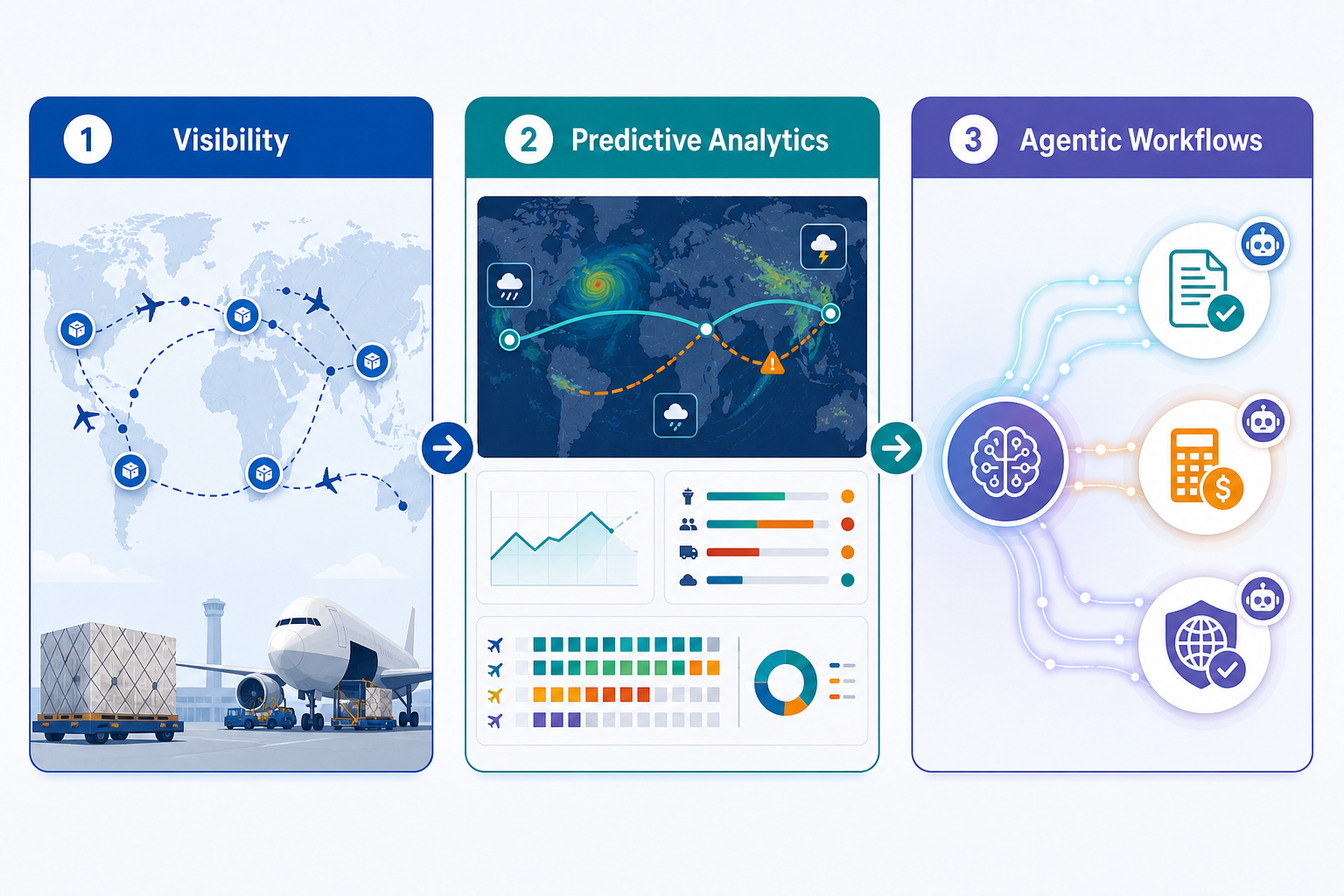
The sensible maturity path is simple enough: visibility first, predictive analytics next, then agentic workflows where the controls are mature. This is not a universal deployment law. It is an operating sequence that respects how freight teams actually absorb risk.
| Stage | What changes | What to watch |
|---|---|---|
| Visibility | Teams get a shared view of shipment, capacity, milestone, and document status | Bad data will make later optimization look smarter than it is |
| Predictive analytics | The system flags likely delay, capacity, or connection failures before they happen | Alerts must be early and specific enough to change an operational decision |
| Agentic workflows | Software can prepare or execute bounded tasks such as document checks, carrier vetting, billing review, and exception routing | Controls, approvals, and audit trails need to match the cost of a wrong action |
Agentic workflows are most credible when they start with bounded tasks. Preparing corrected paperwork for review is lower risk than automatically rerouting a high-value shipment through a new gateway. Checking a carrier against known eligibility rules is easier to govern than letting software negotiate the full service recovery plan. Billing exception triage is another natural candidate because the workflow is structured, repetitive, and expensive when it backs up.
The point is not to remove people from network control. It is to stop making people spend scarce time discovering facts the system could have assembled earlier. A planner should not have to search for capacity, document risk, carrier constraints, and billing exposure separately before making a reroute decision under time pressure.
Market Momentum Is Not The Same As Deployment Proof
The market backdrop supports continued investment. Fortune Business Insights estimates the flight route optimization market at $7.55 billion in 2026 and projects it to reach $17.00 billion by 2034, a 10.68% compound annual growth rate [4]. That is a useful signal that airlines, technology providers, and logistics operators are spending into the category.
It is not, by itself, proof that air cargo route optimization has reached full maturity. The market category includes passenger and cargo use cases, and passenger airline operations have produced more visible operational trial data than dedicated air-cargo routing. OAG and Microsoft also frame trusted data as a prerequisite for resilient airline operations, with a 35% delay-reduction figure presented as an industry estimate rather than a measured deployment result [5]. That distinction should stay visible in any executive business case.
The better reading is that AI route optimization is production-relevant now, while air-cargo-only proof remains thinner than the cleanest headlines suggest. A freight forwarder or cargo airline does not need to wait for perfect evidence before modernizing planning. It does need to avoid borrowing every cross-modal savings figure as if it came from its own network.
What Logistics Leaders Should Expect
A realistic implementation case should start with the work AI can change soonest. Build the visibility layer around shipments, capacity, milestones, and documents. Use predictive routing to move exception handling from late recovery to earlier intervention. Measure whether alerts actually changed decisions: reroutes made before cutoff, connections protected, customs delays reduced, billing exceptions avoided, and transportation spend moved.
The savings case is strongest when it combines cross-modal benchmarks with major-operator evidence such as DHL’s 12% European transportation-spend reduction, then tests those assumptions against the company’s own air cargo lanes [1]. The route optimization model should be evaluated alongside document automation, carrier vetting, billing-agent workflows, and exception management because those are the places where a route change either becomes operationally clean or creates the next mess.
For air cargo, AI route optimization is not just a cleaner path across a map. It is a way to give planners, customs teams, finance teams, and service recovery teams more time to act on the same disruption. The credible expectation for 2026 is not fully autonomous air freight planning. It is earlier warning, better-ranked options, fewer downstream exceptions, and a business case that names exactly which evidence came from air cargo and which came from the wider freight network.
References
- AI in Logistics: Route, Ship, and Bill Autonomously — Digital Applied
- Dynamic route optimization in air and ocean freight — Globalia Logistics Network
- How AI Helps Shippers Choose the Best Route for Air and Ocean Freight — iContainers
- Flight Route Optimization Market Size, Share & Industry Analysis 2026-2034 — Fortune Business Insights
- AI and Trusted Data: Building Resilient Airline Operations — OAG/Microsoft
Comments
Join the discussion with an anonymous comment.