
For a logistics team already losing service hours to storms, the practical question is not whether AI route planning for severe weather sounds useful. It is whether adding real-time weather intelligence to routing produces enough measurable gain to defend the spend when dispatchers, drivers, docks, and customers all have to live with the recommendation.
The qualified answer is yes: weather-aware AI has a stronger ROI case than optimization-only routing in operations exposed to severe weather. The evidence is not all the same quality, though. The largest comparative uplift comes from simulation. The broad cost-reduction ranges come from industry and consulting reports. The most visible production proof point, UPS ORION, validates route optimization at scale, but not weather-aware routing as a standalone audited category.
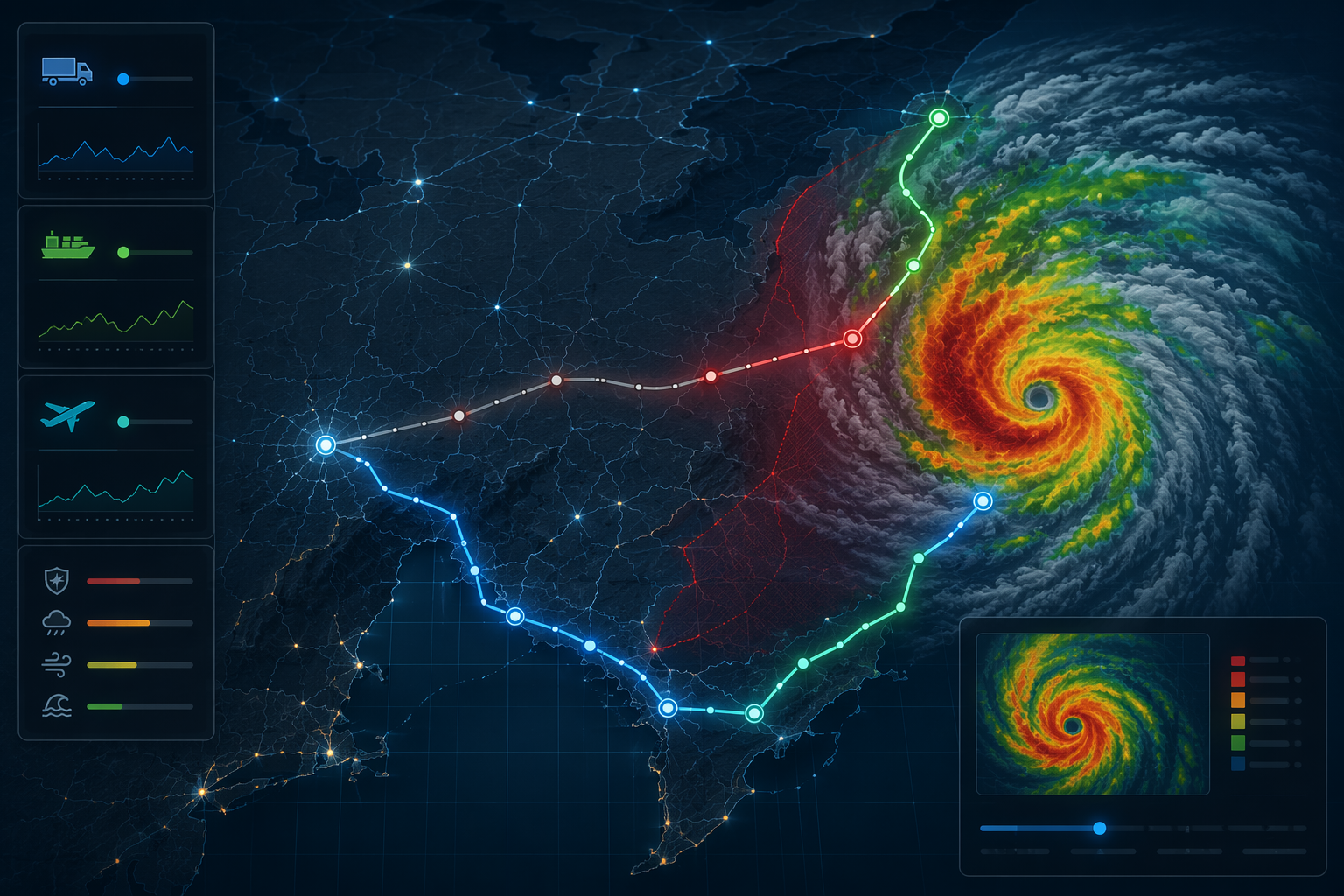
That distinction matters because severe weather is not a cosmetic layer on top of routing. Weather-related crashes account for 22% of commercial motor vehicle crashes, a figure that covers all weather conditions rather than only extreme events.[1] Industry reporting also points to a more volatile operating environment, with supply chain disruptions rising 38% in 2024 and extreme weather events increasing 119% year over year.[2] Those numbers justify attention. They do not, by themselves, prove that a routing engine will pay for itself.
The ROI Case Starts With a Comparison, Not a Feature List
The cleanest comparison in the available evidence is a simulation study by Kikuchi that compared weather-aware AI routing against route-optimization-only AI. In that study, the weather-aware system produced a 107.3% revenue increase, while the optimization-only system produced a 14% increase.[3]
That gap is large enough to be useful, but it has to be read with its work boots on. The study modeled 10,000 taxi trips. It was not a freight logistics field deployment, not a carrier network trial, and not an audited before-and-after implementation across terminals, tractors, trailers, driver hours, and customer appointment windows.[3] It is best treated as directional evidence: when the routing problem includes weather-sensitive demand and operating conditions, weather-aware optimization can outperform routing that only optimizes distance or time.
That is still an important result. Many business cases for AI routing quietly assume the route engine sees the world as a stable map: road segments, travel times, stop sequences, vehicle capacity, and service windows. Severe weather breaks that assumption. A route that is mathematically efficient at 9:00 p.m. can become indefensible by 4:30 a.m. if a storm cell closes the safe operating window, pushes drivers toward hours-of-service pressure, or turns a planned delivery sequence into a string of late arrivals.
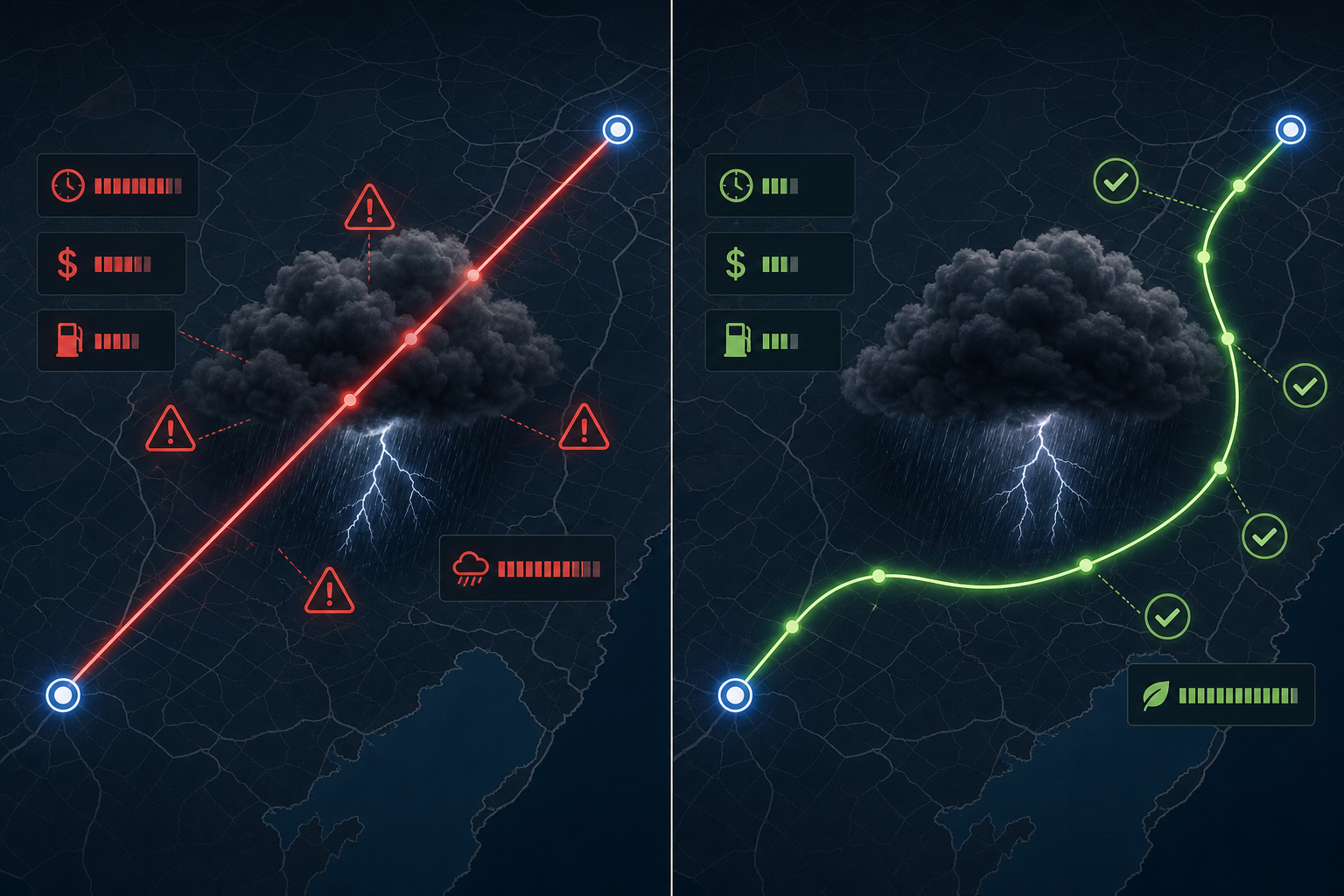
For buyers, the useful takeaway is not the exact 107.3% figure. It is the shape of the comparison. If severe weather changes the operating environment, then route optimization that does not understand weather is solving an incomplete problem.
What Production Route Optimization Has Already Proven
UPS ORION is the evidence point that keeps route optimization from being a slideware category. UPS has reported that ORION saves 100 million miles annually and about $400 million per year.[4] Those are production-scale outcomes, not laboratory claims.
But ORION should not be stretched into proof that every weather-aware routing product will deliver the same return. ORION optimizes many variables in a mature delivery operation. Weather is one factor among many, and the reported savings are not isolated to severe-weather intelligence.[4] Its strongest relevance here is narrower: large-scale algorithmic route planning can produce measurable operational savings when it is embedded deeply enough into the network.
That matters more than it may sound. A routing recommendation only has value if it survives contact with dispatch processes, driver availability, stop commitments, vehicle constraints, scan events, and customer expectations. UPS shows that route optimization can work in production when the surrounding operating system is mature. It does not remove the need to test whether a severe-weather layer improves the specific operation in front of you.
The ROI Ranges Are Useful, but They Are Not Audited Guarantees
Several reported ranges can help frame a business case. McKinsey reports that AI embedded in logistics can reduce logistics costs by 5% to 20% and reduce inventory levels by 20% to 30%.[5] That is a broad AI-in-logistics finding, not a severe-weather routing benchmark. It belongs in the business case as a ceiling or comparison range, not as a promised outcome.
Vendor and industry sources report fuel savings in the 15% to 20% range and delivery-time reductions around 20% for AI route optimization.[6][7] These numbers are directionally consistent with the logic of better sequencing, fewer wasted miles, and faster exception handling. They are also vendor-attributed or industry-reported, not independently audited field trials for weather-aware freight routing.
| Evidence type | What it supports | How to use it in an ROI case |
|---|---|---|
| Kikuchi simulation | Weather-aware AI can materially outperform optimization-only AI in a modeled transport environment | Use as directional evidence, not as a freight ROI guarantee |
| UPS ORION | Algorithmic route optimization can generate measurable production savings at scale | Use as proof that mature route optimization can work operationally |
| McKinsey logistics AI range | AI-embedded logistics can reduce costs across a broad set of use cases | Use as a benchmark range, not weather-specific evidence |
| Vendor-reported fuel and delivery-time ranges | Route optimization can reduce waste and improve service metrics | Use as planning assumptions that require validation against internal baselines |
A defensible ROI model should keep those categories separate. Blending them into one headline number is how a simulation result becomes a freight savings promise nobody can defend during the first storm week.
Where the Return Actually Comes From
Weather-aware routing creates value by reducing bad decisions earlier. The route engine is not merely drawing a prettier path around a radar blob. In a useful deployment, it changes which loads are released, which stops are resequenced, which ETAs are pushed to customers, which drivers are held, and which exceptions are escalated before the operation has already spent the fuel and hours.
The first source of return is avoided exposure. If a route can be adjusted before a driver enters a deteriorating corridor, the operation may avoid a late rescue decision: rerouting under pressure, delaying after departure, or asking a driver to make a judgment with less information than dispatch had an hour earlier. That does not always show up as a neat mileage reduction. It may show up as fewer failed appointments, less detention, fewer emergency calls, and fewer recovery moves.
The second source is service reliability. Weather-aware AI can protect appointment integrity by trading a locally longer route for a more reliable arrival window. That tradeoff is easy to miss if the KPI dashboard only rewards shortest path, miles reduced, or planned travel time. In severe weather, a route that looks less efficient on paper may be the one that keeps the customer from waiting on a dock crew that should have been rescheduled.
The third source is dispatch leverage. A system that ingests weather, orders, vehicle status, driver status, and constraints can reduce the amount of manual cross-checking required before a decision. That is especially valuable during broad disruptions, when the bottleneck is not one hard route but the number of exceptions competing for attention.
Those value pools are measurable, but not interchangeable. A fleet may see fuel reduction without meaningful service improvement. A high-service operation may accept more miles to preserve on-time performance. A dedicated fleet may benefit from better pre-dispatch planning, while a brokerage-heavy network may get more value from earlier exception visibility and customer communication.
Weather Intelligence Is Becoming More Operational
The credibility of weather-aware routing is improving because weather modeling itself is moving deeper into operational infrastructure. ECMWF made its Artificial Intelligence Forecasting System operational in February 2025, describing it as the first fully operational machine-learning weather model. ECMWF also reports that AIFS uses about 0.3% of the compute of its traditional Integrated Forecasting System and improves tropical cyclone track forecasts by up to 20%.[8]
NOAA’s Hybrid-GEFS, introduced in December 2025, is described as the world’s first operational hybrid physics-AI ensemble, with 61 members.[9] For logistics buyers, the point is not to become weather-model experts. It is that AI-generated weather intelligence is no longer only a research story or a vendor dashboard flourish. It is moving into the forecasting stack that routing systems can consume.
Specialized commercial tools are also narrowing weather signals toward operational decisions. ClimateAi’s FICE product operates at 1-kilometer resolution for temperature and solar variables and 25-kilometer resolution for precipitation, with field-level quantification of demand spikes and suppressions.[10] That is adjacent to routing rather than a direct trucking ROI result, but it shows the same useful direction: weather data is becoming more granular and more tied to business decisions.
DHL Resilience360 has been reported at 90% to 95% arrival prediction accuracy, and WCI/Resilinc reporting attributes to a Johnson & Johnson AI system the detection of 85% of major supply disruptions an average of 7 days ahead.[11] The Johnson & Johnson figure should be treated carefully because the original source was not independently verified in this research pass. It is still useful as a sign of where disruption intelligence is heading: earlier warnings, fewer surprises, and more time for operators to choose a safer or more reliable plan.
The Implementation Conditions Decide Whether ROI Survives
The buying mistake is to evaluate the model and underweight the operating floor. Severe-weather routing fails less often because the algorithm cannot find a path and more often because the inputs are stale, the TMS cannot execute the recommendation cleanly, or nobody has written down who gets to override whom when conditions deteriorate.
Data Quality Has to Include Driver and Vehicle Reality
A weather-aware route is only as good as the operational data it is allowed to see. Weather feeds and road conditions are not enough. The system needs current order status, appointment windows, driver hours, vehicle location, trailer availability, equipment restrictions, customer constraints, and exception history. If driver status is delayed or vehicle location is approximate, the model can produce a technically reasonable route that dispatch cannot legally or practically use.
The same applies to facility constraints. A recommendation that avoids a storm but arrives after the receiving window closes may simply move the problem from the highway to the dock. If the TMS does not understand cutoffs, yard congestion, appointment flexibility, and customer notification rules, the system is optimizing a partial version of the operation.
TMS Integration Matters More Than Dashboard Quality
A severe-weather routing tool that lives beside the TMS creates another screen for dispatchers to reconcile under pressure. That may be acceptable in a pilot, but it is not a mature ROI path. The better question is whether the recommendation can write back into load planning, appointment management, customer ETA updates, driver communication, and exception queues without forcing dispatch to manually rebuild the plan.
This is where companies should be careful with benchmark ranges. A 15% fuel-saving assumption may be plausible for one operation and unrealistic for another if the second operation cannot automatically update stop sequences, notify customers, or resequence work across terminals. The AI model may identify value that the workflow cannot capture.
The Dispatch Decision Framework Cannot Be Improvised During a Storm
A routing recommendation needs an authority model. Who reviews severe-weather recommendations before dispatch? When does a route change trigger customer notification? What conditions move a load from automated resequencing to human approval? When does the system recommend holding freight instead of rerouting it? Those questions are not implementation paperwork. They determine whether the tool speeds up decisions or adds confusion.
The driver’s authority is not optional. FMCSA regulation 49 CFR 392.14 requires extreme caution in hazardous conditions and states that a driver shall discontinue operation when conditions become sufficiently dangerous, resuming only when the vehicle can be safely operated.[12] Any routing system used in severe weather has to support that authority. It should preserve driver override, capture the reason for a stop, and give dispatch a clean way to replan around the decision.
That point should sit inside the ROI case, not outside it as a safety disclaimer. If the business case depends on drivers following AI-generated routes through conditions they judge unsafe, the business case is broken.
What to Measure in a Pilot
A useful pilot should compare weather-aware routing against the company’s current process and, where possible, against optimization-only routing. The test should not rely on one post-event success story. Severe-weather value is uneven; a clean week proves little, and a historic storm can distort everything.
- Baseline the same lanes before the pilot: planned miles, actual miles, fuel, on-time performance, detention, failed appointments, driver delay, and manual exception touches.
- Separate normal-weather performance from weather-event performance, because blended averages can hide the use case.
- Track recommendation acceptance, dispatcher overrides, driver stops, customer-notification timing, and reasons for rejection.
- Measure whether the TMS executed the recommendation automatically or whether dispatch rebuilt the plan by hand.
- Review safety-related decisions separately from productivity metrics so the system is not rewarded for pushing into hazardous conditions.
For teams already evaluating route optimization ROI more broadly, the comparison should sit alongside a conventional route-optimization case such as AI last-mile route optimization ROI. The severe-weather layer needs its own measurement window because the value often appears in avoided failures rather than routine mile reduction.
When the Investment Case Is Strong
The investment case is strongest for networks with repeated weather exposure, meaningful service penalties, and enough routing flexibility to act before conditions deteriorate. Regional carriers, private fleets, grocery and retail distribution, healthcare distribution, field service operations, parcel networks, and time-sensitive replenishment lanes can all fit that profile if they have the data discipline to support it.
It is weaker where routes are fixed, appointment windows are immovable, driver and vehicle data is unreliable, or dispatch already has to fight the TMS to make basic updates. In those environments, the first investment may be integration cleanup rather than a more sophisticated routing model.
The readiness test is straightforward. If the company can feed reliable weather, order, vehicle, and driver-status data into the TMS; route recommendations can trigger real workflow changes; dispatchers can see why a recommendation was made; and drivers retain stop-driving authority, then weather-aware AI route planning has a defensible ROI case. If those conditions are missing, the case is premature, regardless of how impressive the model looks in a demo.
References
- Weather-Related Commercial Motor Vehicle Crashes, FleetRabbit
- Annual Supply Chain Risk Report, Resilinc
- arXiv:2507.17099, arXiv, 2025
- ORION Backgrounder, UPS
- Smartening up with artificial intelligence (AI) - what’s in it for Germany and its industrial sector?, McKinsey & Company
- AI Route Optimization, Artech Digital
- AI Route Optimization, RTS Labs
- ECMWF’s Artificial Intelligence Forecasting System becomes operational, ECMWF, February 2025
- Hybrid-GEFS, NOAA, December 2025
- FICE, ClimateAi
- Supply Chain Resilience and AI Disruption Detection, WCI
- 49 CFR 392.14 - Hazardous conditions; extreme caution, Electronic Code of Federal Regulations
Comments
Join the discussion with an anonymous comment.