
Cargo theft prevention is moving into the minutes that used to disappear between “the truck is late” and “we may have lost the load.” That is the practical promise of AI for shipping safety analytics in the supply chain: not a prettier dashboard after the fact, but a faster way to decide whether a carrier check, security escalation, or route intervention needs to happen now.
The urgency is not hard to justify. Confirmed cargo theft losses in the United States and Canada reached $725 million in 2025, up 60% from 2024, and the average theft value rose to $273,990, up 36% year over year, according to CargoNet and Verisk figures released in January 2026.[1] A broader estimate cited by project44 puts the total annual economic impact, including unreported and indirect losses, at $35 billion.[2] Those two numbers should not be blended. One is confirmed direct loss; the other is a wider economic-impact estimate. Together, they still point to the same operational problem: many shippers are carrying losses large enough to justify a response model measured in minutes, not claims-cycle paperwork.
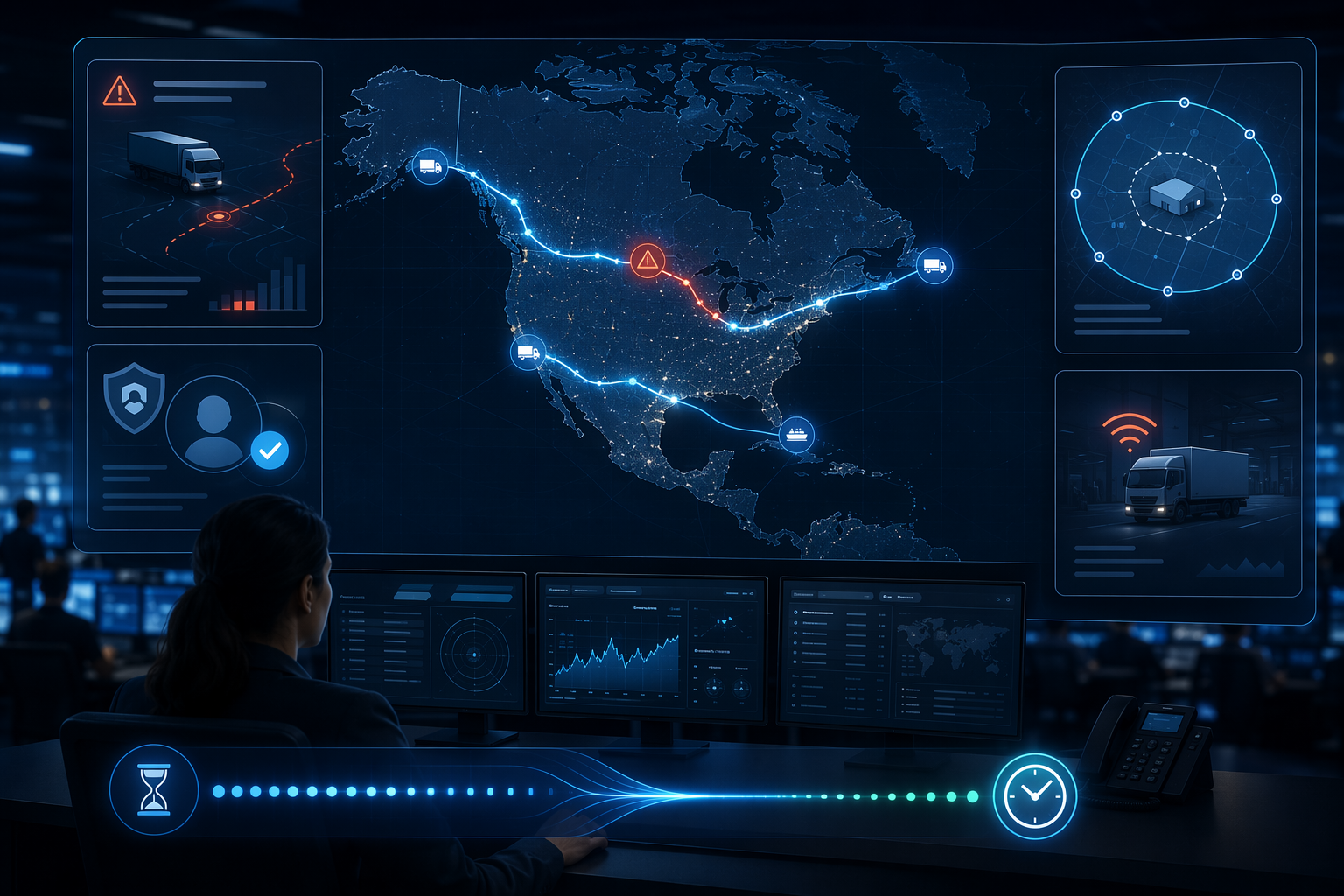
The more uncomfortable part is that theft is no longer just a lock-and-fence problem. Strategic and deception-based theft, including fictitious pickups and carrier identity fraud, grew from about 66 incidents annually in 2022 to 576 in 2024, a roughly 1,500% increase cited from Travelers Insurance data in industry materials.[3] That kind of loss does not begin when a trailer door opens. It often begins when a bad actor gets accepted into the shipment execution process as if it were a legitimate carrier.
That is why the better AI systems are not simply watching dots on a map. They are comparing route plans, carrier identity, shipment value, known risk zones, stop behavior, and available telematics or sensor signals against an escalation path someone is accountable for using.
The Loss Reduction Claim Needs an Operating Model Behind It
The 40–60% cargo theft loss-reduction range is meaningful, but it should be read carefully. Arviem describes it as a client-reported range associated with AI analytics monitoring, not as a universal guarantee that any anomaly model will cut losses by half.[4] In practice, the range becomes credible only when the monitoring layer is connected to response: someone can verify the carrier, contact the driver or dispatcher, escalate to security, and document what happened before the load becomes unrecoverable.
A route-deviation alert by itself is too thin. Trucks leave planned paths for fuel, parking, congestion, weather, staging, driver-hours constraints, receiving delays, and bad instructions. The question is not whether the truck moved differently than planned. The question is whether that movement, in context, crosses the threshold from operational exception to probable theft risk.
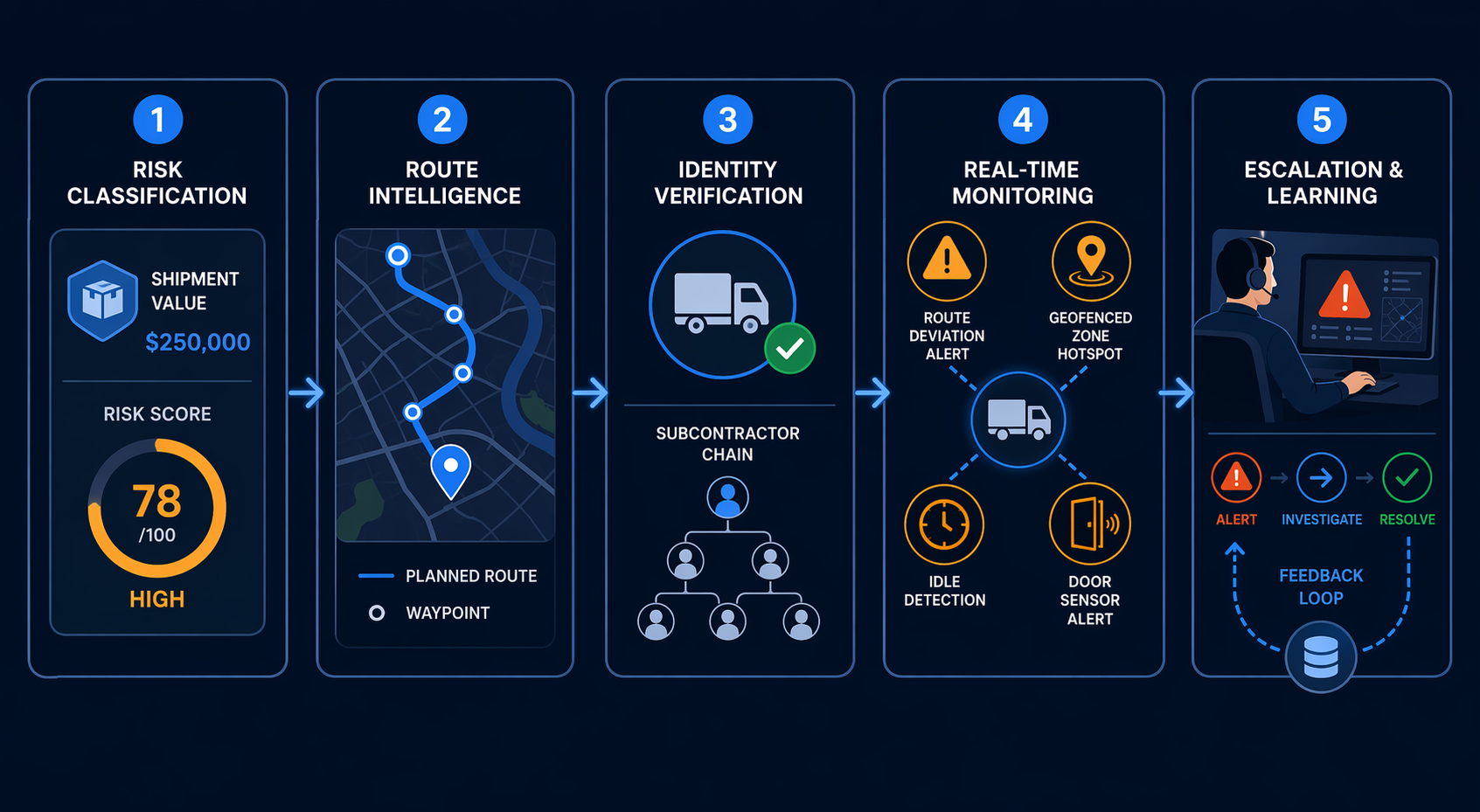
| Layer | What It Decides | What Has To Be Clean Enough To Trust |
|---|---|---|
| Risk Classification | Which loads deserve tighter monitoring before they move | Shipment value, commodity, lane, origin, destination, stop plan |
| Route Intelligence | Whether movement still fits the approved trip pattern | Planned route, waypoints, geofences, dwell expectations |
| Identity Verification | Whether the carrier and any subcontractor match the authorized execution plan | Carrier master data, contact records, tender history, subcontractor visibility |
| Real-Time Monitoring | Whether signals are converging into a suspicious event | Location pings, idle time, zone entry, speed, engine, door or sensor data where available |
| Escalation & Learning | Who gets called, what gets confirmed, and how the model improves | Playbooks, case outcomes, false-positive feedback, human review records |
This five-layer flow is a useful way to separate real theft prevention capability from a noisy alert feed. It also matches the security reality of freight: the weak point might be the lane, the stop, the carrier record, the subcontractor chain, the parking location, or the delay after the first suspicious signal appears. A system that sees only one of those points is useful, but incomplete.
Risk Classification Starts Before the Truck Moves
The first useful decision is made before dispatch: which shipments need tighter controls? A high-value electronics load moving through a known theft corridor should not receive the same monitoring pattern as a routine low-value move on a familiar lane. The AI layer can help rank that risk, but only if the shipment value, commodity, planned lane, carrier assignment, and stop structure exist in usable form.
This is where many theft-prevention projects either become serious or become theater. If a shipper cannot reliably tell the system what the load is worth, who is authorized to carry it, where it is expected to travel, and what exceptions are normal for that lane, the model is forced to guess. Guessing creates one of two failures: too many alerts for dispatchers to trust, or too little sensitivity where the shipment actually deserves attention.
Risk classification is also where the business case becomes concrete. An average theft value of $273,990 does not mean every company faces the same exposure, but it gives security directors a load-level way to think about prevention spend.[1] A small improvement in recovery or avoided loss can matter when the unit of risk is a single shipment, not an abstract annual budget line.
The Middle Hour Belongs to Multi-Signal Analytics
The hardest part of cargo theft analytics sits in the middle of the trip, when the data is messy and the consequences of delay are real. A location ping stops. A truck idles longer than expected. The driver takes an unfamiliar exit. The carrier contact does not answer. None of those signals alone proves theft. Together, on the wrong load in the wrong zone, they can justify waking someone up.
Route intelligence is the first signal most teams recognize. The system compares actual movement against the approved route, expected stops, and timing windows. A deviation near a receiver with known staging congestion is different from a deviation into an unplanned industrial area. Good analytics keeps that difference visible. It should let an operator see whether the truck is merely off-route, entering a hotspot, idling in a risk zone, or showing additional signs such as door activity or engine-state changes where those signals are available.
Zone monitoring matters because a large share of theft happens when freight is stationary. CargoNet and Guardian-reported industry figures identify warehouse storage and unsecured lots as major theft locations, with 41% of cargo stolen while in warehouse storage and 16% in unsecured lots.[3] That makes geofenced hotspot detection more than a map feature. It helps answer a live operational question: is this load stopping in a place where stopping is itself the risk?
Idle detection adds another layer. A high-value trailer sitting still outside the expected stop plan is different from a truck rolling slowly through traffic. If the system can combine speed, dwell time, engine state, and door or sensor signals where available, it can separate ordinary delay from events that deserve immediate verification. The goal is not to accuse the driver. The goal is to reduce ambiguity fast enough that a dispatcher or security lead can make a better call.
Identity verification is the part that gets less attention until a fictitious pickup happens. Strategic theft exposes weak carrier controls: stale master data, poor contact validation, unclear subcontracting, and overreliance on tender acceptance as proof of legitimacy. AI can flag mismatches between the planned carrier, the actual executing party, historical patterns, and contact behavior, but the source data has to be maintained. If the carrier record is dirty, the model inherits the dirt.
The useful pattern is convergence. A route deviation raises attention. Entry into a curated risk zone raises it further. Unplanned idle time increases urgency. A carrier-contact mismatch or failed verification changes the event from transportation exception to security concern. That is where AI earns its keep: not by replacing judgment, but by assembling the evidence before the window closes.
Autonomous Agents Can Speed the First Call, Not Own the Whole Decision
project44’s June 2026 autonomous Theft Prevention launch is a useful marker of where the category is heading. The suite combines route deviation machine-learning models trained on 1.5 billion annual shipments, zone monitoring with curated hotspot data, idle detection using speed, engine, and door-sensor signals where available, and AI agents that automatically contact carriers.[5] That is not just a feature bundle; it reflects a shift from passive visibility toward managed exception handling.
The important word is “contact.” An AI agent can initiate the carrier check faster than a human team working a long queue. It can ask for confirmation, collect a response, compare it with expected behavior, and escalate if the answer does not fit. That is useful in the ugly middle hour because the first call often determines whether the team is still in prevention mode or already drifting toward recovery mode.
But an agent should not be treated as an autonomous security force. High-stakes escalation still needs accountable human review, especially when the next step may involve law enforcement, customer notification, facility security, or a carrier relationship. The bounded-autonomy problem is similar to other logistics agent use cases: automation is strongest when it handles repetitive confirmation and evidence assembly, while humans own consequential decisions. For a broader view of that governance pattern, see ChainSignal’s work on agentic AI for logistics disruption response.
Four Preconditions Separate Prevention From Alert Noise
The operating model can be summarized neatly, but the implementation cannot be hand-waved. Four preconditions decide whether AI theft prevention becomes a working security capability or another screen that operators learn to ignore.
1. Master Data Has To Be Operationally Maintained
Route plans, shipment values, carrier identities, pickup appointments, stop sequences, and authorized contacts have to be current enough for the model to compare reality against intent. This is not glamorous work. It is the same discipline that keeps a transportation management system useful for routing, tendering, and execution. If the TMS is already carrying stale carrier records or vague routes, theft analytics will surface those weaknesses quickly. ChainSignal’s article on AI in TMS route optimization and freight analytics covers the adjacent planning systems that often provide this foundation.
2. The Model Needs Freight-Network Context
Generic anomaly detection will find plenty of weird freight behavior. Freight is full of weird behavior. The better question is whether the model has learned from enough shipment history to distinguish suspicious movement from ordinary operating variance. project44’s use of models trained on 1.5 billion annual shipments is notable for that reason; it signals network-scale learning rather than a narrow single-shipper pattern library.[5]
3. Escalation Must Keep a Human in the Loop
The escalation design needs named owners, not just severity labels. Who calls the carrier? Who contacts the broker? Who reaches the customer? Who decides whether a security provider or law-enforcement contact is appropriate? What happens if the carrier does not respond within the expected window? These questions determine whether minutes gained by the model turn into action or simply age inside an alert queue.
4. Signals Have To Corroborate Each Other
Route deviation, zone entry, idle time, door activity, engine status, carrier identity, and shipment value do not carry the same meaning in every lane. The system should weigh them together. A low-value load idling at a planned warehouse is not the same event as a high-value load idling near an unsecured lot after an unexplained route change. Multi-signal analytics reduces false urgency without waiting so long that the chance of recovery disappears.
The five-layer model of risk classification, route intelligence, identity verification, real-time monitoring, and escalation learning has been described in supply chain AI analysis as a new security layer in execution.[6] Its strength is that it treats theft prevention as an operating process. The model learns from what the team confirms, dismisses, escalates, and recovers. That feedback loop matters because static rules age quickly when theft tactics shift.
What AI Can Actually Change
AI does not make cargo physically safer by itself. It does not replace secured yards, vetted carriers, driver training, facility controls, or recovery relationships. It changes the timing and quality of the decision. That is still a substantial change in cargo theft, because a late decision is often functionally no decision at all.
A production-ready system can classify a load as high-risk before tender, validate whether the carrier identity matches the plan, monitor the route against known risk zones, detect suspicious idle behavior, trigger a carrier check, and send a human operator a case that already contains the relevant context. That is a different workflow from discovering a missing load after a delivery appointment fails or an insurance claim is assembled.
The ROI argument should stay tied to that workflow. The reported 40–60% loss-reduction range belongs to monitored AI analytics programs with real-time security response, not to dashboards that merely display a truck icon turning red.[4] For leaders comparing theft prevention with other supply chain AI investments, the broader pattern is familiar: AI produces value when it shortens a consequential decision cycle and when the organization is prepared to act. ChainSignal’s overview of AI supply chain ROI examples shows the same distinction across other deployment areas.
The honest endpoint is narrower than the sales language around “autonomous prevention.” AI can move cargo theft closer to active prevention when it is built on clean operational data, trained with freight-network context, and tied to human escalation. It can compress the first carrier check from hours to minutes. It can make a suspicious stop visible while there is still something to do. It cannot guarantee recovery, eliminate false positives, or solve law-enforcement coordination on its own.
Minutes gained are valuable only if someone is ready to use them.
References
- 2025 Theft Trends, CargoNet, January 21, 2026.
- project44 Launches Autonomous Cargo Theft Prevention as Industry Losses Reach an Estimated $35 Billion, project44.
- Cargo Theft Statistics, Guardian Integrated Security.
- How Real-Time Security Monitoring Is Preventing Cargo Theft in 2025, Arviem.
- Theft Prevention, project44.
- Cargo Theft, Route Risk, and AI: The New Security Layer in Supply Chain Execution, AI in the Chain, June 3, 2026.
Comments
Join the discussion with an anonymous comment.