
The useful promise of AI in storm disruption planning is not that a model says a hurricane may form. Planners already know how to read a cone, a watch, and a warning. The harder advantage is earlier and narrower: which product should move, into which region, before which competitors discover the same shortage.
The cleanest documented example is ClimateAi’s 2022 Hurricane Ian roofing-materials case. ClimateAi says a roofing materials producer used its hurricane forecasting to pre-position Florida building-code-approved shingles before Ian made landfall, capturing $15 million in incremental sales.[1] That number should be read carefully. It is a historical case result tied to one storm, one category, and one set of operating choices, not a standing forecast for every hurricane season.
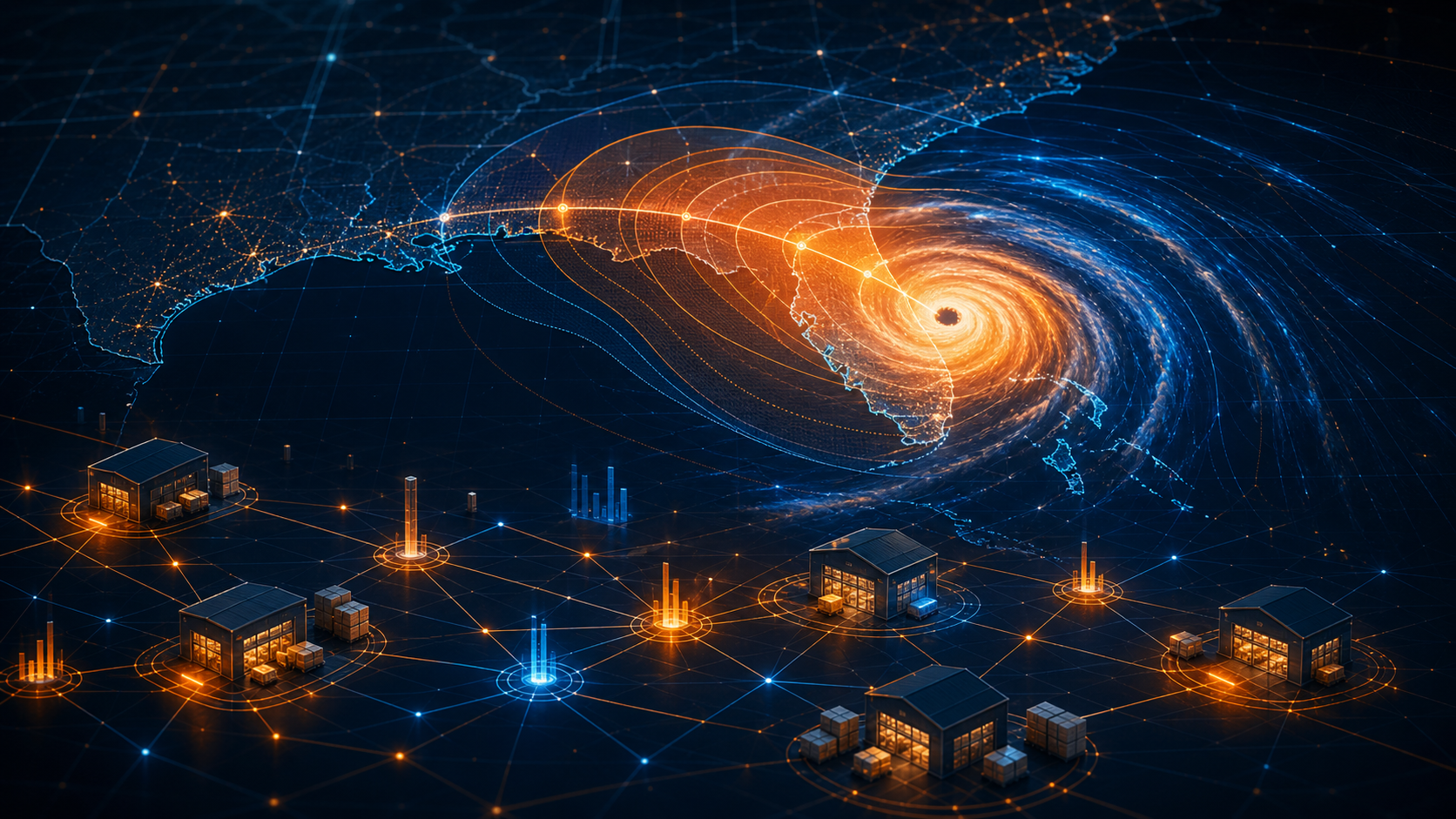
Still, the case matters because the planning move was concrete. The producer did not merely buy more shingles somewhere in the United States. It moved a constrained, region-specific product toward the market where storm damage and building-code requirements would shape post-landfall demand. That distinction is where storm planning usually succeeds or fails.
A storm surge is not a national demand signal
Storm demand is lumpy in several ways at once. It is geographic, because landfall risk and damage paths differ by county and metro area. It is time-bound, because purchases can split between preparation, emergency response, repair, and rebuilding. It is SKU-specific, because bottled water, generators, plywood, roofing materials, batteries, insulation, and food staples do not peak on the same day or for the same reason. And in categories like roofing, the correct product can depend on local code requirements rather than generic national assortment.
That is why a basic weather alert does not solve the inventory problem. A dashboard can tell a planner that Florida risk is rising; it cannot, by itself, decide whether to pull forward production of an approved shingle, divert a truck from another region, or hold back inventory because the modeled demand does not match the available SKU mix.
For demand planners, the valuable window is often measured in weeks, not days. A 2–6 week signal can still change allocation, procurement, production sequencing, carrier commitments, and warehouse positioning. A 48-hour signal may help expedite, ration, or communicate, but much of the cost structure has already hardened by then.
What the AI is doing between weather risk and revenue
The mechanism is more specific than “add weather data to the forecast.” SupplyChainBrain describes ClimateAi’s FICE model as combining traditional sales inputs with detailed weather and geological data to quantify the timing, duration, and magnitude of demand spikes.[2] In planning terms, that means the model is trying to estimate not only whether demand rises, but when it starts, how long it lasts, and how large the spike may be for the relevant market.
A practical workflow usually looks like this:
- Storm probability changes early enough to matter operationally.
- The model translates that risk into regional demand signals rather than a broad weather alert.
- Demand sensing filters the signal through historical sales, seasonality, product constraints, and location-level relevance.
- Planners decide which SKUs deserve inventory, production, or transportation changes.
- Inventory moves before the market becomes visibly short.
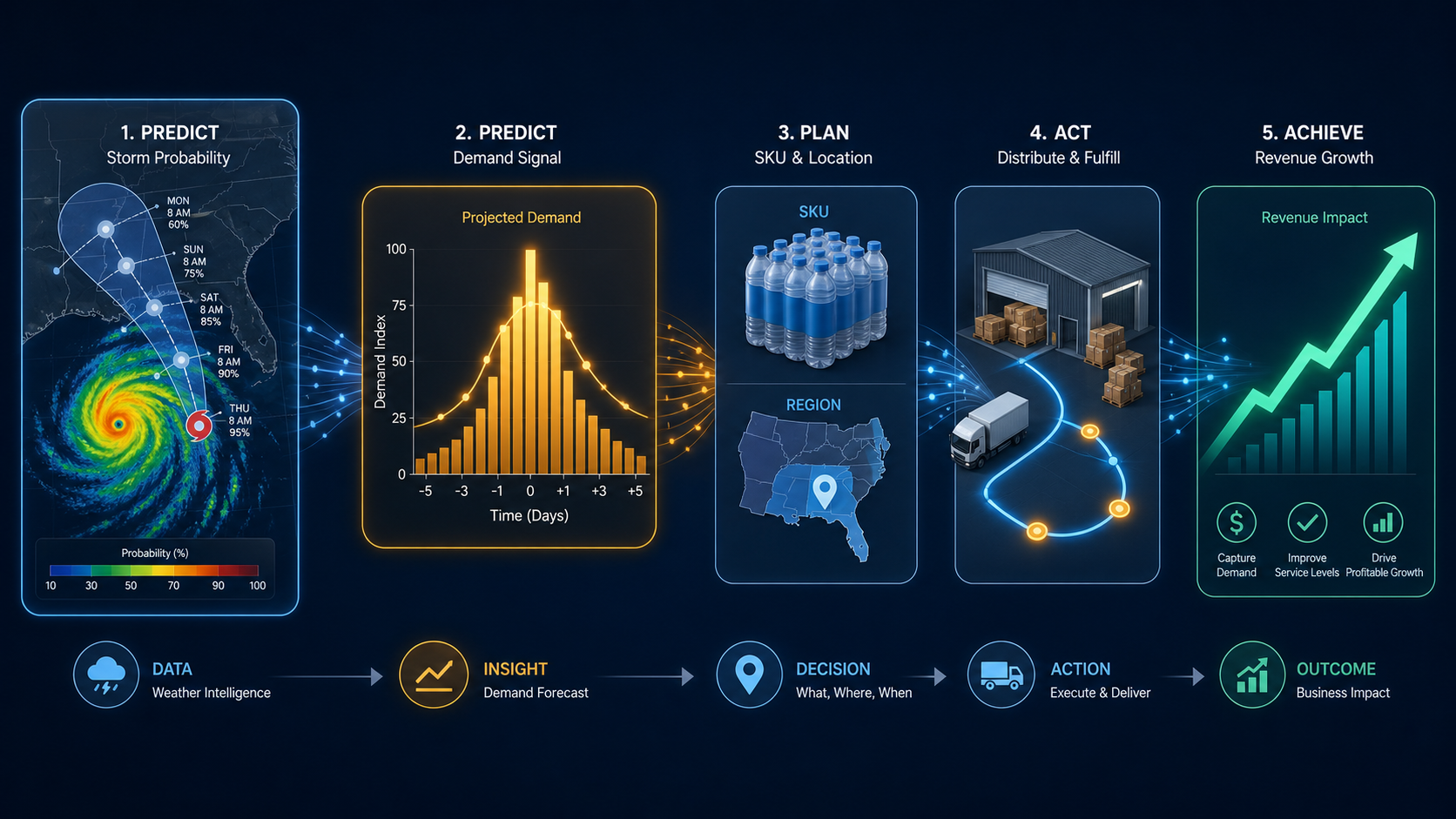
The middle steps are the part worth defending. If the chain jumps from “storm probable” to “increase inventory,” the planner is exposed. The right question is not whether the model predicted weather stress; it is whether it narrowed the decision enough to justify consuming scarce supply.
In the Hurricane Ian roofing case, the operational chain was visible: storm risk appeared early, Florida demand relevance was high, the SKU constraint mattered because shingles had to meet Florida building-code requirements, and inventory was positioned before landfall. The $15 million outcome came after those steps, not from the forecast alone.[1]
Where demand sensing adds value
Demand sensing is useful when it prevents planners from treating all storm-adjacent products as equal. A hurricane may lift demand for emergency supplies before landfall, but roofing materials are typically tied to damage and repair. A generator may surge in one corridor while another region needs cleanup supplies. A product can be nationally available and locally wrong.
This is also where internal data quality starts to matter. Weather intelligence can indicate exposure, but the planning system still needs usable product-location history, substitution rules, lead times, service-level priorities, pack configurations, and constraints. A company that cannot see inventory cleanly across nodes will struggle to turn an early demand signal into a reliable allocation decision. For teams still building that foundation, a data readiness assessment for AI inventory optimization is often more important than adding another external signal.
The business case is plausible, but the evidence should stay in its lane
The broader AI supply chain argument is supported by secondary-source statistics, but those numbers should not be confused with storm-case proof. The World Certification Institute cites McKinsey findings that AI can reduce supply chain errors by 20–50% and mitigate lost-sales risk by up to 65% during disruptions.[3] Those figures support the general value of AI-enabled planning, not a guarantee that every hurricane-preparation model will produce those exact gains.
The same caution applies to market projections. The AI supply chain market is projected to grow from $7.15 billion in 2024 to $192.51 billion by 2034, according to Precedence Research as cited by the World Certification Institute.[3] That growth says companies are spending into the category. It does not prove that any one planning room has solved SKU-level storm allocation.
For a planner, the stronger business case starts smaller. If an early signal lets the company move the correct constrained inventory into a high-probability demand region before spot freight, emergency purchasing, and allocation fights begin, the upside can be real. The roofing case gives one concrete example. The broader statistics explain why executives are listening.
Why storm planning is becoming worth systematizing
Storm planning used to be treated as a seasonal exception in many supply chains. The disruption data makes that posture harder to defend. Resilinc reported that supply chain disruption notifications rose 38% year over year in 2025, with extreme weather events up 33% and floods up 34%.[4] Those are notification counts, not direct demand forecasts, but they show that weather-related stress is no longer rare enough to manage only through heroic expediting.
The United States also saw 27 confirmed billion-dollar climate disasters in 2024, according to NOAA data cited in industry disruption coverage.[5] A billion-dollar event does not automatically create a profitable demand opportunity for every supplier. It does mean more companies face the same uncomfortable planning problem: demand and supply are both moving while transportation, labor, customer urgency, and local constraints are changing at the same time.
That is the context in which AI weather intelligence becomes more than a seasonal add-on. It gives planners a repeatable way to monitor risk, connect it to exposed products and locations, and decide when a scenario is strong enough to change inventory posture. The value is not in making storms predictable in a perfect sense; it is in reducing the number of decisions made after everyone else has already reacted.
Tool categories matter less than the handoff to planning
Vendors approach the problem from different starting points. ClimateAi emphasizes climate and weather intelligence tied to demand and supply risk. Everstream frames disruption monitoring and risk analytics across supplier networks. Blue Yonder is commonly discussed in the context of planning and supply chain execution platforms. The Weather Company and IBM describe predictive weather analytics and real-time insights for managing supply chain weather risks.[6] Those categories can overlap in an implementation, but they do not remove the need for a planner-owned decision rule.
| Signal or capability | Planning question it should answer |
|---|---|
| Early storm probability | Is the risk strong enough to open a scenario before standard forecast cycles catch up? |
| Regional demand sensing | Which markets are likely to see a demand spike, and when? |
| SKU-level relevance | Which products match the likely damage, preparation behavior, code requirements, or emergency use case? |
| Inventory visibility | Where is usable stock now, and what would moving it leave behind? |
| Production and transportation constraints | Can the company still make, allocate, or move product inside the useful window? |
The handoff is where many pilots become uncomfortable. A risk score may be probabilistic, but the purchase order, production change, and truck assignment are real. Someone must decide whether a 2–6 week signal is strong enough to act, what threshold triggers a move, and which markets are allowed to lose inventory so another market can be protected.
That decision should be documented before the storm season starts. If the rule is improvised during a named storm, the loudest customer, largest account, or most recent stockout memory can overpower the model. The result may still be called proactive planning, but it is often just reactive allocation with a better weather feed.
The over-ordering trap
The most common failure mode is not skepticism. It is enthusiasm applied too broadly. A planner sees storm risk, adds inventory across a family of products, and later discovers that demand concentrated in fewer SKUs, different counties, or a later repair phase. The company then carries excess inventory in one node while another region still stockouts.
Storm-driven planning should therefore separate three decisions that are often collapsed into one:
- Whether the storm scenario is credible enough to change the plan.
- Which SKUs are actually exposed to the likely demand pattern.
- Which inventory can be moved without creating a worse shortage elsewhere.
A hypothetical example makes the risk clear. A home-improvement supplier may correctly identify elevated hurricane risk in a coastal state and still make the wrong buy if it adds generic roofing inventory that does not match local code requirements or customer repair behavior. The weather signal was useful; the SKU decision failed.
The better control is not to slow everything down until the signal is certain. Certainty arrives too late. The control is to tie each action to a constraint: approved SKU list, target counties or distribution nodes, available production slots, substitution rules, minimum inventory retained for donor markets, and a date when the scenario will be refreshed or unwound.
What good storm-demand planning looks like
A good implementation does not ask planners to trust an AI answer in isolation. It gives them a scenario that can be challenged: expected demand timing, expected duration, products affected, regions affected, inventory currently available, recommended moves, expected service risk in donor markets, and the assumptions that would cause the recommendation to change.
The operational standard is plain. If the model says demand will spike in a region, the planning system should show whether the company can still do something useful inside the window. Can production be pulled forward? Can a regional SKU be switched into the schedule? Can a distribution center receive product before carriers are constrained? Can ecommerce and store allocation rules preserve inventory for the market most likely to need it? These are the decisions covered in stronger demand forecasting and inventory allocation use cases, not just in weather analytics.
For companies selling into hurricane-prone US regions, the documented evidence is strongest. The same pattern is logically transferable to typhoon and cyclone markets where products, regulations, and response behavior are known, but the available source material is less documented outside the US hurricane belt. That should shape expectations: treat the use case as portable in method, not automatically proven in every geography.
AI can help planners see storm-driven demand surges 2–6 weeks earlier and act before reactive competitors. The gain depends on whether the company can translate that signal into the correct SKU, location, and inventory decision. The real test is the right product in the right region before the storm, without creating a new shortage somewhere else.
References
- Accurate Hurricane Forecasting Helps Roofing Materials Producer, ClimateAi, 2022.
- Harnessing AI for Supply Chain Resilience in Extreme Conditions, SupplyChainBrain, August 2025.
- From Reactive to Proactive: How AI-Driven Supply Chains Weather Every Storm, World Certification Institute.
- Supply Chain Disruption Is Accelerating: Why 2026 Demands a New Response, Resilinc, January 2026.
- Are You Prepared for the Supply Chain Disruptions of 2026?, Everstream.
- Managing Supply Chain Weather Risks With Predictive Analytics and Real-Time Insights, The Weather Company.
Comments
Join the discussion with an anonymous comment.