

The word “agentic” is doing too much work in procurement right now. In one demo, it means a chatbot that summarizes a supplier profile. In another, it means a sourcing assistant that drafts an RFx. In the more consequential versions, it means an AI procurement platform that can negotiate, trigger events, route approvals, coordinate supplier responses, and escalate only when something falls outside policy.
That distinction matters because procurement risk changes when software stops advising and starts acting. A dashboard that recommends a payment-term strategy creates one kind of review problem. An autonomous negotiation agent that offers those terms to thousands of suppliers creates a different one. The first asks whether the recommendation was sound. The second asks who authorized the agent’s boundaries, how exceptions were handled, and whether the outcome can be audited after the fact.

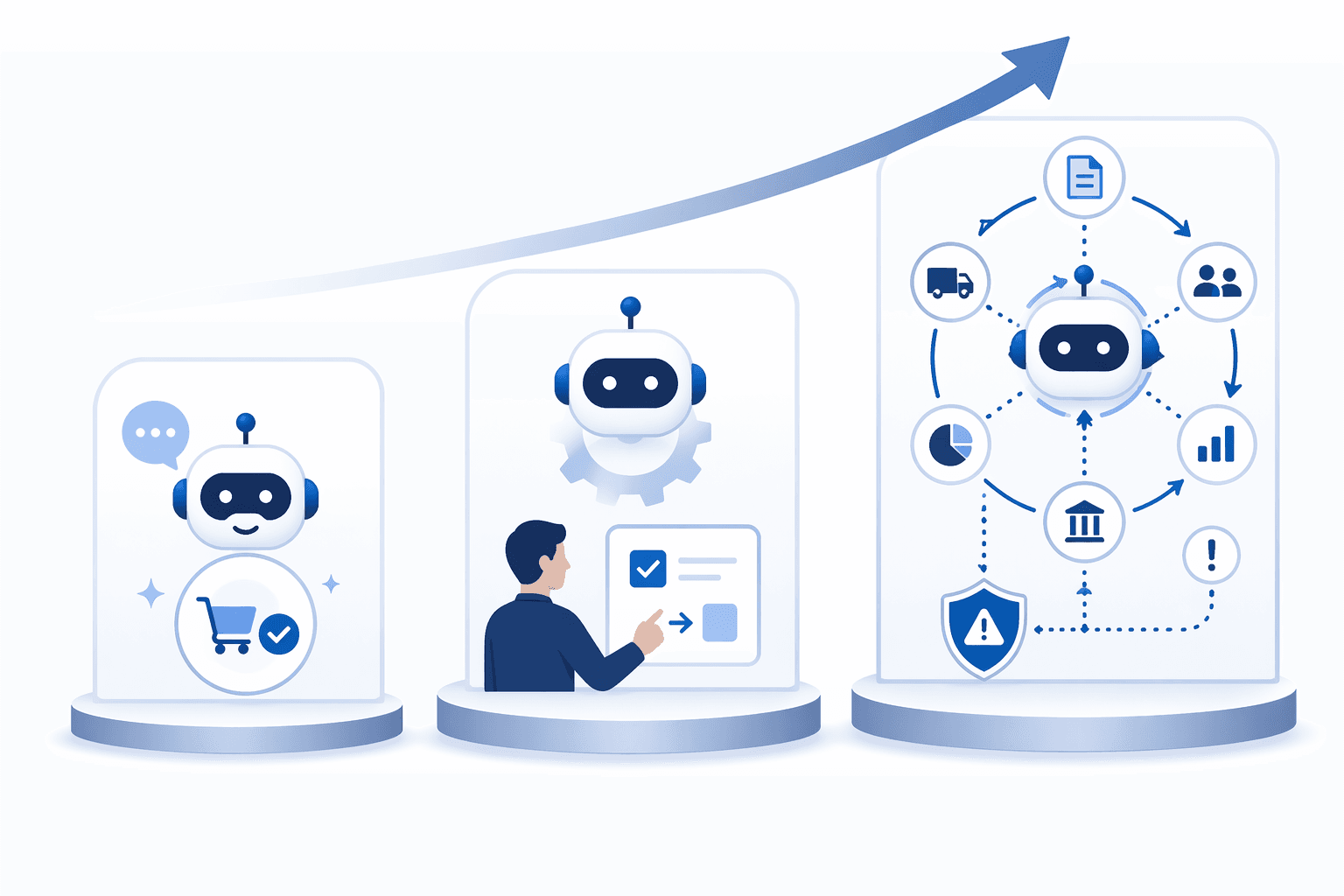
A useful dividing line comes from Gartner’s three-tier taxonomy: AI chatbots and assistants at the first level, simple task-specific agents with human-in-the-loop control at the second, and advanced agents that coordinate multi-step work, act proactively, and collaborate with other agents at the third. Gartner also forecasts that supply chain management software with agentic AI capabilities will grow from less than $2 billion in 2025 to $53 billion in 2030, a 93.5% compound annual growth rate, with 60% of enterprises expected to adopt by 2030; importantly, that forecast covers SCM software broadly, not procurement alone.[1]
The clarifying question, then, is not whether procurement will use AI. It already does. The question is where agentic AI is mature enough to run work inside an operating model rather than merely impress a steering committee.
Recommendation, bounded action, and autonomous orchestration are not the same product
A procurement copilot can help a category manager write a supplier email. A simple agent can collect intake data, check a policy rule, and send a request to the right reviewer. An advanced agent can run several steps of the process: identify eligible suppliers, launch an event, compare bids, negotiate within guardrails, update records, and alert a human only when the case breaks a threshold.
Most vendor language blurs these levels. That blurring is not harmless. If a tool only drafts recommendations, governance can focus on user review and decision quality. If a tool executes procurement actions, governance has to define delegated authority, approval rights, audit logs, fallback paths, supplier disclosures, data lineage, and exception ownership.
Gartner has already warned that more than 40% of agentic AI projects will be canceled by the end of 2027 because of escalating costs, unclear business value, and inadequate risk controls. It has also warned about “agent washing,” with only about 130 real agentic AI vendors among thousands claiming the label.[2] That does not make agentic AI a mirage. It means the market is early enough that definitions still have financial consequences.
The Walmart and Pactum case still sets the bar for autonomous negotiation
The most persuasive production evidence is not a forecast. It is the Walmart and Pactum autonomous negotiation case, first documented in Harvard Business Review in 2022 and still cited by procurement AI vendors in 2025 and 2026 because it shows something unusually concrete: suppliers negotiated with AI, many accepted, savings were measured, and supplier experience did not collapse.[3]
Walmart used Pactum’s autonomous negotiation system for tail-end supplier negotiations. The results were stronger than the internal target: a 68% supplier agreement rate against a 20% target, 3% average cost savings, a 35-day average payment-term extension, and 4× ROI. Supplier sentiment was also striking: 75% of suppliers reportedly preferred negotiating with AI over a human, and 83% rated the system easy to use.[3]
This case matters because it sits exactly where agentic procurement makes operational sense: high-volume, low-complexity negotiation where human teams often do not have enough time to pursue every opportunity. In that environment, the alternative to an autonomous agent is often not a better human negotiation. It is no negotiation at all.
The discomfort is just as important as the promise. Payment terms, supplier acceptance, and value capture are not abstract model outputs; they are commercial outcomes. An agent negotiating with suppliers must operate within approved positions, know when to stop, and leave a record that a procurement leader can defend months later. The Walmart case is compelling because it shows measurable value inside a bounded use case, not because it proves autonomous negotiation belongs everywhere.
Pactum has also reported deployments with Maersk, Henkel, Rolls-Royce, Honeywell, Veritiv, Otto Group, and Linde, with value generation ranging from 2% to 30% on negotiated spend.[3] Those figures help establish autonomous negotiation as more than a laboratory scenario, but they still point toward a specific deployment pattern: many similar commercial conversations, clear negotiation variables, and enough spend fragmentation that human teams cannot economically cover the entire supplier base.
Agentic sourcing looks strongest when the event pattern repeats
The second convincing evidence block comes from agentic sourcing, especially where procurement teams run many repetitive events with familiar inputs and decision rules. Keelvar reports that its sourcing automation can automate 93% of tasks in manufacturing, that early adopters automate 85% of sourcing events, that Mars saved $64 million in one year, and that Siemens achieved more than 90% automation across thousands of events.[4]
Those numbers should not be read as a universal sourcing automation benchmark. They are evidence that sourcing agents can scale when the domain is bounded: categories are recurring, supplier data is usable, event structures are repeatable, and award logic can be expressed in rules that the business accepts before the agent acts.
This is where the agentic label earns some of its weight. A sourcing bot that launches events, collects bids, monitors responses, recommends or executes next steps, and escalates only exceptions is doing more than drafting a sourcing document. It is taking over a process pattern. That is useful precisely because many sourcing teams do not need every event to be reinvented; they need repetitive events to move without waiting in a queue.
For broader ROI context outside agentic-specific deployments, readers may want to compare these cases with the evidence base in AI Procurement Tools: What the ROI Data Actually Shows. The important distinction here is that autonomous sourcing value depends less on generic AI capability than on the repeatability of the procurement lane.
The vendor landscape is better understood by capability pattern than by logo count
The market is already crowded enough that a flat vendor list is not very helpful. The more useful question is what kind of action the platform is trying to own.
| Capability pattern | What the agent does | Vendors appearing in this pattern | Best-fit deployment lane |
|---|---|---|---|
| Autonomous negotiation | Runs supplier negotiations inside preapproved commercial boundaries | Pactum; Zycus also positions agentic negotiation capabilities through Merlin | Tail spend, payment terms, low-complexity commercial renegotiation |
| Agentic sourcing | Automates recurring sourcing events, bid collection, event monitoring, and next-step execution | Keelvar; JAGGAER positions JAI autonomous procurement agents in adjacent sourcing and procurement workflows | Repetitive categories, high-volume RFx, structured award logic |
| Intake orchestration | Guides users through requests, classifies demand, applies policy, and routes work | Zip with 50+ Superagents; Zycus Merlin; Ivalua IVA | Purchasing intake, guided buying, policy triage, request routing |
| Execution orchestration | Coordinates multi-step procurement workflows across systems and data sources | Opstream; Ivalua; Zycus; JAGGAER | Cross-functional procurement operations where data quality and approval rules are already explicit |
Pactum is the clearest reference point for autonomous supplier negotiation because its flagship evidence includes measured supplier acceptance, savings, payment-term movement, and supplier experience data.[3] Keelvar is the clearest reference point for high-volume agentic sourcing because its public cases describe automation across large numbers of recurring events.[4]
The other platforms are harder to compare from the available evidence because their claims span broader orchestration layers and suite strategies. Zycus positions Merlin as an agentic procurement platform and has cited intake orchestration results including a 40% NPS increase and 20% increase in spend under management.[5] Zip’s Superagents emphasize intake orchestration, Ivalua’s IVA emphasizes orchestrated execution, Opstream emphasizes data-first autonomous workflow orchestration, and JAGGAER positions JAI as autonomous procurement agents.
That is enough to map the field, but not enough to rank it. A buyer evaluating an AI procurement platform should press for deployment-specific proof: production usage, event volume, adoption by procurement users and suppliers, exception rates, approval design, auditability, and value measurement. For a fuller platform selection lens, see How to Evaluate AI Procurement Software: A CPO's Buyer's Guide.
The market signal is strong, but the productivity claims are not interchangeable
The momentum is real. McKinsey reports 20% to 30% staff efficiency gains and 1% to 3% additional value capture from early agentic procurement deployments.[6] PwC estimates that agentic AI will transform 75% of procurement activities, with 30% overall productivity gains and up to 70% productivity gains in agent-driven tasks, though the methodology behind the highest figure is not fully detailed in the available material.[7]
Those numbers should not be averaged into a single business case. They measure different things: staff efficiency, additional value capture, overall activity transformation, and productivity in agent-driven task subsets. A procurement leader building an investment case should decide first whether the target is labor capacity, negotiated value, cycle-time reduction, spend under management, supplier experience, or compliance. The KPI determines whether the agent is succeeding.
Gartner’s longer-term view also suggests that procurement’s value proposition may change, with cost reduction falling from 52% to 29% of procurement value by 2030 and innovation rising from 35% to 54%.[1] That is a strategic signal, not a license to skip the operating details. Innovation does not reduce the need to define who can approve an autonomous sourcing decision.
Governance is the bottleneck most pilots will run into
The adoption gap is sharper than the vendor demos suggest. Hackett Group’s 2026 Adoption Index, as reported in Zycus coverage of APS 2026, surveyed more than 250 CPOs and found that fewer than half felt confident monitoring agentic AI. Only 24% had defined KPIs, only 19% had governance infrastructure, and 58% had IT rather than procurement leading strategy.[5]
That distribution explains why many organizations can run pilots before they can run autonomous procurement. Pilots can survive on executive sponsorship, manual oversight, and a narrow dataset. Scaled deployment needs a control model: which categories are eligible, which suppliers are in scope, which terms are negotiable, which thresholds trigger review, which records are written back to source systems, and who owns the exception.
The fact that IT often leads strategy is not automatically a problem. Agentic procurement depends on architecture, identity management, integration, and data governance. But if procurement is not leading the operating design, the result can be a technically impressive agent with unclear commercial authority. That is where risk accumulates.
Data readiness remains the quiet prerequisite. An agent can only act safely when supplier records, contract terms, category rules, policy thresholds, taxonomies, and approval paths are clean enough to support delegated action. Organizations still sorting out data foundations should treat autonomous deployment as a lane-by-lane exercise, not a platform-wide switch. The data-readiness problem is familiar from adjacent use cases such as AI supplier risk scoring, where poor input quality quickly turns an elegant model into an untrusted workflow.
The practical deployment model is lanes, not blanket autonomy
Oliver Wyman’s lanes model is a useful way to move from enthusiasm to design. Standard requests can flow touchlessly inside guardrails; higher-risk work belongs in supervised lanes; exceptions become the unit of management.[8] That framing fits procurement because not every buying decision deserves the same control burden.
| Lane | Suitable work | Human role | What must be defined before launch |
|---|---|---|---|
| Touchless | Standard, low-risk requests and repetitive events | Human-on-the-loop exception oversight | Eligibility rules, thresholds, audit logs, supplier communication rules |
| Supervised | Moderate-risk sourcing, negotiations, or intake cases | Human approval at defined decision points | Approval rights, escalation paths, review SLAs, KPI ownership |
| Manual or advisory | Strategic suppliers, complex categories, disputed terms, policy ambiguity | Human decision maker supported by AI recommendations | Clear limits on what the agent may suggest versus execute |
This is also the right way to interpret human-in-the-loop, human-on-the-loop, and human-out-of-the-loop language. Human-in-the-loop means the agent prepares or advances work but waits for approval. Human-on-the-loop means the agent acts within boundaries while humans monitor outcomes and exceptions. Human-out-of-the-loop should be reserved for narrow situations where policy, data, and risk are stable enough that autonomous execution is explicitly approved.
The first lane should usually be boring. Tail-spend negotiation, recurring spot buys, guided intake for standard purchases, low-complexity RFx events, and supplier data enrichment are better candidates than strategic category transformation. The point is not to minimize ambition. It is to choose a domain where the organization can prove the agent’s action boundaries before widening them.
Architectural choices also matter. Some organizations will prefer agents inside a full source-to-pay suite; others will use orchestration layers across incumbent systems. That decision depends on integration depth, data ownership, workflow fragmentation, and the number of systems that must be coordinated. The tradeoff is explored further in Procurement AI Tools in 2026: Orchestration Layers vs. Full S2P Suites.
What has to be true before an AI procurement platform can act
The production-ready pattern is becoming visible. The strongest cases share several conditions: bounded categories, high transaction volume, repeatable process logic, clean-enough data, measurable outcomes, and a control model that procurement and IT both understand.
- The category has clear boundaries. The agent knows which spend, suppliers, geographies, and request types are in scope.
- The commercial levers are preapproved. Savings targets, payment terms, award rules, preferred suppliers, and negotiation ranges are defined before execution.
- The data is usable. Supplier records, contracts, historical pricing, taxonomy, policy, and approval paths are accurate enough for delegated action.
- The exception model is explicit. The agent does not improvise when risk rises; it escalates to a named role or queue.
- The audit trail is complete. Procurement can reconstruct what the agent saw, what rule it applied, what action it took, and who approved the operating boundary.
- The KPI is not vague. The deployment measures cycle time, staff capacity, savings, value capture, spend under management, supplier satisfaction, compliance, or another defined outcome.
If those conditions are missing, the agent should remain advisory or supervised. A capable model connected to messy policy and incomplete data is not autonomous procurement. It is automated ambiguity.
This is where change management becomes more than a communications plan. Category managers have to trust the lane design. Legal and finance have to accept the guardrails. Suppliers have to understand the interaction. Procurement operations has to monitor exceptions. For organizations preparing that operating model, the more relevant work may be the readiness framework in Change Management Guide for Autonomous Procurement AI.
Where agentic procurement is production-ready in Q2 2026
As of Q2 2026, agentic AI in procurement is production-ready in narrow, governed, data-ready domains. Autonomous negotiation has credible evidence in tail-spend and similar low-complexity supplier negotiations. Agentic sourcing has credible evidence in repetitive event environments. Intake orchestration is moving quickly because it can remove friction without immediately handing the agent full commercial authority.
It is not yet production-ready as a broad autonomous layer across all procurement activity for most organizations. The barrier is not only model capability. It is governance maturity, data quality, exception handling, and the willingness to define exactly where the agent may act.
The next 12 to 18 months should be spent choosing the first bounded lane, proving the control model, measuring the result, and then widening carefully. Debating whether agents will eventually matter is less useful than deciding which procurement process is stable enough to let one act.
References
- Gartner Forecasts SCM Software With Agentic AI Capabilities to Grow to $53 Billion by 2030, Gartner, April 2026.
- Gartner Predicts Over 40% of Agentic AI Projects Will Be Canceled by End of 2027, Gartner, June 2025.
- How Walmart Automated Supplier Negotiations, Harvard Business Review, 2022.
- Keelvar Customer Stories and Agentic Sourcing Automation Materials, Keelvar.
- Agentic AI in Procurement: APS 2026 and Hackett Adoption Index Coverage, Zycus.
- Redefining procurement performance in the era of agentic AI, McKinsey & Company, February 2026.
- Agentic AI in Procurement, PwC.
- Agentic AI in Procurement and the Lanes Model, Oliver Wyman, March 2026.
Comments
Join the discussion with an anonymous comment.