

Artificial intelligence sourcing changes most when AI stops waiting for a procurement analyst to ask the next question. In 2026, the important shift is from systems that classify spend, surface supplier risk, and summarize bids to agentic systems that can assemble a sourcing event, monitor markets, draft RFP materials, compare responses, prepare negotiation positions, and check whether contracted value is actually captured.
The documented results are no longer limited to productivity claims. McKinsey’s February 2026 case studies report linked AI agents identifying 12–20% savings in contact center operations and 20–29% in BPO and financial services spend at a technology company; autonomous sourcing agents increasing procurement staff efficiency by 20–30% and improving value capture by 1–3% in consumables at a chemicals company; and negotiation agents reducing analysis time by up to 90% while producing 10–15% savings across vendors at a telecom company.[1] Those are material outcomes, but they are not a blanket business case. They come from large-enterprise pilots in categories where the work could be decomposed, the data was usable, and humans still governed important decisions.

What agentic AI adds beyond sourcing analytics
Most procurement teams already know what analytical AI can do. It can normalize vendor names, classify spend, flag price variance, summarize supplier performance, and populate dashboards. That is valuable, but the operating model still depends on a human user to interpret the signal, open the sourcing workflow, request the right documents, compare the alternatives, and decide what should happen next.
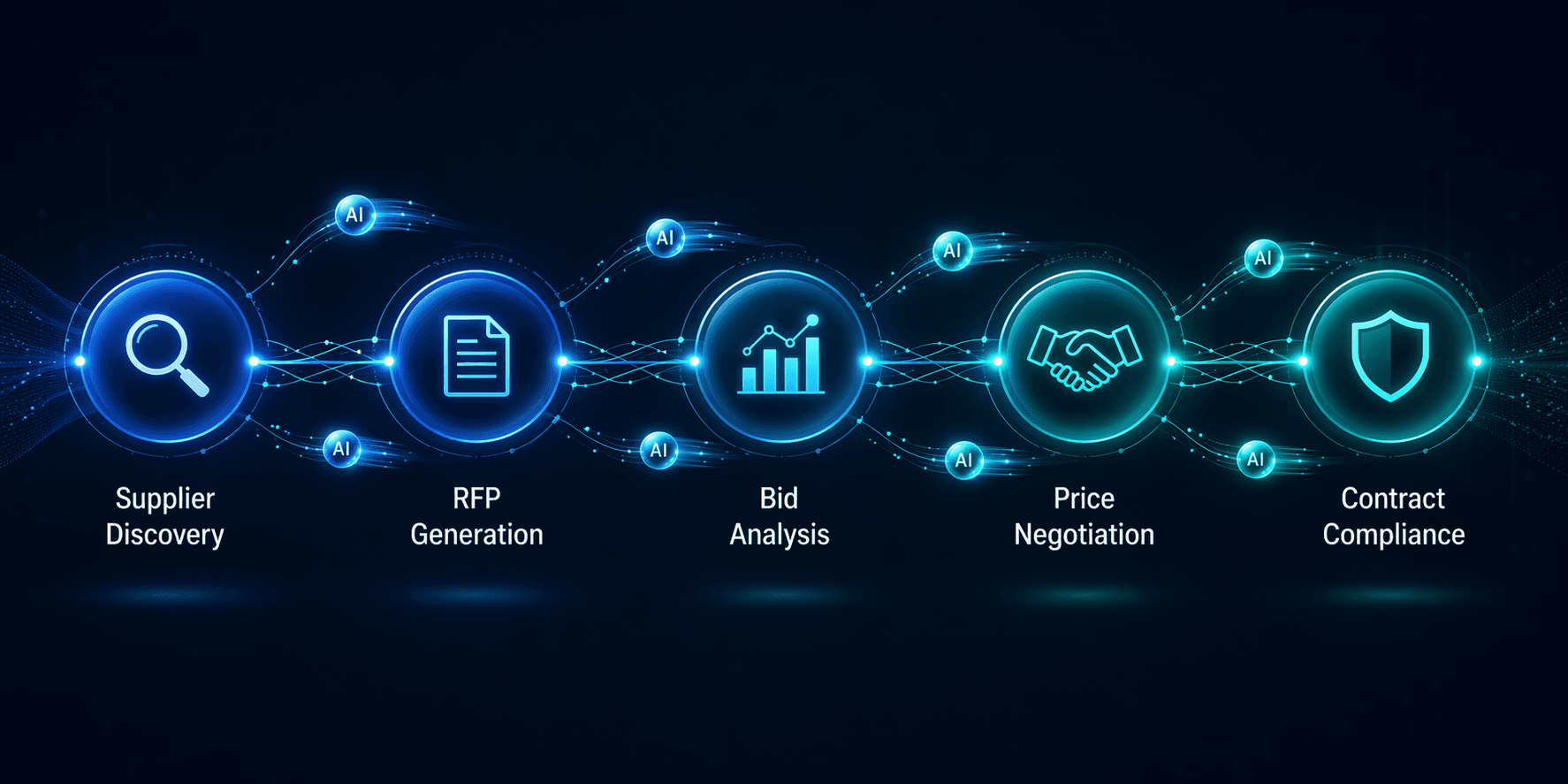
Agentic AI changes the unit of automation. Instead of automating one task in a sequence, it coordinates specialized agents that work in parallel across market monitoring, supplier risk, category strategy, negotiation, and execution. GEP describes this as a move away from conveyor-belt workflow automation toward agent networks that can sense changes, trigger tasks, and collaborate across a sourcing lifecycle rather than waiting for each previous step to finish.[2]
That difference matters because strategic sourcing work is full of handoffs. A category manager may start with demand history, then ask for supplier options, then rewrite an RFP, then wait for bids, then ask finance for baselines, then prepare negotiation ranges, then check contract terms against invoices months later. Analytical AI improves fragments of that chain. Agentic AI tries to compress the chain itself.
| Sourcing activity | Analytical AI contribution | Agentic AI contribution |
|---|---|---|
| Supplier discovery | Ranks suppliers from existing data and risk indicators | Searches, filters, monitors, and proposes supplier shortlists for review |
| RFP preparation | Summarizes past events and category requirements | Drafts event materials using approved templates, specifications, and policy constraints |
| Bid analysis | Compares bid fields and highlights variance | Tests scenarios, explains trade-offs, and prepares negotiation positions |
| Negotiation | Provides benchmarks and recommended targets | Conducts or prepares structured negotiations within approved boundaries |
| Contract compliance | Reports leakage after invoices are processed | Checks invoice-to-contract compliance and escalates exceptions earlier |
This is why the strongest early evidence appears in areas where sourcing work is structured enough to delegate but repetitive enough that delegation matters. Agentic systems do not need to “own” strategic sourcing to create value. They need to remove enough analysis, document preparation, supplier comparison, and compliance checking that category teams spend less time assembling the case and more time making the judgment.
The clearest gains are in preparation, comparison, and controlled negotiation
The telecom negotiation case is the cleanest example of agentic AI doing something more specific than “better analytics.” The reported gain was not only that the company found savings. The agents reduced negotiation analysis time by up to 90% and achieved 10–15% savings across vendors.[1] In practical terms, that means the machine work moved upstream of the negotiation meeting: baseline building, vendor comparison, target setting, and scenario preparation.
That distinction is important for sourcing directors building an adoption case. If the category team already has strong analytics but still needs days to turn bid data into a negotiation pack, the bottleneck is not visibility. It is preparation capacity. Agentic AI has a stronger claim where it reduces the time between receiving supplier input and taking a commercially defensible action.
The Walmart and Pactum autonomous negotiation case points in the same direction, though it should be treated as a narrower benchmark rather than proof of full multi-agent sourcing. In that case, autonomous negotiations reached a 68% supplier close rate, generated 3% average savings, and supported 2,000 simultaneous negotiations.[3] The scale is notable because it shows where autonomous negotiation is most useful: high-volume commercial interactions that would otherwise receive little or no human negotiation attention.
That is not the same as handing complex supplier relationships to a bot. A large strategic supplier with technical dependencies, regulatory exposure, or supply continuity risk still needs human commercial judgment. The relevant lesson is narrower: when the negotiation problem is bounded, the rules are explicit, and the fallback path is clear, autonomous agents can pursue value that human teams often leave untouched because the events are too numerous or too small to justify manual effort.
Savings vary sharply by category
The spread in reported results is more useful than a single average. A chemicals company saw autonomous sourcing agents in consumables increase procurement staff efficiency by 20–30% while improving value capture by 1–3%.[1] A telco saw 10–15% savings in vendor negotiations.[1] A technology company’s linked agents identified 12–20% savings in contact center operations and 20–29% in BPO and financial services spend categories.[1]
Those figures do not support a universal savings promise. They show that agentic sourcing depends heavily on category structure. Savings potential is stronger when supplier alternatives are real, specifications can be compared, historical baselines are available, and commercial levers are not already exhausted. Efficiency gains can still appear in lower-savings categories because agents remove preparation and execution work, but the value story will be different.
For a procurement VP, that difference affects sequencing. A team should not start by asking which categories are most visible to leadership. It should ask where the sourcing process has enough repeatable logic for agents to act, enough spend or transaction volume to matter, and enough human oversight to prevent automated mistakes from becoming supplier or compliance problems.
The operational value is not limited to source-to-award
Some of the most consequential examples sit outside the classic sourcing event. McKinsey reports that an aircraft OEM used AI agents to automate order execution, reducing active inventory by 30% and boosting EBIT by approximately $700 million.[1] A pharma company used agents to enforce invoice-to-contract compliance and reduced value lost through leakage by 4%.[1]
These cases matter because sourcing value is often lost after the award. A category manager may negotiate a better rate card, rebate, or service level, but the business only realizes the value if orders, invoices, contract terms, and supplier behavior stay aligned. Agentic AI is well suited to this follow-through work because it can monitor exceptions continuously and route only the meaningful cases to humans.
This also changes how leaders should evaluate artificial intelligence sourcing programs. If the business case stops at faster RFPs, it may miss leakage, compliance, and execution value. If it claims end-to-end autonomy without proving that agents can act safely across procurement, finance, legal, and operations data, it overreaches.
Graduated autonomy is the practical boundary
The useful governance question is not whether AI should be autonomous. It is where autonomy should stop. A low-risk tail-spend negotiation, a consumables reorder analysis, or an invoice compliance exception can tolerate more agent-led execution than a sole-source component, a regulated clinical supplier, or a strategic outsourcing decision.
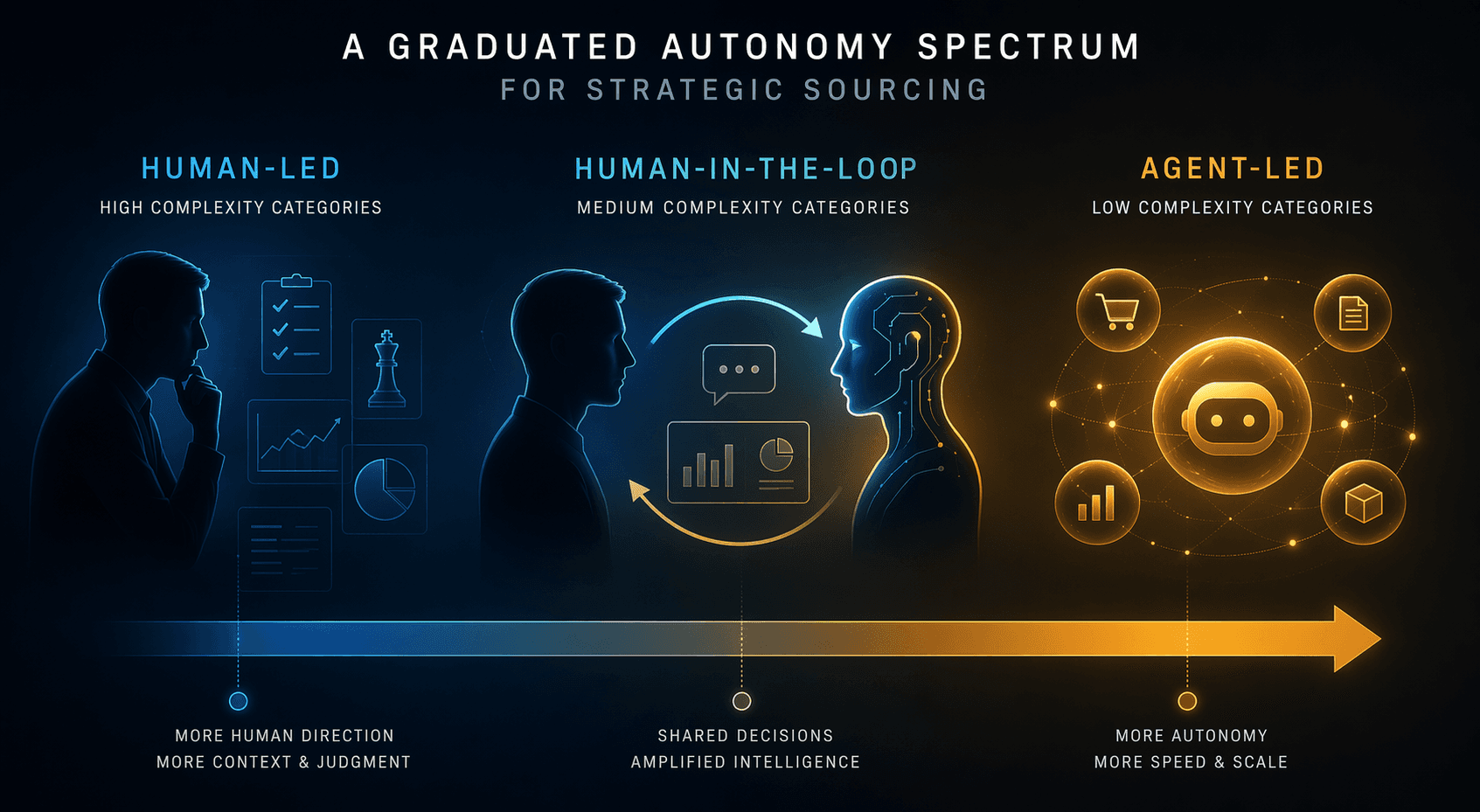
A workable model usually has three operating zones. Human-led categories keep agents in a research, drafting, and monitoring role. Human-in-the-loop categories allow agents to prepare recommendations, run scenarios, and execute bounded steps after approval. Agent-led categories allow autonomous action within preapproved commercial, legal, and escalation limits. For a broader treatment of the governance model, see Agentic AI in Supply Chain: A Practitioner's Guide to Graduated Autonomy in 2026.
The boundary should be set by consequence, not by enthusiasm for the technology. If an agent’s action can affect supply continuity, regulatory exposure, intellectual property, worker safety, or a strategic supplier relationship, the approval threshold should rise. If the action is reversible, low-value, policy-bound, and auditable, more autonomy is easier to justify.
Data readiness is the constraint that separates pilots from operations
Agentic sourcing requires better data discipline than spend analytics because the system is not merely describing the business. It is acting on what it reads. A supplier record with duplicate entities, outdated risk attributes, inconsistent payment terms, or missing contract metadata is annoying in a dashboard. In an agentic workflow, it can cause the wrong supplier to be shortlisted, the wrong clause to be applied, or the wrong exception to be ignored.
Gartner’s 2025 leadership work for CPOs reported that 74% of procurement data was not ready for AI use, a constraint that should be treated as an implementation prerequisite rather than a reason to abandon the effort.[4] The same source projects agentic AI in supply chain and procurement software growing from about $2 billion in 2025 to $53 billion by 2030, which is best read as an investment signal rather than a precise adoption guarantee.[4]
The practical implication is straightforward. Before expanding autonomy, procurement leaders need to know which data domains agents will rely on: supplier master data, contract repositories, invoice and PO history, specification libraries, risk feeds, category taxonomies, and approval rules. A team that cannot explain the source of truth for those domains is not ready for broad autonomous execution. A focused assessment, such as a data readiness assessment for AI procurement automation, is a better starting point than another general AI workshop.
The organization has to change with the workflow
Agentic AI also exposes organizational friction that analytical AI could work around. A dashboard can sit on top of fragmented responsibilities. An agent trying to execute sourcing work has to cross them. It may need category input, legal templates, finance baselines, supplier risk rules, and business-owner approvals in the same workflow.
Deloitte’s 2025 Global CPO Survey found that 57% of CPOs cited siloed working as the top barrier.[5] That barrier becomes more visible when agents are expected to coordinate work rather than simply report on it. If legal does not trust AI-drafted clauses, finance does not accept AI-generated baselines, or category teams do not know when to override an agent recommendation, the workflow slows down at the same human checkpoints that slowed it before.
This is why the operating model should be designed with named owners, not just configured permissions. Someone must own category-specific autonomy limits. Someone must review exception patterns. Someone must decide when a model’s recommendation quality is good enough to expand scope. Someone must be accountable when an agent follows the rules and the result is still commercially poor.
For teams moving from pilots into production, the harder question is often not tool selection but adoption design: which buyers will trust the system, which category managers will retain final authority, which suppliers will accept autonomous interaction, and which controls procurement will show to finance, legal, and internal audit. The patterns discussed in From Pilot to Production: How Procurement Teams Are Actually Deploying AI are relevant here because agentic sourcing magnifies the same scaling problem.
Where the business case is strongest in 2026
The strongest business case is not “agentic AI for procurement.” It is narrower: agentic AI for sourcing workflows where the next action can be defined, the risk of a wrong action can be bounded, and the value of compressing preparation or execution time is visible.
- High-volume negotiations where many events are too small for manual treatment but large enough in aggregate to matter.
- Categories with structured specifications, comparable suppliers, and accessible historical baselines.
- RFP and bid-analysis workflows where teams lose time assembling documents, normalizing responses, and preparing negotiation packs.
- Contract compliance and leakage monitoring where agents can compare invoices, POs, and contract terms continuously.
- Supplier risk and market-monitoring use cases where agents escalate changes rather than waiting for periodic review.
Supplier risk monitoring is a good example of a supporting agent rather than a standalone transformation. A risk-scoring model may already flag supplier exposure, but an agent can watch for changes, connect the alert to active sourcing events, and prompt a category manager before the risk becomes a late-stage award issue. Teams evaluating that layer can use AI supplier risk scoring and spend analysis as a more focused reference.
The weaker case is full autonomy in strategically sensitive categories. The research available in 2026 does not justify a broad claim that agentic AI can replace human sourcing judgment for complex supplier selection, regulated sourcing, or major strategic partnerships. It supports a more disciplined conclusion: agents can take over bounded sourcing work and prepare higher-stakes work faster, but the approval architecture has to match the consequence of the decision.
How to read the early evidence
McKinsey estimates that agentic AI can make procurement functions 25–40% more efficient overall, and notes that procurement teams now manage 50% more spend per FTE than five years ago.[1] Those figures explain why the topic has moved from experimentation to operating-model discussion. They also need context. The underlying cases are early, concentrated in large enterprises, and published by a firm that also advises clients on implementation. They are useful evidence, not independent proof of universal performance.
The right way to use the evidence is to compare pattern to pattern. The strongest pattern is efficiency gain in work that agents can structure and repeat. The second is additional savings where markets, suppliers, and baselines give agents real commercial levers. The third is value protection after award, where compliance agents can reduce leakage. The unproven pattern is broad autonomous decision-making across strategic categories without close human governance.
That makes 2026 an important year for artificial intelligence sourcing, but not because procurement is becoming self-running. The more defensible claim is that sourcing teams now have evidence for graduated autonomy: let agents execute bounded preparation, comparison, negotiation, and compliance work; keep humans accountable where supplier choice, risk, regulation, and commercial strategy carry larger consequences.
References
- Redefining procurement performance in the era of agentic AI, McKinsey, February 2026.
- How Agentic AI Makes Sourcing Smarter, Faster, and Scalable, GEP, October 2025.
- Walmart/Pactum autonomous negotiation case, Harvard Business Review.
- 2025 Leadership Vision for Chief Procurement Officers, Gartner, 2025.
- 2025 Global Chief Procurement Officer Survey, Deloitte, 2025.
Comments
Join the discussion with an anonymous comment.