

The first number to put in front of a finance team is not the biggest savings claim. It is the adoption gap. Hackett reported that 49% of procurement organizations had piloted generative AI, while only 4% had reached scale; the same report also found 94% weekly generative AI use, but that latter figure describes individual executive use, not enterprise procurement platform deployment.[1] That distinction matters. An AI procurement tool used by one category manager to draft an email is not the same investment case as an agentic sourcing workflow connected to spend data, supplier records, approvals, and contract leakage controls.
Deloitte’s 2025 CPO survey sets the second guardrail: 85% of CPOs increased AI investment, but only 6% reported ROI in under a year, with most satisfactory returns showing up over a 2–4 year window.[2] So the practical question is not whether AI can save procurement money. It can. The question is where the saving lands, how quickly it is measurable, and whether the organization has the operating discipline to move from a promising pilot to a budget-visible result.

The ROI range is real, but it is not one range
The cleanest way to read the current evidence is by use case. Tail-spend negotiation, strategic sourcing, inventory optimization, specification rationalization, and procurement staff productivity do not produce the same kind of return. They also do not carry the same implementation burden.
| Use case pattern | Reported ROI or savings range | What the number measures | Evidence quality note |
|---|---|---|---|
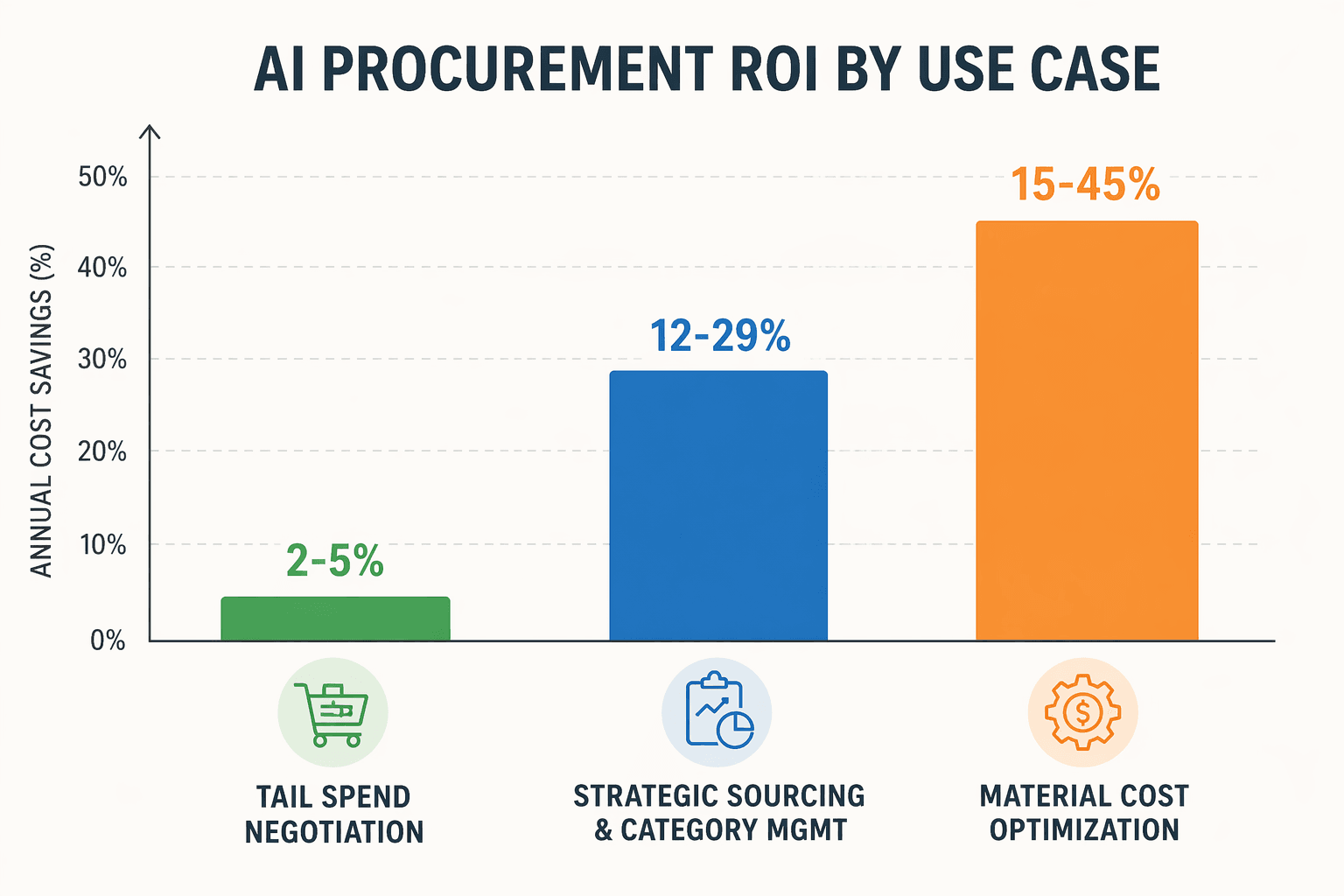
| Autonomous tail-spend negotiation | 2–5% average savings, up to 10% | Savings on spend that was previously uneconomical to negotiate manually | Deployment-specific vendor evidence; useful for bounded tail-spend cases |
| Strategic sourcing and category negotiation | 12–29% savings in targeted McKinsey case patterns | Category savings from specific sourcing and BPO/contact center procurement motions | Stronger case-study evidence, but not a universal category benchmark |
| Supplier negotiation preparation | 90% reduction in negotiation prep time; 10–15% vendor savings | Time compression and vendor savings in a telco case | Concrete case pattern; depends on category data and workflow adoption |
| Procurement productivity and value capture | 20–30% staff efficiency improvement; 1–3% value capture | Efficiency and recovered value in a chemicals procurement context | Good example of labor efficiency plus P&L capture, not just automation |
| Inventory optimization | 30% inventory reduction; approximately $700M EBIT uplift | Inventory reduction and EBIT impact in an aircraft OEM case | Large, attributed case pattern; not a normal software payback benchmark |
| Material cost optimization | 15–45% material cost reduction | Forecasting, benchmarking, and specification rationalization effects | Vendor-adjacent upper bound; should be treated as directional, not base case |
That table is the business case in miniature: an AI procurement tool does not have a single ROI profile. A CFO reviewing a request for funding will want to know whether the team is buying negotiation capacity, sourcing intelligence, spend leakage control, working-capital reduction, or staff productivity. The answer changes the savings line, the owner, the timing, and the audit trail.
Where McKinsey’s cases show the money moving
McKinsey’s February 2026 work on agentic AI in procurement is the most useful source in the current evidence set because it separates the deployment patterns instead of rolling them into one “AI procurement” claim. Its cases cover savings in contact centers, BPO, chemicals procurement, telecom negotiation, pharma leakage, and aircraft inventory—not one generic automation story.[3]
In the technology-sector examples, McKinsey reported 12–20% savings in contact center procurement and 20–29% savings in BPO procurement.[3] Those are sourcing and supplier-cost outcomes, not merely time saved by buyers. The procurement motion matters: the saving comes from using AI to improve spend analysis, sourcing event design, supplier comparison, and negotiation support in categories where there is enough addressable spend to make the work worthwhile.
The chemicals case is different. McKinsey reported 20–30% staff efficiency improvement plus 1–3% value capture.[3] That is a useful pairing because it forces a distinction procurement teams often blur in business cases. Staff efficiency is not automatically budget relief. It may mean more events handled by the same team, faster cycle time, better compliance coverage, or fewer outside advisory hours. Value capture is closer to the P&L, but it needs a baseline and a mechanism for proving that negotiated value did not leak before invoice or renewal.
The telecom negotiation case shows why AI procurement tools often look better in preparation-heavy workflows than in fully autonomous decision-making. McKinsey reported a 90% reduction in negotiation preparation time and 10–15% vendor savings.[3] If that result is going into a business case, the right owner is not just procurement operations. Category leadership has to confirm that the tool is changing supplier strategy, should-cost analysis, concession planning, and negotiation discipline—not simply producing briefing documents faster.
The pharma leakage case is narrower but important: McKinsey reported a 4% leakage reduction.[3] Leakage is one of the more finance-friendly AI use cases because the loss is usually visible after the contract is signed: off-contract buying, missed rebates, price mismatches, unclaimed credits, or noncompliant renewals. The hard part is not persuading people that leakage exists. It is getting the contract, purchase order, invoice, supplier, and approval data into a shape where the tool can find recoverable value and route exceptions to someone accountable.
The aircraft OEM case is the outlier in size and should be treated that way. McKinsey reported a 30% inventory reduction and approximately $700 million EBIT uplift.[3] That is not a normal benchmark for a procurement software purchase. It is a reminder that the largest AI-linked procurement returns may sit at the boundary between procurement, supply chain planning, engineering, and working capital. A team trying to justify a sourcing assistant should not borrow the economics of an enterprise inventory transformation.
For teams looking for more examples by workflow, the related use-case library at AI in procurement examples is useful precisely because it keeps the operational pattern visible.
Tail spend is smaller, cleaner, and often easier to defend
Pactum’s autonomous negotiation data is not the biggest savings claim in the market, which is part of why it is useful. The reported range is 2–5% average savings, with up to 10% savings, on tail spend that was previously uneconomical to negotiate manually.[4] This is not the same business case as transforming strategic sourcing. It is a capacity case.
Tail spend often fails the manual-effort test. The dollars are fragmented, the suppliers are numerous, and the category manager has better uses for the next hour. An AI procurement tool that can run bounded supplier negotiations inside pre-approved rules changes that equation. The saving may be modest as a percentage of total enterprise spend, but the baseline is credible: without automation, much of that spend would not have been touched at all.
The business case should therefore avoid pretending tail-spend automation will behave like a strategic sourcing program. It should show the unmanaged spend pool, the portion eligible for autonomous negotiation, the expected savings range, the guardrails for supplier interaction, and the internal cost of exception handling. If the tool negotiates $1 of value but creates $1 of dispute management, the finance case will notice.
Material-cost claims need a tougher haircut
Thinklytics’ 2026 material-cost analysis reports a 15–45% reduction opportunity across AI procurement patterns, including 8–18% excess inventory reduction from SKU-level forecasting, 4–12% negotiation leverage from supplier benchmarking, and 6–14% unit-cost savings from specification rationalization.[5] The components are plausible procurement levers. The full range should still be treated as a vendor-adjacent upper bound, not as a default assumption.
The reason is simple: each lever needs a different sponsor. SKU-level forecasting involves planning and operations. Supplier benchmarking involves category management. Specification rationalization often requires engineering, quality, product, or manufacturing approval. If the business case books the full 15–45% as if procurement alone controls all three levers, it will overstate both the savings and the speed.
That does not make the claim useless. It makes it a ceiling. A defensible base case would usually carve the range into separate savings pools, assign owners, apply confidence levels, and distinguish cash savings from avoided cost, working-capital release, and productivity.
Payback: the uncomfortable bridge between pilot math and budget approval
The optimistic payback story says AI procurement tools can show returns in months 6–9 on investments of roughly $220,000–$480,000.[6] That can be true for bounded deployments with accessible data, a clear savings owner, and a workflow where the tool reduces effort or captures leakage quickly. It is not the same as saying most organizations recover their investment inside a year.
Deloitte’s survey is the necessary counterweight: only 6% of CPOs reported ROI in under a year, and most satisfactory returns appeared over 2–4 years.[2] The gap between those two statements is where most business cases either become credible or start to look like software theater.
Fast payback is more likely when the implementation has a narrow scope and a measurable before-and-after line: autonomous negotiation on a defined tail-spend pool, leakage detection against known contract terms, intake automation where cycle-time and labor effort are already measured, or sourcing support in a category with a near-term event calendar. Slower payback is more likely when the return depends on data cleanup, operating-model redesign, supplier master normalization, integration with source-to-pay suites, or behavior change across multiple business units.
This is also where implementation architecture matters. Opstream/Coupa analysis contrasts legacy source-to-pay suite implementations that can take 6–12 months with orchestration platforms that can be deployed in weeks.[6] That comparison is useful for time-to-value planning, but it should not be read as proof that a faster deployment automatically produces faster ROI. A workflow can go live quickly and still wait months for enough transaction volume, supplier response, or contract events to prove value.
For a deeper treatment of measurement timing, the companion analysis on AI supply chain ROI timelines is the better place to pressure-test payback assumptions before they become board-slide math.
Market momentum is not ROI evidence
There is plenty of market oxygen around agentic procurement. Gartner projected agentic AI in supply chain and procurement software to grow from $2 billion in 2025 to $53 billion in 2030, a 93.5% compound annual growth rate.[7] Accenture also found that companies with AI-mature supply chains were 23% more profitable and six times as likely to use AI or generative AI widely, based on a study of 1,148 companies across 10 industries.[8]
Both data points are useful context. Neither should be used as the savings line in an AI procurement tool business case. Gartner’s number is a market-size projection. Accenture’s finding links AI maturity and profitability, but it does not prove that buying a procurement tool will cause a specific margin improvement. A finance reviewer will separate market adoption, organizational maturity, and project-level ROI. Procurement should do the same before being asked.
Why the 4% scale and the 96% stall
The useful lesson from the 4% scale rate is not that AI procurement is doomed. It is that deployment discipline is part of the ROI calculation. Hackett’s data says many organizations are experimenting; very few have turned that experimentation into scaled operating capability.[1] MIT’s 2025 study adds a broader enterprise caution, finding that 95% of enterprise generative AI pilots delivered no measurable ROI.[9] That is not a verdict against every AI use case. It is a warning against pilots that never attach themselves to measurable work.
The scaled pattern in McKinsey’s agentic procurement work is more specific: start with no-regret agents, build the data spine, and make human-agent teaming explicit.[3] In procurement terms, no-regret agents are the assistants that remove obvious friction without asking the organization to surrender commercial judgment on day one: intake triage, supplier discovery support, contract summarization, spend classification assistance, negotiation-prep drafting, leakage flagging, and event-status follow-up.
The data spine is less glamorous and more decisive. Spend taxonomy, supplier master quality, contract metadata, item data, approval rules, risk records, and invoice history determine whether the tool can do anything beyond summarize documents. If a procurement team cannot connect the recommendation to the supplier, the contract, the category, the purchase order, and the owner, the savings claim will remain soft.
Human-agent teaming is the control system. It defines which decisions the tool can make, which recommendations require review, which suppliers can be contacted autonomously, which commercial terms are off-limits, and who is accountable when the agent escalates an exception. The better deployments do not hide the human role to make the technology sound more advanced. They specify it so the savings can survive audit, supplier pushback, and internal compliance review.
A procurement team building the case can keep the structure simple:
- Name the spend pool or workflow, not just the technology category.
- Separate savings, avoided cost, working-capital release, and staff productivity.
- Show the baseline: current spend, cycle time, leakage, inventory, or manual effort.
- Assign a business owner for each value line.
- State the expected payback window and the operational assumptions behind it.
- Define what the tool may do autonomously and what requires human approval.
That is not a full implementation guide, and it should not be. It is the minimum evidence structure a serious AI procurement tool investment needs before it goes near capital allocation. The related operating-model discussion at agentic AI procurement operating model goes further on governance once the business case has cleared the first test.
A defensible ROI view
The evidence supports a fair, bounded conclusion. AI procurement tools can produce real savings: low-single-digit gains in tail-spend negotiation, double-digit savings in targeted sourcing and negotiation cases, meaningful leakage reduction, staff-efficiency improvements, and, in some supply-chain-heavy contexts, large working-capital and EBIT effects. The evidence does not support treating every AI procurement tool as a 15–45% savings engine.
The best business case will look less exciting than the vendor demo and more useful to the people approving the money. It will identify the use case, cite the appropriate benchmark, haircut vendor-adjacent claims, show when payback is expected, and make clear which part of the organization must change for the savings to become measurable. That is the difference between AI potential and procurement value that actually closes in a budget cycle.
References
- 2025 CPO Agenda Report, The Hackett Group, 2025.
- 2025 Global CPO Survey, Deloitte, 2025.
- Redefining procurement performance in the era of agentic AI, McKinsey, February 2026.
- Autonomous negotiation data, Pactum.
- AI Procurement Cuts Material Cost 15–45%, Thinklytics, 2026.
- Opstream/Coupa analysis, Opstream/Coupa.
- Agentic AI in supply chain and procurement software market projection, Gartner, January 2026.
- AI-mature supply chains profitability study, Accenture, 2024.
- 2025 enterprise generative AI pilot ROI study, MIT, 2025.
Comments
Join the discussion with an anonymous comment.