
The CrowdStrike outage became a supply chain event the moment status screens stopped being trustworthy. It was no longer just an endpoint failure or a cybersecurity headline. It was a network outage turning into flight delays and broken supply chain planning in one operating day: aircraft out of position, cargo sitting where it was not supposed to sit, planners waiting for extracts that did not arrive, and logistics teams trying to distinguish a real constraint from stale data.
The scale is still uncomfortable to read in operational terms. About 8.5 million Windows devices crashed. FlightAware counted 128,000 delayed flights. Parametrix estimated Fortune 500 direct losses at $5.4 billion, a figure that covers direct loss and insurance-impact estimates rather than the full economic drag of reputational damage and downstream disruption. Airlines alone lost an estimated $860 million, and Delta’s prolonged recovery drew scrutiny from the U.S. Department of Transportation after a multi-day failure to return to normal operations.[1][2]
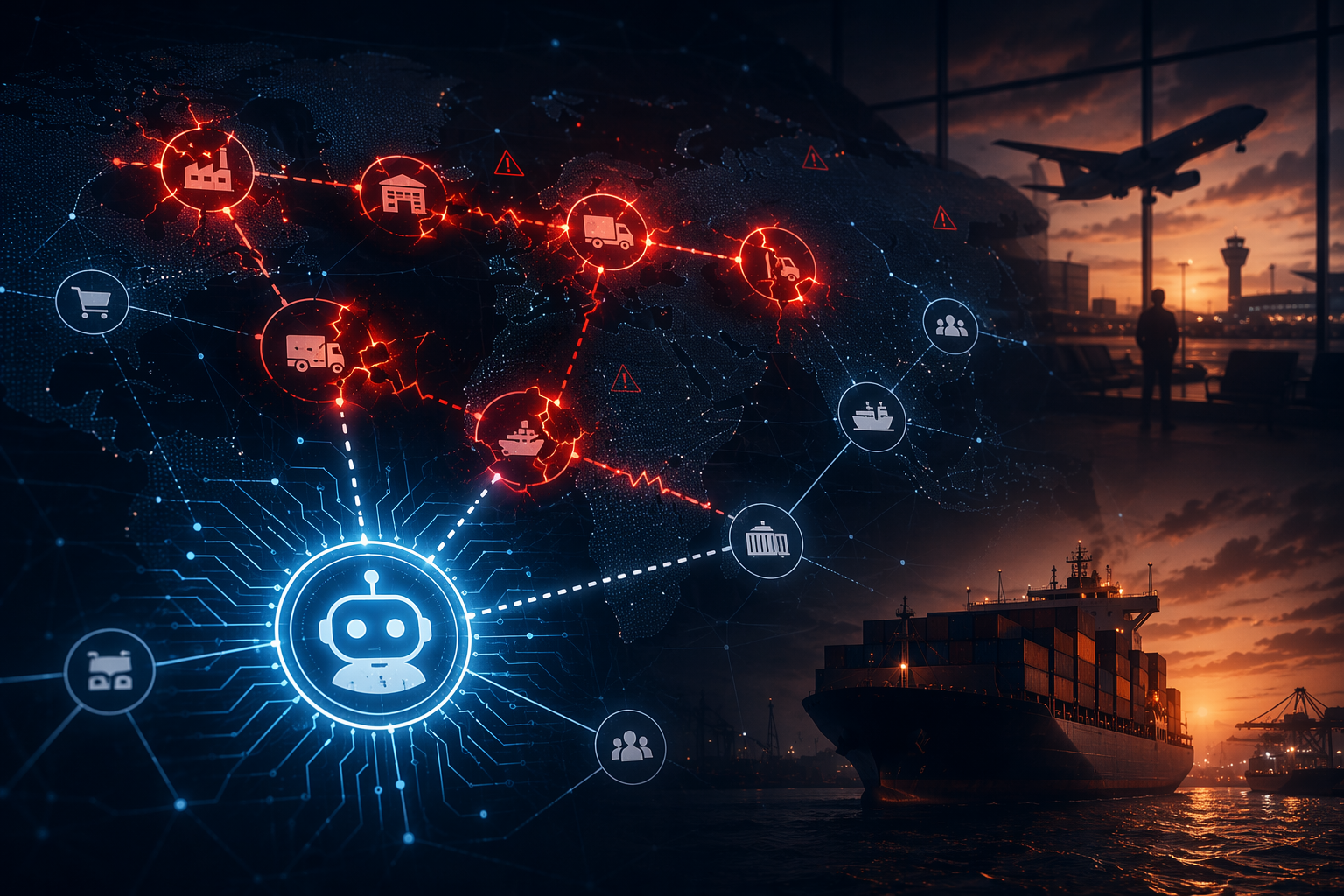
A planner does not experience that as one outage. She experiences it as missing appointment confirmations, rolling carrier exceptions, customer promises that may already be wrong, and a queue of people asking for answers before the data layer has recovered. SupplyFrame described air freight recovery after the outage as taking days or weeks, with stranded cargo, airport congestion, and delayed production inputs moving through the network after the original software problem had already been identified.[3]
That is the part most postmortems underplay. The first failure crashed machines. The second failure broke timing assumptions. Supply chain planning depends on the idea that fresh signals will arrive quickly enough to be useful: flight status, inventory availability, supplier commits, transport milestones, customer demand changes. When those signals freeze or arrive out of sequence, the plan does not merely become less accurate. It can start directing scarce attention toward the wrong bottleneck.
The Manual Response Was Already Too Slow
Network-borne disruption has a specific shape. It starts somewhere technical, then appears everywhere operational. A bad software update, a cloud service failure, a ransomware incident, or a telecommunications outage can hit the systems that tell people what is happening at the same time it changes what is happening.
That matters because the normal contingency rhythm was built for slower evidence. Assemble the bridge call. Pull the supplier list. Ask logistics for affected lanes. Check open orders. Ask finance what can be expedited. Wait for a carrier update. Reconcile three spreadsheets that use different location names. Then do it again when the first answer proves stale.
In multi-tier supplier impact analysis, the human-led cycle averages roughly five days. A Cambridge agentic AI framework tested on synthesized automotive scenarios completed comparable disruption analysis in an average of 3.8 minutes, with reported F1 scores from 0.962 to 0.991 and an estimated cost of $0.08 per analysis.[4]
That comparison is not a nice-to-have productivity metric. It is the difference between responding while the disruption is still forming and publishing a very careful answer after workarounds have already hardened into reality. In an incident room, five days is not an analysis cycle. It is an era.
The CrowdStrike outage also showed why a single-provider digital dependency can behave like a physical choke point. The software did not need to own the cargo, operate the aircraft, or manage the purchase order to affect all three. It sat inside the operating environment that other processes assumed would be available.
What Agentic AI Actually Has To Do
The useful version of agentic AI is not a chatbot that summarizes bad news. It is a response loop that can keep moving while the organization is still forming its bridge call. For a network outage tied to flight delays and supply chain planning, the loop has to do four jobs in order, sometimes repeatedly.
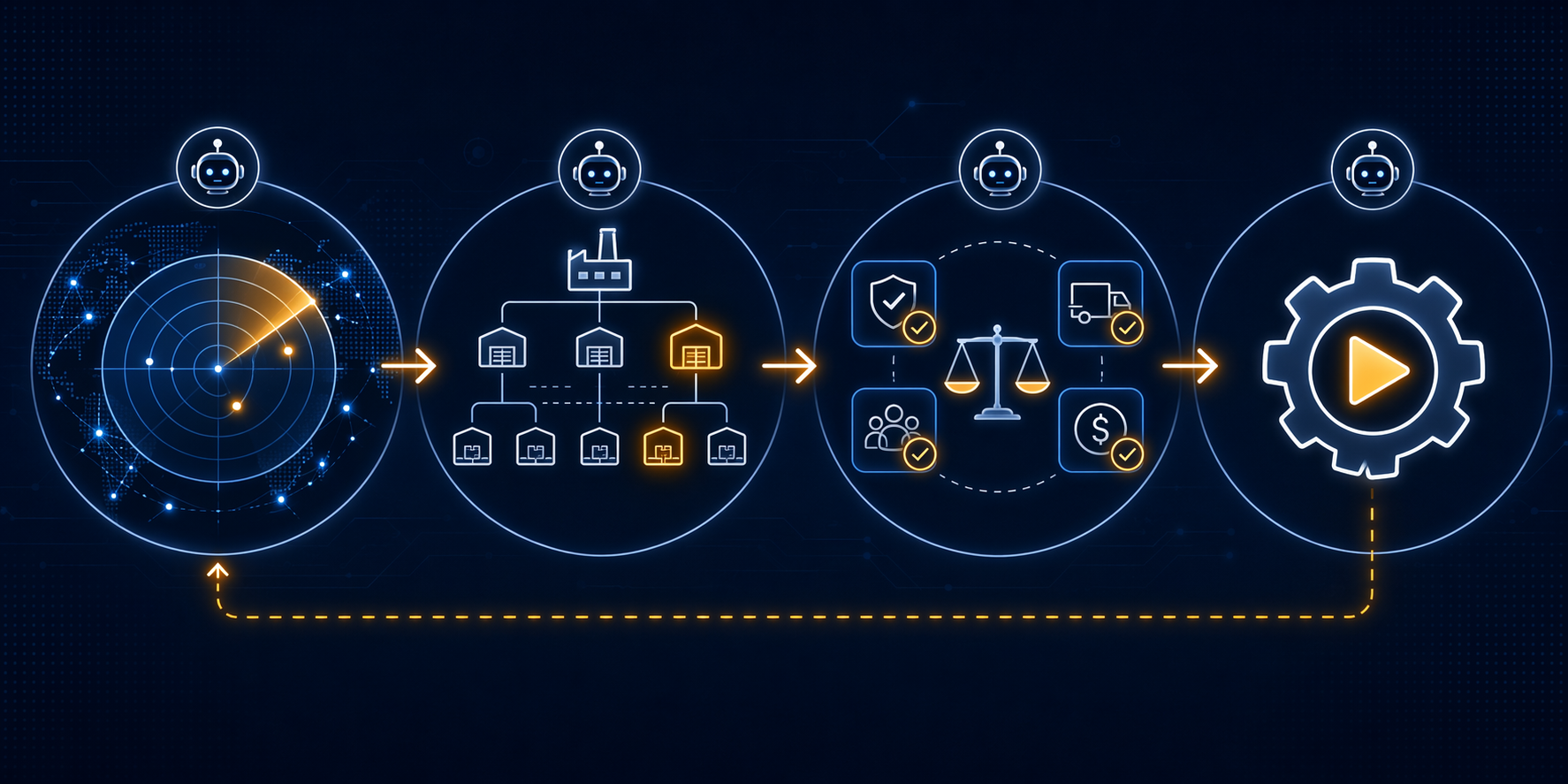
| Response job | What the AI must produce | Why it matters during an outage |
|---|---|---|
| Detect disruption | A structured event signal from system alerts, transport feeds, supplier messages, and anomaly patterns | Teams need to know that the planning environment has changed before every exception is handled as a one-off |
| Map exposure | Affected suppliers, lanes, facilities, orders, inventory positions, and customer commitments | A flight delay only matters operationally when it is connected to parts, shipments, and promises |
| Evaluate mitigations | Ranked options such as rerouting, alternate sourcing, allocation changes, or order reprioritization | The organization needs trade-offs, not a longer exception list |
| Prepare or execute bounded actions | Pre-approved moves with audit trails, confidence scores, and escalation triggers | Speed is useful only if the action stays inside governance that was agreed before the incident |
The Cambridge results are important because they tested this kind of multi-agent workflow against a problem humans handle badly under time pressure: multi-tier disruption propagation. The framework did not just identify a broken node. It analyzed how disruption could move through supplier relationships and recommended mitigation paths fast enough to remain operationally relevant.[4]
The uncomfortable caveat is just as important. The scenarios were synthesized. They covered 30 scenarios across three automotive manufacturers. That is a promising experimental base, not proof that the same performance will hold across live commercial production environments, messy master data, contracted carriers, constrained inventory, and industry-specific exception rules.[4]
Still, the direction is hard to ignore. Gartner predicted in March 2026 that 60% of supply chain disruptions will be resolved without human intervention by 2031.[5] That is a forecast, not present capability. Its value here is not that it proves autonomy is already safe. It shows that the operating model is moving toward machine-speed resolution because human-speed triage no longer matches the failure pattern.
Detection Is Not Enough
Many control towers already detect disruption. They show red lanes, late shipments, weather risks, supplier alerts, and transport exceptions. During a network outage, that visibility layer can become another source of noise if it cannot separate three questions: what failed, what business commitments are exposed, and which actions are still available.
A delayed flight is not automatically a production risk. It becomes one when it carries a constrained component, feeds a committed installation, misses a consolidation window, or creates a customs handoff problem. The AI system has to attach the external disruption to internal consequence: order, lane, bill of material, allocation rule, service-level commitment, and recovery option.
That is also where related use cases matter. AI-based flood planning can sense a hazard before it fully hits a lane, while AI risk monitoring for drone threats can watch for a different kind of disruption signal. Those are not the same as a global software outage, but they point to the same operating requirement: disruption sensing has to become consequence mapping, not just alert collection. See ChainSignal’s work on AI flood disruption planning and AI drone threat monitoring for adjacent examples.
Mitigation Has To Be Pre-Approved
The worst time to negotiate authority is after the airport queue is already growing. If an agentic system identifies that a shipment should be rerouted, inventory reallocated, or an alternate supplier activated, it still needs boundaries set before the outage: spend limits, customer priority rules, compliance restrictions, carrier eligibility, service trade-offs, and human approval thresholds.
This is where autonomy is often discussed too loosely. A useful agent does not need unlimited authority. It needs enough authority to prepare actions, execute low-risk moves, and escalate the expensive or irreversible ones with the evidence already assembled. The operational win is not that humans disappear. It is that humans stop spending the first hours discovering the shape of the problem.
For a network-borne event, the minimum evidence package should be auditable: affected nodes, data sources used, assumptions made, confidence level, recommended action, rejected alternatives, approval path, and expected consequence if no action is taken. Without that, speed becomes another manual workaround with better branding.
The Pattern Is Wider Than One Bad Update
CrowdStrike deserves to be the load-bearing case because it showed how fast a digital dependency can become a physical logistics problem. But it is not the only signal that supply chains are absorbing more network-originated disruption. Everstream Analytics reported that cyber-attacks on logistics surged 965% from 2021 to 2025.[6]
That number should not be read as a prediction that every logistics outage will look like CrowdStrike. It should be read as pressure on the same operating muscle: detecting digital disruption, deciding whether it touches supply, and acting before data latency turns into inventory latency. The Fairlife ransomware case is a useful parallel because it shows how a digital attack can interrupt a physical supply chain; ChainSignal covers that case in How a ransomware attack shut down Fairlife's $4B dairy supply chain and the AI-defense angle in Why AI Could Have Prevented the Fairlife Ransomware Attack.
There are also adjacent signs that AI-enabled operating models can improve disruption response when they are attached to real process controls. Siemens digital twin work was reported to reduce downtime by about 20% and logistics cost volatility by 14%. Genpact described a client outcome using agentic and generative AI for disruption response that improved forecast accuracy by 15% and reduced inventory by 10%.[7]
Those examples do not prove that an AI agent would have recovered the CrowdStrike cascade. They show that AI-based sensing, simulation, and planning are already being applied around the same failure surface: unstable demand signals, volatile logistics costs, and downtime caused by disruptions. For a broader investment view, ChainSignal’s 2026 supply chain AI ROI use-case guide separates where the business case is already concrete from where the language is still ahead of the operating proof.
Demand planning is especially exposed when transport and fulfillment signals break. If shipment status is stale, backorders are misread, or recovery dates shift faster than the forecast can absorb, the system may interpret outage-driven noise as demand behavior. ChainSignal’s benchmarks on AI demand forecasting accuracy are relevant here because recovery is not just about moving freight; it is also about restoring the signal quality that planning depends on.
The AI System Has To Survive The Same Outage Class
There is an obvious irony in proposing AI as the response to network-borne disruption. The agent needs data, compute, identity access, integration paths, and communications channels. If those dependencies fail with the same class of outage, the organization has built a very fast responder that cannot reach the incident.
Reports on AI infrastructure risk have warned that complex AI workloads can strain network infrastructure, while out-of-band management is increasingly positioned as a resilience requirement for keeping critical systems reachable during network failure.[8][9] In supply chain terms, that is not an IT architecture footnote. It is part of the operating model.
A credible agentic AI deployment for outage response needs at least three resilience tests before anyone should trust it in a control tower.
- Can it operate with degraded data feeds, and does it label stale or missing sources clearly?
- Can it reach decision-makers through out-of-band channels when the normal collaboration stack is impaired?
- Can it run a reduced but useful analysis if one cloud, identity, or integration layer is unavailable?
- Can it preserve an audit trail when actions are prepared or executed under incident conditions?
- Can it fail safely, handing off to human teams with a clear statement of what it knows and what it cannot verify?
These are not questions for the final slide of a risk review. They determine whether the AI is part of the recovery system or another dependency waiting to be diagnosed.
A 2026 Decision Standard
The strongest evidence for agentic AI is speed matched to structure. A network outage can distribute operational consequences faster than people can manually assemble the supplier, logistics, inventory, and customer view. The Cambridge framework’s 3.8-minute average analysis is the only evidence in this brief that operates at the same tempo as the disruption class it is meant to manage.[4]
The weakest evidence is production generalizability. Synthesized automotive scenarios are not the same as a live multi-industry deployment during a major outage. Gartner’s 2031 forecast points toward autonomous disruption resolution, but forecasts do not clear exception queues at 2 a.m.[5]
So the practical test in 2026 is narrow and demanding. Do not evaluate agentic AI by whether it sounds autonomous. Evaluate whether it can survive the same outage conditions it is supposed to manage, produce auditable recommendations in minutes, and operate inside pre-approved mitigation boundaries before the five-day manual cycle becomes irrelevant.
References
- CrowdStrike outage caused $5.4B in losses for Fortune 500 companies: Parametrix, Cybersecurity Dive
- Delta says CrowdStrike outage cost it $550 million, CNBC
- The CrowdStrike outage and global supply chain disruption, SupplyFrame
- arXiv:2601.09680, arXiv
- Gartner Predicts 60% of Supply Chain Disruptions Will Be Resolved Without Human Intervention by 2031, Gartner, March 2026
- 2026 Risk Report, Everstream Analytics
- Digital Twins, Agentic AI and the Future of Supply Chain Resilience, Supply Chain Management Review/Rutgers, 2025
- AI Workloads Are Pushing Network Infrastructure to the Brink, Techspective
- Out-of-Band Management: A Critical Component of Supply Chain Resilience, SupplyChainBrain/Opengear, 2025
Comments
Join the discussion with an anonymous comment.