
On July 16, 2026, Coca-Cola told investors that a ransomware attack had breached “production-related systems” at Fairlife and that U.S. production of Fairlife products had been suspended indefinitely.[1] That is the part of the disclosure that matters first for the supply chain: not that a large brand had a cyber incident, but that the incident reached the systems tied to making product.
In dairy, an indefinite production halt does not sit politely inside an IT ticket queue. Milk still moves toward intake. Refrigerated trailers still have appointments. Plant schedules still assume narrow windows for processing, packaging, sanitation, and outbound loading. Retail replenishment teams still expect product to arrive before shelf gaps become visible. Once production-related systems are unavailable, every hour asks the same operational question in a different language: what physical flow can still be accepted, diverted, held, or sold?

Fairlife is not a small side line. Food Business News reported Fairlife at about $4 billion in annual sales, operating across three U.S. production sites in Coopersville, Michigan; Goodyear, Arizona; and Webster, New York. The same reporting described the brand as already capacity constrained, with a $650 million Webster facility still ramping up.[2] That matters because a cyber halt at a constrained perishable operation has less slack to absorb missed production than a business with excess plant capacity, long shelf-life inventory, or easy third-party substitution.
What Is Known, and What Is Still Too Early to Claim
As of July 17, 2026, this is still an active incident, not a completed case history. The strongest public source is Coca-Cola’s Form 8-K: Fairlife experienced a ransomware attack; production-related systems were breached; U.S. production was suspended; the company was working to restore operations; and the company had not yet determined whether the incident would have a material impact.[1]
| Publicly supported point | Operational reading |
|---|---|
| Production-related systems were breached.[1] | This was not disclosed merely as an office-network disruption; it touched systems connected to making product. |
| U.S. Fairlife production was suspended indefinitely.[1] | Schedulers, procurement teams, carriers, and retail account teams had to operate without a public restart date. |
| Material impact had not yet been determined.[1] | The financial loss, service impact, spoilage exposure, and recovery cost could not responsibly be quantified from the filing alone. |
| Early reporting said no ransomware group had publicly claimed responsibility and data theft had not been confirmed.[3][4] | Attribution, extortion mechanics, and data-exposure claims should remain open until stronger evidence appears. |
TechCrunch and BleepingComputer both reported the attack soon after the filing, but neither turns the incident into a finished narrative: the public record did not yet identify the ransomware group, confirm stolen data, disclose a ransom demand, or provide a restoration timetable.[3][4] Those gaps are not footnotes. They determine whether the next operating problem is primarily restart sequencing, data exposure, customer communication, ransom negotiation, insurance recovery, or all of them at once.
Why “Production Suspended” Travels Faster Than the Cyber Team
A dairy plant is a conversion point between biological supply and commercial demand. Farms cannot simply stop cows from producing milk because a manufacturer’s production environment is locked. A plant cannot safely improvise every automated control, quality check, batching step, and packaging sequence if the affected production systems are unavailable. Cold-chain partners cannot assume trailers will turn on schedule if inbound receiving or outbound loading is uncertain.
The first cascade is upstream. Milk procurement teams need to know whether scheduled volumes can be received, whether any intake can be safely processed, whether tank capacity is available, and whether alternative outlets exist. If production is suspended across the U.S. network, the question is not simply “where else can this milk go?” It is “where else can this specific volume go, at this time, under these quality, transport, and contractual constraints?”
The second cascade sits inside the plant network. Fairlife’s three-site footprint gives the brand national manufacturing reach, but the July 16 disclosure said U.S. production was suspended, not that one local line was down.[1][2] When a constrained network loses production broadly, the usual playbook of shifting volume from one site to another becomes less useful. A plant that is still ramping, a line that is booked, or a SKU that requires specialized equipment cannot absorb unlimited stranded demand just because the spreadsheet wants it to.
The third cascade is refrigerated logistics. A carrier assigned to dairy does not become free capacity the moment a load is delayed. Drivers, trailers, washouts, appointments, dwell time, temperature monitoring, and backhauls all have their own clock. If inbound loads are held, diverted, or rejected, someone has to decide whether assets wait, move to another customer, or reposition empty. If outbound finished goods cannot load, retail distribution centers may face a service gap even before consumers notice one.
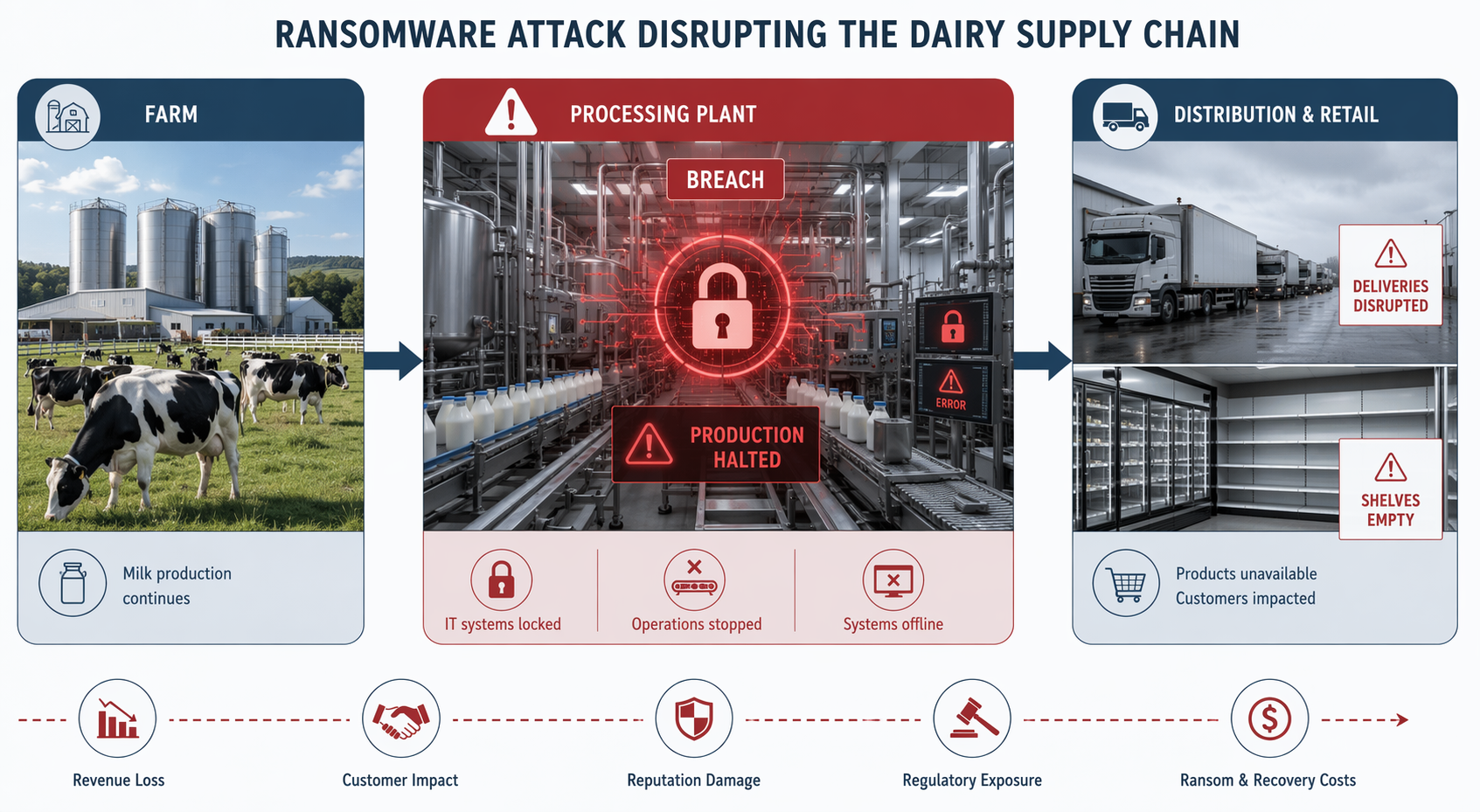
The fourth cascade reaches retail buyers. A fast-growing refrigerated brand has shelf space because the retailer expects turns, service, and shopper loyalty. A buyer may tolerate a short disruption differently from an indefinite one. Without a reliable restart date, account managers are not only explaining a cyberattack; they are negotiating allocation, substitution, promotion changes, and patience.
The Capacity Crunch Makes the Cyber Event More Physical
The Fairlife case is sharper because the brand was already operating under pressure. Food Business News described Coca-Cola’s Fairlife brand as facing a capacity crunch while the company worked through its production footprint, including the newer Webster, New York facility.[2] In that context, ransomware does not merely interrupt a comfortable system. It removes time from a network that was already trying to create more of it.
Capacity constraints change the recovery math. A plant that misses a day may not be able to “make it up” later if every future day is already committed. A brand with strong demand may have limited finished-goods inventory relative to expected orders. A new facility that is still ramping may be valuable future relief but not an immediate shock absorber. The practical result is that the recovery period can extend beyond the technical restoration period.
That distinction is easy to miss in cyber coverage. A system can be decrypted, rebuilt, or isolated before the supply chain is whole again. After production resumes, the company still has to decide which SKUs run first, which customers receive constrained supply, which loads are rescheduled, which promotions are cut, and which upstream commitments need adjustment. The restart sequence becomes a commercial allocation exercise, not just an engineering milestone.
A Dairy Precedent: Schreiber Foods
The closest comparison is not every ransomware attack in food manufacturing. It is another dairy processor whose outage showed how production downtime can surface later in consumer availability. In October 2021, Schreiber Foods was forced to halt production after a ransomware attack; Control Engineering later described the incident as involving a $2.5 million ransom demand.[5]
The useful lesson from Schreiber is the lag. A dairy disruption can begin as an incident-response problem and later appear as a shortage, a missed holiday season, a customer-service problem, or an allocation dispute. The public does not necessarily experience the outage when the malware first lands. It experiences the outage when inventory that should have been produced, packed, shipped, and replenished is not there.
Fairlife’s public facts are not the same as Schreiber’s, and the scale, product mix, network design, and recovery conditions should not be treated as interchangeable. The comparison is narrower and more useful than that: dairy production is time-sensitive, capacity is not infinitely portable, and the commercial effect of a cyber halt may become clearer after the initial news cycle has moved on.
This Is a Food-Manufacturing Pattern, Not a Fairlife Oddity
Fairlife is unusually visible because it sits inside Coca-Cola, carries billion-dollar scale, and was disclosed through an SEC filing. But food and agriculture have been a steady ransomware target. Food & Ag-ISAC counted 265 ransomware incidents affecting the food and agriculture sector in 2025.[6] That number does not prove that every processor faces the same risk profile, but it does make a major dairy halt feel less like an outlier and more like a visible instance of a known exposure.
Other food cases show different versions of the same operational pressure. JBS paid $11 million after a 2021 attack that disrupted meat production. Dole disclosed material costs after its 2023 ransomware incident. Duvel Moortgat faced data-leak consequences after a 2024 attack. Those examples matter here only to the extent that they show the range of consequences: production stoppage, cost absorption, extortion, data exposure, and customer impact can arrive in different combinations.
For supply chain leaders, the relevant category is not “cyber incident.” It is “unplanned loss of conversion capacity with uncertain duration.” Once the attacker reaches production systems, the boardroom vocabulary changes too slowly unless the operations vocabulary is already prepared: gallons not processed, loads not shipped, tanks not available, orders not filled, customers not allocated.
The Planning Gap Exposed by an Indefinite Halt
Most business continuity plans are more comfortable with a broken machine, a weather closure, a labor disruption, or a supplier failure than with a cyber-induced production halt of unknown length. Those older scenarios usually come with a more familiar boundary. A storm passes. A replacement part ships. A supplier can be qualified or expedited. Ransomware in production systems creates a less cooperative timeline because restoration depends on forensics, containment, rebuild decisions, operational validation, insurance, legal review, and sometimes negotiations that operations teams do not control.
The missing plan is often not the incident-response plan. It is the supply-chain operating plan for day two, day three, and day ten without production certainty. Who has authority to refuse inbound milk? Which farms or cooperatives receive diversion instructions first? Which alternate processors are commercially and technically viable? Which customers are protected by contract, margin, strategic value, or public-health considerations? Which SKUs are suspended before others? Which refrigerated assets are held despite cost because they are needed for restart?
That plan cannot be built during the breach. It requires a current dependency map that goes beyond tier-one suppliers and finished-goods customers. A dairy network depends on farms, haulers, ingredients, packaging, sanitation chemicals, quality labs, equipment vendors, warehouse slots, carriers, retail distribution centers, and customer service commitments. If that map lives in separate procurement, logistics, plant, and sales systems, the cyber incident will expose the seams at the worst possible moment.
This is where supply chain visibility work stops being a dashboard project and becomes a continuity requirement. A company trying to understand which farms, lanes, SKUs, customers, and facilities are affected needs a relationship model, not just a supplier list. Tools built around a supply chain visibility knowledge graph can help frame that problem because the question is not whether a supplier exists; it is how a node failure moves through connected physical and commercial dependencies.
What Food Manufacturers Need Before the Next Breach
The Fairlife incident does not support a neat prescription about who attacked, whether a ransom should be paid, or how long recovery will take. It does support a practical readiness agenda for perishable manufacturers whose cyber and supply chain teams still plan in parallel.
- Define production-system outage scenarios in supply chain terms: lost intake windows, lost conversion capacity, stranded refrigerated assets, SKU allocation, and customer service exposure.
- Pre-assign decision rights for perishable flows: who can divert, reject, hold, rebook, substitute, or allocate when the restart date is unknown.
- Rank products and customers before the incident: not every SKU deserves the first restart slot, and not every order can be protected when capacity returns unevenly.
- Test manual and degraded-mode operations honestly: if quality, safety, traceability, or control requirements cannot be met without specific systems, the plan should say so.
- Bring OT-cyber posture into supplier and co-manufacturer risk scoring, especially where a partner controls irreplaceable conversion capacity.
Procurement has a specific role here. It should not wait for a breach to discover that an alternate processor lacks the right equipment, that a packaging supplier cannot accelerate a compatible format, or that a logistics provider has no spare refrigerated capacity in the affected region. The same logic applies to vendor risk programs: OT-cyber maturity belongs beside financial health, quality performance, and geographic concentration. Teams building that discipline can look at AI-driven supplier risk scoring and the broader supplier-risk monitoring tools market, but the metric only matters if it changes sourcing, contracting, or contingency decisions.
Operations teams need a resilience score that includes cyber-triggered downtime, not just supplier count or inventory coverage. A facility that is efficient under normal conditions but has no tested degraded-mode process may be less resilient than it appears. A supplier with a strong service record but weak production-system segmentation may carry risk that does not show up in on-time delivery. That is the useful role for an AI resilience score for supply chains: not to make resilience look scientific, but to force cyber, capacity, perishability, and customer impact into the same decision frame.
The other gap is timing. Many companies still discover supply chain exposure reactively, after the plant is down and the calls begin. Proactive monitoring will not prevent every ransomware attack, but it can shorten the time between “systems are unavailable” and “we know which flows, customers, and suppliers are now at risk.” That is the practical value of proactive supply chain risk management in this context.
The Case Is Still Open, but the Continuity Lesson Is Already Clear
Fairlife is not yet a completed loss story. As of July 17, 2026, the public record does not establish the attacker, the ransom demand, the data-theft outcome, the restart date, the total financial cost, or the final customer impact. Treating those unknowns as known would make the case tidier and less useful.
What the case already shows is enough. A ransomware attack reached production-related systems at a $4 billion dairy brand, and Coca-Cola suspended U.S. Fairlife production indefinitely.[1][2] For a perishable supply chain, that sentence is not an IT status update. It is a farm intake problem, a plant scheduling problem, a refrigerated logistics problem, a retail allocation problem, and a customer-trust problem arriving through the same door.
Cyber resilience and physical supply chain resilience can no longer be planned separately in food manufacturing.
References
- The Coca-Cola Company Form 8-K, SEC.gov, July 16, 2026.
- Coca-Cola fairlife brand facing capacity crunch, Food Business News.
- Coca-Cola suspended production at its Fairlife dairy after a ransomware attack, TechCrunch, July 16, 2026.
- Coca-Cola says Fairlife ransomware attack halts US dairy production, BleepingComputer.
- Throwback Attack: Dairy giant forced to halt production because of ransomware, Control Engineering.
- Navigating the 2025 Food and Agriculture Sector Ransomware Landscape, Food & Ag-ISAC.
Comments
Join the discussion with an anonymous comment.