
The important part of the Fairlife ransomware disclosure is not that another large company filed another cyber incident notice. It is that dairy production stopped.
On July 16, 2026, Coca-Cola disclosed in a Form 8-K that ransomware had affected Fairlife and that production was suspended at facilities in Coopersville, Michigan; Goodyear, Arizona; and Webster, New York.[1] TechCrunch reported that the incident halted the U.S. operations of Fairlife, a brand it described as generating about $4 billion in annual retail sales.[2] For a food manufacturer, that is not an abstract availability event. It means milk flows, cleaning schedules, cold-chain commitments, packaging lines, customer allocations, and restart safety all become part of the cyber problem.
That is the right entry point for analyzing AI in supply chain cybersecurity after Fairlife: not whether an AI tool could have sounded clever in a dashboard, but whether layered detection and containment could have reduced the chance that a ransomware intrusion became a three-plant production halt.
The boundary matters. Coca-Cola’s public filing confirmed ransomware and operational disruption, but it did not disclose the exact intrusion path, whether data was exfiltrated, who was responsible, how long recovery would take, or whether the affected systems were IT, OT, or both.[1] The production halt could have resulted from compromised plant systems, corporate IT dependencies, order and logistics systems, safety decisions, or a combination. Any claim that a specific AI layer would have stopped this exact attack is stronger than the public record allows.
Why a Dairy Plant Is a Bad Place to Learn You Had Lateral Movement
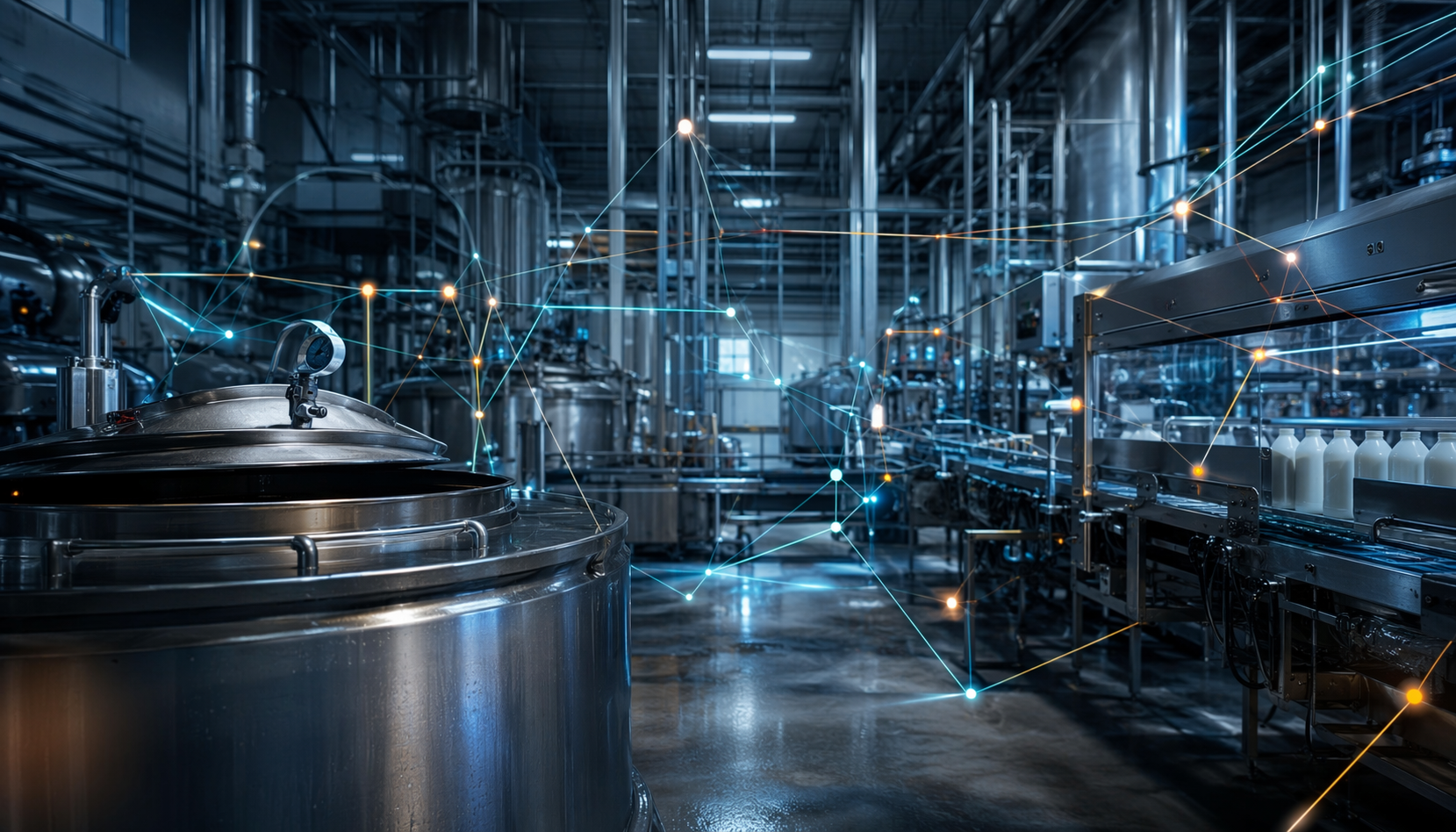
In enterprise IT, ransomware is often described around encrypted laptops, file shares, and recovery images. In food manufacturing, the same campaign can reach a different kind of consequence before anyone proves that a controller was touched. A plant may rely on historians, batch records, quality systems, MES, remote vendor access, identity infrastructure, warehouse coordination, labeling, and shipping systems that sit close enough to production that losing trust in them can force operators to stop.
That distinction is easy to lose in clean diagrams. The question is not simply whether a programmable logic controller was encrypted. It is whether the plant can safely keep running when the systems that schedule, verify, record, clean, release, and ship product are degraded or suspected of compromise. A dairy plant cannot casually pause and resume as if it were a back-office workflow. Perishable inputs and sanitary production sequences make downtime more expensive than the visible ransom demand.
Fairlife also landed inside a broader sector pattern. Food & Ag-ISAC reported 265 ransomware attacks against food and agriculture in 2025, roughly double the prior year, while Halcyon reported 6,377 ransomware incidents overall in 2025, an 82% year-over-year increase.[3][4] Food & Ag-ISAC also identified Qilin, Akira, and CL0P among the groups with notable food and agriculture activity, including 37 attacks attributed to Qilin and 36 to Akira in the sector.[3]
Those numbers do not prove anything about the Fairlife intrusion. They do make it harder to treat the event as a one-off corporate IT mishap. JBS, Dole, Schreiber Foods, and UNFI had already given the food and beverage sector enough warning that ransomware can move from cyber incident to supply disruption quickly; Xantrion summarizes JBS’s 2021 $11 million ransom payment and Dole’s 2023 $10.5 million incident among recent examples.[5]
The Failure Mode Legacy Defenses Miss
The old answer to ransomware was perimeter hardening, endpoint protection, backups, and segmentation. Those still matter. The problem is that food manufacturing plants rarely give defenders a neat, fully managed endpoint estate. There are legacy controllers, engineering workstations, vendor jump paths, historian servers, unmanaged devices, and production systems that cannot tolerate casual agent installation or aggressive scanning.
This is where the 29-minute breakout-time figure changes the conversation. A vendor-contributed Supply Chain Management Review article by a Stellar Cyber executive cites CrowdStrike’s 2026 average adversary breakout time as 29 minutes and argues that, in OT environments where endpoint agents often cannot be deployed, AI-powered network detection becomes the primary detection mechanism.[6] Because the framework is vendor-aligned, it should not be read as neutral product evaluation. But the architectural point is still useful: if attackers can move laterally faster than a human team can manually triage weak signals, detection has to happen across the paths attackers actually use.
For Fairlife, the public facts do not show whether the attacker moved from IT toward OT, from a vendor path into a plant-adjacent system, or through some other route. The relevant question is narrower and more defensible: which layered AI functions are designed to catch the kinds of lateral movement, abnormal authentication, and production-adjacent network behavior that can turn a ransomware intrusion into a plant stoppage?
Layer One: Network Detection Where Agents Do Not Belong
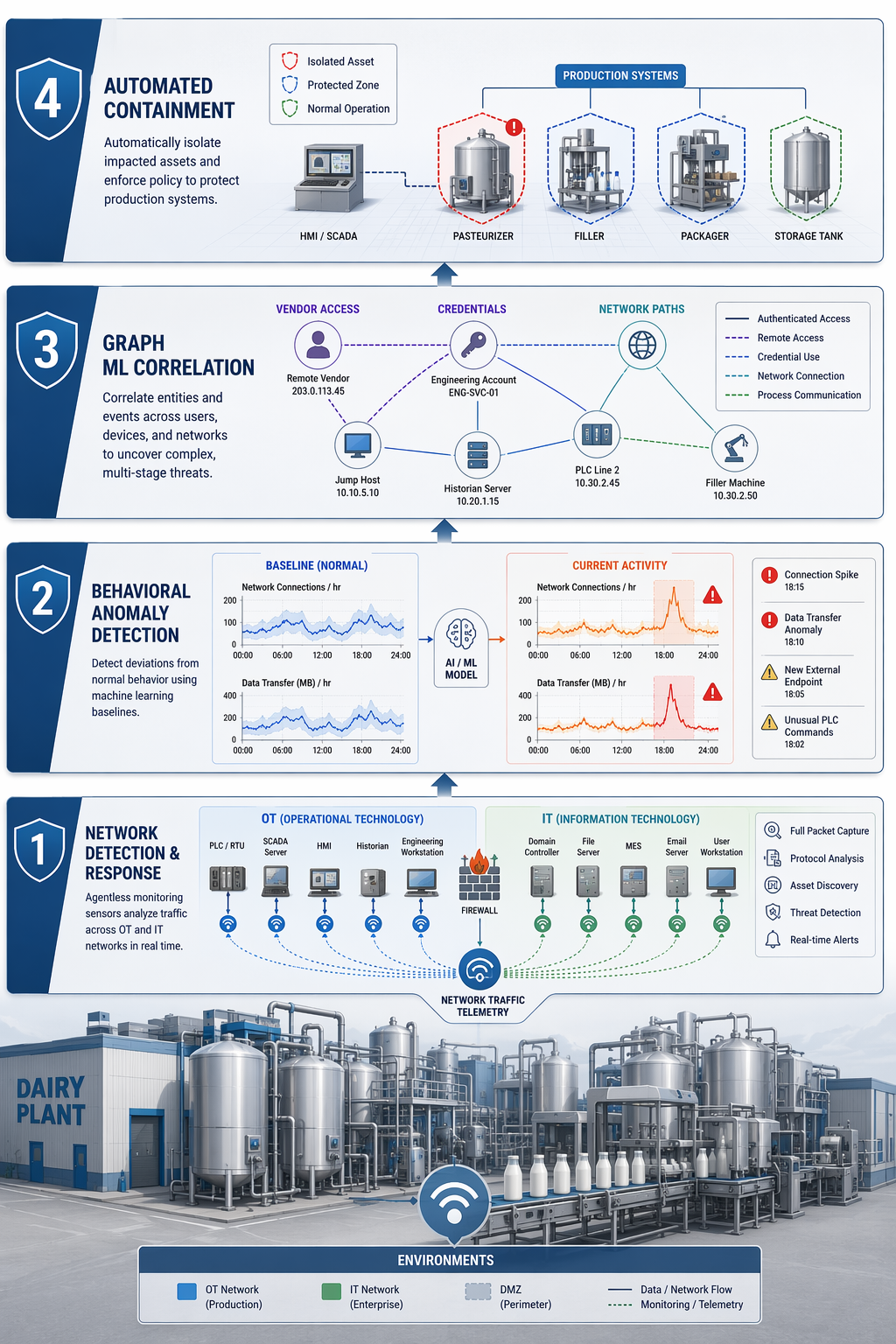
Network detection and response deserves to come first because it fits the messiest part of industrial reality. A bottling line, dairy processing area, warehouse control network, or packaging cell may include systems that are unsupported, fragile, vendor-managed, or simply too important to touch with a standard endpoint agent. Agentless network monitoring gives defenders a way to observe without pretending every asset can be managed like a corporate laptop.
In a plausible food-manufacturing ransomware path, the first plant-impacting signal may not be malware execution on a controller. It may be a workstation talking to an unusual subnet, a historian receiving connections from a system that never needed that access, a remote support account appearing outside its usual pattern, or a file server suddenly becoming a bridge between corporate and production-adjacent zones. Signature tools may see none of that as decisive. A network model trained on normal traffic can at least flag that the shape of the plant has changed.
This is not AI “knowing ransomware.” It is statistical visibility into protocols, flows, timing, peer relationships, and authentication behavior across networks where many devices cannot defend themselves. In the Fairlife context, NDR would not be valuable because it could read the attacker’s mind. It would be valuable because a dairy plant needs early warning before uncertainty spreads far enough that stopping production becomes the safer option.
Layer Two: Behavioral Baselines for Factory-Floor Normal
The factory floor has rhythms. Some are obvious to operators and invisible to corporate security tools: when cleaning cycles occur, when packaging lines change over, when remote vendors usually connect, which engineering workstation talks to which device, which service accounts appear during maintenance, and which systems never need internet-facing authentication.
Behavioral anomaly detection is useful when it respects those rhythms. A model that treats every industrial protocol as suspicious will drown the OT lead in noise. A model that learns normal plant behavior can separate ordinary production variation from events that deserve escalation: a credential used in an abnormal sequence, an engineering workstation scanning unfamiliar assets, a vendor connection followed by access to production-adjacent systems, or a spike in traffic between zones that are normally quiet.
Built By Rose describes smart-factory approaches that use AI-based OT anomaly detection, local inference, and digital-twin baselines to identify abnormal device and process behavior while keeping sensitive telemetry closer to the plant.[7] That matters for food and beverage manufacturers because the plant may not want all telemetry shipped to a cloud service before a decision is made. Edge AI gateways and on-premises inference are not cosmetic architecture choices; they can determine whether detection still works when connectivity is degraded or when data residency and latency constraints are real.
In a Fairlife-like scenario, behavioral baselines would not need to identify the ransomware family to be useful. They would need to answer a more operational question quickly: is this activity consistent with how this plant normally runs, or is a system now behaving in a way that could put production, quality, or recovery confidence at risk?
Layer Three: Graph ML for the Weak Signals Between IT and OT
Lateral movement is rarely one clean alert. It is a chain. A credential is used in a new place. A remote access path opens. A server touches a network it normally does not touch. An account that once belonged to routine support becomes useful to an attacker. A system that is not technically OT becomes important because production depends on it.
Graph machine learning is well suited to that shape of problem because it can model relationships among users, devices, network paths, applications, vendors, and dependencies. The value is not in labeling one event as bad. It is in correlating several weak events quickly enough to see a path forming before the blast radius is obvious.
For a dairy manufacturer, the graph should include more than IP addresses. It should connect remote vendors to the assets they support, MES dependencies to lines and plants, identity groups to privileged access, historians to reporting and quality workflows, and logistics systems to shipment execution. That is where cybersecurity begins to look like supply chain visibility rather than isolated alert triage. A manufacturer that already maintains a supply chain visibility knowledge graph has a starting point for mapping which dependencies become chokepoints when cyber uncertainty reaches operations.
This is also where AI supplier and third-party monitoring becomes relevant without turning every vendor into the villain. If a remote support provider, logistics partner, ingredients supplier, or managed service provider creates a pathway into production-impacting systems, security teams need continuous risk signals rather than annual questionnaires. Tools in an AI supplier risk monitoring vendor directory or an autonomous procurement AI supplier risk scoring workflow can support that work, provided they are tied back to actual access paths and operational dependencies.
Layer Four: Containment That Moves Faster Than the Outage
Automated containment is the part of AI security that most needs discipline. A food plant should not let a generic model start isolating production assets without guardrails, especially when an overreaction can stop a line just as surely as ransomware can. The goal is response acceleration, not magic autonomy.
There are useful, narrow actions that an AI-assisted workflow can tee up or execute under policy: disable a suspicious remote session, revoke a token, quarantine a corporate endpoint, block a lateral path between zones, require step-up authentication, open an incident bridge with the right plant and corporate contacts, assemble the relevant asset context, and recommend containment options ranked by production impact. LLM or agentic orchestration can reduce the time spent gathering facts and routing approvals. It should not replace the plant’s safety authority.
Digital-twin baselines can help here by validating playbooks before an incident. If a proposed containment action would isolate a server that feeds batch records, quality release, or warehouse execution, the team should know that before the worst half hour of the incident. Built By Rose’s discussion of digital twins for anomaly detection and containment validation points in that direction, though implementation quality will matter more than the label on the architecture.[7]
In the Fairlife case, no public evidence proves that automated containment would have prevented the shutdown. A defensible claim is more limited: if the incident involved lateral movement toward production-adjacent systems, a layered architecture that saw the movement, correlated the path, and contained the session or route earlier could have reduced the chance that the safest decision became suspending production across multiple plants.
What the Fairlife Case Changes in the Investment Conversation
The business case after Fairlife should not be “buy AI cybersecurity.” That phrase is too broad to survive a serious plant review. The better case is that food and beverage manufacturers need layered visibility, anomaly correlation, and controlled containment across IT/OT boundaries because production dependencies now sit inside the ransomware blast radius.
The spending backdrop is already moving. Adaptive Security cited a $29.64 billion AI cybersecurity market in 2025 and a 24.1% compound annual growth rate, while also reporting that data theft occurred in 96% of ransomware incidents in 2025.[8] Those figures support investment attention, but they do not tell a manufacturer what to buy. A plant can spend heavily and still miss the path that matters if tools are not mapped to historians, MES, remote access, identity, vendor support, and production restart decisions.
Regulatory exposure adds pressure, especially where ransomware involves data theft, SEC disclosure obligations, and critical infrastructure reporting regimes such as CIRCIA. But for a dairy processor, the more immediate board-level language may be simpler: how many plants can lose production confidence from one intrusion, and how quickly can the organization prove where the attacker did and did not go?
That question leads to practical selection criteria:
- Prioritize agentless NDR where legacy industrial assets, vendor-managed systems, or fragile endpoints make endpoint deployment unrealistic.
- Require behavioral baselines that learn plant-specific normal activity rather than flooding operators with generic OT alerts.
- Use graph correlation to connect credentials, vendors, assets, applications, and production dependencies instead of triaging each alert in isolation.
- Constrain automated containment with plant-aware policies, approval paths, and playbooks tested against production impact.
- Measure success by time-to-detection, time-to-containment, confidence in scope, and ability to restart safely, not by the number of AI features enabled.
Food manufacturers that need a basic vocabulary for the techniques involved can ground internal discussions in an AI and machine learning in supply chain definition before procurement turns into a feature checklist. The important distinction is between adoption and effectiveness. Installing an AI-labeled platform does not protect a plant. Mapping detection and containment to the actual routes from corporate compromise to production disruption might.
The Fairlife Lesson
Fairlife is too recent to carry more certainty than the disclosure supports. The public record confirms ransomware and suspended dairy production across three plants; it does not confirm a technical root cause or prove that OT systems were directly compromised.[1][2] That uncertainty is exactly why the case is useful.
A food manufacturer does not need to wait for a perfect forensic reconstruction to see the investment problem. When production depends on connected IT and OT systems, the defensive architecture has to see abnormal movement across that boundary, correlate weak signals before they become a plant-wide decision, and contain the path without creating a new safety or quality problem. After Fairlife, the defensible business case is not that AI would have heroically stopped ransomware. It is that layered AI detection and containment can shrink the window between intrusion and operational consequence, which is where a cyber incident becomes a supply chain failure.
References
- The Coca-Cola Company Form 8-K. U.S. Securities and Exchange Commission. July 16, 2026. link
- Coca-Cola suspended production at its Fairlife dairy after a ransomware attack. TechCrunch. July 16, 2026. link
- Navigating the 2025 Food and Agriculture Sector Ransomware Landscape. Food & Ag-ISAC. link
- Ransomware Attacks Targeting Agriculture and Food Production Doubled in 2025. Halcyon. link
- Ransomware Risks for Food & Beverage: Key Lessons from Recent Attacks. Xantrion. link
- Why a secure industrial supply chain depends on layered AI. Supply Chain Management Review. link
- Securing Smart Factory: AI OT Anomaly Detection & Ransomware Resilience. Built By Rose. link
- Ransomware Trends 2025-2026: The 213% Attack Surge, AI-Powered Tactics, and Data-Driven Defense. Adaptive Security. link
Comments
Join the discussion with an anonymous comment.