

The reason executives keep looking at AI in inventory management is not mysterious. A credible deployment promises fewer stockouts, lower working capital, faster exception handling, and a planning team that spends less time reconciling spreadsheets. ToolsGroup has reported 20–50% stockout reduction and 15–30% holding-cost reduction from AI-enabled inventory optimization, which is exactly the kind of result that gets attention in a margin review.[1]
There are also more aggressive claims in the market. Cmarix describes 200–400% ROI over three years, and Openxcell describes 90–95% forecasting accuracy for AI inventory systems.[2][3] Those claims should be read for what they are: vendor-adjacent implementation and sales material, not neutral benchmarks that can be copied into a business case without conditions.

The useful question is not whether AI can improve inventory management. It can. The harder question is what has to be true before those numbers are plausible in your operation. Most failures begin before model selection, before the pilot dashboard, and before anyone debates whether a demand-sensing algorithm is sophisticated enough. They begin when the system is asked to optimize inventory that the company cannot accurately see.
The first failure mode: the system believes the records
An AI model does not start with reality. It starts with the records it is given. If those records say a store has twelve units, the model treats twelve as the operating fact unless another data source corrects it. If the warehouse management system says a pallet is available but it is blocked, damaged, misplaced, or already committed, the recommendation inherits that false certainty.
That is not a small edge case. Tailor cites the ECR Loss Study finding that roughly 60% of inventory records were inaccurate across about 1 million products in 100 stores.[4] The figure matters because it reframes the AI discussion. A planning system can calculate more quickly than a planner, but speed does not cure a false on-hand balance.
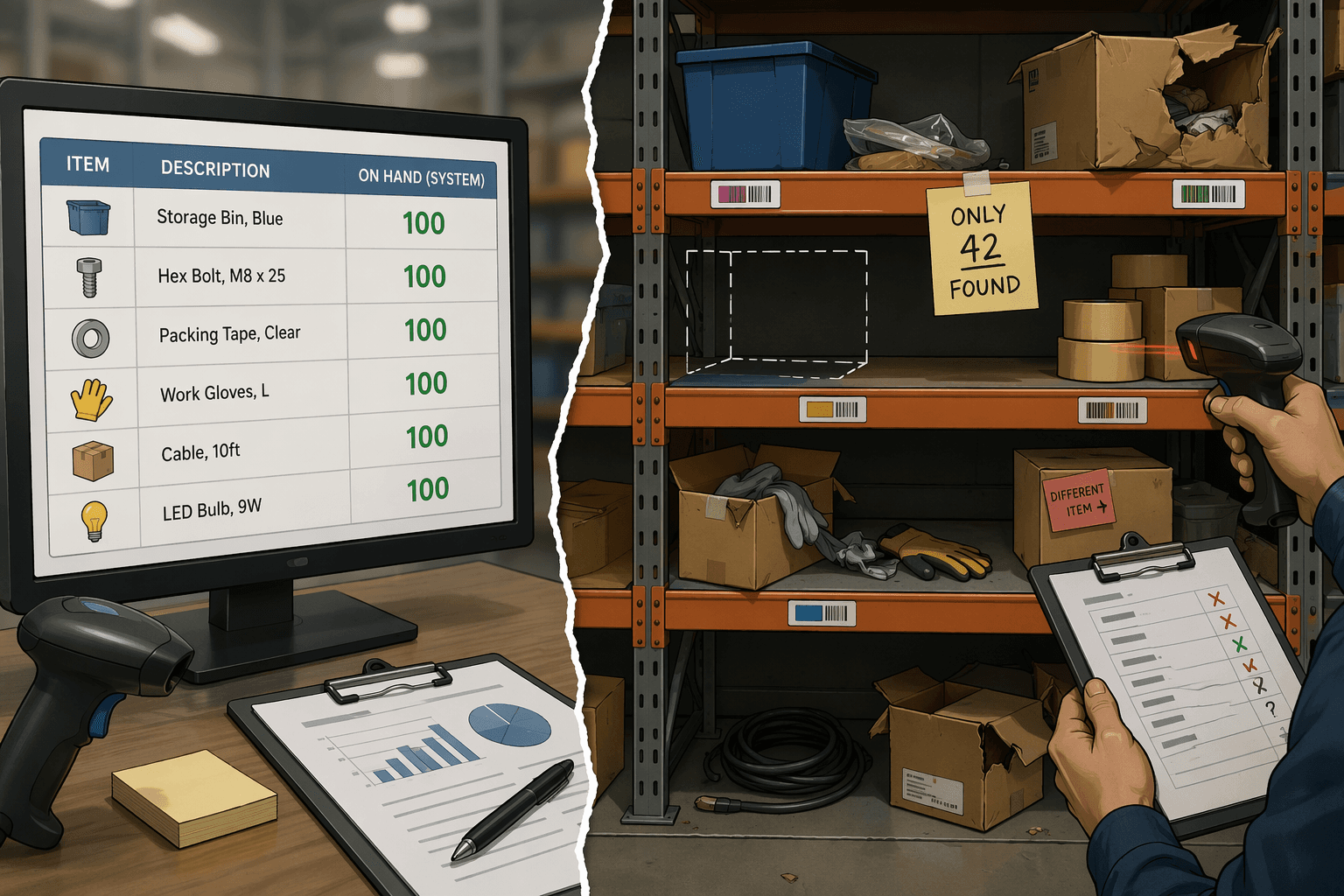
This is where many implementation plans get too polite. They list “data quality” as a workstream, then treat it like a cleansing exercise that can run alongside configuration. But in inventory planning, record quality is not cosmetic. It determines whether the algorithm is learning actual demand and supply behavior or learning a distorted version of the business.
SolidBrain and Cmarix both identify data quality as the single biggest obstacle in AI inventory implementations, and both point to a practical minimum that many companies discover too late: 12–24 months of clean, consistent historical data.[5][2] That means usable order history, inventory positions, stockout flags, substitutions, promotions, lead times, returns, transfers, and master data—not just a CSV export with two years of transactions.
The difference is operational. If the history does not distinguish true zero demand from a stockout, the model may learn that demand disappeared. If returns are posted inconsistently, it may misread replenishment needs. If item codes changed without a clean mapping, the system may treat one product’s history as three unrelated signals. These are not advanced AI problems. They are planning-control problems that become more expensive once automated recommendations start flowing.
ERP, WMS, and POS fragmentation is one problem, not three
Vendor material often compresses integration into a phrase like “connects to your ERP” or “uses real-time data.” That wording hides the hardest part. The ERP may own item master, purchase orders, suppliers, finance rules, and standard costs. The WMS may own location, lot, handling status, and execution events. POS or ecommerce systems may own demand signals closest to the customer. Inventory decisions need all of them, and they rarely agree without mediation.

A familiar pattern: finance trusts the ERP, operations trusts the WMS, commercial teams trust POS, and the AI project needs a single planning truth. When these systems disagree, the implementation team has to decide which source wins by data element, by timing, by location, and by exception. That decision cannot be left to an integration connector.
Cmarix specifically notes that legacy ERP systems such as SAP, Oracle, and NetSuite often lack modern APIs or real-time data processing, making integration costly and time-consuming and requiring dedicated data engineering resources.[2] That is a practical warning, not a generic IT complaint. If the model needs daily inventory snapshots but the ERP batch closes overnight, the planning cadence changes. If the WMS event stream is incomplete, exception logic changes. If POS data arrives with store-level delays, demand sensing is not really sensing the present.
This is also where the business case can quietly deteriorate. A pilot budget may include software subscription, configuration, and a small implementation team. It may not include the data engineering backlog required to reconcile item masters, location hierarchies, units of measure, lead-time definitions, inventory status codes, and historical overrides. The result is predictable: planners continue running side files because the system output does not match what they see on the floor.
Before vendor selection, a supply chain leader should force a short but uncomfortable inventory of the plumbing:
- Which system is the system of record for on-hand, available-to-promise, committed, damaged, in-transit, and quarantined inventory?
- How often does each source update, and what planning decision depends on that timing?
- Which item, customer, supplier, and location identifiers need mapping before history is usable?
- Where are overrides, substitutions, stockouts, and lost sales captured today?
- Who owns reconciliation when ERP, WMS, and POS disagree?
- What engineering capacity is reserved for integration defects after pilot launch?
For organizations already seeing the same readiness problem across multiple supply chain AI efforts, the issue is usually broader than inventory. The same data-quality and ownership gaps show up in demand planning, warehouse optimization, and agent pilots; they are explored further in The AI Readiness Paradox.
“Real-time” does not help if no one has defined the decision
Real-time inventory data sounds valuable, and sometimes it is. But inventory management is not a single decision. A store replenishment recommendation, an ecommerce allocation rule, a safety-stock update, a purchase-order acceleration, and a warehouse transfer all use different timing, risk tolerance, and approval logic.
If a vendor says the platform uses real-time data, the follow-up should be: real-time for which decision? Some inventory decisions need immediate exception alerts. Others are harmed by reacting to noise before demand, receiving, or fulfillment events have stabilized. Faster refresh cycles do not replace decision design.
| Planning question | Data problem to resolve before AI recommendations |
|---|---|
| Should the system reorder today? | Available inventory, open orders, supplier lead time, minimum order quantities, and recent demand must be synchronized. |
| Should stock move from one location to another? | Source-location availability, destination demand, transfer cost, handling constraints, and service impact must be visible. |
| Should safety stock change? | Demand variability, lead-time variability, service targets, and stockout history must be consistently defined. |
| Should an exception be escalated to a planner? | The business must define materiality thresholds, approval rights, and what the system is allowed to execute automatically. |
A phased implementation roadmap helps here because it ties data integration to specific decisions instead of trying to prepare the entire enterprise for every possible use case at once. The same principle applies in warehouse ML deployments; a practical sequencing model is covered in the ML Implementation Roadmap for Warehouse Management.
The model can be good and still wrong for your demand pattern
Model mismatch is quieter than bad data but still damaging. Inventory portfolios rarely behave as one clean statistical population. Some items have stable repeat demand. Some are intermittent. Some are promotion-driven. Some are seasonal. Some are long-tail products where the difference between one unit and zero units matters more than an elegant average forecast.
An algorithm that works well for high-volume, stable SKUs may perform poorly on sparse demand. A system optimized for short lead times may understate risk in a supply base with variable replenishment. A model trained on normal periods may misread a promotion, assortment reset, product launch, or disruption unless those events are represented and labeled in the data.
The due-diligence question is not “Which model is most advanced?” It is “Which demand patterns dominate the inventory value and service risk, and has the vendor shown performance by those segments?” A single forecast-accuracy number across the portfolio can hide the items that actually cause stockouts, expediting, markdowns, and planner escalation.
For a deeper treatment of the techniques behind demand sensing, probabilistic forecasting, and demand-pattern fit, see how AI demand planning software works. The implementation risk is narrower: do not accept an average model-performance claim until it has been tested against the inventory segments that matter.
Planner adoption is a control design issue
The planner’s job changes in an AI-enabled inventory process. The old role was often spreadsheet operator, exception hunter, and informal reconciler. The new role is supposed to be reviewer, approver, exception manager, and business-context provider. LeewayHertz and AGR Inventory both describe this shift, and both note that teams skipping change management can see adoption stall even when model accuracy is strong.[6][7]
That stall is not simple resistance to technology. Planners are being asked to trust recommendations that may affect service levels, supplier commitments, production schedules, and working capital. If they cannot see why a recommendation was made, what assumptions changed, and what happens if they approve it, they will protect the business with manual workarounds.
Gartner predicts that 40% of enterprise applications will include task-specific AI agents in 2026.[8] In inventory management, that raises the stakes because an agent may not merely display a recommendation; it may monitor exceptions, draft actions, trigger workflows, or coordinate with other systems. Deloitte’s caution is important here: agentic AI requires deliberate human-in-the-loop architecture, not an assumption that autonomy can be switched on safely after technical deployment.[9]
Human-in-the-loop does not mean every recommendation waits in a queue forever. It means the company defines which actions can be automated, which require planner approval, which require manager approval, and which must be blocked until data conflicts are resolved. It also means the planner can inspect the evidence behind a recommendation: demand signal, inventory position, lead-time assumption, service target, confidence level, and business constraint.
A useful adoption test is simple: if the AI recommends increasing safety stock on a constrained item, can the planner tell whether the driver was demand volatility, lead-time variability, a service-level change, a supplier issue, or bad inventory history? If the answer is no, the organization has not designed a review process. It has handed planners a black box and asked them to carry the consequences.
For the specific risks around autonomous and semi-autonomous supply chain pilots, see Why AI Agent Pilots Fail in Supply Chain. Inventory is one of the areas where weak governance can move from pilot inconvenience to service failure quickly.
What to ask before approving a pilot
A pilot should not be a fishing expedition where the team discovers basic readiness gaps after the vendor has been selected. Before approval, leadership should require answers in five areas.
| Area | Pre-commitment question |
|---|---|
| Inventory record accuracy | What is the measured accuracy of on-hand and available inventory in the pilot scope, and how will exceptions be corrected before model training? |
| Historical data | Do we have 12–24 months of clean, consistent history for the decisions in scope, including stockouts, substitutions, promotions, lead times, and overrides? |
| System integration | Which ERP, WMS, POS, ecommerce, supplier, and planning-system data elements are required, and what engineering capacity is assigned? |
| Demand-pattern fit | Which item segments will be tested separately, and what performance measures matter for each segment? |
| Planner workflow | Who reviews recommendations, what evidence is visible, what can be automated, and what happens when the planner disagrees? |
These questions are not meant to slow every AI initiative into committee work. They are meant to prevent a narrow software pilot from pretending to be an operating-model test. If the data is not available, the integration path is unknown, and the planner workflow is undefined, the pilot will mostly measure the organization’s ability to improvise under pressure.
This is also the right moment to separate use-case ambition from implementation readiness. A company may have a strong business case for dynamic safety stock, automated replenishment, inventory rebalancing, or exception prioritization. The companion article AI for Inventory Management: Which Use Cases Deliver Real ROI? covers that promise side. The implementation decision still has to pass the readiness test.
The failure chain to look for
Most AI inventory failures do not arrive as one dramatic collapse. They move through a chain. Inventory records are less reliable than assumed. Historical data is incomplete or inconsistently labeled. ERP, WMS, and POS feeds disagree. Integration takes longer than the pilot plan allowed. The model performs unevenly across demand patterns. Planners do not trust recommendations they cannot explain. Manual files return. The official system becomes one more screen in the war room.
McKinsey’s cited 35–65% improvement range, as reported by LeewayHertz, is useful mainly because of its conditions: improvement depends heavily on data quality, implementation maturity, and change management.[6] The model is part of the answer, but it is not the whole differentiator.
The hard part is that none of these risks is exotic. They are visible before contract signature if leadership asks for evidence rather than assurances. Can the systems expose the data? Are the inventory records accurate enough? Does the model match the demand pattern? Who reviews the recommendation? What happens when the planner rejects it? Who fixes the source record when the model is right but the system data is wrong?
AI in inventory management fails less often because the mathematics is impossible than because the operating conditions were assumed into existence. These failures are not mysterious, and they are not inevitable. They are predictable enough that discovering them after go-live is a governance failure, not bad luck.
References
- ToolsGroup AI inventory optimization data — ToolsGroup, 2025
- Cmarix AI inventory management implementation documentation — Cmarix, 2026
- Openxcell AI inventory management forecasting accuracy material — Openxcell, 2026
- ECR Loss Study inventory record inaccuracy finding, cited by Tailor — Tailor, 2025
- SolidBrain AI inventory management implementation documentation — SolidBrain, 2026
- LeewayHertz AI inventory management and McKinsey-cited improvement range — LeewayHertz, 2026
- AGR Inventory planner adoption and AI inventory management material — AGR Inventory, 2026
- Gartner 2026 AI agent enterprise application prediction — Gartner, 2026
- Deloitte human-in-the-loop agentic AI guidance — Deloitte
Comments
Join the discussion with an anonymous comment.