
For Middle East supply chains, AI-enabled geopolitical risk management has to start with the shipment, not the dashboard. In March 2026, the operating picture was blunt: Interos reported that 30% of S&P 500 companies had direct suppliers in the Middle East, while roughly 20% of global petroleum and roughly 20% of LNG moved through the Strait of Hormuz.[1] Oliver Wyman described the same escalation window in physical terms procurement and freight teams could not ignore: an 81% drop in Strait of Hormuz transits, Brent crude up 25%, European natural gas up 56%, jet fuel up 58%, urea up 26%, helium up 35%, sulfur up 23%, polymers up 14–18%, Maersk reroutes adding 8–15 days, and air cargo capacity down 22%.[2]
Those figures should not be treated as a permanent baseline. They describe a specific March 2026 disruption window. But that is exactly why they matter. A category owner did not need a permanent theory of the region to face a price file that no longer matched landed cost. A freight lead did not need a policy memo to see that a vessel schedule had turned into a margin event. A procurement manager with a Middle East supplier on the approved vendor list had to decide whether to expedite, qualify an alternate, renegotiate delivery terms, hold inventory, or wait.
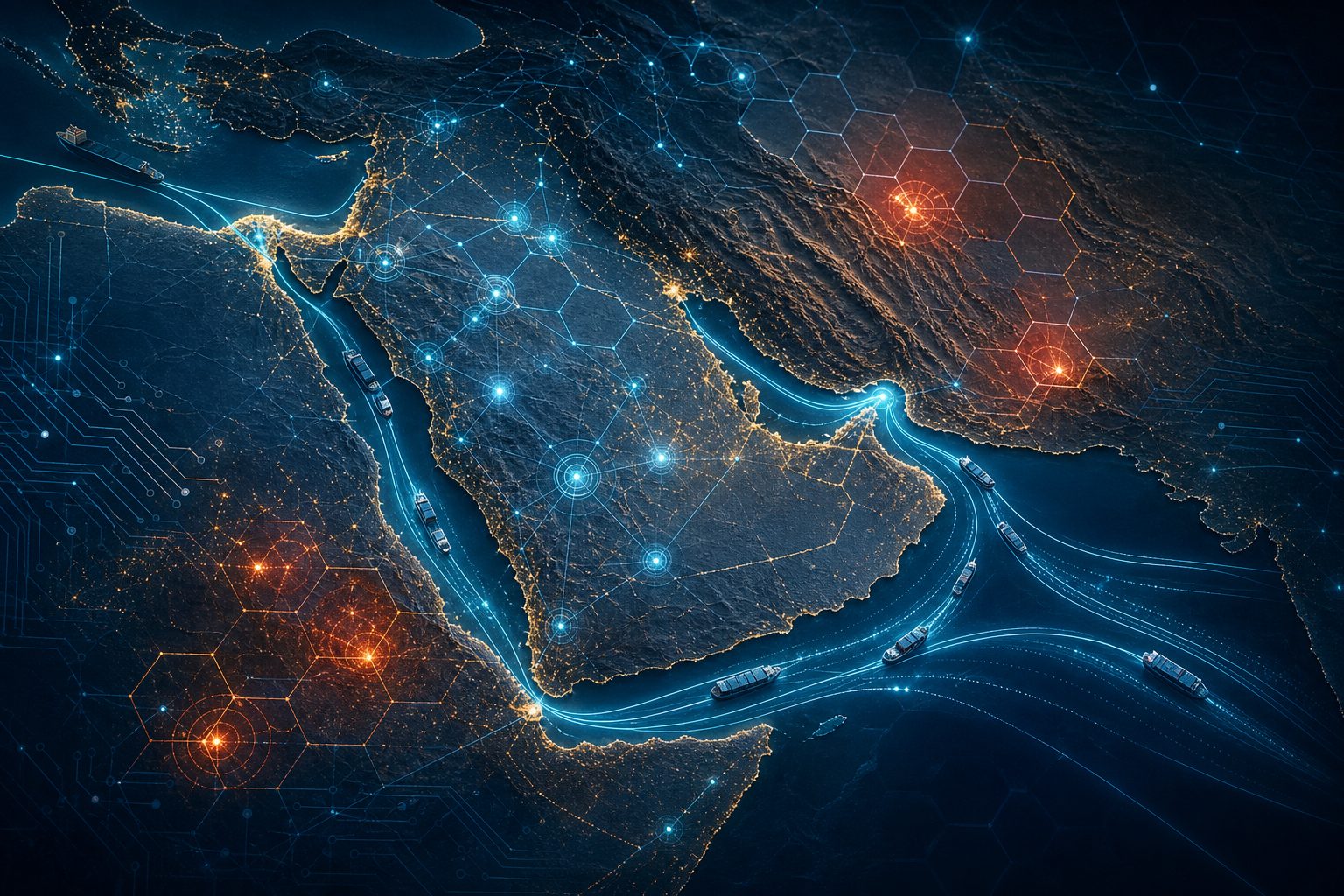
That is the practical test for any geopolitical intelligence program. It is not whether the organization knew a crisis was happening. Everyone knew. The test is whether the warning arrived early enough, mapped cleanly enough to supplier and route exposure, and translated into a decision before the disruption reached the purchase order, shipment milestone, or margin line.
The Middle East Is No Longer an Episodic Supply Chain Exception
The uncomfortable part of the March 2026 data is not only the scale of the shock. It is how many different operating levers moved at once. Vessel transits, fuel, polymers, industrial gases, fertilizer inputs, and air cargo capacity were all affected in the same disruption window.[2] That combination does not behave like a single late supplier delivery. It changes inventory math, transport mode choices, customer allocation, supplier payment conversations, and hedging assumptions at the same time.
This is where many executive conversations become too broad to help. Treating the Middle East as a permanent red zone is operationally lazy; it encourages overcorrection, excess buffers, and avoidance where a more precise exposure map would support selective action. Treating every regional signal as a clean probability score is not much better. The region’s logistics exposure runs through chokepoints, commodity chains, insurance markets, port decisions, airspace restrictions, and supplier sub-tiers. A neat score can hide the actual point of failure.
Traditional monitoring struggles because it usually separates the event from the company’s exposure. A country-risk report may be correct and still arrive too late for a sailing decision. A headline feed may be fast and still amplify the loudest event rather than the most relevant one. Bloomberg and SDCE described this shift as a move away from static country-risk reporting and toward a “risk intelligence trifecta” of human oversight, interoperable data, and AI/ML detection.[3] MIT Sloan’s Winter 2026 treatment of geopolitical supply chain risk lands on a similar operational problem: firms need to separate signal from noise before the risk becomes a planning failure.[4]
The useful question, then, is not whether AI can predict geopolitical risk. It is how geopolitical intelligence becomes an operational decision while there is still time to change sourcing, routing, inventory, supplier management, or financial exposure.
A Practical Framework Has Three Layers
The strongest operating model combines three layers that cannot substitute for one another: regional human expertise, interoperable supplier and logistics data, and AI/ML pattern detection. Remove any one of the three and the program weakens in a different way.
| Layer | What it contributes | What fails without it |
|---|---|---|
| Human regional expertise | Interprets actors, timing, escalation pathways, and local context | AI turns ambiguous signals into confident noise |
| Interoperable supplier and logistics data | Connects events to suppliers, lanes, commodities, facilities, contracts, and orders | Risk alerts cannot identify who must act |
| AI/ML pattern detection | Scans large volumes of signals, detects weak patterns, and updates exposure views faster than manual teams | Human teams see important signals too late or miss cross-network patterns |

There is some empirical support for the direction of travel. A 2025 ScienceDirect study of Chinese-listed firms found that AI positively moderated the relationship between geopolitical risk and supply chain resilience.[5] That is useful evidence, but it should be used carefully. The sample is Chinese-listed firms, so it does not prove that the same effect size or mechanism applies automatically to Western multinationals with different supplier governance, systems landscapes, and regulatory constraints.
The finding still points to the right operating hypothesis: AI matters most when it helps an organization absorb geopolitical pressure without losing visibility, decision speed, or supplier optionality. It is not a replacement for risk judgment. It is a way to make judgment arrive earlier and attach to the right commercial object.
Layer One: Regional Expertise Keeps the Machine Honest
Human regional expertise is the part most easily praised and most often underfunded. It is also the layer that keeps an AI system from mistaking volume for importance. In the Middle East, the same visible event can mean different things depending on location, actor, timing, target, and the surrounding diplomatic or military posture. A procurement team does not need every nuance, but it does need someone who can say whether a signal is likely to affect shipping lanes, energy flows, port operations, insurance pricing, supplier labor availability, or nothing material at all.
This is not an argument for slow expert review of every alert. It is an argument for putting expertise into the design of the thresholds, watchlists, escalation logic, and scenario assumptions. If the regional layer is absent, the system may learn to overreact to dramatic headlines and underweight boring signals that matter more to the network: a port notice, an airspace change, a customs delay, an insurance exclusion, a carrier advisory, or a supplier’s sudden reluctance to confirm capacity.
This is also where “AI versus humans” becomes a false debate. Human experts without scalable data often arrive after the procurement team has already made the expensive decision. AI without human interpretation can produce a tidy escalation label that nobody with regional experience would trust. The useful design is a loop: experts shape the model’s attention, the model surfaces patterns at scale, and humans review the signals that could change commercial action. For a deeper treatment of that limitation, ChainSignal’s analysis of the limits of AI in geopolitical supply chain risk is the natural companion piece.
Layer Two: The Data Layer Is Where Most Programs Break
The data layer deserves the most attention because it is where polished risk programs usually fail. A company can have excellent regional intelligence and strong AI tools and still be unable to answer the question that matters at 6 a.m.: which suppliers, shipments, customers, plants, purchase orders, and margin lines are exposed?
Supplier master data is rarely built for geopolitical disruption. Legal entities are not always linked to operating sites. Parent companies, distributors, contract manufacturers, logistics providers, and sub-tier suppliers may sit in different systems. A supplier marked as “Europe” in the vendor master may rely on a Middle East input. A shipment booked by one forwarder may move through a lane the category team does not routinely monitor. A dual-source strategy may look healthy in sourcing documents and still collapse if both suppliers depend on the same upstream material or route.
That is why interoperable data is not a back-office cleanup exercise. It is the layer that turns a geopolitical signal into an action queue. The signal “regional escalation near a chokepoint” is not yet useful. The useful version is closer to: these purchase orders rely on these suppliers, these suppliers depend on these facilities or sub-tiers, these shipments are scheduled through these lanes, these contracts have these delivery terms, these customers are exposed to these service risks, and these product margins are sensitive to these commodity moves.
Interos positions its March 2026 analysis around exactly this kind of multi-tier mapping, including the ability to trace Middle East supplier dependencies beyond Tier 1.[1] The point is not that one platform solves the data problem by itself. The point is that Tier 1 visibility is not enough when the disruption travels through inputs, logistics lanes, and entities the buying company does not directly manage.
This layer also determines whether finance gets involved early or late. A fuel shock, polymer price move, or air cargo capacity reduction becomes operationally useful only when it can be linked to lanes, inventory policy, customer commitments, and cost-to-serve. The March 2026 price and capacity moves described by Oliver Wyman were not abstract macro signals; they were potential changes to expedite costs, contract exposure, allocation decisions, and margin forecasts.[2] ChainSignal’s work on AI procurement analytics for oil price shocks goes deeper into that financial translation.
Layer Three: AI Detection Has to Do More Than Watch the News
AI and machine learning earn their place when they detect patterns that manual teams cannot monitor continuously: changes in incident frequency, route behavior, entity-level exposure, supplier signals, sanctions-relevant relationships, commodity sensitivity, port congestion, airspace disruption, and the interaction between several weak signals that would look harmless in isolation.
The better tools are moving away from generic heat maps. Earthian AI describes its Geopolitics Axiom-0 small language model as purpose-built for geopolitical scenario modeling with probability distributions rather than only static heat-map views, and it has published Middle East 2026 risk material around that approach.[6] Bloomberg’s company-level geopolitical risk scores, developed with Seerist, quantify country risk at entity granularity across 7 million companies.[7] Mantis Analytics and New Lines Institute announced a partnership combining AI monitoring with think-tank regional expertise for customizable geopolitical risk assessment.[8] Resilinc’s EventWatch AI is positioned for supply chain disruption detection, and the company has also announced an agentic AI platform.[9]
These examples should be read as capability patterns, not as a frozen vendor comparison. The platform landscape is moving quickly, and product claims need testing against the company’s own exposure data. What matters is the pattern: AI is being applied at three useful levels of granularity—event detection, entity-level risk, and scenario modeling. A procurement organization needs all three in some form, but not always from one system.
- Event detection helps teams notice that a disruption pattern is forming before it appears in a formal country-risk update.
- Entity-level scoring helps connect country or regional exposure to specific suppliers, customers, carriers, and counterparties.
- Scenario modeling helps compare rerouting, inventory, sourcing, and pricing responses before the escalation path is clear.
The mistake is buying the third layer while leaving the second layer unresolved. A model can detect a relevant escalation faster than any analyst team, but if the company cannot connect that alert to supplier tiers, route dependencies, and open orders, the alert still lands as awareness. Awareness is not the same as action.
The Operating Question: Who Changes What?
A useful geopolitical intelligence capability should make the next owner obvious. If a signal affects a route, freight should see it in lane terms. If it affects a supplier or sub-tier dependency, procurement should see it in supplier and purchase-order terms. If it affects a commodity or expedite path, finance should see the probable cost range. If it affects customer commitments, sales and operations planning should see the service-risk tradeoff.
| Risk signal | Operational translation | Likely decision owner |
|---|---|---|
| Chokepoint transit disruption | Affected lanes, shipments, lead-time assumptions, reroute options | Logistics and supply planning |
| Supplier entity exposure | Open purchase orders, approved alternates, contract terms, inventory cover | Procurement and category management |
| Commodity or fuel shock | Margin exposure, surcharge impact, expedite economics, customer allocation | Finance, procurement, and commercial operations |
| Regional escalation scenario | Scenario playbooks, safety stock triggers, supplier escalation calls | Supply chain risk and executive operations |
This is the point where scenario planning becomes more than a workshop. During a Middle East escalation, teams need to compare imperfect choices: keep the current route and accept delay risk, reroute and absorb 8–15 extra days if the lane resembles the Maersk reroute pattern described in March 2026, move critical freight to air while capacity is constrained, qualify an alternate supplier, or protect scarce inventory for higher-margin or contractually exposed customers.[2] The decision does not become easy, but it becomes visible.
GEP argued in March 2026 that procurement teams need “AI-orchestrated risk sensing and scenario planning,” not just analytics dashboards.[10] That distinction is right. A dashboard that displays disruption without a workflow leaves the category owner to translate the problem manually. A stronger system pre-loads the escalation path: which suppliers to call, which lanes to check, which alternates to price, which inventory positions to protect, and which financial assumptions to update. ChainSignal’s scenario planning guide for Middle East disruptions expands that operating layer.
What Better Daily Decisions Look Like
The advantage of AI-augmented geopolitical intelligence shows up in ordinary decisions made earlier than usual. The sourcing team can move from “we may have Middle East exposure” to “these three sub-tier dependencies need alternates.” Logistics can move from “the region is unstable” to “these sailing schedules and incoterms need review.” Finance can move from “fuel is up” to “these product families now carry margin exposure if we expedite.” Vendor management can move from “check with suppliers” to “ask these suppliers these questions because these entities, lanes, or inputs are exposed.”
The Middle East procurement agenda is already moving in that direction. Global Supply Chain ME and CIPS reported in June 2026 that 69% of MENA procurement leaders said their influence had increased, and 78% said ESG importance had grown.[11] Those are attitude and role-shift indicators, not proof that every team has built advanced AI risk capability. Still, they suggest procurement is being pulled closer to strategic exposure management at the same time that regional supply chain risk is becoming harder to isolate inside a logistics function.
For platform selection, the practical test is not the number of feeds ingested. It is whether the tool can support the decisions the organization actually makes under pressure. A freight-heavy company needs lane visibility and carrier implications. A manufacturer with specialized inputs needs sub-tier supplier mapping and commodity sensitivity. A distributor with thin margins needs fast financial translation. A regulated company needs entity-level explainability and auditability. ChainSignal’s framework for choosing an AI geopolitical supply chain risk platform is the better place to take that evaluation in detail.
Agentic AI will push this further, especially where systems can draft supplier emails, prepare reroute options, update scenario assumptions, or recommend escalation tasks. Resilinc’s agentic AI announcement is one signal of that direction.[9] But autonomy should not be confused with authority. In Middle East supply chain risk, the expensive decisions still involve commercial judgment, customer commitments, contractual exposure, and regional interpretation. ChainSignal’s piece on agentic AI and Iran-related supply chain risk is a useful extension, but the immediate work is more basic: connect signals, exposure, and decisions.
The Competitive Advantage Is Earlier Translation
The companies that handle Middle East geopolitical risk well will not be the ones claiming that AI sees the future. They will be the ones that notice weak signals early, separate them from noise, connect them to real supplier and route exposure, and move the right decision to the right owner before competitors finish the briefing cycle.
That advantage is operational, not theatrical. It appears in a supplier escalation call placed before capacity disappears, a reroute priced before everyone is chasing the same option, a qualified alternate activated before the buyer is negotiating from panic, an inventory decision made before service commitments collide, and a margin adjustment made before expedite costs are treated as a surprise.
Human regional expertise, interoperable supplier and logistics data, and AI/ML pattern detection each solve a different part of the problem. Together, they turn geopolitical intelligence from a news-monitoring function into a procurement and logistics capability. The point is not to make uncertainty disappear. It is to act while the uncertainty is still manageable.
References
- Middle East Supply Chain Risk: How the War in Iran Affects Global Trade, Interos.ai, March 2026.
- How conflict in the Middle East affects global supply chains, Oliver Wyman, March 2026.
- Geopolitical Risk in Supply Chain Management is Entering a New Era of Human and AI Intelligence, Bloomberg/SDCE Executive.
- Stay Ahead of Geopolitical Supply Chain Risks, MIT Sloan Management Review, Winter 2026.
- Enhanced supply chain resilience under geopolitical risks: The role of artificial intelligence, ScienceDirect, October 2025.
- Geopolitical Risk Intelligence AI Platform and Geopolitical Risks in the Middle East 2026, Earthian AI.
- Bloomberg Launches Company-Level Geopolitical Risk Scores, Bloomberg Press, 2025.
- AI start-up partners with policy think tank, New Lines Institute, September 2025.
- Resilinc press release, Resilinc.
- U.S.-Israel-Iran War Is Stress-Testing Global Supply Chains, GEP Blog, March 2026.
- AI, resilience and supplier risk to dominate procurement agenda in the Middle East, Global Supply Chain ME / CIPS, June 2026.
Comments
Join the discussion with an anonymous comment.