
A useful AI system for geopolitical supply chain risk does not begin with a map of the world. It begins with a queue: sanctions notices, tariff proposals, port advisories, customs guidance, news reports, vessel-routing changes, supplier filings, local-language social posts, and internal shipment records. The question is whether that queue can be turned into a decision before procurement, logistics, or a plant scheduler has already run out of options.
The practical workflow is narrower than the use case can make it sound. An external signal is ingested, classified, mapped to exposed suppliers, lanes, ports, products, and contracts, scored for probability and cascade effects, tested against response options, and routed to the people who can act. That chain matters because geopolitical risk rarely arrives as a clean headline. It arrives as a policy change in one jurisdiction, a route constraint in another, and a second-tier supplier problem that only becomes obvious when someone connects the two.
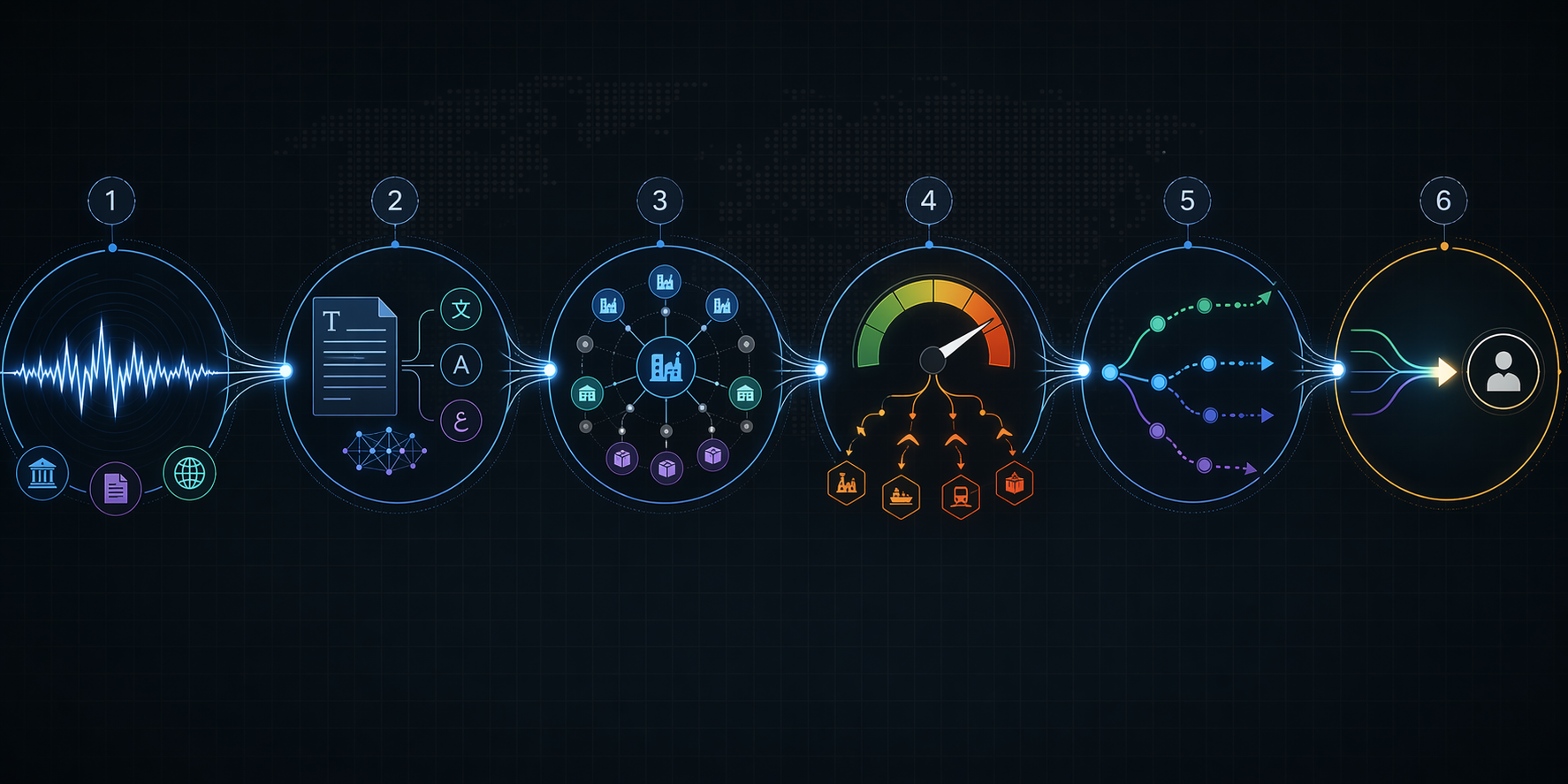
From External Signal to Supply Chain Exposure
The first job is not prediction. It is triage. Natural language processing systems scan large volumes of unstructured material, normalize language, identify entities, classify event types, and attach each signal to something the supply chain can recognize: a country, port, commodity, supplier, part number, regulatory body, shipping lane, or customer commitment.
Scale is the obvious reason to use AI here, but scale alone is not the achievement. QuantSpark has described AI tools processing more than 1 million content pieces in hours, which it frames as equivalent to nearly ten person-years of manual analysis.[1] The operational value is not that a machine read more articles than an analyst could. It is that the sanctions update, the regional port disruption, and the local-language report about a supplier’s operating region can be classified fast enough to enter the same risk queue.
Good ingestion separates several tasks that are too often bundled together under the label “AI.” Named-entity recognition finds companies, agencies, locations, ports, vessels, commodities, restricted parties, and product categories. Event classification distinguishes a proposed tariff from an enacted tariff, a sanctions designation from a media rumor, a strike notice from a work stoppage, and a military incident from a shipping advisory. Relationship extraction then asks whether the event is connected to a supplier, a route, a part family, or a customer-facing promise.
That distinction prevents a common failure: treating geopolitical monitoring as a news-alert problem. A headline about export controls is not automatically a procurement risk. It becomes one if a controlled input appears in a bill of materials, if a supplier in the affected jurisdiction feeds a critical component, if a logistics lane depends on a restricted route, or if a contract has no approved alternate source.
| Signal type | What NLP needs to identify | What the supply chain model needs to know |
|---|---|---|
| Sanctions or restricted-party update | Named entities, ownership links, jurisdiction, effective date | Supplier exposure, indirect ownership risk, open purchase orders, substitute availability |
| Tariff or trade-policy movement | Product category, country pair, policy status, implementation window | Sourcing exposure, landed-cost change, contract pass-through terms, customer margin impact |
| Route or port disruption | Location, route, severity, duration clues, affected carriers | In-transit shipments, lead-time risk, alternate ports, capacity pressure, service-level commitments |
| Conflict or civil disruption | Event location, proximity to sites or corridors, escalation indicators | Plant exposure, supplier continuity, security constraints, insurance and compliance limits |
Tariffs show why this matters. One source citing Stanford SIEPR reported that 68% of U.S. public companies described negative tariff impacts in the first half of 2025.[1] That figure does not prove an AI system can solve tariff exposure. It does show why manual monitoring becomes brittle: the work is not just watching policy, but translating policy into SKU-level costs, supplier choices, and timing decisions.
The Mapping Layer Is Where the Risk Becomes Real
After ingestion, the system has to map a geopolitical signal onto the supply chain graph. This is where many dashboards become less impressive. A red country-risk bubble is not enough. The model needs supplier hierarchies, approved-source lists, manufacturing sites, bills of materials, shipping lanes, inventory buffers, port dependencies, contract obligations, and customer priorities.
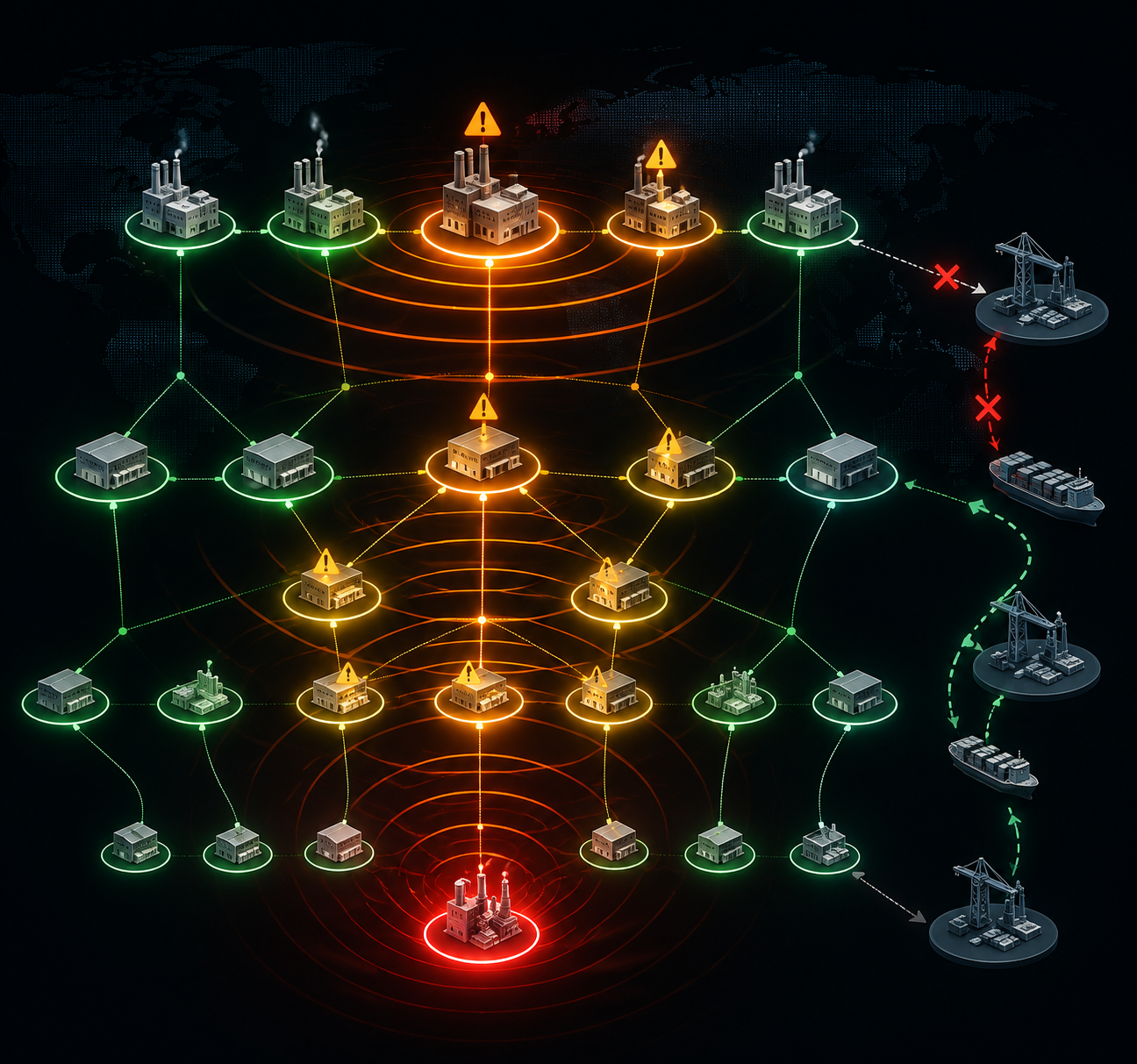
Multi-tier exposure is the hard part. A tier-one supplier may look stable while a tier-two or tier-three dependency sits in the affected region. A shipment may not touch a sanctioned country but may rely on a port, channel, carrier, insurer, or financing path now subject to disruption. A policy may not ban a finished product but may restrict the material or machine tool needed to make it.
Recent examples make the point without needing to overstate frequency. Georgetown’s Baratta Center has pointed to Ford plant shutdowns tied to rare earth shortages and to the Nexperia sanction cascade as illustrations of how geopolitical decisions can move through supplier networks rather than stop at the first affected company.[2] These are not generic “world is risky” anecdotes. They are reminders that the exposure can sit below the level where traditional supplier scorecards are most comfortable.
A mature mapping layer therefore does several things at once:
- Links external entities to internal supplier, site, product, and logistics master data.
- Separates direct supplier exposure from indirect material, route, ownership, and capacity exposure.
- Flags where the organization has alternate sources in name only because qualification, tooling, volume, or compliance constraints make switching slow.
- Shows who owns the next action: procurement, trade compliance, logistics, legal, plant operations, finance, or customer account teams.
This is also where data provenance matters. If the system cannot show why it linked a notice to a supplier, or whether the link came from a verified internal record, a third-party database, a scraped article, or a probabilistic match, the alert is hard to trust under pressure. Operators do not need an essay from the model; they need to know whether the evidence is strong enough to interrupt a shipment plan or escalate a supplier review.
Prediction Means Probability, Cascades, and Time
Once exposure is mapped, predictive machine learning enters the workflow. It does not need to “predict geopolitics” in the grand sense to be useful. In supply chain terms, the model is usually estimating more bounded questions: Which suppliers are likely to miss commitments? Which lanes are likely to experience lead-time degradation? Which ports are likely to become capacity bottlenecks if carriers reroute? Which product lines will run out of qualified alternatives first?
The inputs are mixed. External signals include incident velocity, policy status, trade flows, route advisories, port congestion, sanctions lists, commodity constraints, and local reporting. Internal signals include purchase-order exposure, inventory position, supplier past performance, transit history, qualification status, margin sensitivity, and customer service-level requirements. The model’s output should not be a single threat score. It should be a ranked set of operational risks with time windows, assumptions, and confidence levels visible enough for review.
Route risk scoring is a good example. A Red Sea incident is not only a maritime security event. It can become a lead-time problem, a fuel-cost problem, a port-capacity problem, a carrier-allocation problem, and eventually a production-schedule problem. An AI system that already knows which shipments, suppliers, and customer commitments depend on a lane can estimate the cascade faster than a team assembling the picture by email.
A reported Red Sea crisis case gives a concrete version of that workflow. Sensos and Lucid.now both describe an unnamed automaker that avoided $220 million in losses by using AI-recommended rerouting through 12 pre-mapped alternative ports with political stability scores.[1][3] The number should be treated as a reported value, not as independently verified evidence; the automaker is not named and the public writeups do not provide a primary-source attribution. Still, the case is useful because it shows what makes the system different from a faster news feed: the alternative ports were already mapped, scored, and ready to compare before the decision window closed.
That pre-work is the difference between a model that alerts and a model that helps. If alternate ports, carriers, customs implications, inland transport capacity, and receiving-site constraints are not represented before disruption, the system can only say “risk increased.” If they are represented, it can ask whether rerouting through one port protects production but overloads a downstream lane, whether another port lowers geopolitical exposure but adds customs delay, or whether holding inventory at a regional hub is cheaper than expediting later.
Where Generative AI Fits: Scenario Work, Not Fortune-Telling
Generative AI is most credible in this workflow when it helps compare response scenarios, summarize evidence, draft escalation notes, and surface overlooked dependencies. It is least credible when it turns uncertainty into fluent certainty. The useful output is not “the crisis will last X days” unless the model can show why that estimate is bounded and what assumptions drive it. The useful output is a set of options with trade-offs that a human team can inspect.
A response simulation might compare several options: reroute shipments through alternative ports, shift volume to a qualified supplier outside the affected region, pull forward orders before a tariff window, allocate scarce components to the highest-margin or most contractually exposed products, or notify customers of revised delivery commitments. The generative layer can turn model outputs into a narrative that procurement, logistics, finance, and operations can act on together.
The important discipline is to keep generated text attached to structured evidence. If a system recommends moving volume away from a supplier, it should expose the source signal, the supplier relationship, the part or product exposure, the inventory buffer, the alternate-source constraint, the cost consequence, and the reason the recommendation outranks other options. Otherwise the prose becomes a liability: persuasive enough to spread, too thin to audit.
This is also where internal playbooks can become more useful. A geopolitical-risk system can route sanctions exposure to trade compliance, route-risk exposure to logistics, and sole-source material exposure to procurement and engineering. It can draft the first version of the action brief. It should not quietly become the approver. The approver still needs to understand what data the model used, what it ignored, and which assumption would change the recommendation.
Measurable Outcomes Are Emerging, With Caveats
The most defensible outcomes are operational: detection time, time to map exposure, time to decide, time to recover, avoided premium freight, protected revenue, and fewer surprise supplier escalations. Sensos reports that companies using AI visibility tools reduced crisis recovery times by up to 63% compared with organizations relying on manual monitoring, citing collaborative visibility research.[3] That figure is more useful than a broad preparedness claim because recovery time is something operations teams can recognize and test against their own incident history.
The tariff example belongs in the same category. If monitoring identifies tariff-impact trends early enough to move sourcing, adjust pricing, or renegotiate terms before earnings damage appears, the value is not that AI had a better opinion about trade policy. It is that the company converted a policy signal into a sourcing and margin decision while options still existed.
For teams comparing use cases, geopolitical disruption planning sits beside other early-warning problems such as infrastructure attacks, strikes, and weather shocks. The same broad pattern appears: ingest signals, map exposure, simulate response, and route action. The differences are in data quality, legal constraints, political ambiguity, and the speed at which historical assumptions can become unsafe. Readers moving from use-case understanding to tool selection will need a separate evaluation lens, including data provenance, workflow integration, governance, and model transparency; that is the natural territory for Choosing an AI Platform for Geopolitical Supply Chain Risk.
The Failure Mode: When History Stops Being a Guide
The central limitation is not that AI makes mistakes. Human risk rooms make mistakes too. The sharper problem is that many models learn from patterns that assume the future will rhyme with the past. Xeneta’s 2026 supply chain risk analysis warns that AI models trained on “normal” freight market conditions can fail precisely when geopolitical volatility spikes, because the conditions that made the training patterns useful no longer hold.[4]
That warning should sit near the front of any serious evaluation. Freight behavior during normal volatility is not the same as freight behavior during route closures, war-risk repricing, sanctions escalation, or sudden capacity displacement. Supplier performance during a stable trade regime may say little about supplier performance after export controls cut off a critical input. A model can be mathematically clean and operationally fragile if the world it learned from has disappeared.
The answer is not to abandon models and return to inbox triage. It is to design the system so exception handling is visible. When volatility exceeds the model’s training envelope, the platform should flag degraded confidence, widen scenario ranges, ask for human review, and show which assumptions have become unstable. A low-confidence warning is not a defect if it prevents false precision.
Broad adoption statistics are less helpful unless their methods are clear. Surveys about disruption expectations or preparedness can point to anxiety in the market, but without sample size, sector mix, and regional coverage, they should not carry much weight in a platform decision. Proprietary threat-level ratings can be directionally interesting, but they are not objective measures unless the methodology is available. The stronger evidence is closer to the work: how fast the system detected the event, how accurately it mapped exposure, how well the recommended response held up, and whether teams acted sooner than they otherwise would have.
Implementation Is an Operating Model, Not a Dashboard Rollout
Even a capable model fails if no one owns the handoff. A sanctions alert that does not reach trade compliance is noise. A route-risk score that logistics cannot translate into carrier, port, and customer decisions is decoration. A supplier cascade map that procurement sees after the purchase order is already late is an autopsy.
Implementation has to define thresholds, review rights, escalation paths, and override rules. Which alerts interrupt daily planning? Which require legal review? Which can be handled by procurement? When should the system recommend alternate sourcing versus inventory allocation? Who approves a scenario that protects one customer at the expense of another? These are not software settings alone; they are operating decisions.
Training also matters. Dataiku cites Gartner’s prediction that 60% of supply chain digital adoption efforts will fail to deliver promised value by 2028 without investment in learning and development.[5] The point is not that every team needs to become a data science team. The point is that users must understand enough to question confidence scores, inspect assumptions, interpret scenario outputs, and know when to escalate.
A practical evaluation should therefore test the full loop, not just the interface. Give the system a sanctions change, a tariff proposal, or a route disruption and ask what happens next. Does it find the signal quickly? Does it classify the event correctly? Does it map direct and indirect exposure? Does it distinguish confirmed facts from weaker indicators? Does it generate response options that reflect real constraints? Does it route the decision to the right owner?
A Practical Standard for AI Geopolitical Risk Analysis
AI can materially improve geopolitical supply chain risk analysis when it connects real-time signal ingestion to supply chain-specific exposure models and response simulation. The improvement is not mystical foresight. It is compression: less time between external signal and internal consequence, less time between consequence and option, less time between option and accountable action.
The credible systems will be specific about their mechanics. NLP ingests and classifies messy signals. Machine learning estimates disruption probability, route risk, supplier failure likelihood, and cascade exposure. Generative AI helps compare scenarios and communicate recommended actions. Human review tests the evidence, approves the trade-offs, and watches for the moment when the historical map no longer matches the territory.
That is the standard worth applying: not whether the system sounds confident about geopolitics, but whether it exposes assumptions, surfaces cascade effects, and supports faster human action when certainty is unavailable.
References
- AI Tools for Geopolitical Risk Forecasting — Lucid.now
- Geopolitical Risk Meets AI: How Business Leaders Can Stay Ahead — Georgetown Baratta Center
- Navigating Geopolitics and AI | Stabilizing Supply Chains in Turbulent Times — Sensos
- The Biggest Supply Chain Risks of 2026 — Xeneta
- Supply chain AI trends 2026: building resilient operations — Dataiku
Comments
Join the discussion with an anonymous comment.