
Helium is the kind of line item that looks harmless until it becomes the line that stops the building. In advanced semiconductor manufacturing, it can cost about $10 per wafer while supporting a wafer whose value may be around $15,000; the planning error is treating that $10 input as if its risk is also small.[1] When supply is normal, that mistake hides inside procurement dashboards. When helium becomes the binding constraint, the mistake moves into fab scheduling, customer allocation, equipment uptime, and executive escalation.
That is the operating problem behind AI supply chain planning for helium shortage in Q3 2026. The current crisis has reportedly taken 27-30% of global helium supply offline and put $650 billion in AI infrastructure investment at risk.[2] QatarEnergy’s Ras Laffan recovery is described as a three-to-five-year repair horizon, not a temporary shipping delay.[3] Spot prices were reported to have jumped 40-100% within weeks.[4] Price matters, but availability is the harder constraint. A fab cannot hedge its way into running a process step that has no gas.

Conventional planning systems are poorly built for this shape of risk. They tend to rank by spend, contracted volume, supplier name, and first-tier availability. The shortage is governed by different variables: sub-tier exposure, non-substitutability, supplier allocation rules, on-site inventory, recovery timelines, and which customer commitments are strategically worse to break. The useful question is not whether AI can predict a shortage in the abstract. It is whether AI can give planners better allocation, recycling, and demand-shaping choices once a low-cost critical input becomes the material constraint.
The Planning Flow When Helium Becomes the Constraint
A useful AI planning workflow does not start with a price forecast. It starts by making the physical dependency visible, then tests what happens when supply is cut, then decides whether conservation investments pay back inside the shortage window, then reshapes demand before the remaining supply is consumed by whoever shouts first.
| Planning use case | Decision it improves | What conventional systems miss |
|---|---|---|
| Sub-tier dependency mapping | Which fabs, products, suppliers, and contracts actually depend on constrained helium | Low-spend inputs buried below first-tier supplier records |
| Multi-scenario allocation optimization | Which fab, product line, or customer order receives scarce gas under different assumptions | Allocation caps, strategic customer impact, and continuity trade-offs |
| Recycling ROI prediction | Where recovery systems or process changes produce usable supply within the shortage horizon | Fab-level recovery variance and payback under scarcity rather than normal prices |
| Demand-shaping and alternate qualification | Which demand can be sequenced, deferred, qualified differently, or contractually renegotiated | The difference between theoretical substitution and qualified production reality |
The order matters. Allocation optimization without dependency mapping is just rationing with better charts. Recycling analysis without allocation logic can fund equipment in the wrong fab. Demand-shaping without contract and product dependency data becomes a sales negotiation detached from the factory floor.
Map the Sub-Tier Helium Dependency Before the Shortage Maps It for You
The first job for AI planning is not to announce that helium is important. It is to connect helium exposure from source region to supplier site, supplier site to component, component to product, product to customer promise, and customer promise to revenue or continuity risk. That chain is where many procurement systems get thin. They can show contracted supplier volume. They often cannot show where a second-tier component supplier uses helium in a leak test, a cooling step, or a production process that never appears as a direct material on the OEM’s bill of materials.
The exposed network is large enough that manual mapping will not hold. Resilinc estimates that more than 11,000 suppliers and 100,000 products are affected by the Hormuz disruption, with $460 billion in revenue exposure.[5] Those figures should not be read as a count of semiconductor fabs alone. They describe how a helium shock propagates across electronics, storage, materials, and adjacent industrial processes. That is exactly why planning teams need machine-assisted entity resolution, supplier-site mapping, part-number normalization, contract extraction, and dependency graphs.

The point is not to make a prettier supplier map. The point is to find the places where a low-cost input controls an expensive output. High-capacity HDD prices have reportedly risen 20-50% since mid-2025, and 95% of Western Digital’s 2026 HDD output is described as locked to enterprise contracts.[6] PCB prices were reported to have surged up to 40% after SABIC Jubail was knocked offline.[5] EV battery packs are helium leak-tested, and switching to hydrogen or argon blends can require a six-month regulatory re-qualification.[5] These are different markets, but they share the same planning lesson: helium risk does not stay inside the gas category.
An AI dependency model has to ingest more than purchase orders. It needs supplier disclosures, site locations, freight lanes, contract clauses, engineering specifications, qualification records, customer commitments, and historical consumption by process or toolset. It should flag where the same helium source supports multiple supposedly independent suppliers. It should also separate three very different facts that are often blended in crisis meetings: a supplier has a contract, a supplier has physical gas, and a supplier is willing or able to allocate that gas to your site.
That last distinction becomes decisive when strategic buffers disappear. The U.S. Federal Helium Reserve was sold to Messer in June 2024 for $460 million, removing a public strategic buffer that older planning assumptions may still implicitly rely on.[3][7] If a model still treats national reserve access as a fallback, it is not conservative; it is stale.
What the mapping model should answer
- Which finished goods and customer orders depend on helium directly or through sub-tier suppliers.
- Which supplier sites share the same upstream helium source or shipping corridor.
- Which process steps have no qualified substitute and which only need re-qualification time.
- Which contracts contain force majeure, allocation, priority, or surcharge language.
- Which customer commitments would be damaged by delayed output, not merely deferred revenue.
A planner can only defend an allocation decision if the organization can trace the dependency. Otherwise, the first executive with a margin table will dominate the room, and the model will miss the fab that cannot be restarted cleanly once its helium-backed process sequence is interrupted.
Run Allocation Scenarios Before Supplier Caps Decide for You
Once supply is constrained, the planning problem changes from procurement to governance. Airgas declared force majeure on March 17, 2026, with reported allocation caps at 50% and $13.50 per hundred-cubic-feet surcharges.[3] A 50% cap is not a pricing nuisance for a fab with roughly a week of on-site helium inventory and limited process flexibility.[8] It is a decision deadline.
Without scenario modeling, organizations tend to fall back on two crude rules: serve the highest-payer or serve the first order in the queue. Both can look defensible in a spreadsheet. Both can be damaging if they starve a strategic customer, interrupt a high-value process sequence, or keep one product line running while idling a fab module whose restart penalty is far larger than the saved gas.
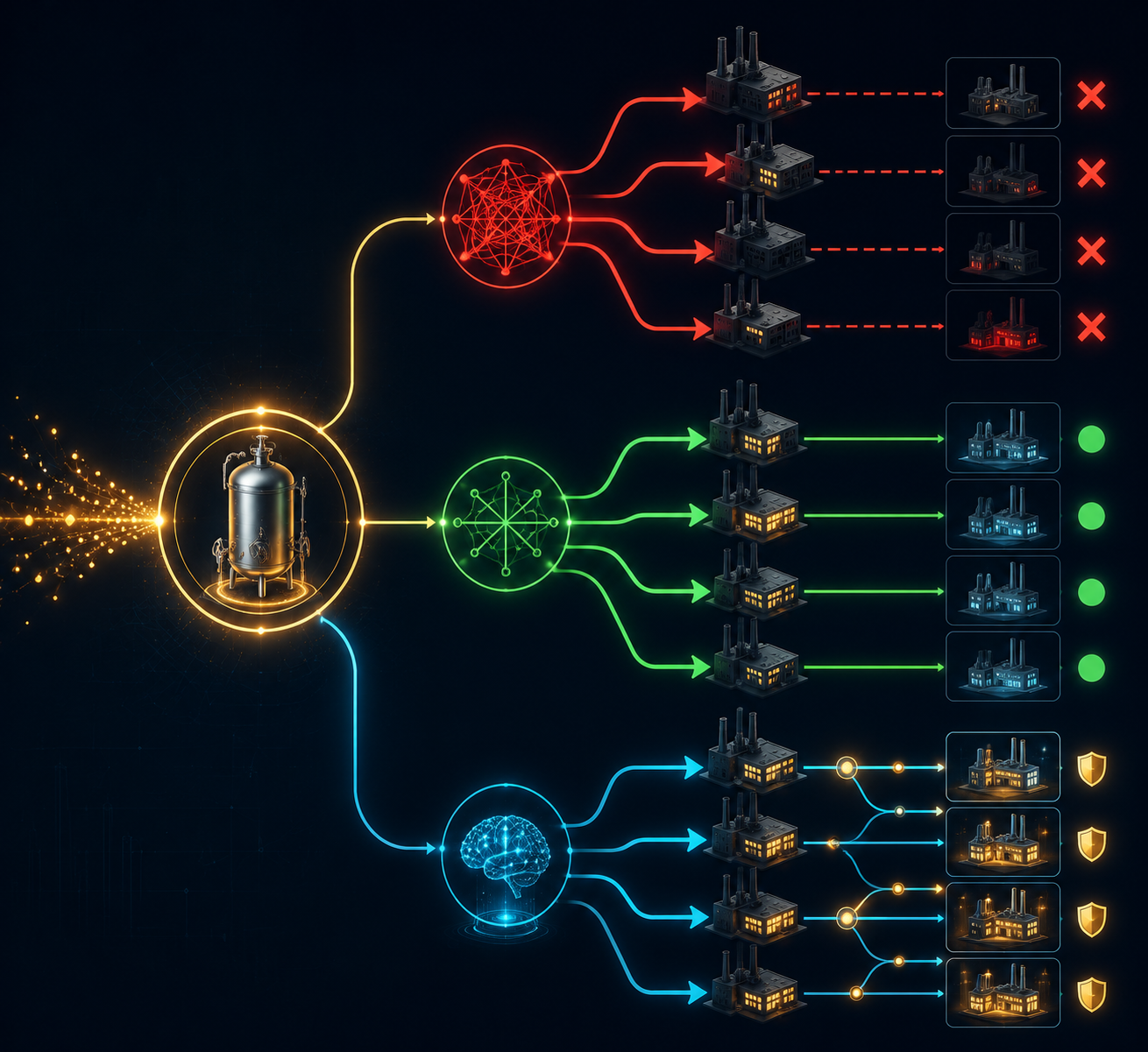
AI allocation planning should simulate the shortage as a set of constrained choices, not a single forecast. One run might assume a 50% supplier cap persists. Another might model a sharper cut for one region, an emergency spot purchase at prior shortage peak levels, or a supplier choosing different allocation percentages by customer sector. Previous shortage peaks reportedly saw helium exceed $2,000 per thousand cubic feet, and suppliers may have flexibility to set different allocation percentages across sectors.[6][4] The point is not that any one scenario is certain. The point is that management needs to see which decisions remain stable across ugly assumptions.
A serious allocation model should score options across several dimensions at once: fab continuity, customer priority, contractual penalty, revenue timing, restart risk, qualification status, and downstream dependency. It should expose the trade-off, not hide it. If one allocation path protects quarterly revenue but consumes the last reliable helium for a process supporting a multi-year customer commitment, the planner needs that conflict visible before the gas leaves the cylinder.
This is also where contract data matters. Force majeure language, take-or-pay obligations, allocation priority, surcharge pass-throughs, and customer delivery commitments should be machine-readable inputs to the allocation engine. Procurement teams already using AI-powered contract extraction can extend that work into helium-specific allocation logic rather than treating legal review as a separate after-action process.
| Scenario input | Planning question | Decision output |
|---|---|---|
| Supplier allocation reduced to 50% | Which fabs can run critical processes without breaking strategic commitments? | Minimum viable gas allocation by fab and process |
| One region loses access for several weeks | Which alternate sites or suppliers can absorb production without unqualified process changes? | Site-level transfer and customer sequencing plan |
| Spot market price doubles | Where is price still less important than continuity? | Approved emergency purchase thresholds |
| Customer demand exceeds constrained output | Which orders should be protected, delayed, split, or renegotiated? | Customer allocation and communication sequence |
The harsh part is that every allocation model will identify losers. That is not a defect. A hidden loser becomes a surprise shutdown, a missed enterprise order, or a customer escalation after the organization has already spent its remaining gas. A visible loser can be negotiated with, sequenced, compensated, or moved into an alternate qualification path.
Use AI to Price Recycling Against Availability, Not Public Relations
Helium recycling belongs in the planning model because the shortage horizon is long enough to change the investment math. Samsung has deployed an industry-first helium recovery system with measurable reductions, while TSMC has been reported to achieve 80-90% helium recovery at leading fabs.[8] Those figures are practical evidence that recovery can matter, but they should not be copied blindly into every site model. Recovery depends on fab design, process node, capture infrastructure, gas purity requirements, and the difference between recoverable and reusable helium.
The wrong way to evaluate recycling is to compare equipment cost against normal helium spend. That repeats the original planning error. The right comparison includes avoided downtime, protected wafer starts, emergency sourcing premiums, restart risk, and the probability that the shortage persists long enough for the investment to matter. NMR helium recovery systems have been described as costing about $300,000-600,000 with a roughly six-year payback in that context; semiconductor fabs will have different economics, but the example is useful because it shows how payback depends heavily on operating assumptions.[7]
AI planning can help by ranking candidate sites for recovery investment under multiple futures: a three-year constrained market, a five-year constrained market, partial Ras Laffan recovery, higher spot-market volatility, or supplier allocation that favors certain customer sectors. It can also detect where recycling has poor near-term value because installation would arrive too late, purity losses would limit reuse, or the fab’s bottleneck is not helium after all.
Demand growth strengthens the case for disciplined modeling. Semiconductor manufacturing helium demand is projected to grow fivefold by 2035.[9] That does not prove every recovery investment is justified in 2026. It does mean a planner should be suspicious of any capital review that treats helium conservation as a discretionary sustainability project rather than a capacity-protection option.
Shape Demand Where Qualification Reality Allows It
Demand-shaping is the least glamorous part of the workflow and often the most uncomfortable. It asks commercial, manufacturing, engineering, and procurement teams to agree on which demand should be accelerated, delayed, split, renegotiated, or protected. The binding constraint is availability, not cost, as Georgetown CSET analyst Sarah Feldgoise has argued in the helium context.[2] That changes the commercial conversation. The question is not simply who will pay more. It is which demand can be served without consuming scarce helium needed for less flexible commitments.
AI can support this work by linking customer orders to gas-consuming process routes, qualification status, contractual priority, margin, and relationship risk. A planner might discover that two products with similar revenue consume very different helium volumes, or that a lower-margin customer order protects a strategic platform commitment. Those are not facts a standard sales backlog view will reveal.
Alternate qualification should be handled carefully. For most semiconductor and fiber optic uses, there is no easy substitute for helium. Where alternatives exist in adjacent processes, qualification time and yield risk still control the plan. EV battery leak testing is a useful reminder: switching to hydrogen or argon blends may require six months of regulatory re-qualification.[5] In semiconductor production, a theoretically available gas is not the same as a qualified process change.
- Sequence demand that can run on already-qualified process routes before demand that requires scarce rework or engineering review.
- Separate customers who can accept delivery smoothing from customers whose operations fail if deliveries are interrupted.
- Prioritize alternate qualification only where the timeline is shorter than the expected constraint and the yield risk is tolerable.
- Use contract data to identify where renegotiation is possible before a missed commitment becomes a dispute.
This is where softer customer language becomes operational. Relationship risk is not a sentiment score; it is the future cost of allocating scarce gas to the wrong promise today.
The Caveat Is Not a Reason to Wait
The 2026 helium crisis is still evolving. Supply resumption dates, ceasefire conditions, and price levels may shift after any model run. Some of the available crisis data comes from commercially interested parties, including gas distributors and procurement software firms. Recovery percentages from Samsung and TSMC are useful signals, but they may vary by fab, process node, and implementation detail.[8] None of that weakens the case for AI planning. It weakens the case for a single fixed plan.
In Q3 2026, AI supply chain planning is valuable because it makes scarcity legible enough to govern. It can continuously remap sub-tier dependencies, rerun allocation scenarios as supplier caps change, justify recycling investments against downtime rather than normal spend, and shape demand before the shortage does the shaping on its own.
The asymmetry has not changed: a roughly $10 input can still decide the fate of a $15,000 wafer.[1] Over the next three to five years, the organizations that manage that asymmetry best will not be the ones with the cleanest resilience language. They will be the ones that can prove, rerun, and defend the allocation decisions that keep critical capacity operating while helium remains scarce.
References
- What helium reveals about the next chip shortage, Kinaxis
- The AI economy runs on helium. The Iran war just created a $650 billion problem, Fortune
- 2026 Helium Shortage: Why Recovery Will Take Years, Not Weeks, WestAir
- Kornbluth Consulting helium market commentary, Kornbluth Consulting
- The Iran War's Supply Chain Shockwaves, LightSource
- The Global Helium Crisis: What It Means for Semiconductor Manufacturing, J2 Sourcing
- The world keeps running out of helium, BBC
- Helium Crisis Tightens Grip On Global Chip Supply Chain, Forbes/Tirias Research
- IDTechEx helium demand projection, IDTechEx
Comments
Join the discussion with an anonymous comment.