
The worst moment in an oil spike is not the headline price move. It is the next morning, when suppliers have begun issuing new quotes, open purchase orders are being revised, sales wants to know whether to raise prices, and the cost system is still calmly reporting last month’s truth.
That is the practical problem behind AI supply chain risk management during oil price shocks: not whether software can predict the next barrel price, but whether procurement can convert the shock into a defensible SKU-level answer before margin leaks for weeks. Which finished products are exposed? By how many dollars per unit? Which customers or orders are now underpriced? Which inputs changed enough to justify a conversation with sales?
The early-2026 oil shock gave this question a clean stress test. CMRA described WTI moving from about $70 to about $100 in three weeks during February-March 2026, with OVX near record levels.[1] SprocketAI, in a vendor-authored account of a March 2026 Hormuz crisis deployment, described Brent moving from about $70 to about $119 per barrel and plastics processors using AI analytics to reprice within days rather than weeks.[2] The second claim should not be read as an independently verified benchmark. It is still a useful operating example because the workflow it describes is exactly where traditional cost cycles are weakest.
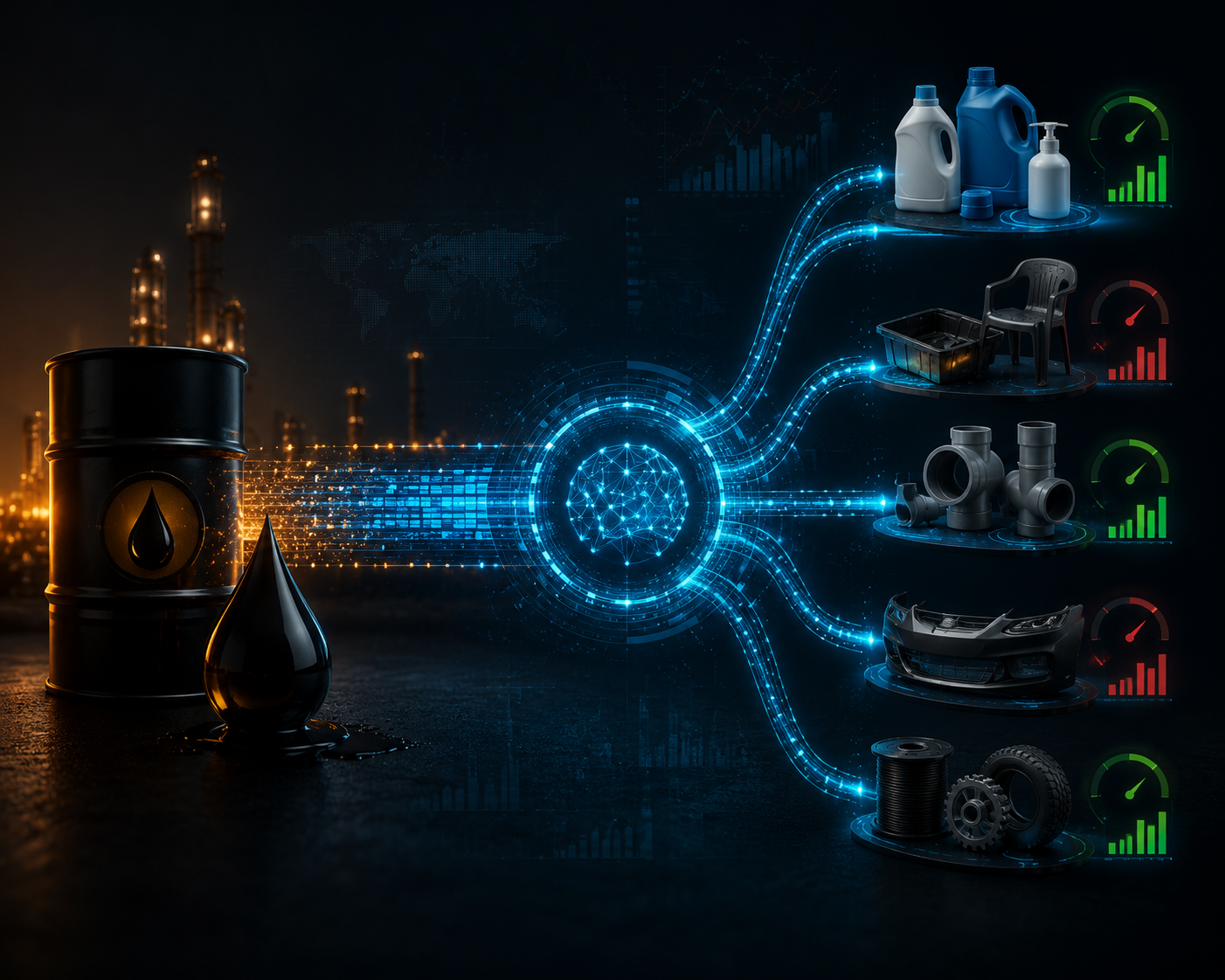
The lag that turns commodity movement into margin loss
Manufacturers already know that resins, chemicals, diesel, fertilizers, freight, and many packaging inputs do not wait politely for the next standard-cost refresh. The operating problem is timing. A standard cost may be accurate enough for financial reporting discipline, yet too slow for pricing discipline when suppliers begin quoting at the new market level.
That timing gap is where AI procurement analytics become more than a dashboard. The useful version does not start with last received cost and ask what happened historically. It reads the earlier signals: purchase order issuances, supplier invoices, BOM structure, production rates, and current commodity price feeds. The central operating claim is that using PO issuances instead of received-cost history can create a 1-2 month advantage in calculating dollarized and percent margin impact per product.
That advantage matters because price recovery is rarely damaged evenly. A blanket 6% or 8% increase might look decisive in a meeting and still under-recover on the items that carry the most exposed resin, chemical, fuel, or freight content. High-volume parts compound the problem because a small under-recovery per unit becomes real money quickly. High-material-cost parts compound it because the commodity pass-through is not diluted by labor, overhead, or conversion margin.
What the AI agent actually has to calculate
The credible use case is narrow and demanding. The agent needs to identify affected products, quantify margin impact in dollars and percent, show which inputs changed, and do it with enough traceability that procurement, finance, and sales can use the output in a customer conversation.
| Question from the business | Data the agent needs | Useful output |
|---|---|---|
| Which products are exposed? | BOMs, material masters, supplier items, commodity mappings | A ranked list of SKUs affected by oil-linked inputs |
| How much margin moved? | Current PO issuances, supplier invoices, standard costs, sell prices | Dollar and percent margin impact by item |
| Which parts need action first? | Open orders, forecast demand, production rates, customer commitments | Prioritized repricing or escalation queue |
| Can sales defend the change? | Input-level cost movement, prior quotes, customer item history | Customer-facing explanation tied to specific cost drivers |
SprocketAI’s account describes an AI agent using controlled SQL tool access to interrogate ERP data and calculate per-item material-cost impact during the Q1 2026 shock.[2] That controlled access point is important. Procurement analytics do not become trustworthy because a model is fluent. They become useful when the model is constrained to query governed tables, retrieve the relevant BOM and purchasing records, and return a calculation that a cost analyst can audit.
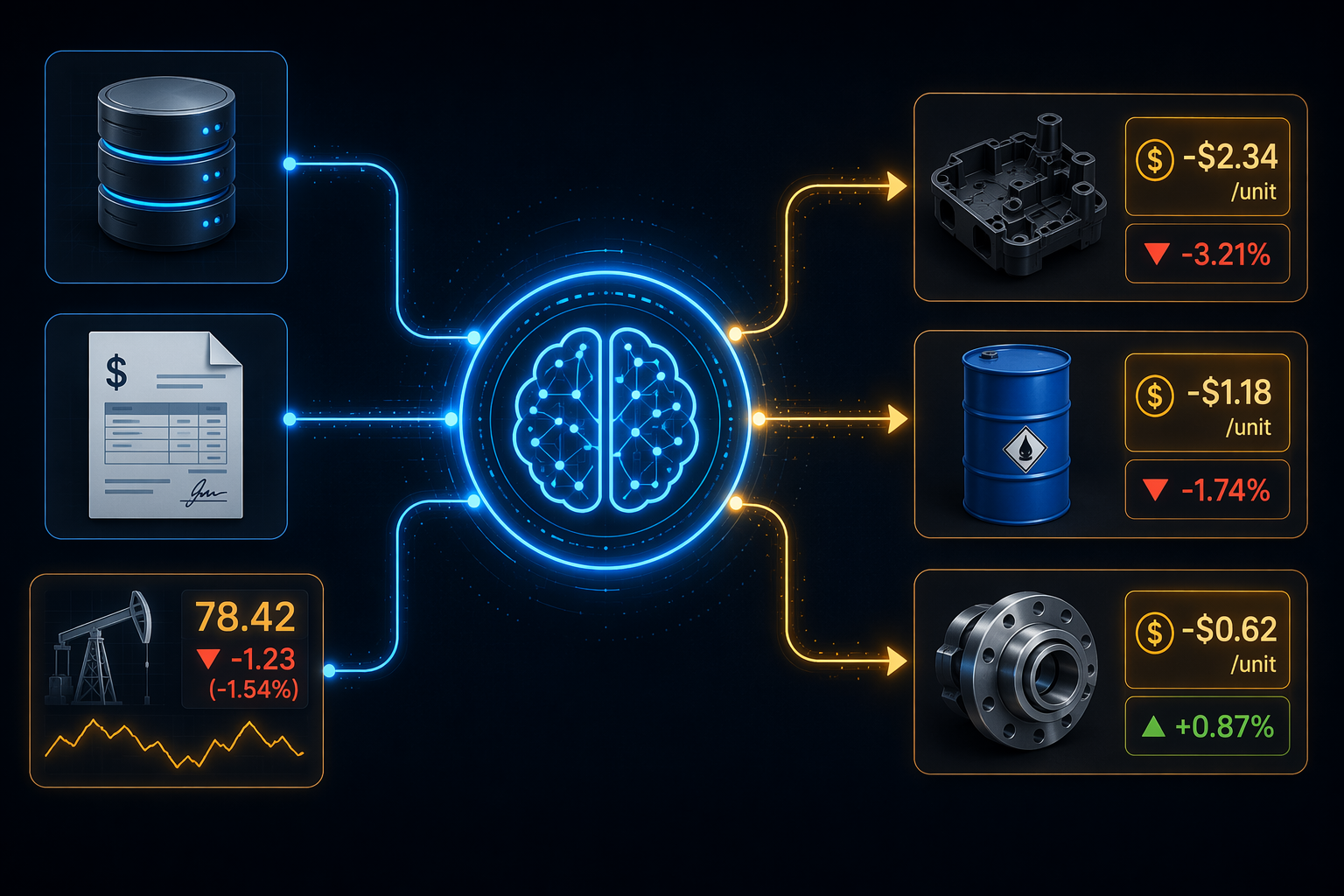
The most valuable input is often not the neatly posted cost. It is the messy, earlier purchasing signal. A new PO issuance or supplier quote can show that the next buy will land at a different price before inventory is received, consumed, costed, and rolled into a formal standard. In a volatile month, waiting for the received-cost trail is a choice to let the first wave of underpriced shipments go out with better documentation but worse economics.
Why per-item repricing beats a clean percentage increase
A blanket increase is tempting because it is simple enough to explain. It is also blunt enough to create two opposite errors at once: undercharging the products where oil-linked inputs dominate cost, and overcharging products where the same commodity shock barely touches the bill of materials.
Per-item analytics change the conversation. Procurement can show that Product A needs a larger move because a specific resin grade now represents a larger share of unit cost under new PO pricing. Product B may need a smaller change because its material exposure is lower or because conversion cost carries more of the total. The customer discussion becomes less about “we are taking price because oil is up” and more about “these line items moved by this amount because these inputs changed.”
That precision also helps internally. Sales does not have to fight every customer with the same script. Finance can see whether the proposed action closes the margin gap or merely spreads pain evenly. Procurement can separate urgent repricing from watch-list exposure, which matters when teams cannot renegotiate every item at once.
The Q1 2026 plastics example, used carefully
The SprocketAI Hormuz example is useful because it is not framed around generic forecasting. The vendor describes four tactics used by plastics processors: prioritizing likely orders, analyzing productivity by resin grade under new prices, executing precision per-item repricing, and supporting customer communication with data.[2] Those are the jobs a real procurement and pricing team has to complete when crude-linked materials move faster than the monthly close.
The repricing-within-days claim is relevant, but it needs a label attached. It comes from the vendor that provides the tool, not from a third-party audit.[2] It should therefore be treated as an illustrative deployment pattern rather than proof that every plastics processor will achieve the same cycle time or margin recovery.
Even with that caveat, the sequence is credible. A processor facing resin movement does not first need a perfect oil forecast. It needs to know which resin grades are affected, which SKUs consume them, which open or likely orders carry those SKUs, and what price change would protect margin under current supplier pricing. If the data path exists, an agent can shorten the clerical and analytical work that normally sits between the shock and the customer decision.
The financial stakes are large, but not universal
The exposure is not theoretical. An IJEAP study on Middle Eastern firm data estimated that each unit of oil price volatility increases procurement costs by $3.96 million.[3] That is a useful scale marker, especially for companies with oil-linked materials or logistics-heavy operations. It should not be lifted out of context as a global rule of thumb; the sample geography matters.
Other oil-shock effects sit outside the SKU margin file but still pressure procurement. Bramwith Consulting cited a WTO warning that sustained high energy prices could slow global trade growth from 4.6% in 2025 to 1.9% in 2026.[4] That kind of macro warning does not tell a margin analyst which customer item is underwater on Tuesday morning, but it explains why executives press for faster answers when energy prices stop behaving like a background assumption.
Where predictive risk tools fit
Beroe’s work on predictive commodity risk management for diesel and gasoline places AI-supported analytics alongside hedging strategies, scenario planning, and predictive risk management.[5] Those capabilities matter, particularly for logistics-heavy procurement teams that need to model fuel exposure before the invoice arrives.
For this use case, though, hedging is adjacent rather than central. Treasury and sourcing teams may decide how much exposure to hedge, which contracts to restructure, or which suppliers to qualify. The procurement analytics question is closer to the operating floor: given the shock already visible in the market and in supplier documents, which products now require price action?
Scenario planning becomes useful when it feeds that decision. A team can model what happens if resin-linked inputs move again, if diesel surcharges persist, or if a supplier quote resets at the next order. The output still has to land at item level. A scenario that cannot be translated into affected SKUs, expected margin movement, and a recommended commercial action is interesting, but not yet operational.
Implementation is a data-readiness problem before it is an AI problem
The companies best positioned to use this capability already have ERP data integrated into a warehouse, with BOMs, supplier invoices, PO data, production rates, and pricing records available for governed analysis. The agent also needs controlled SQL access, not open-ended permission to improvise against operational systems.
Initial training cycles matter because cost structures are not self-explanatory. One company’s resin grade mapping, surcharge logic, freight treatment, scrap assumption, and customer-specific pricing exception may not look like another’s. The agent has to learn where the relevant fields live, how material categories map to commodity signals, and which calculations finance will accept.
- Strong fit: manufacturers with oil-linked materials, reliable BOMs, current PO visibility, and frequent price negotiations.
- Moderate fit: teams with good spend data but weak finished-goods margin visibility; the first project may be data cleanup.
- Weak fit: companies without governed ERP access, inconsistent item masters, or no mechanism to act on item-level price findings.
The action mechanism is easy to overlook. A beautiful exposure report does not protect margin if commercial approval still waits for the next quarterly review. The procurement system has to connect to a pricing workflow: escalation rules, customer communication, sales approval, and a record of why the change was made.
The practical advantage
AI procurement analytics are most valuable in oil shocks when they compress the distance between market movement and product-level action. The defensible advantage is not perfect forecasting. It is a faster, narrower, dollarized answer: which products need repricing, by how much, and soon enough that the business is not waiting for the cost cycle while shipments go out under-recovered.
References
- Data-driven guide, CMRA
- Price shocks: using AI tools to protect yourself from turbulent commodity markets, SprocketAI LinkedIn
- Impact of Crude Oil Price Volatility on Procurement and Inventory Strategies in the Middle East, IJEAP
- Oil shock context, Bramwith Consulting
- Managing volatility: Predictive Commodity Risk Management for Diesel and Gasoline, Beroe
Comments
Join the discussion with an anonymous comment.