
The hard part of choosing AI for geopolitical risk supply chain planning is not finding a platform that can detect trouble. Most credible vendors can show maps, alerts, supplier exposures, sanctions signals, conflict indicators, weather overlays, or news ingestion at impressive scale. The harder procurement question is more prosaic: when the alert arrives, does it change the next S&OP discussion, inventory parameter, supplier escalation, allocation rule, or executive trade-off?
That distinction matters because geopolitical risk intelligence has a habit of looking complete inside a demo and becoming stranded inside the operating model. A risk team may see an elevated probability of disruption in a sourcing region. A planner may accept that the signal is directionally useful. Finance may still ask why working capital should rise this quarter. Procurement may have no approved alternate supplier. By the time everyone agrees the signal was real, the planning window has closed.
The evaluator’s job, then, is not to rank models by geopolitical elegance. It is to trace the route from external signal to internal decision. Three platform families now compete for that role: specialist risk intelligence platforms, integrated planning suites and partnerships, and AI-native geopolitical modeling firms. Each can be useful. Each fails in a different place.

Why the evaluation is urgent, but not settled
A 2025 Ivalua survey illustrates both the urgency and the measurement problem. In a Sapio Research sample of 100 U.S. supply and procurement decision-makers, 98% of organizations with fully deployed AI said they felt prepared for geopolitical disruption, compared with 0% of organizations with no AI plans. The same survey found that only 36% currently viewed AI as a top priority, while 65% were pausing AI investment because of trade policy uncertainty.[1]
The preparedness gap is striking, but the sample is small enough that it should be treated as indicative rather than definitive. The more operationally useful finding is the pause itself. Many companies feel exposed to tariff shifts, sanctions, regional conflict, logistics disruption, and supplier fragility, yet the same uncertainty makes them hesitate to fund new AI programs. That is exactly where architecture becomes a buying criterion. If a platform cannot show how its intelligence enters existing planning routines, the business case depends on belief.
The stakes are not abstract. Axidio, citing IMF and World Economic Forum context, described more than $1 trillion in projected geopolitical risk cost to supply chains in 2025. The same analysis reported that Suez Canal traffic fell 58%, from 2,068 ships in November 2023 to about 877 in October 2024, and that rerouting could add roughly $1 million in fuel cost per ship.[2] Those figures are enough to justify attention, but they still do not tell a buyer which AI platform will alter a replenishment plan before the next disruption hits.
The three platform families are solving different parts of the problem
A useful shortlist should separate the platform’s native strength from the planning work it must still connect to. The same vendor may appear under more than one commercial story, especially through partnerships, but the architectural distinction is still useful.
| Platform family | Native strength | Typical weak point | Best evaluation question |
|---|---|---|---|
| Specialist risk intelligence platforms | Broad signal detection, supplier-risk monitoring, event classification | Risk signals may remain outside S&OP, inventory optimization, or sourcing execution unless integrated | How does an alert become a planning action, and in which system? |
| Integrated planning suites or partnerships | Closer connection to planning scenarios, constraints, inventory, and S&OP workflows | External geopolitical intelligence may depend on partners or narrower data coverage | Is the risk signal rich enough, and can planners simulate the operational response? |
| AI-native geopolitical modeling startups | Custom reasoning, scenario analysis, and complex geopolitical interpretation | Higher integration burden before outputs affect planning and supplier workflows | Who translates probabilistic insight into an approved planning decision? |
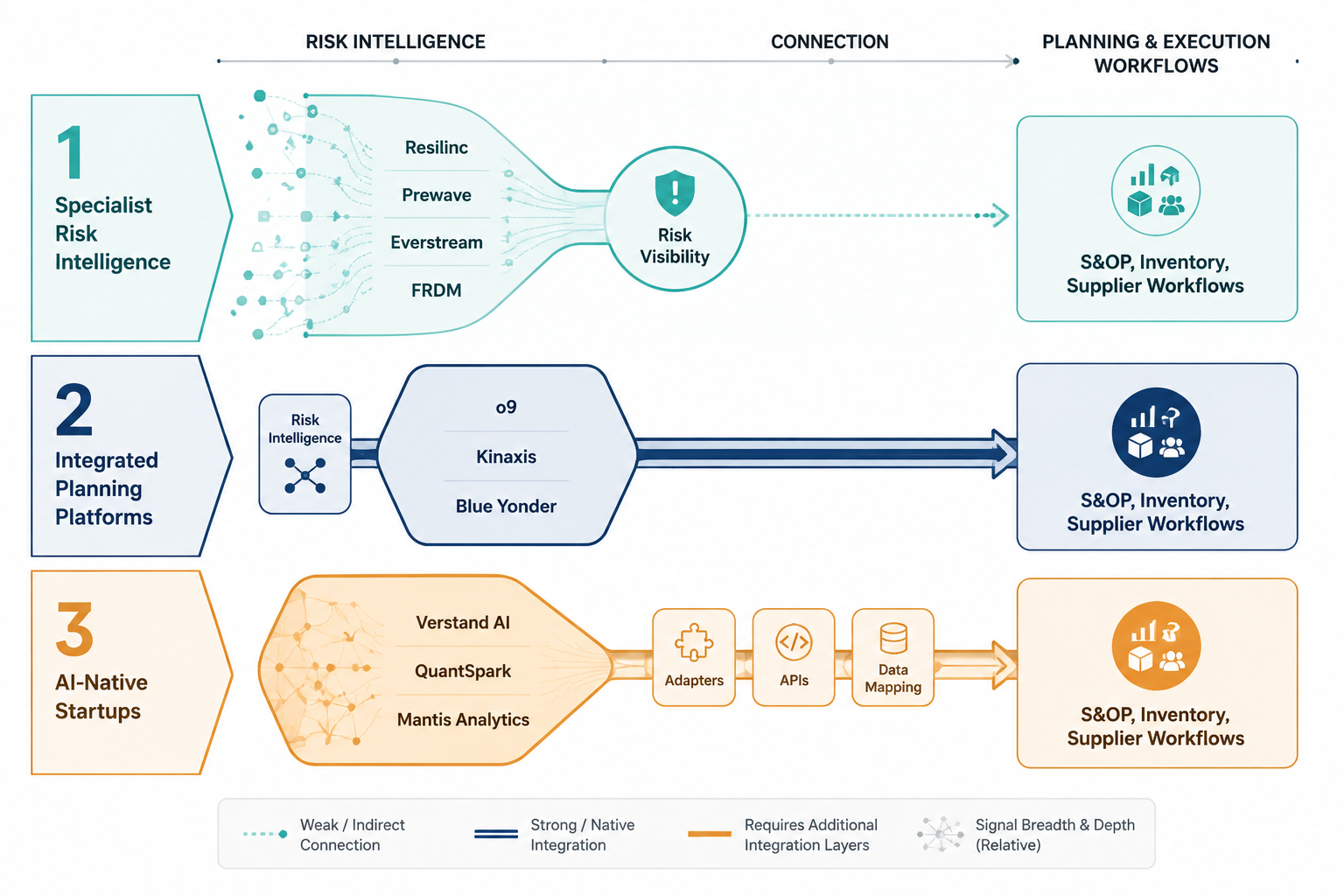
Specialist risk intelligence platforms: strong signal coverage, incomplete planning leverage
Specialist risk platforms are often the most convincing at the front end of the problem. They ingest external information, classify events, map exposures, and alert teams before a disruption becomes visible in orders or transport lanes. Resilinc, for example, describes five AI model types, more than 400 disruption scenarios, and more than 8 million daily data rows across 108 languages from more than 104 million sources. These are vendor-published capability claims, not independent audit findings, but they show the scale at which the specialist category wants to compete.[3]
Prewave is another example of the same front-end strength. In coverage of its partnership with o9, Procurement Magazine described Prewave as monitoring more than 200 risk categories across more than 400 languages.[4] Everstream, in its own 2026 disruption outlook, reported a 61% surge in cyberattacks on logistics in 2025 and a 965% increase from 2021 to 2025; that figure is also vendor-published, and it should be read as a risk-intelligence provider’s disclosed view rather than a neutral benchmark for the whole market.[5]
The value of these platforms is visibility. They are built to notice that a supplier site, sub-tier region, logistics corridor, port, commodity, or regulatory domain is becoming more fragile. For companies that still discover disruption through late shipments and supplier emails, that is a real improvement.
The evaluation should slow down at the handoff. Does the platform know the parts, products, revenue streams, plants, and customer commitments affected by the supplier or region? Does it write back to the planning environment, open a workflow, trigger a scenario, or merely send a notification? Can procurement see qualified alternates, contract constraints, and supplier owners? Can planning see projected inventory burn, service-level exposure, and capacity trade-offs? The more a specialist platform remains a separate risk console, the more its value depends on disciplined manual translation.
This does not make specialist platforms inferior. It makes their integration burden explicit. A company with weak supplier-risk visibility may need the specialist layer first. But if the goal is to change S&OP decisions, the buyer should require a demonstration that follows one alert through the planning stack: affected suppliers, affected materials, affected finished goods, affected customers, proposed planning options, approver, audit trail, and final disposition.
Integrated planning platforms: closer to the decision, sometimes thinner on external intelligence
Integrated planning platforms approach the problem from the opposite direction. Their advantage is not that they necessarily see the world better. It is that they already sit closer to the people and systems that set supply plans, inventory targets, allocations, production scenarios, and executive trade-offs.
The o9 and Prewave partnership is a useful example because it makes the risk-to-planning workflow visible. Procurement Magazine described the partnership as combining Prewave’s supply chain risk monitoring with o9’s Digital Brain platform, with the aim of giving companies risk visibility and scenario-planning capability inside planning workflows.[4] That is not a blanket endorsement of either vendor. It is a clean illustration of the architecture many buyers should be asking for: specialist intelligence feeding a planning system where trade-offs can be modeled.
In a mature implementation, that connection should let a planner move from alert to options. If a region’s risk score rises, the planning environment should help estimate which SKUs are exposed, how many weeks of cover remain, what happens if lead times extend, whether alternate suppliers have capacity, and which customers would be constrained under different allocation rules. The alert has not done its job until it creates a decision surface.
Kinaxis RapidResponse and Blue Yonder belong in the same buyer conversation when the central requirement is planning execution rather than risk discovery. The evaluator should still avoid assuming that a planning suite automatically provides sufficient geopolitical intelligence. Some suites will depend on partner feeds, customer-provided risk data, or narrower event layers. The right question is not whether the product has an AI risk module. It is whether its external intelligence is strong enough for the risks the company actually faces, and whether its planning model is detailed enough to test a response.
This is where companies that already invested in planning maturity have an advantage. If item-location data, supplier mappings, lead times, bills of material, approved alternates, and customer priorities are already governed, a geopolitical signal can travel farther. If those foundations are fragmented, even a well-integrated planning platform may produce elegant scenarios that no one trusts.
AI-native geopolitical firms: deeper reasoning, heavier operational burden
AI-native geopolitical modeling firms deserve a fair place in the shortlist, especially for companies whose exposure cannot be handled by generic event categories. Their pitch is usually not just faster alerting. It is richer interpretation: how political decisions, sanctions, conflict dynamics, information environments, infrastructure constraints, and policy shifts may interact before the effect reaches a supplier or lane.
Georgetown’s Global Business Initiative has discussed Verstand AI in the context of helping business leaders stay ahead of geopolitical risk, including an Airbus case study.[6] New Lines Institute announced a partnership with Mantis Analytics to launch a customizable geopolitical risk assessment solution.[7] QuantSpark is also positioned in this AI-native category through claims about large-scale content analysis, though the available material here should be treated as vendor positioning rather than independent evidence.
The strongest use case for this category is not a company asking, “Will there be a disruption next week?” It is a company asking, “Which geopolitical pathways would make our current network design untenable, and which options should we build before the signal becomes obvious?” That can be valuable for sourcing strategy, regional footprint decisions, executive scenario planning, and board-level risk discussion.
The weakness is not necessarily analytical quality. It is operational distance. A custom geopolitical model may produce a nuanced probability distribution, narrative scenario, or early warning indicator. Someone still has to map that output to supplier master data, item criticality, inventory policy, qualification timelines, contract terms, logistics routes, and S&OP governance. Without that design work, the model becomes an advisory layer that executives may find interesting and planners may struggle to use.
This is also where the conveyance problem appears. Probabilistic outputs are often the honest form of geopolitical analysis, but operating committees frequently want certainty before approving cost. A model may say that a disruption pathway is becoming more likely; the business may ask whether it is definitely happening before funding safety stock or dual sourcing. The platform cannot solve that tension by itself. The workflow must define what level of risk is enough to trigger which class of action.
A better demo follows the signal into S&OP
Most vendor demos begin where the vendor is strongest. Specialists show detection coverage. Planning suites show scenarios. AI-native firms show reasoning. A serious proof of concept should begin with the buyer’s operating question instead: what decision would have changed if this platform had been live last quarter?
That proof of concept does not need a theatrical crisis. A credible test can use a contained, representative scenario: a supplier region faces rising political instability; a logistics corridor becomes less reliable; a tariff or sanctions risk affects a sourced category; a cyber risk emerges around a logistics partner. The point is to see whether the platform can cross the boundary between intelligence and planning.
- Signal provenance: which sources, languages, event types, and confidence measures produced the alert?
- Exposure mapping: which suppliers, sub-tiers, sites, parts, lanes, commodities, plants, SKUs, and customers are affected?
- Planning translation: which S&OP, inventory, supply planning, or sourcing workflow is interrupted?
- Option generation: does the system show feasible responses, or only describe the risk?
- Human review: who validates the signal, approves the scenario, and owns the action?
- Auditability: can the company later see why a decision was made, which data supported it, and who overrode it?
The MIT Sloan Management Review framework is useful here, as long as it is not treated as universal law. Based on a study of 13 multinational companies, it organizes geopolitical supply chain resilience around three capabilities: understand signals, anticipate by creating options, and adapt quickly.[8] That maps closely to the evaluator’s task. A platform that only understands signals is incomplete. A platform that creates options but cannot adapt operationally is also incomplete.
The Bloomberg and Supply & Demand Chain Executive view is similarly practical: the most effective risk intelligence strategy combines human oversight, interoperable data, and AI/ML detection.[9] That “trifecta” is not glamorous, but it describes why many risk dashboards fail. Detection without data plumbing creates awareness without action. Data plumbing without human authority creates automated noise. Human judgment without machine-scale detection arrives too late.
What buyers should ask by architecture
The shortlist conversation becomes clearer when questions are tailored to the category. The goal is not to force every vendor into the same checklist. It is to expose where each architecture will need help.
| If evaluating... | Ask first | Red flag |
|---|---|---|
| A specialist risk intelligence platform | Which planning, ERP, supplier management, and ticketing systems does it integrate with, and what objects does it exchange? | The demo ends at alerts, heat maps, or risk scores. |
| An integrated planning suite or partnership | Which external risk signals feed the planning model, and how are scenarios converted into approved actions? | The planning workflow is strong, but the geopolitical data layer is vague. |
| An AI-native geopolitical modeling startup | How will its outputs map to supplier, item, lane, inventory, and S&OP data in the first 90 days of deployment? | The analysis is sophisticated, but ownership of operational translation is unclear. |
ERP connectivity deserves a very literal discussion. Buyers should ask whether the platform reads purchase orders, supplier master records, item masters, inventory positions, bills of material, contracts, shipment milestones, and approved vendor lists. They should ask whether it writes anything back, and if not, what workflow system receives the task. A one-way data feed may be enough for monitoring. It is rarely enough for planning influence.
Scenario workflow is the next filter. A useful system should not merely say that a route, country, supplier, or category is risky. It should help compare responses: carry more stock, shift volume, expedite, qualify an alternate, delay promotion, reallocate constrained supply, or accept the risk. Not every action belongs inside the AI platform, but the platform should make the handoff explicit.
Human review should be designed rather than improvised. Some risks should trigger procurement review. Others belong with planning, logistics, legal, compliance, finance, or an executive risk committee. The approval threshold for adding buffer inventory is not the same as the threshold for monitoring a supplier. If those thresholds are not defined, probabilistic AI outputs will sit in the familiar gap between “interesting” and “approved.”
Auditability is not only a compliance concern. It is how a planning organization learns whether its risk process works. When a team chooses not to act on a warning, the reason should be visible later. When it does act, the business should be able to compare the cost of action with the disruption avoided or absorbed. Without that record, every quarter starts over as a debate about whether the last alert was real.
Model sophistication still matters, but it decays without operating context
It would be a mistake to dismiss model quality. Geopolitical risk is messy, multilingual, adversarial, and often ambiguous. Better entity resolution, source evaluation, language coverage, event classification, and scenario reasoning can improve the quality of the signal that enters the planning process.
But volatile environments punish overconfidence. Xeneta, citing a convergence of BCG, Gartner, and McKinsey findings, argued that only a minority of supply chain AI initiatives deliver provable ROI because of fragmented data quality and model degradation in volatile conditions.[10] The exact share is not specified in the available material, so the useful takeaway is narrower: supply chain AI performance depends on data quality, operating fit, and continued validation, not just model ambition.
This is why procurement teams should be careful with black-swan language. Rare, high-impact events do happen, but treating every uncertainty as unknowable can become an excuse for not defining thresholds, playbooks, or decision rights. A platform does not need to predict every shock perfectly to be useful. It needs to improve the timing and quality of decisions the company is actually prepared to take.
How to choose without pretending there is one winner
The right architecture depends on where the organization is weakest. If the company lacks basic supplier-risk visibility, a specialist risk intelligence platform may be the right first move. It can create the external sensing layer the organization does not yet have, especially if supplier mapping and alert governance are part of the implementation.
If the company already runs mature S&OP, inventory optimization, and supplier collaboration workflows, the best geopolitical AI may be the one that plugs into those workflows cleanly. In that environment, a partnership model or planning-suite extension can matter more than the most sophisticated standalone geopolitical model, because the operating system for decisions already exists.
If the company faces complex exposure that standard event categories cannot explain, an AI-native geopolitical firm may be worth the integration burden. That choice should be made with open eyes. The buyer is not only buying analysis; it is funding translation into master data, planning scenarios, executive thresholds, and repeatable workflows.
A practical evaluation can borrow from broader procurement technology taxonomies without becoming a vendor leaderboard. The same three-tier logic that appears in Procurement AI Tools in 2026: A Three-Tier Market Taxonomy applies here, but geopolitical risk adds a sharper test: can the tool carry uncertainty into a decision forum where money, service levels, and supplier commitments change?
For procurement teams comparing AI use cases more broadly, geopolitical risk also belongs beside price forecasting, supplier intelligence, and agentic workflow automation rather than in a separate innovation box. Commodity exposure may connect naturally to AI Commodity Price Forecasting Delivers Measurable Procurement Savings, while autonomous response claims should be read alongside Agentic AI in Procurement Platforms. The more automated the proposed response, the more important it becomes to define who can override it and how the decision is recorded.
A platform that detects geopolitical disruption has done the first job. A platform that changes planning behavior has done the job that supply chain leaders are actually trying to fund. The difference is integration architecture: what data moves, which workflow opens, who reviews it, what options are generated, and which decision rights turn probability into action.
References
- AI-Ready Supply Chains Prove More Resilient Amid Rising Global Risk — Ivalua, April 2025
- Geopolitical Risk Analytics in SCM 2025 — Axidio
- AI Supply Chain Risk Management: 5 Models — Resilinc
- o9 & Prewave risk visibility partnership — Procurement Magazine, February 2025
- Are You Prepared for the Supply Chain Disruptions of 2026? — Everstream Analytics
- Geopolitical Risk Meets AI: How Business Leaders Can Stay Ahead — Georgetown Global Business Initiative
- AI Start-Up Partners With Policy Think Tank to Launch Customizable Geopolitical Risk Assessment Solution — New Lines Institute
- Stay Ahead of Geopolitical Supply Chain Risks — MIT Sloan Management Review
- Geopolitical Risk in Supply Chain Management Is Entering a New Era of Human and AI Intelligence — Supply & Demand Chain Executive
- The Biggest Supply Chain Risks of 2026 and How to Navigate Them — Xeneta
Comments
Join the discussion with an anonymous comment.