
The Red Sea case is the cleanest place to start because it shows the difference between a useful alert and a decorated crisis feed. Sensos reported in January 2026 that an automaker client avoided an estimated $220 million in losses during the 2024 Red Sea crisis by using AI-powered visibility to reroute through 12 pre-mapped alternative ports, each paired with political stability scores.[1] That number should be read carefully: it is vendor-reported, not independently verified, and the avoided-loss baseline is not public. Still, the operational detail matters. The system was not merely flagging danger near a shipping lane. It had already connected geopolitical risk signals to a set of executable port choices.
That is the practical test for AI-driven supply chain disruption planning for geopolitical conflict: did the signal change a planning variable before the disruption became obvious to everyone else? In this case, the variables were port selection, rerouting readiness, and the confidence to move before the chokepoint fully translated into missed delivery windows. A control room can survive a late warning if the response is cheap. It cannot survive a late warning when the response requires ocean bookings, customer allocation decisions, supplier sequencing, and executive approval.
What an Early Warning System Has to See
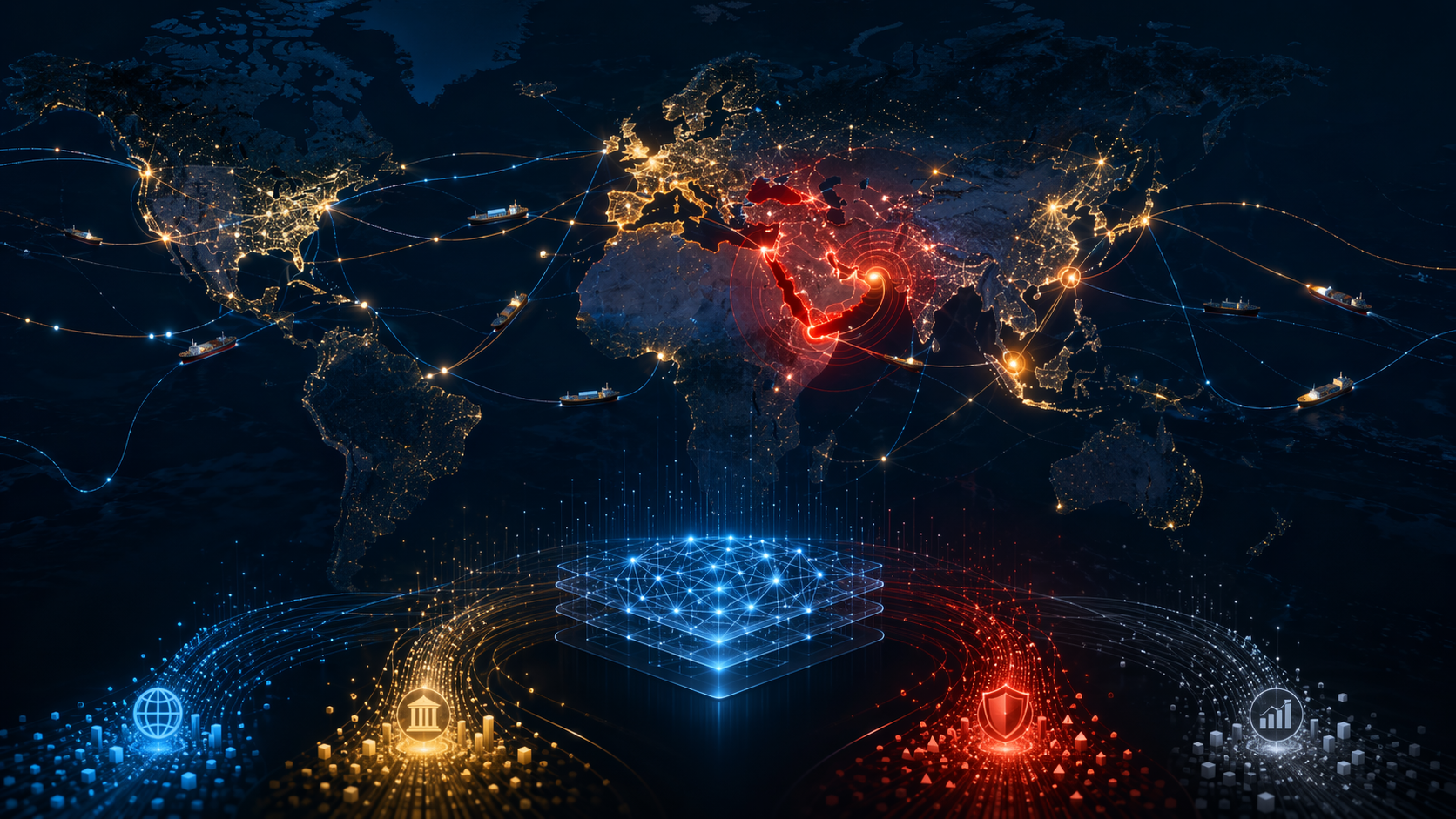
A geopolitical risk platform that only watches vessel movement is already late. By the time congestion, blank sailings, or abnormal dwell times show up in logistics data, planners may still have options, but the cheapest options are usually gone. The useful signal set starts upstream: trade policy proposals, sanctions developments, export-control changes, conflict indicators, political instability, labor and ethics enforcement, insurance and freight signals, macroeconomic pressure, and internal exposure data such as supplier location, lane dependency, inventory position, and customer priority.
That breadth is why a geopolitical AI platform should be judged less like a news monitor and more like a planning instrument. A news monitor can tell a team that a region is deteriorating. A planning instrument can show which supplier allocation, safety-stock assumption, lane, or escalation threshold now deserves review. The difference is not cosmetic. It determines whether the analyst is sending a link to an article or asking procurement, logistics, and sales operations to make a defended change.
The market pressure behind these tools is real, even if some of the headline numbers need careful handling. Dataiku, citing Everstream Analytics, described “Geopolitical Fragmentation and Strategic Use of Trade Regulations” as the top 2026 supply chain risk at a 97% threat level. The same Dataiku article cited a DP World study finding that 78% of firms expected geopolitical instability and trade friction to intensify, while only 25% said they were well prepared.[2] Those figures come through a vendor-linked source chain, so they are better used as context for buyer urgency than as proof that any one platform will perform well.
For teams still defining the broader role of AI in this area, AI as a geopolitical early warning system for supply chains is the adjacent question. This article is narrower: what has to be in place before early warning changes the plan?
Geopolitical Disruption Is Not One Risk
The Red Sea example can make the use case look like a chokepoint problem. That is only one version. A ScienceDirect systematic literature review of 80 studies, published in October 2025, identifies six types of geopolitical supply chain disruption: trade policy shifts, sanctions and export controls, armed conflict, political instability, terrorism, and forced-labor or ethics regulations.[3] The accessible material provides the classification, not a full public ranking of frequency or severity by industry, but the classification is still useful because it keeps planning teams from overfitting their tools to shipping lanes.
| Disruption type | Planning variable most likely to move |
|---|---|
| Trade policy shifts | Tariff scenarios, sourcing cost assumptions, customs routing, landed-cost models |
| Sanctions and export controls | Supplier eligibility, restricted-party screening, customer allocation, contract review timing |
| Armed conflict | Lane viability, port choice, transit lead time, insurance exposure, emergency inventory positioning |
| Political instability | Supplier continuity assumptions, production sequencing, near-term escalation thresholds |
| Terrorism | Site security assumptions, transport risk, contingency routing, employee and carrier exposure |
| Forced-labor and ethics regulations | Supplier qualification, documentary evidence, shipment holds, audit prioritization |
This is where weak implementations usually reveal themselves. They can ingest conflict news and maybe port data, but they struggle with sanctions, export-control language, customs enforcement, supplier ownership structures, or forced-labor documentation. That gap matters because many geopolitical disruptions do not begin with a blocked route. They begin with a new rule, a new designation, an enforcement action, or a political shift that quietly changes whether a supplier, product, lane, or customer is still viable.
Tariff exposure is a good example. An AI system does not need to predict a final policy perfectly to be useful. It can still help planners identify which SKUs, supplier sites, contract clauses, and customer commitments are sensitive to a possible duty change. For a deeper operational treatment of that branch of the problem, see AI-powered scenario planning for tariff disruption response.
From Signal to Planning Action
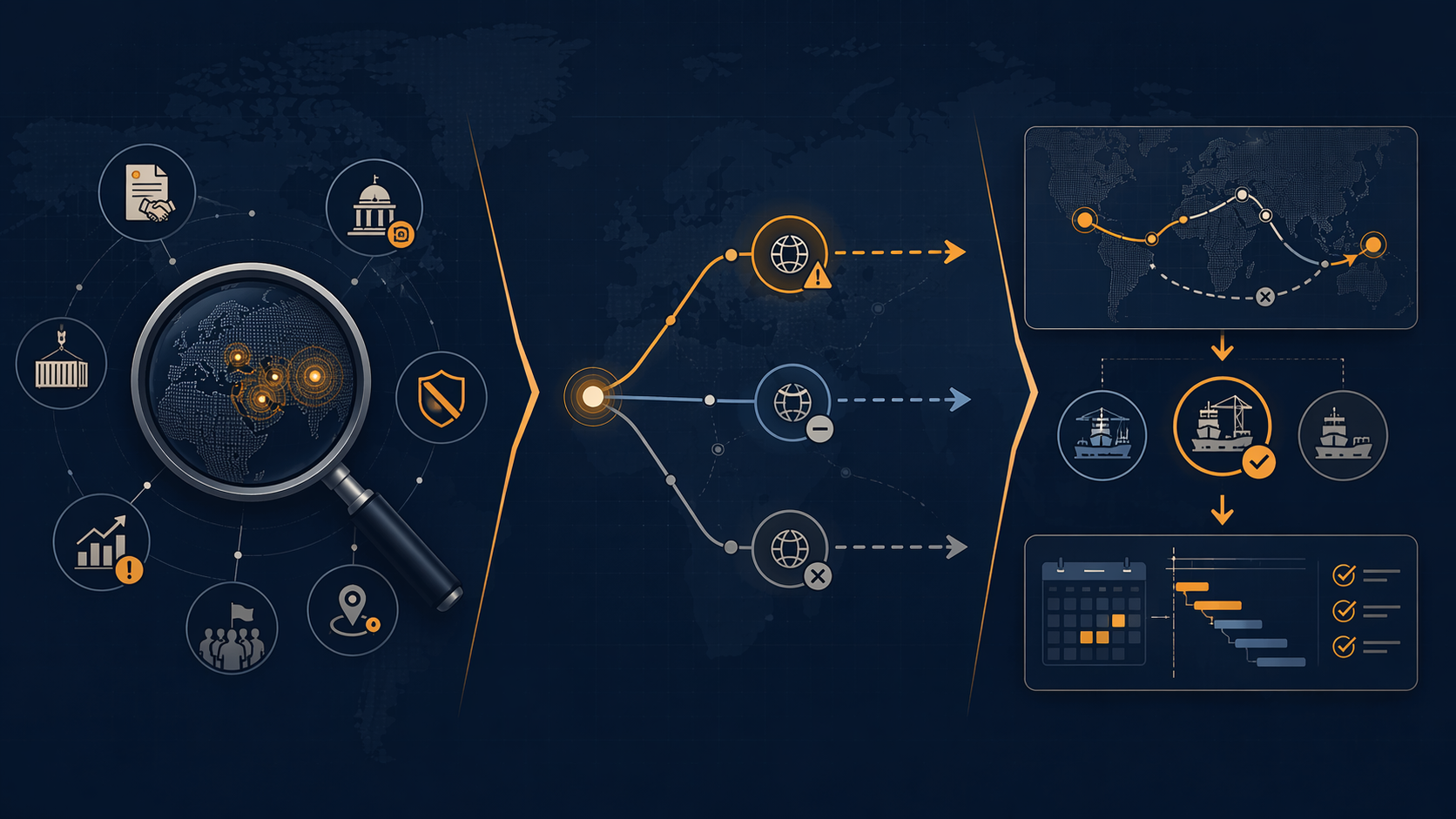
MIT Sloan frames geopolitical supply chain resilience around three actions: understand signals, anticipate risks, and adapt quickly.[4] For AI implementation, that sequence is more than a tidy framework. It is the difference between a system that detects geopolitical movement and a system that changes how the business operates.
Understand: Build the Exposure Map Before the Alert
The first task is not prediction. It is exposure mapping. A company needs to know which products, suppliers, ports, lanes, plants, customers, and compliance obligations are tied to a region or policy domain before a model score means anything. If a sanctions alert names a country, ministry, port operator, commodity, or ownership network, the planning team needs to see its own exposure immediately. Otherwise, the alert starts a manual scavenger hunt.
This is where internal data quality becomes geopolitical risk capability. Supplier master data, bill-of-material links, lane history, purchase orders, inventory balances, production calendars, carrier contracts, and customer commitments all determine whether an external signal can be translated into a decision. If the platform cannot connect a policy or conflict signal to actual material flow, it may still be useful to risk intelligence teams, but it is not yet doing disruption planning.
Anticipate: Convert Weak Signals Into Scenarios
Anticipation is not the same as declaring that a war, sanctions package, tariff increase, or port closure will happen. In supply chain planning, it is often enough to say: if this risk moves one stage further, which commitments become fragile, and which options disappear first? The answer may be a lane switch, a supplier split, an inventory pull-forward, a customer allocation plan, or an executive review before freight rates and capacity tighten.
The Sensos case is useful because the alternatives were not invented during the emergency. The reported 12 alternative ports had already been mapped and scored for political stability before dynamic rerouting was needed.[1] That pre-work is the part many dashboards skip. A warning has little value if the first response is a meeting to ask whether the company has any realistic alternatives.
Scenario planning should also distinguish between reversible and expensive moves. Asking a planner to refresh lead-time assumptions is different from asking a logistics team to reroute freight, a buyer to shift supplier allocation, or a commercial lead to protect scarce inventory for one customer over another. The model threshold for each action should not be the same.
Adapt: Push the Decision Into the Operating System
Adaptation is where many “predictive” tools fail the weekend test. A platform may display a rising risk score, but the business still has to update planning parameters, book capacity, change allocations, revise ETAs, notify customers, or escalate a compliance hold. If those actions live outside the platform’s workflow, the organization is relying on people to bridge the last mile under pressure.
Supply Chain Management Review reported in January 2026 that AI-based control towers are moving toward integration across procurement, manufacturing, and logistics data to improve disruption visibility.[5] That direction matters. A geopolitical alert becomes more credible when it can sit next to purchase order exposure, supplier constraints, production needs, inventory buffers, transport capacity, and customer priority. The better the integration, the less the analyst has to argue from a geopolitical headline alone.
A working implementation usually needs three connections: external risk feeds into the platform, internal operational data into the same decision layer, and response workflows back into planning, procurement, logistics, or control tower systems. Without the third connection, AI may improve awareness but still leave planners copying screenshots into escalation decks.
What Buyers Should Test Before Trusting the Alert
The right vendor question is not “Do you use AI?” It is “Which planning decision does your alert change, and what evidence does the user see before acting?” A risk score without provenance is hard to defend when the commercial team still sees normal shipment flow. A risk score with source traceability, affected lanes, exposed suppliers, available alternatives, confidence limits, and recommended escalation owners is a different object.
- Signal coverage: Does the platform cover trade policy, sanctions, export controls, conflict indicators, political instability, economic stress, and logistics data, or only a subset?
- Exposure linkage: Can it map a geopolitical signal to suppliers, SKUs, lanes, ports, customers, contracts, and inventory?
- Action mapping: Does it connect alerts to pre-modeled alternatives such as backup ports, substitute suppliers, tariff scenarios, or inventory rules?
- Workflow integration: Can planners act inside existing control tower, planning, procurement, or transportation workflows?
- Human review: Does the platform show why an alert fired and allow risk, legal, procurement, and logistics teams to validate high-cost responses?
This is also where vendor comparison becomes practical rather than cosmetic. Some platforms will be stronger in logistics visibility, some in sanctions and compliance intelligence, some in supplier risk, and some in scenario modeling. Readers who are already shortlisting tools may want a broader AI supply chain tools buyer's comparison or a more focused guide on choosing an AI platform for geopolitical supply chain risk.
The Reliability Problem: When History Stops Helping
AI systems are strongest when weak signals resemble patterns they have seen before. Geopolitics has a bad habit of breaking that comfort. A sudden sanctions package against a previously unsanctioned major economy, a new export-control regime, an unexpected military escalation, or a fast-moving enforcement campaign can produce conditions where historical data is a poor guide. The danger is not just a missed prediction. It is misplaced confidence.
Regime shifts expose three weaknesses. First, the model may overweight familiar indicators and underweight novel political moves. Second, the data may arrive fragmented across government releases, local reporting, carrier advisories, legal interpretations, and internal supplier updates. Third, even when the external signal is accurate, the company’s own exposure map may be incomplete. A hidden tier-two dependency can make a tidy dashboard dangerously reassuring.
Human validation is not a ceremonial control in this setting. It is the mechanism that separates low-cost monitoring from high-cost response. A procurement director may accept a supplier-watch alert with limited review. A reroute through a different port, a supplier allocation change, or a customer prioritization decision needs a stronger evidence trail. The platform should make that review faster, not pretend it is unnecessary.
Data fragmentation is the quieter constraint. No single platform can be assumed to ingest every relevant signal comprehensively across trade policy, sanctions, conflict data, economic indicators, supplier networks, freight markets, and internal ERP records. Buyers need to inspect what is native, what is partnered, what must be integrated, and what remains manual. A platform may be excellent for maritime risk and still weak for export controls. Another may handle regulatory intelligence well and still need help connecting that intelligence to inventory and production plans.
The most honest implementation posture is tiered response. Low-confidence or low-impact alerts can feed watchlists and planning assumptions. Medium-confidence alerts can trigger scenario refreshes and supplier outreach. High-confidence, high-impact alerts can move into executive escalation, lane changes, inventory actions, or allocation decisions. The point is not to wait for certainty. It is to match the cost of the action to the quality of the evidence.
Chokepoints Still Matter, But They Are Not the Whole System
Physical chokepoints remain the easiest geopolitical disruptions to visualize. The Red Sea case had the ingredients executives recognize quickly: vessel exposure, rerouting options, transit-time consequences, and high monetary stakes. Hormuz planning has a similar logic, especially for companies exposed to tanker flows, energy-linked inputs, or regional escalation risk; that use case is explored separately in AI disruption planning for Hormuz tanker crises.
But chokepoint thinking can make companies underprepare for slower and less visible disruptions. Sigma7 argues that geopolitical conflict reshapes supply chains beyond shipping delays, including through regulatory, supplier, and operating exposure.[6] That is the right caution. A ship waiting outside a port is visible. A supplier caught by a new export-control interpretation, a component exposed to forced-labor enforcement, or a customer market affected by retaliatory trade policy may not be visible until planning assumptions have already gone stale.
Where AI Is Credible Now
AI-powered geopolitical risk intelligence is credible when it does four things at once: watches diverse external signals, maps them to company-specific exposure, tests pre-modeled alternatives, and pushes validated actions into operational workflows. The Red Sea automaker example shows what that can look like when alternative ports and political stability scoring are prepared before the crisis response.[1] The MIT Sloan sequence of understanding, anticipating, and adapting gives planners a useful operating model for turning that preparation into routine practice rather than a one-off rescue.[4]
The technology is much less credible when it is sold as an autonomous geopolitical oracle. It cannot remove the ambiguity of politics, the gaps in supplier data, or the judgment required before expensive moves. Its value is more specific and more useful: it can give human teams enough lead time to defend an earlier decision, adjust a planning variable, and avoid discovering the problem only after the logistics system has already started to break.
References
- Navigating Geopolitics and AI | Stabilizing Supply Chains in Turbulent Times — Sensos, Jan. 2026
- Supply chain AI trends 2026: building resilient operations — Dataiku, Feb. 2026
- Modeling supply chain disruptions due to geopolitical reasons: A systematic literature review — ScienceDirect, Oct. 2025
- Stay Ahead of Geopolitical Supply Chain Risks — MIT Sloan Review, 2026
- How AI is shifting global supply chains from reactive to predictive — Supply Chain Management Review, Jan. 2026
- How Geopolitical Conflict Reshapes Supply Chains Beyond Shipping Delays — Sigma7
Comments
Join the discussion with an anonymous comment.