
A cancelled air cargo booking rarely stays inside the airline’s system. It moves quickly into the shipper’s week: a planner asks whether another forwarder can still find uplift, a warehouse holds finished goods longer than expected, a procurement team accepts a worse routing, and next month’s buffer quietly grows. That is the practical reason AI demand forecasting for flight cancellations in supply chain work matters. The question is not whether a model can make a clever prediction. It is whether the warning arrives early enough for someone to use the space, protect the shipment plan, and avoid another late exception.
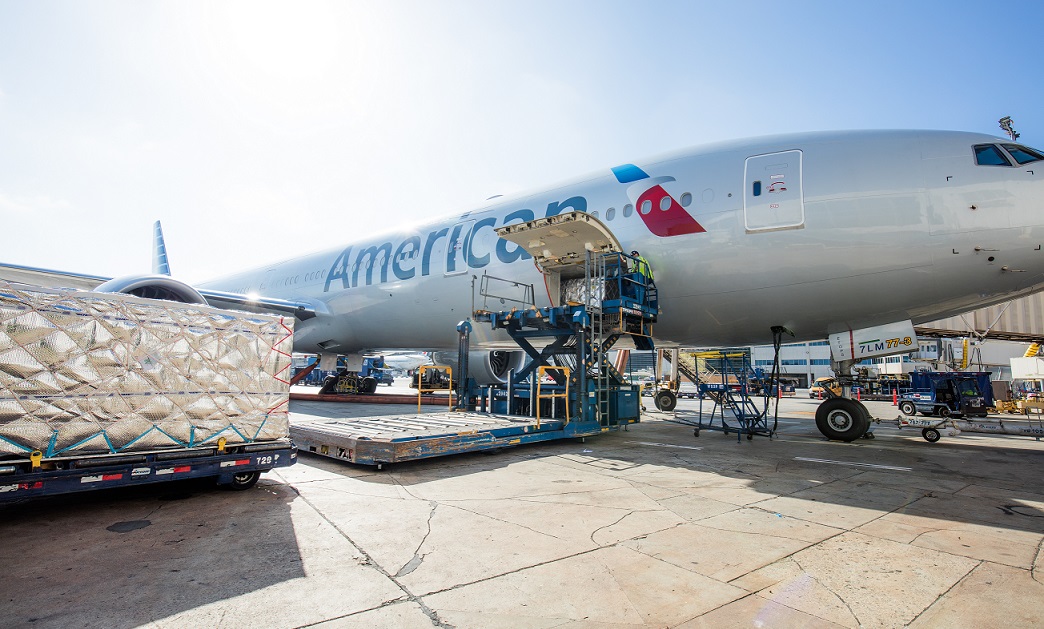
In air freight, the relevant cancellation is often a cargo no-show: capacity was booked, load planning assumed it would appear, and then the freight does not move as expected. American Airlines has reported a machine-learning approach that predicts likely cargo no-shows three days before departure with at least 90% accuracy, using H2O4GPU on NVIDIA workstations, and the reported business result was more than $10 million in annual revenue recovery from reselling space that otherwise would have flown empty [1].
The 72-hour window is the point
A forecast made after cut-off is mostly an explanation. A forecast made several days before departure can still change the operation. In the American Airlines case, the model ran three days ahead of each cargo flight, giving the commercial and capacity teams time to identify bookings likely to fail and release that space back into the market [1].
That timing matters for both sides of the transaction. The airline has a revenue problem when booked cargo does not show and the aircraft departs with avoidable empty space. The shipper has a reliability problem when capacity signals are noisy: booked space looks unavailable to someone who needs it, while another booking consumes planning attention and then disappears. Reselling predicted no-show capacity is therefore not only a yield-management story. It is one way to make the capacity picture less false before the flight leaves.
The reported 90% accuracy should be read carefully. It is a documented practitioner case, not an independently audited industry benchmark. The source material is vendor- and partner-adjacent, and the reporting window belongs to earlier 2020-2023 coverage rather than a live guarantee for every current lane, customer mix, or station [1]. Still, it is stronger than a general claim that “AI improves forecasting,” because it names the operational event, the lead time, the implementation environment, and the revenue mechanism.
What the model is likely learning
Cargo no-show prediction is not magic demand sensing. It is pattern recognition applied to a messy booking environment. A useful model would look for combinations that have historically preceded a no-show: the customer’s booking behavior, the origin-destination pair, commodity type, seasonality, booking timing, declared weight, flight-level constraints, and how similar bookings actually behaved when departure arrived.
The need for that prediction comes partly from the gap between what is declared and what arrives. Industry commentary tied to the American Airlines cargo discussion notes that traditional systems often rely on declared booking weights, while actual cargo volumes can differ by 20% or more [2]. That gap is enough to distort load planning. If a carrier treats every booking as equally reliable until it fails, it will protect capacity for freight that may never reach the tender point.
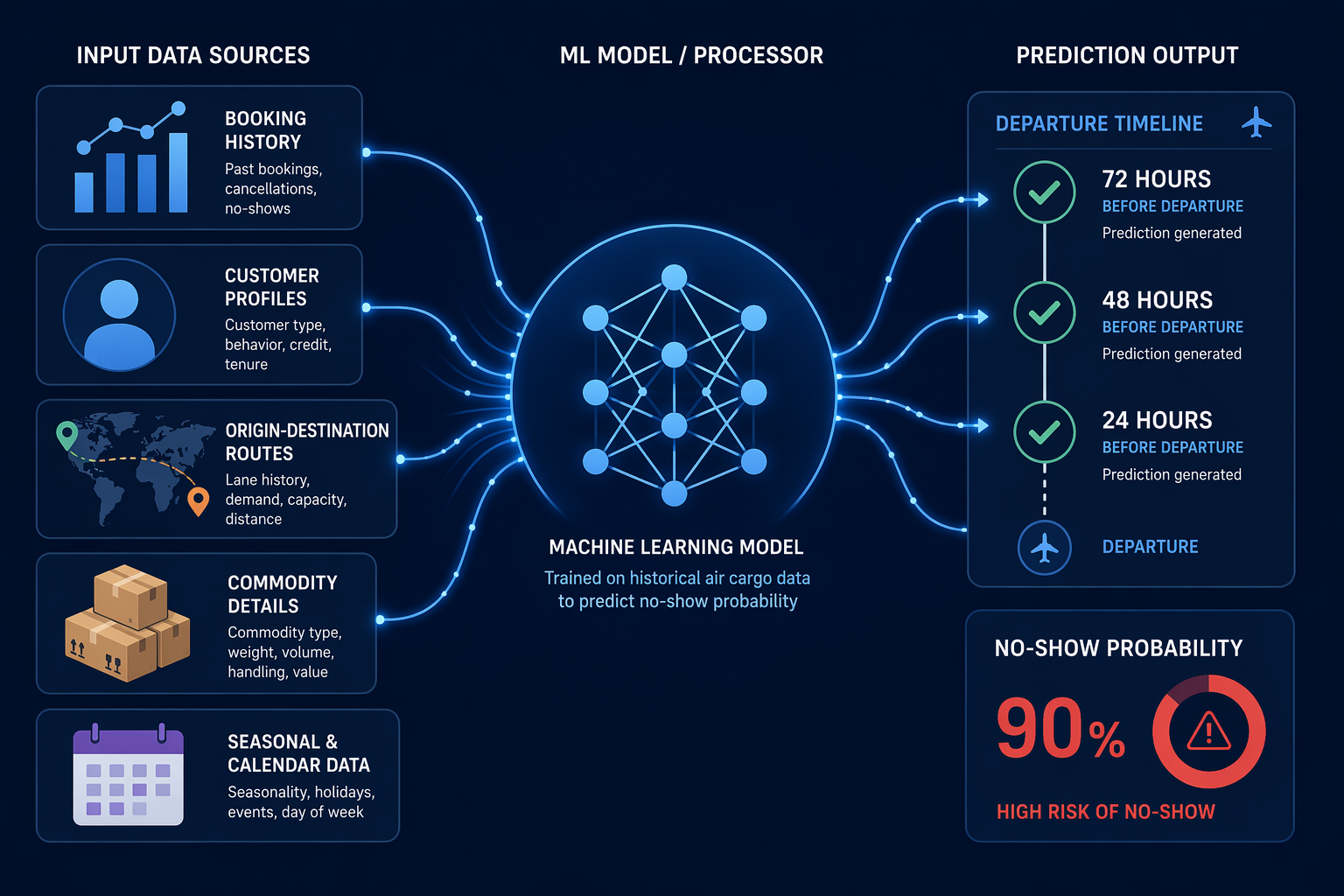
The practical distinction is between a booking record and a dependable shipment. A booking record says space has been requested and accepted. A dependable shipment is one that is likely to tender, clear the necessary process steps, and use the booked capacity close to plan. The model’s job is to score that difference early enough that a capacity team can decide whether to keep protecting the space, sell some of it, or watch the booking more closely.
| Signal | Why it matters operationally |
|---|---|
| Customer history | Some customers may regularly book conservatively, split freight, cancel late, or tender below declared weight. |
| Origin-destination pattern | Certain lanes can have recurring volatility from local cut-offs, handling constraints, or demand swings. |
| Commodity | Perishable, urgent, high-value, or lower-priority cargo can behave differently when schedules change. |
| Seasonality | Peak periods and slow periods can change both booking discipline and the value of released capacity. |
| Flight-level features | Aircraft capacity, load history, and departure timing affect whether a no-show creates a meaningful resale opportunity. |
From prediction to resale
The American Airlines case is useful because it connects the model output to a decision. A probability score by itself does not recover revenue. Someone has to expose that warning inside the cargo organization, decide the threshold at which capacity can be released, and make the space available to customers who can still tender freight in time. The reported annual recovery of more than $10 million came from reselling capacity associated with predicted no-shows, not from the existence of the model alone [1].
That handoff is also where supply chain reliability can improve. If a carrier can identify likely unused capacity earlier, the space becomes visible to another shipper before the operational window closes. A procurement team that would otherwise hear “no capacity” may get a workable option. A forwarder may avoid an emergency reroute. A warehouse may avoid holding freight through another missed departure. None of those outcomes is automatic, but they are the operational pathway by which cancellation forecasting becomes useful outside the airline.
A separate carrier example reported by Star Concord, citing Air Cargo Week and The Wall Street Journal, described forecasting error falling from 20% to 14% and cargo load factors improving by 8% [2]. That is directionally consistent with the American Airlines story: better forecasting can reduce the amount of capacity protected for freight that does not materialize. But it is still a single carrier data point, not a general air cargo average.
Prediction is spreading beyond no-shows
The broader air cargo AI movement is shifting from visibility toward prediction. In 2026, CargoAi announced predictive tracking that uses machine learning trained on millions of historical shipments to estimate P50 and P90 milestone timing for events including FWB, RCS, MAN, DEP, ARR, NFD, and DLV, and to flag at-risk shipments before flight cut-offs [3][4].
That is adjacent rather than identical. Predicting a shipment delay is not the same as predicting that booked capacity will no-show. But the direction is relevant for supply chain teams because it shows the same operating pattern: air cargo data is being used less as a record of what already happened and more as an early-warning layer before a milestone is missed.
The distinction matters when evaluating vendors. A platform that predicts arrival risk may help a planner manage exceptions after the freight is already moving. A no-show model helps a carrier decide whether booked capacity is trustworthy before departure. Both can protect service, but they sit at different points in the shipment lifecycle and should not be treated as interchangeable.
The fragile part is the data layer
The hardest part of this use case is usually not choosing a forecasting algorithm. It is assembling a trustworthy view of the booking and shipment lifecycle. Booking systems, warehouse systems, forwarding platforms, carrier portals, and APIs often preserve different versions of the same operational truth. A model trained on incomplete booking history may learn the wrong habits. A model that cannot see tender behavior, cut-off failures, or late amendments may confuse a data gap with a customer pattern.
For an airline, that means the no-show score is only as useful as the integration behind it. The model needs historical bookings and outcomes at a level of detail fine enough to distinguish customers, lanes, commodities, stations, flight conditions, and seasonal patterns. For a shipper or logistics procurement team, it means the business case should ask where the prediction is produced and whether it is exposed early enough to change a transport decision.
This is where broad market projections add little. Forecasts that AI in supply chain will become a very large market may be directionally interesting, including projections around $157.6 billion by 2033 at a 42.7% CAGR, but those figures do not prove that a no-show model will perform on a specific carrier network or shipper profile [2]. The buyer’s question is narrower: are the right events captured, are they linked across systems, and can the forecast arrive before the operational choice disappears?
How supply chain leaders should validate the claim
A responsible evaluation starts with the carrier or vendor’s documented performance, then moves quickly to the buyer’s own lanes. The American Airlines result gives the use case credibility. It should not become the planning assumption for a different network without testing.
- Ask whether the reported accuracy measures no-show classification, booking-weight variance, load-factor improvement, revenue recovery, or another outcome.
- Validate performance by lane, station, customer segment, commodity, and season rather than relying on a network-wide average.
- Check the lead time of the warning. A high-confidence prediction that arrives too late may not protect capacity.
- Confirm who receives the alert, who can release or rebook capacity, and whether commercial teams have rules for acting on the score.
- Review the data integrations behind the model, especially links among booking records, warehouse milestones, carrier APIs, amendments, and actual flown cargo.
- Monitor model drift. Booking behavior changes, and a model that worked in one period may need retraining when customer habits, demand patterns, or network conditions shift.
The same discipline applies to other disruption-forecasting decisions. Teams evaluating AI for broader disruption planning can use a similar validation frame when reviewing AI supply chain disruption planning against infrastructure attacks, geopolitical supply chain risk platforms, or wildfire smoke monitoring tools. The common issue is not whether AI can produce a risk score. It is whether the score is tied to a decision owner, a data trail, and enough lead time to change the plan.
AI demand forecasting has credible documented evidence for predicting air cargo no-shows before departure and turning some of that uncertainty into usable capacity. The American Airlines case is the clearest proof point: a three-day prediction window, reported accuracy of at least 90%, and more than $10 million in annual revenue recovery through resale of predicted unused space [1]. For supply chain leaders, the practical value is more dependable access to capacity and fewer last-minute workarounds. The responsible assumption, however, is conditional: test the model against your own booking patterns, lane mix, customer behavior, and integrations before treating someone else’s 90% as your operating baseline.
References
- AI for Avoiding Supply Chain Disruptions - Two Use Cases, Emerj
- Putting the AI in air cargo: How machine learning is reshaping demand forecasting, Star Concord
- CargoAI utilises AI to predict air cargo shipment delays, Air Cargo News
- CargoAi moves Air Cargo Tracking from Visibility to Prediction, Global Trade Magazine
Comments
Join the discussion with an anonymous comment.