
By Q3 2026, geopolitical supply chain risk is no longer a category that can be parked in the annual risk register and revisited after the next escalation. It is showing up in tariff exposure, sanctions screening, export controls, conflict-driven rerouting, cyber escalation, and critical mineral availability. Z2Data reports U.S. effective tariff rates near 17% to 18%, the highest level since 1932; China’s control of roughly 90% of rare earth refining; Red Sea container traffic down about 75% during Houthi attacks; and Ford plant shutdowns tied to rare earth shortages after Chinese export controls [1].
That is the environment behind the question now sitting with procurement, logistics, and resilience teams: how can AI-enabled geopolitical risk systems detect weak signals early enough to change a plan before the plan is already broken?
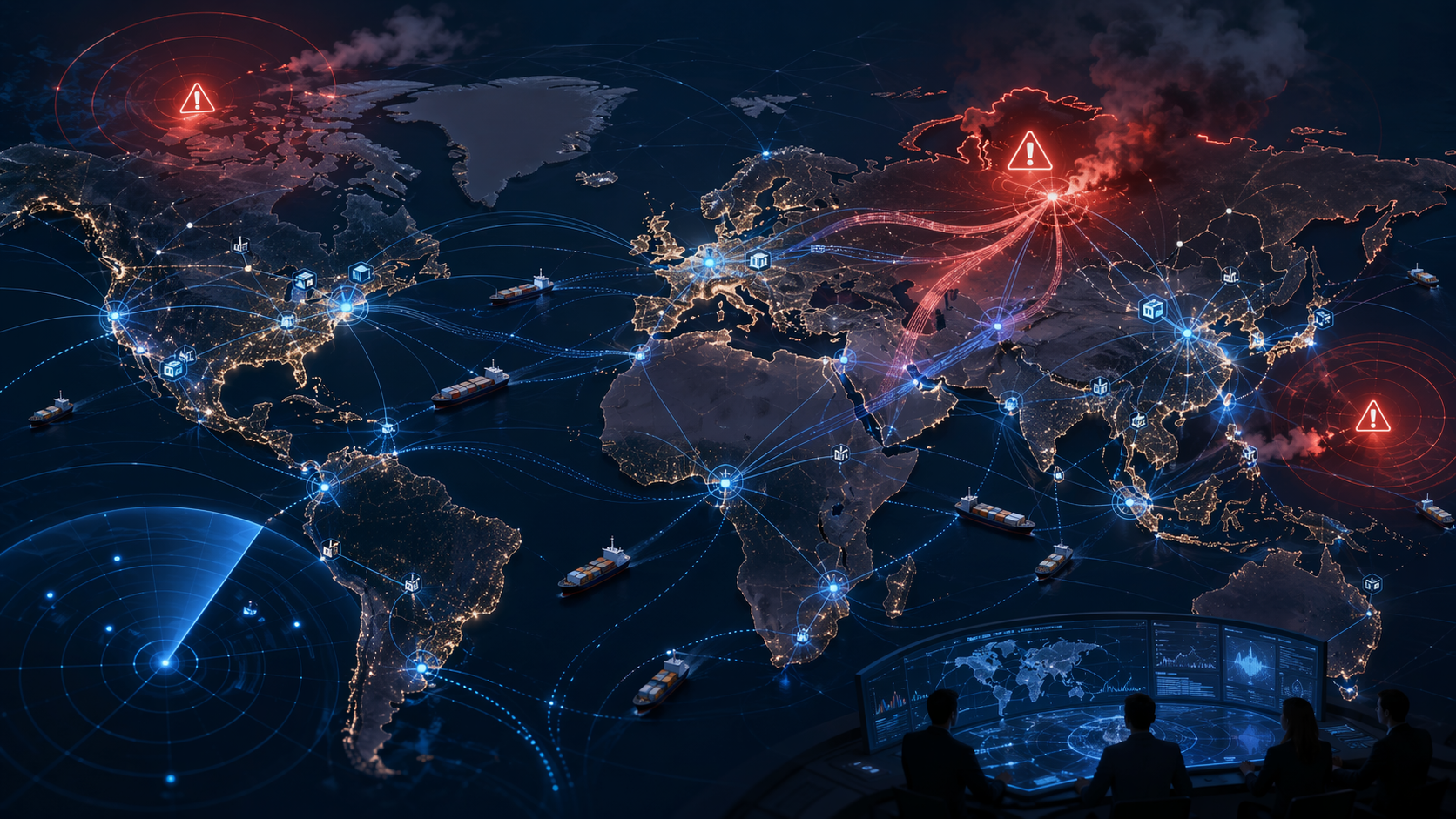
The useful answer is narrower than many AI pitches make it sound. AI does not make geopolitics predictable in the clean way a forecast model predicts a reorder point. Its real value is earlier signal capture, faster dependency matching, and scenario generation that gives people something specific to argue about: which supplier, which lane, which material, which customer order, which port, which contract clause, which mitigation option.
The Point Is Not More Alerts. It Is Earlier Planning Variables
A geopolitical early warning system earns its keep when an external event becomes a planning variable before it becomes an exception report. A tariff proposal is not just a policy headline; it may change landed cost assumptions for a commodity category. A sanctions update is not just a legal bulletin; it may touch a logistics provider, a sub-tier processor, or a bank used in trade finance. A port attack is not only a security event; it may consume alternate-port capacity days before a company formally decides to reroute.
This is why the center of the system is not a dashboard full of red dots. It is the mapping between signal and exposure. If the model flags unrest near a shipping corridor but the enterprise cannot connect that lane to purchase orders, production sites, and committed delivery dates, the alert still lands as background noise. Someone still has to ask the late, expensive questions: who buys through this lane, what inventory is already in motion, which customers will feel the miss, and which alternative is pre-approved rather than merely imaginable?
What the Early Warning Stack Actually Does
The working stack has three jobs: ingest a wider field of signals, detect patterns that humans would not catch quickly enough, and simulate the consequences against the company’s own network. Each job is different. Confusing them is how teams end up buying a monitoring tool and expecting it to behave like an operating model.
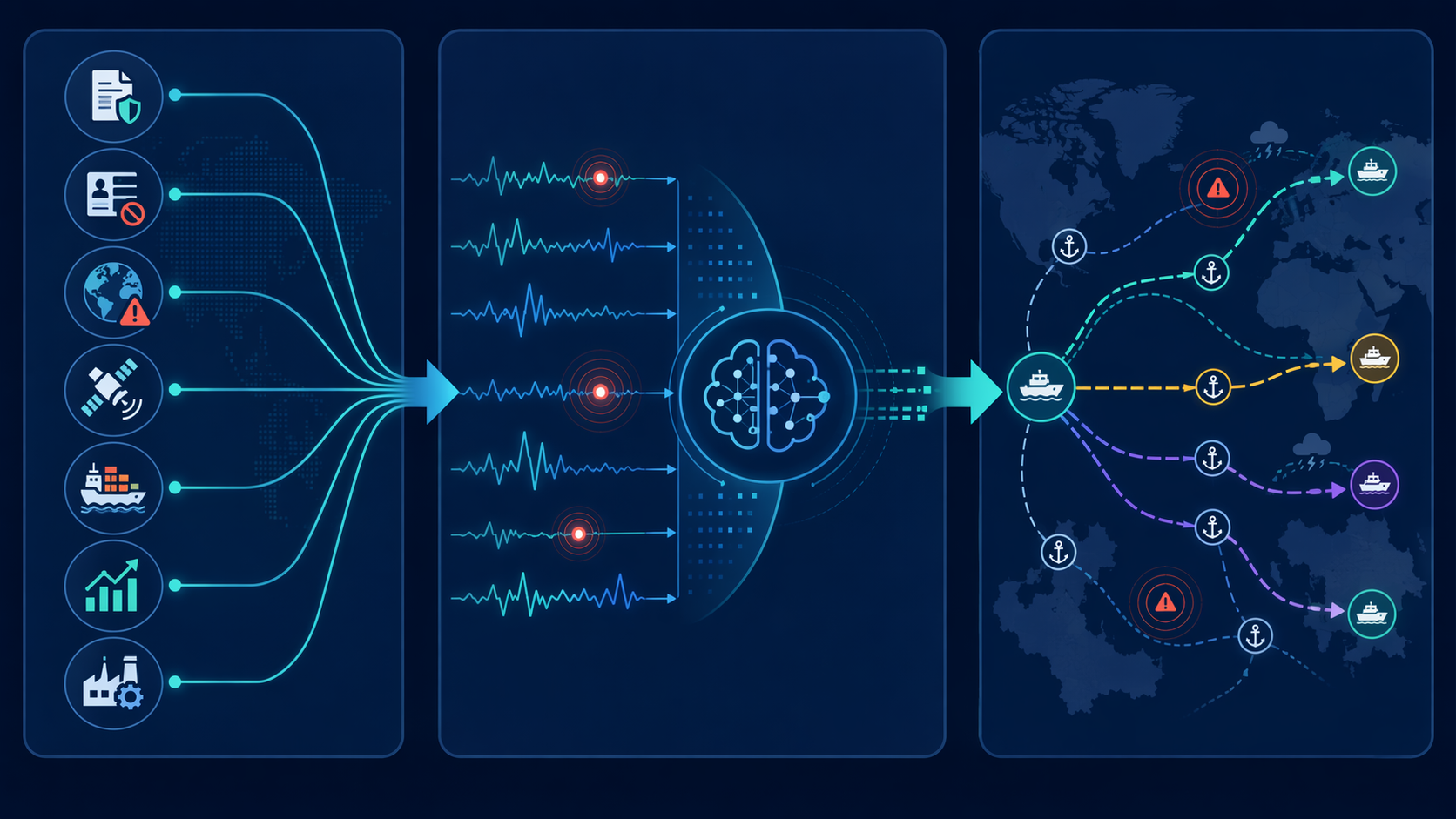
| Layer | What It Ingests Or Produces | Supply Chain Question It Should Answer |
|---|---|---|
| Ingest | Trade policy signals, sanctions lists, conflict intelligence, media and social signals, satellite imagery, port congestion, economic indicators, supplier and logistics data | Which external signals may touch our suppliers, lanes, materials, sites, customers, or contracts? |
| Detection | Machine-learning pattern recognition, anomaly detection, entity matching, clustering of weak signals, escalation scoring | Is this signal unusual, accelerating, spreading across sources, or linked to an exposure we already carry? |
| Simulation | Scenario modeling across routes, ports, inventory positions, qualified suppliers, lead times, allocation rules, and cost-to-serve | If this disruption materializes, which option buys time, and who must approve it? |
Ingest: widen the field before the war room opens
Traditional supply chain risk monitoring often waits for a supplier notice, a freight forwarder update, or a direct news event in a known geography. That leaves too much to timing and too much to whoever happens to be watching. AI systems can ingest structured and unstructured sources at a scale that a regional procurement team cannot sustain manually: proposed tariff language, sanctions designations, export control announcements, local media, vessel movement, port congestion, satellite-derived indicators, currency moves, and supplier master data.
The hard part is not collecting feeds. The hard part is entity resolution. A supplier may appear under a legal name in one system, a trade name in another, a local-language name in news coverage, and a parent-company structure in sanctions or ownership data. If the system cannot reconcile those identities, it may detect the right geopolitical signal and still miss the supplier relationship that matters.
Detection: separate a weak signal from a loud distraction
Detection is where machine learning can help most, provided the team is clear about what it is asking the model to do. The model may identify unusual clustering across sources, a sudden increase in references to an export-control category, deteriorating port dwell patterns, or a sanctions-adjacent entity appearing closer to the supplier graph. None of that is the same as certainty. It is a reason to investigate earlier, with a narrower scope.
That narrower scope matters operationally. A broad alert saying “Middle East risk rising” does not help a logistics planner decide whether to hold bookings, split shipments, or reserve capacity through an alternate gateway. A useful alert says the risk is linked to a defined lane, a defined carrier pattern, a defined product family, or a defined plant dependency. Even then, it should carry source lineage: which signals drove the score, when they updated, and what confidence limits are attached.
Simulation: turn warning into options
The simulation layer is where early warning becomes useful to the people who have to move freight, allocate supply, and defend the decision afterward. It tests scenarios against the company’s own operating constraints: available inventory, production sequence, supplier qualification status, contract terms, transport lead times, port capacity, customs friction, and customer priority rules.
A hypothetical example makes the distinction clear. If a model detects rising risk around a chokepoint, the response is not automatically “reroute everything.” The better workflow is to simulate several choices: continue current routing with closer monitoring, split volume between two corridors, pre-book alternate-port capacity, pull forward critical components, or reallocate constrained supply to higher-penalty customers. Each option has a cost, a lead-time implication, and an approval owner.
The Red Sea Example Shows the Difference Between Alerting and Preparedness
Sensos describes an automaker that used AI-powered visibility during the Red Sea crisis to reroute through 12 pre-mapped alternative ports, with ports scored on political stability, customs efficiency, and infrastructure readiness. The same account says the automaker avoided about $220 million in losses, and that companies co-investing in visibility tools with suppliers reduced crisis recovery time by 63% [2].
Those figures should be treated carefully. The account comes from a vendor blog, not an independent third-party audit. It is still a useful illustration because the operational pattern is the one mature teams try to build before a crisis: alternatives were not invented in the middle of the disruption; they were mapped, scored, and made available for decision-making when the signal arrived.
The interesting part is not that an AI system “saw” the Red Sea risk. Plenty of people saw it. The useful part is that the warning appears to have connected to route options, port attributes, and execution criteria. That is the gap in many enterprise setups: intelligence says one thing, transportation planning says another, procurement owns a third piece, and no one has a pre-cleared rule for when to absorb cost in exchange for time.
Supplier Visibility Is Where Many AI Programs Stall
Early warning depends on knowing what is exposed. That sounds obvious until the analyst is asked to trace a Tier 3 dependency through five systems, three naming conventions, and a supplier relationship that was never meant to support geopolitical risk analysis. McKinsey’s finding, cited by Sensos and SDCExec, is blunt: only 2% of companies have visibility beyond second-tier suppliers [2][3].
That visibility gap changes what AI can realistically do. A model may detect a policy shift affecting a rare earth processor, a sanctions risk near a logistics intermediary, or conflict exposure in a component region. But if the enterprise supplier graph stops at Tier 1 or Tier 2, the system cannot reliably tell whether the signal touches a production-critical part. The missing dependency does not become visible just because the alert is AI-generated.
The practical implication is uncomfortable: some of the highest-value work happens before model performance is even the main issue. Supplier master data has to be cleaned. Parent-child relationships have to be maintained. Critical materials need to be mapped beyond the direct supplier where feasible. Logistics lanes, ports, and carriers need to be connected to actual products and purchase orders. Without that connective tissue, an early warning tool may be technically impressive and operationally thin.
Human Judgment Is Not a Governance Decoration
The more volatile the risk environment becomes, the less convincing fully automated geopolitical decision-making sounds. Bloomberg’s risk intelligence framework, described by SDCExec, is useful because it does not pretend AI is the whole system. It pairs human regional expertise, interoperable multi-source data, and AI or machine-learning detection at scale [3].
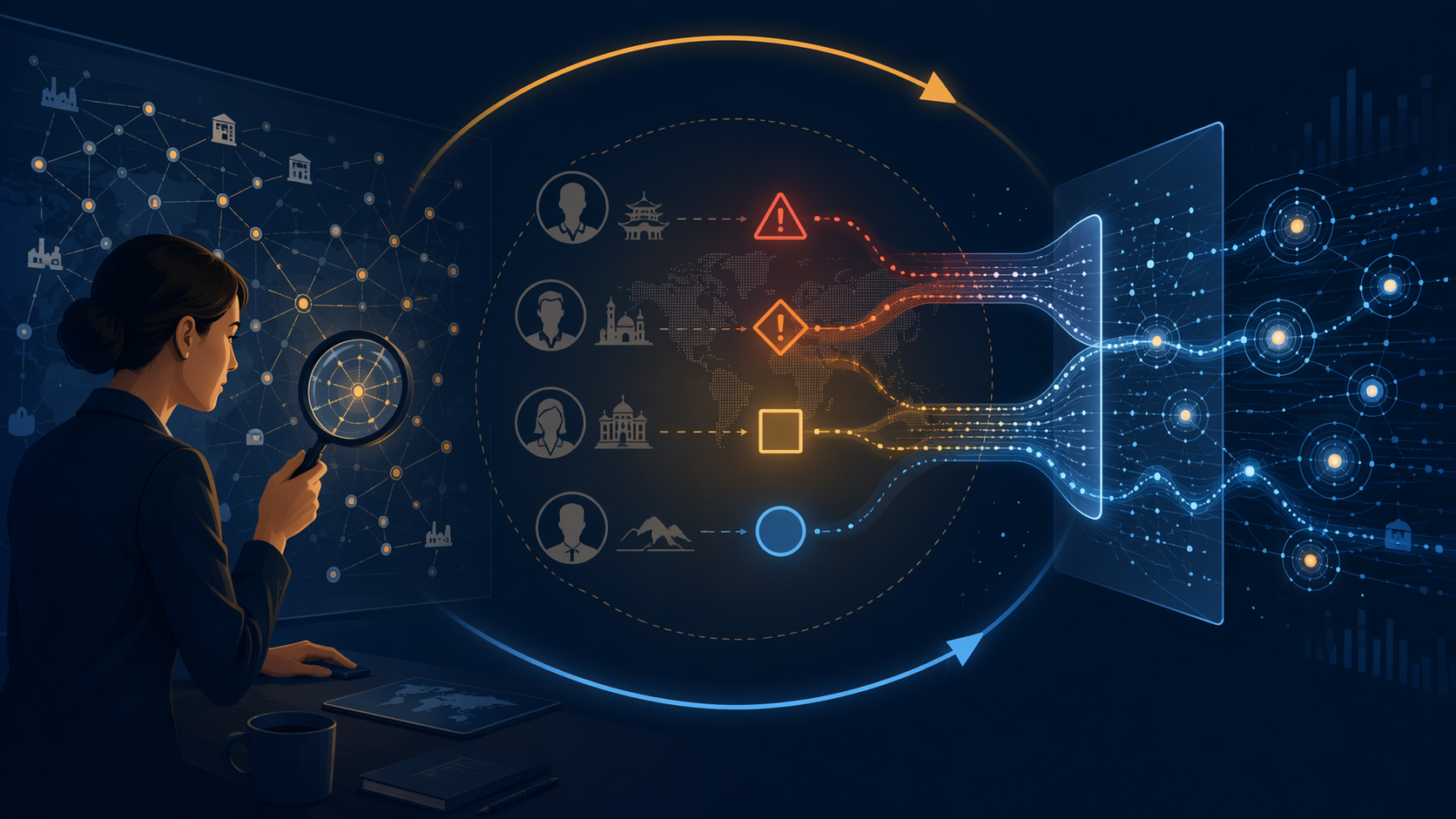
That combination is not just philosophically tidy. It reflects how geopolitical risk actually lands. A model may detect that a regulation, conflict event, or media pattern resembles prior disruptions. A regional expert may know that the local political actor has changed incentives, that a port authority’s public statement is unreliable, or that a supplier’s “monitoring the situation” email is covering a capacity allocation problem. The machine can widen the field. The human has to qualify what the signal means now.
MIT Sloan frames the operating sequence as understanding signals through scenario planning and risk monitoring, anticipating options through flexible sourcing, and adapting quickly. Its article is based on a study of 13 multinational companies, so it should not be read as universal proof. It does, however, describe the right sequence of work: sensing without options is incomplete, and options without adaptation discipline are shelfware [4].
- Regional experts review whether the signal is politically meaningful or just noisy.
- Category leads test whether the exposed material, part, or supplier is actually constrained.
- Logistics planners check whether alternate ports, carriers, and transit times are executable.
- Legal and trade teams confirm sanctions, export-control, and contract implications.
- Executives approve pre-defined thresholds for cost, service trade-offs, and customer allocation.
What To Implement Before the Next Shock
A credible AI geopolitical early warning program starts with scope. The first version does not need to cover every commodity, every supplier, and every corridor. It should begin where exposure is material and response time matters: critical minerals, sole-source components, high-penalty customer commitments, constrained logistics lanes, sanctioned-region adjacency, or production sites with limited buffer.
| Implementation Workstream | What Good Looks Like | Common Failure Mode |
|---|---|---|
| Exposure mapping | Critical suppliers, sub-tier dependencies where available, lanes, ports, materials, sites, and customers are connected in one risk view. | The model flags a threat, but no one can tell which purchase orders or plants are exposed. |
| Signal governance | Sources are current, traceable, and separated by type: policy, sanctions, conflict, port, cyber, economic, supplier, and media signals. | Alerts appear without source lineage, so teams either overreact or ignore them. |
| Scenario playbooks | Alternate suppliers, ports, carriers, inventory moves, and allocation rules are pre-modeled with approval thresholds. | The team detects risk early but still negotiates every response from scratch. |
| Human review | Regional, category, logistics, legal, and executive owners know when they enter the decision loop. | AI scores become de facto decisions without accountable judgment. |
| Post-event learning | False positives, missed signals, response times, and outcome data are reviewed after disruptions. | The system accumulates alerts but does not improve the operating rhythm. |
The middle column is where procurement and logistics leaders should spend their design time. A pre-approved alternate port is more valuable than a beautiful risk heat map. A qualified secondary supplier with known constraints is more useful than a generic supplier list. A tariff scenario tied to margin, customer pricing, and sourcing lead time is more actionable than a policy-news feed. The tool should force these conversations earlier, not hide them behind a confidence score.
Adoption Signals Are Rising, but They Are Not Proof of Effectiveness
Enterprise interest in AI-enabled resilience is real. ABI Research reports that 65% of supply chain professionals say AI or GenAI is important for technology purchase decisions, and that 77% are considering or implementing mobile automation [5]. Everstream reports that cyber attacks on logistics surged 61% in 2025 and increased 965% since 2021, putting another fast-moving risk category into the same monitoring-and-response conversation [6]. The World Economic Forum has also argued that AI can help protect supply chains from the next major shock [7]. Forbes Tech Council has separately discussed using generative AI in supply chain risk assessment and mitigation [8].
Those materials support a limited but important conclusion: the market is paying attention, and the risk surface is broadening. They do not prove that any specific implementation will reduce disruption losses. Adoption is not effectiveness. A budget line for AI does not mean the supplier graph is usable, the model is calibrated, or the mitigation choices are executable.
Where the Model Breaks Down
Geopolitical shocks do not always rhyme with the training data. A new export-control tactic, a sudden sanction package, a conflict spillover, or a government decision to weaponize a concentrated mineral market can change behavior faster than historical correlations can adjust. That does not make AI useless. It means the system should be designed to surface uncertainty, not bury it.
There are also quieter failure modes. Source feeds may lag. Local-language material may be mistranslated or misclassified. Port data may show congestion but not the informal reason behind it. Supplier declarations may be stale. A model may over-weight a source that is loud and under-weight a dependency that is commercially sensitive but poorly documented. In a crisis, these weaknesses do not remain technical; they become allocation errors, premium freight decisions, and missed customer commitments.
The right posture is not distrust of the model. It is disciplined use. The system should show why an alert fired, what assumptions drive the scenario, which data is missing, and which human role must review it. A regional procurement manager should be able to challenge the conclusion. A logistics planner should be able to test an alternate route. A category lead should be able to say that the named supplier is not the real bottleneck because the constrained process sits one tier lower.
The Practical Judgment
AI is best understood as an early warning and decision-support layer for geopolitical supply chain risk, not as an autonomous geopolitical oracle. Its strongest use is to connect weak signals to known dependencies, generate response options early, and give accountable people enough time to act before the disruption becomes a service failure.
The winning teams will not be the ones with the most signals. They will be the ones that connect signals to supplier tiers, logistics lanes, materials, scenarios, human review, and pre-planned mitigation choices. That is less glamorous than the promise of automated foresight, but it is the part that keeps a warning from arriving as just another email in the middle of an already-late escalation call.
References
- The 6 Most Critical Geopolitical Supply Chain Risks Today, Z2Data.
- Navigating Turbulent Waters: How Geopolitical Shifts and AI-Powered Visibility Stabilize Global Supply Chains, Sensos.
- Geopolitical Risk in Supply Chain Management Is Entering a New Era of Human and AI Intelligence, Supply & Demand Chain Executive.
- Stay Ahead of Geopolitical Supply Chain Risks, MIT Sloan Management Review.
- Supply Chain Disruptions 2026: How to Build Resilience with AI and Automation, ABI Research.
- Are You Prepared for the Supply Chain Disruptions of 2026?, Everstream Analytics.
- AI can protect supply chains from the next major shock. Here’s how, World Economic Forum, January 2025.
- Leveraging Generative AI In Supply Chain Risk Assessment And Mitigation, Forbes Tech Council, February 13, 2025.
Comments
Join the discussion with an anonymous comment.