
Severe weather has moved from exception handling into ordinary logistics planning. In 2024, the U.S. recorded 28 billion-dollar weather and climate disasters with $92.9 billion in damages, compared with an average of 8.1 such events per year from 1980 through 2022.[1] That damage number is not a transportation KPI, but it describes the operating environment behind delayed linehauls, stranded inventory, refrigerated loads waiting on unsafe roads, and customer promises that were made before anyone knew which node would lose capacity.
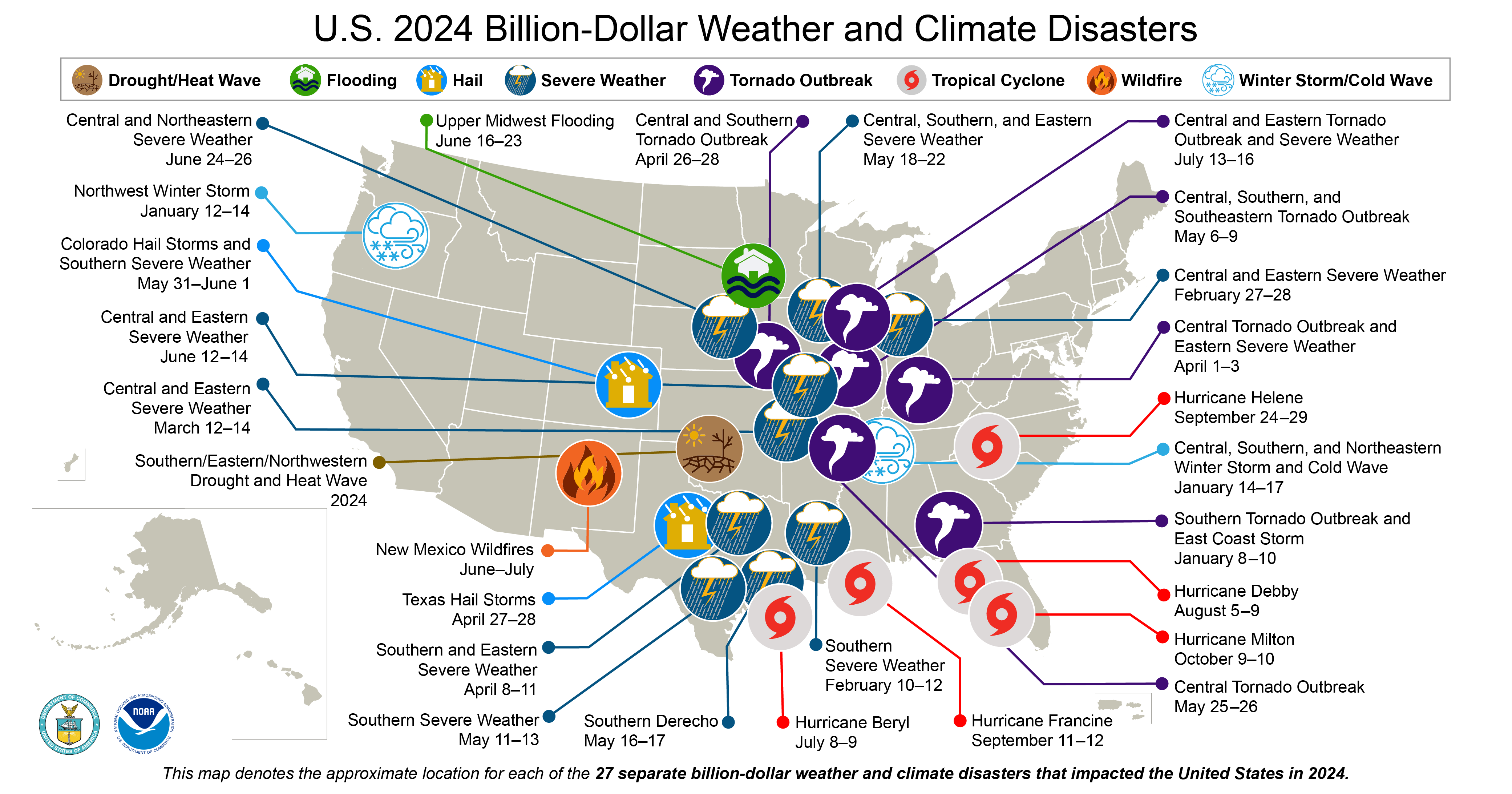
The useful question for AI severe weather planning in supply chain logistics is therefore narrow: can AI weather intelligence give transportation and inventory teams enough lead time and location precision to change a plan before disruption becomes visible in the control tower? A better forecast is not, by itself, an operational result. The result is a refrigerated truck leaving earlier, a load being routed around a flood zone, a replenishment order being pulled forward, or a delivery promise being changed before the carrier failure lands in customer service.
The Decision Window Is the Product
AI weather intelligence matters when it creates an action window. In logistics, that window is the time between "the risk is credible enough to act" and "the network has already absorbed the disruption." If the signal arrives after drivers are committed, docks are staffed, inventory is allocated, and customers have received firm delivery promises, the technology has become a better explanation of a late decision.
The most relevant platforms do three jobs at once. They ingest weather model data and observation feeds. They map the forecast onto supply chain assets: lanes, ports, warehouses, suppliers, temperature-sensitive loads, service commitments, and inventory buffers. Then they express risk in a form operations teams can use: probability, location, timing, severity, and the likely business consequence of waiting.
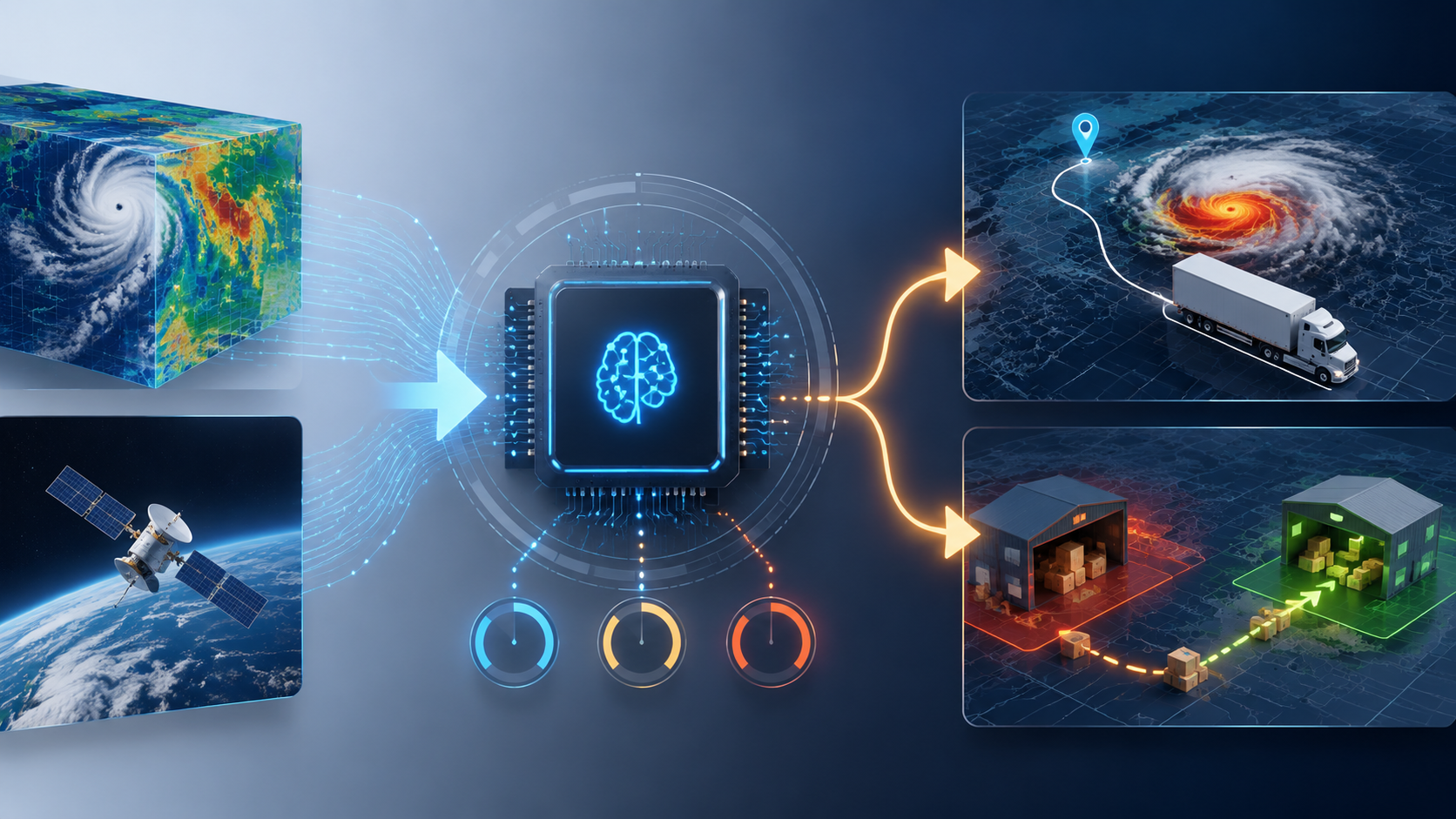
That is the difference between a weather alert and an executable supply chain signal. A generic alert says a storm may affect a region. An operational signal says a specific lane, warehouse, supplier, or delivery cluster is likely to be exposed during a defined time window, and that a decision must be made before dispatch cut-off, carrier tender acceptance, yard release, or replenishment planning closes. The alert layer is useful, but only if it feeds a routing, inventory, or service-level decision; AI weather alerts for logistics routes are strongest when they are treated as inputs to execution, not as another dashboard for someone to watch.
What the Platforms Actually Add
The current generation of AI weather intelligence is not simply taking yesterday's forecast and coloring it red. ClimateAi says its FICE model quantifies the timing, duration, and magnitude of weather-related demand spikes and supply disruptions at 1 km resolution globally, with forecast horizons extending to six months. Hitachi deployed the capability for global supply chain risk modeling, according to ClimateAi's case study.[2] Those are vendor-published capability claims, but the important operational idea is concrete: risk is being tied to place, time, demand, and supply exposure rather than left as a regional weather narrative.
Everstream describes a similar supply-chain-specific layer. The company says it processes more than 20 billion data points daily from sources including NOAA's GFS and GEFS and ECMWF, using the inputs to generate tailored supply chain risk scores. In one named deployment, Unilever used Everstream for refrigerated truck timing and routing decisions.[3] For cold-chain logistics, that distinction matters. A storm risk does not merely threaten transit time; it can change temperature exposure, driver hours, fuel planning, appointment feasibility, and whether a load should move at all.
The Weather Company frames the business case around predictive analytics and real-time weather insights. In a 2024 Magid study cited by The Weather Company, companies leveraging weather intelligence self-reported revenue increases of 5% to 10% and measurable operating cost reductions.[4] That is useful as a directional signal, not proof that a logistics network will produce the same result. It is vendor-sponsored and self-reported, so it should support a business case only after a company defines which decisions will change and how avoided disruption will be measured.
The hard part is that these systems do not hand down certainty. AI weather models still operate inside probabilistic limits. A 70% flood-risk signal for a corridor is not an instruction from the sky; it is a management problem with a timestamp. Someone must decide whether the cost of acting early is lower than the cost of waiting until the risk is undeniable.
From Forecast to Freight Movement
A working AI weather logistics workflow usually starts before the dispatch team is in crisis mode. The platform ingests forecast ensembles, satellite and radar observations, historical weather impacts, and sometimes external signals such as demand and consumer behavior. TraxTech describes the shift from deterministic forecasting toward probabilistic outputs and multi-source data fusion across weather, economic, and consumer-behavior inputs.[5] In practice, the value comes from connecting those outputs to the freight plan already sitting in the TMS, ERP, order management system, warehouse management system, or planning tool.
| Operational question | AI weather intelligence input | Possible logistics action |
|---|---|---|
| Will this lane remain usable during the promised transit window? | Localized probability of flooding, ice, wind, heat, or port/airport exposure | Reroute, retender, advance departure, delay release, or split freight |
| Will this node lose capacity or become the wrong place to hold stock? | Warehouse, supplier, DC, or store exposure by time window | Move inventory to an unaffected node or alter replenishment priorities |
| Will a temperature-sensitive load face unacceptable dwell or delay risk? | Weather severity plus route timing, dwell points, and carrier constraints | Change pickup time, select a different lane, use alternate equipment, or hold shipment |
| Should customers receive a revised promise before the network fails? | Probability-weighted service risk by order, route, or destination cluster | Adjust delivery commitment, notify accounts, or protect priority orders |
Consider a refrigerated load scheduled to cross a storm-exposed corridor. A conventional process may wait for road closures, carrier updates, or a driver escalation. By then, the load is already moving, appointment changes are harder, and the cost of recovery has multiplied. An AI weather workflow should flag the corridor exposure earlier, compare the timing against planned pickup and delivery windows, identify alternate lanes or departure times, and show whether the reroute protects both service and product condition. If the only output is "storm likely," the operations team still has to build the decision logic manually.
Inventory positioning works the same way but with longer consequences. A forecast that suggests an exposed DC may lose outbound capacity is useful only if planners can still move stock, change allocation, or alter replenishment before labor, trailers, and customer orders are locked. This is where weather intelligence connects with multi-echelon inventory optimization: the weather signal should help decide not just whether to hold more inventory, but where inventory can still serve demand if one node becomes constrained.
The workflow is especially valuable when events compound. Logistics Viewpoints reported in July 2026 that the Rhine at Kaub fell to 53 cm, restricting barges to 20% capacity; Missouri flash floods halted regional trucking; and Typhoon Bavi grounded more than 680 flights.[6] Those examples should not be stretched into a universal ROI claim. Their value is simpler: severe weather rarely respects mode boundaries. When river capacity, trucking access, and air freight reliability are all vulnerable, routing software that sees only one leg of the move will miss the actual risk.
The Named Deployments Are Encouraging, With Limits
Hitachi, Unilever, and Cooper Health are the most useful kind of evidence because they point to named operating contexts rather than abstract adoption. Hitachi used ClimateAi for global supply chain risk modeling, according to ClimateAi.[2] Unilever used Everstream to support timing and routing decisions for refrigerated trucks, according to Everstream.[3] Cooper Health used Interos.ai to pre-order supplies ahead of Hurricane Idalia, giving a practical example of weather-driven pre-event inventory action rather than post-event expediting.
Those cases should be read carefully. A named deployment proves that a company found a use case worth implementing; it does not prove a universal reduction in disruption, a repeatable ROI percentage, or a guarantee that another network can copy the workflow unchanged. The Unilever example is strongest when kept at the level the source supports: refrigerated truck timing and routing decisions. The Hitachi example supports supply chain risk modeling at global scale, based on the vendor's case study. The Cooper Health example shows the operational pattern that matters for hurricanes: order earlier, position supplies before the event, and avoid making procurement compete with everyone else after landfall.
For hurricane-specific planning, the same principle applies with more lead-time pressure. The relevant question is not whether an AI model can name a single future track perfectly. It is whether procurement, transportation, and inventory teams can use a probability cone, facility exposure, supplier dependency, and demand surge signal to make earlier commitments. Proactive hurricane supply chain planning is a sharper version of the same operating discipline.
Where Logistics Teams Usually Get Stuck
Most organizations do not fail because nobody saw the storm. They fail because the forecast never became an authorized decision. Dispatch sees risk but lacks authority to retender. Inventory planning wants to move stock but finance resists carrying cost. Sales does not want to revise a customer promise while there is still a chance the storm shifts. The model says "likely," while the organization is waiting for "certain."
That delay has a measurable business cost beyond weather events. A 2026 Incisiv study reported by SupplyChainBrain found that organizations lose more than 5 cents on every dollar because of slow response to demand signals, described as a $55 million opportunity for a $1 billion organization.[7] Weather risk is not the same as demand sensing, but the operating failure is similar: a signal arrives early enough to matter, then gets trapped in review until action becomes expensive.
A serious implementation should define thresholds before the next storm season. For example, a company may decide that a high-probability flood risk on a primary lane within a dispatch window triggers transportation review, while exposure of a critical DC inside a replenishment lead time triggers an inventory-positioning meeting. The exact thresholds should depend on product value, temperature sensitivity, customer priority, margin, available alternate capacity, and the cost of false alarms. The key is that the rule exists before the planner is trying to defend an early move on a live escalation call.
- Probability thresholds: what risk level requires monitoring, review, approval, or automatic action.
- Escalation ownership: who can reroute freight, change carrier selection, move inventory, or revise a promise.
- Timing rules: which decisions must be made before dispatch cut-off, order allocation, dock scheduling, or replenishment freeze.
- Cost boundaries: how much premium freight, extra handling, safety stock, or lost utilization the business will tolerate to avoid disruption.
- Exception review: how false alarms and missed disruptions will be reviewed without punishing every reasonable early action.
The last point is not soft culture talk. Early action often looks wasteful if the storm turns, weakens, or lands somewhere else. If every false alarm is treated as a failure, planners will learn to wait. Then the company has bought probabilistic intelligence but kept a deterministic approval culture.
Integration Is Not an Implementation Detail
Weather intelligence can be accurate and still fail operationally if it sits outside execution systems. TraxTech notes that AI weather risk management depends on fusing weather data with other business and supply chain inputs, and the same integration challenge appears in logistics strategy discussions around extreme weather.[5][6] For transportation, the signal needs to reach the TMS while loads can still be retendered or resequenced. For inventory, it needs to reach planning systems while stock can still be reallocated. For customer service, it needs to reach order promising before the customer hears about the delay from the carrier.
A practical architecture does not need to be elegant on day one. It does need to answer where the weather signal lands and what it changes. If the platform assigns a high risk score to a lane, does the TMS show alternate routes, or does a planner have to copy the alert into a spreadsheet? If a DC is exposed, does the ERP or planning tool show affected SKUs and substitute nodes, or does inventory planning discover the issue in a separate portal? If a carrier's network is likely to be impaired, is procurement informed early enough to secure alternate capacity?
This is also where AI weather intelligence intersects with broader TMS and routing investments. Route optimization, last-mile planning, and predictive freight analytics can all consume better weather risk signals, but they only matter if the workflow can execute. The relevant integration question is covered more broadly in AI in TMS: does the recommendation reach the system where dispatchers, planners, and carrier managers already make decisions?
How to Evaluate the Use Case Without Buying Hype
A logistics team evaluating AI severe weather tools should start with the decisions it is willing to change. Vendor demos often show attractive storm maps and risk scores. The better test is whether the tool can support a named operational move: reroute this lane, move this inventory, advance this purchase order, retender this load, protect this customer group, or revise this delivery promise.
- Resolution: can the platform localize risk at the lane, node, supplier, or customer-cluster level rather than at a broad regional level?
- Lead time: does the forecast horizon match the decision cycle for routing, procurement, replenishment, and customer communication?
- Business context: does the model understand product sensitivity, inventory position, capacity constraints, and service commitments?
- Execution path: can recommendations reach TMS, ERP, WMS, planning, or order promising systems without manual translation?
- Measurement: will the pilot compare avoided disruption, premium freight, spoilage, service failures, dwell time, and false-alarm cost?
The measurement point deserves discipline. A pilot should not claim success because the platform predicted a storm that everyone already saw on public forecasts. It should show that a decision changed early enough to reduce a specific operational cost or protect a specific service commitment. Adjacent AI routing benchmarks can help frame the business case, but the severe-weather use case should be judged on avoided disruption and decision latency, not on generic AI adoption metrics. Broader ROI context belongs in a separate comparison of AI supply chain use cases where ROI is real, not in a weather pilot that has not yet proven operational impact.
There are also claims that should not carry weight without original verification. One claim sometimes cited is that Johnson & Johnson detected 85% of disruptions seven days ahead through AI. Without an original source, that figure should be fact-checked before publication or excluded from a business case. Logistics leaders do not need inflated proof points; they need credible evidence tied to decisions they can audit.
The Practical Test
AI weather intelligence can reduce severe-weather disruption in logistics when it is tied to executable routing, inventory, and service-level decisions. The evidence is strongest where platforms connect high-resolution, probabilistic weather risk to named supply chain actions: Hitachi modeling global supply risk, Unilever timing and routing refrigerated trucks, and Cooper Health pre-ordering before Hurricane Idalia. The evidence is weaker when it relies on broad ROI percentages, isolated pilots, or capability claims presented as outcomes.
The decisive capability is not perfect prediction. It is the organization's ability to act before certainty arrives: to define thresholds, authorize exceptions, integrate weather risk into execution systems, and accept that some early moves will look unnecessary after the fact. Severe weather will keep creating bad options. AI weather intelligence is useful when it gives logistics teams enough time, precision, and authority to choose the least bad one before the window closes.
References
- The Impact of Extreme Weather on the Supply Chain, Everstream Analytics.
- ClimateAi Enables Global Supply Chain Risk Model for Hitachi, ClimateAi.
- Applying NOAA and AI Weather Forecasting Models to Supply Chains, Everstream Analytics.
- Managing Supply Chain Weather Risks with Predictive Analytics and Real-Time Insights, The Weather Company, 2024.
- AI Weather Forecasting and Supply Chain Risk Management, TraxTech.
- From Deluges to Dry Beds: How Extreme Weather is Rewriting Logistics Strategy, Logistics Viewpoints, July 13, 2026.
- 2026 Supply Chain Resilience & AI Adoption Study, SupplyChainBrain.
Comments
Join the discussion with an anonymous comment.