
The useful question is no longer whether an earthquake alert gives people a few seconds to duck under a desk. For supply chain earthquake preparedness, the harder question is whether a warning gives a planner enough time to move freight, protect inventory, slow a hazardous process, or ask a supplier to make a decision before the ground moves.
That is an uncomfortable window. Seconds are easy to classify as life-safety alerts. Weeks are easy to classify as planning assumptions. One day, seven days, or possibly 25 days sit in the middle, where someone has to authorize cost before certainty arrives.

Taiwan’s April 2024 Hualien earthquake is a useful anchor because it was not a story of helplessness. TSMC reportedly recovered 70% of its tools within 10 hours after the magnitude 7.4 earthquake, which is a strong operational response by any manufacturing standard.[1] The same event also touched a semiconductor network where roughly 58,000 parts fed 21,000 products, according to Resilinc data cited by Interos.[2] Both facts matter. Rapid recovery does not erase exposure; it only shows how much disciplined response is needed when exposure is that large.
Advance warning changes the job. It does not remove the earthquake. It moves some of the decision-making from the emergency room into the planning meeting, where the questions are less dramatic and more expensive: which inbound containers should be diverted, which tools should be protected, which supplier teams should be woken up, and who pays if the warning turns out to be wrong?
What The New AI Evidence Actually Supports
Two different AI approaches are pushing earthquake warning from immediate alerting toward operational preparation, but they should not be treated as equally proven.
The more credible near-term bridge is the University of Texas at Austin work reported through PreventionWeb. In a seven-month trial in China, the machine learning algorithm correctly predicted 70% of earthquakes one week before they occurred, within about 200 miles of the actual location. The reported result included 14 correct predictions out of 15 predicted earthquakes and eight false warnings.[3] That is not a production-grade global control tower. It is, however, specific enough to ask what a supply chain team could do with a seven-day signal.
The caveat is not small. The researchers said they are “not yet close to making predictions for anywhere in the world,” so the China trial should be read as proof of promise in a defined setting, not as evidence that every seismic region can be managed the same way next quarter.[3] A model that performs in one geography over one trial period may still be too uncertain for automatic plant shutdowns elsewhere.
The more ambitious claim comes from AstroTeq, which describes a system using deep-space cosmic ray anomaly detection to provide up to 25 days of warning. In a Risk & Insurance interview, the company’s CEO also cited damage-reduction ratios ranging from 1:7 to 1:160 depending on industry.[4] That deserves attention because a 25-day window would change the scope of possible actions for fabs, tooling, work-in-process, and multi-tier supplier coordination. It also deserves restraint: those ratios are company claims from an interview, not independent peer-reviewed validation.
There is enough here to build a playbook. There is not enough to let the model own the decision.
The Warning Window Determines The Action
A warning is only useful if it is tied to a decision threshold. The same alert should not trigger the same response at every lead time. One day may justify protecting people, inventory, and hazardous processes. Seven days may justify logistics and backup-system moves. Twenty-five days may justify production and supplier-network actions that would be reckless under a weaker or shorter signal.
| Warning window | Useful for | Actions that may be proportionate | Main governance question |
|---|---|---|---|
| 1 day | Immediate physical protection and process safety | Secure high-value inventory, pause hazardous operations, confirm headcount and emergency communications | Who can stop or slow work without waiting for corporate approval? |
| 7 days | Inventory, logistics, and site readiness | Pre-position buffer stock, reroute inbound shipments, test generators, verify backup communications, stage recovery vendors | What false-alarm cost is acceptable for this site and product family? |
| 25 days | Production allocation and multi-tier supplier preparation | Shift production, drain WIP, execute tooling shutdown protocols, coordinate contingency plans across supplier tiers | What confidence level justifies disrupting the plan before the hazard is certain? |
The table is deliberately uneven. A one-day warning is not a compressed version of a 25-day warning. It is a different operating mode.
One Day: Protect The Irreplaceable And Stop The Dangerous
With one day of credible warning, the priority is not elegant optimization. It is reducing avoidable damage without creating more risk through last-minute movement.
High-value inventory should move only if the move itself is safe and short. Finished goods sitting in vulnerable racking, temperature-sensitive material near systems likely to lose power, and parts that are both expensive and hard to replace deserve attention before lower-value bulk stock. A warehouse team should already know which SKUs fall into that category; if the list has to be debated after the alert, the window is already being wasted.
The same discipline applies to production. Hazardous processes should be slowed or halted when the risk of continuing is worse than the cost of interruption. That could include processes involving heat, pressure, chemicals, fragile tooling, or material that becomes unsafe if power is lost at the wrong point. The decision belongs in a preapproved matrix, not in a late-night argument between operations, safety, finance, and the site leader.
A one-day playbook should also confirm the boring items that fail loudly: emergency contacts, backup communications, forklift charging, generator fuel, manual receiving procedures, and access to repair vendors. These are not advanced AI use cases. They are the difference between a warning that changes the outcome and a warning that only adds anxiety.
Seven Days: The Most Useful And Most Dangerous Planning Window
Seven days is the window supply chain teams should take most seriously first, because it is long enough to do real work and short enough that bad governance becomes expensive quickly. The UT Austin trial gives this horizon a concrete evidence base, while the eight false warnings are a reminder that every action needs a cost threshold.[3]
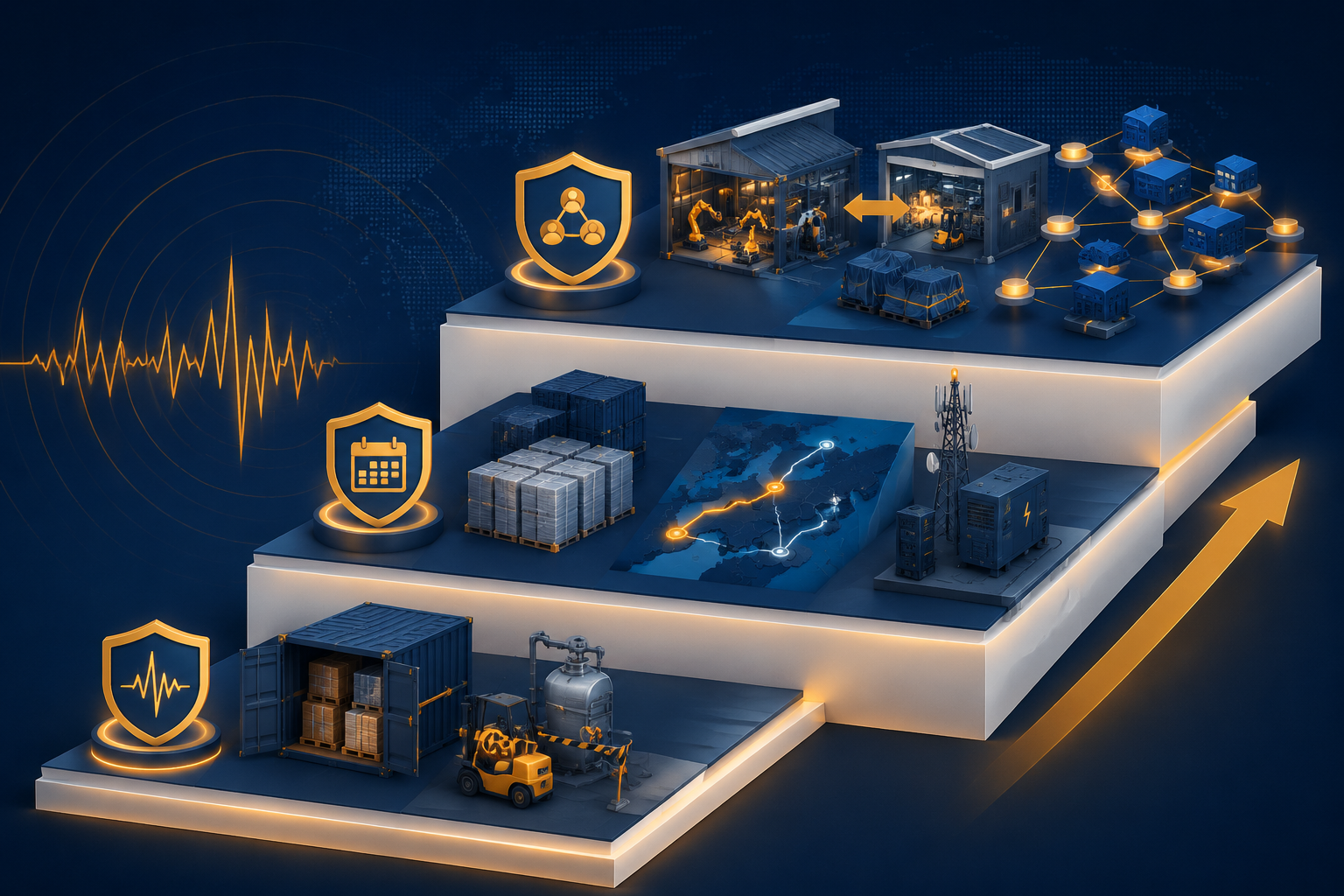
For inventory, the seven-day move is pre-positioning, not panic buying. The inventory lead should identify materials that would cause the longest restart delay if the site, supplier, or regional transport network is disrupted. The answer is often not the highest-value part. It may be a low-cost component with a long qualification path, a consumable needed to restart a tool, or a packaging item without which finished goods cannot ship.
The action should be bounded. Move enough stock to protect the restart path, not enough to distort the entire network. If an alternate distribution center, contract manufacturer, or customer-facing buffer location is outside the likely impact zone, a seven-day warning may justify repositioning selected inventory there. If every available location sits inside the same seismic corridor, the better move may be physical protection and power resilience rather than transport.
For logistics, seven days is enough time to call carriers before everyone else is calling. Inbound shipments can be reviewed against port exposure, rail and road alternatives, customs status, and detention risk. A planner does not need to reroute every load. The first cut should isolate shipments that are both critical and still controllable: containers not yet discharged, air freight not yet tendered, supplier shipments not yet released, or domestic loads that can be staged outside the risk area.
Alternate ports and lanes should be chosen with recovery in mind. Diverting freight to a port that avoids the earthquake zone but strands material away from the plant after the event may only move the bottleneck. The logistics team needs a return path, not just an escape route.
For facilities, seven days is the window to test rather than assume. Generators, backup communications, fire suppression, water, compressed air, access control, and manual receiving procedures should be checked while there is still time to fix small failures. If the site has satellite phones in a cabinet no one can open, or a generator contract without confirmed fuel priority, the warning has already created value by exposing the gap.
For suppliers, the seven-day question is not “are you prepared?” It is “which order, material, tool, or shipment will you protect first if the warning escalates?” Tier-1 suppliers may answer quickly. Tier-2 and tier-3 exposure is harder, which is why multi-tier visibility matters before the alert arrives. Teams that need a deeper map of upstream exposure can pair this preparation playbook with multi-tier earthquake risk monitoring.
The governance point is blunt: a seven-day warning should not automatically trigger a full shutdown. It should trigger a tiered checklist with named owners, spending limits, and escalation rules. Otherwise, the false positives become politically fatal. After two or three expensive false alarms, people stop acting even when the next warning is right.
Twenty-Five Days: Useful If The Confidence Bar Is Higher
A 25-day signal, if validated for a given region and hazard profile, opens a different class of decisions. This is where semiconductor fabs, precision manufacturing, complex tooling, and constrained supplier networks start to matter. It is also where overreaction can do the most damage.
Production can be shifted earlier in the cycle. A plant may pull forward output for products with exposed single-source components, move selected orders to an alternate site, or reduce dependence on a line that would be difficult to restart. None of this should be improvised. Alternate production requires qualification, labor planning, material availability, customer prioritization, and a decision about who absorbs the inefficiency.
Work-in-process deserves special handling. In complex manufacturing, WIP can be more vulnerable than raw material or finished goods because it may be sitting between process steps, dependent on environmental controls, or tied to tooling that cannot be easily replaced. A longer warning window allows teams to drain pipelines deliberately: finish what can be finished, avoid starting batches that would be stranded, and protect partially completed material that is expensive or hard to rework.
Tooling protocols also become realistic. A one-day warning may be enough to secure obvious hazards. A longer window may allow a site to execute more careful shutdown, calibration protection, vibration-sensitive equipment procedures, spare-part staging, and vendor scheduling. The Taiwan example shows why this matters: fast tool recovery is possible, but it is still a race against a large and interconnected product network.[1][2]
Supplier coordination can move beyond emails. A 25-day window may justify tiered contingency calls, allocation agreements, temporary buffer builds, shared logistics planning, and customer prioritization decisions. It may also justify asking a supplier to protect a subcomponent the buyer rarely sees but cannot build without. That requires commercial authority, not just risk visibility.
The confidence bar should be higher because the actions are larger. Shifting production, draining WIP, and executing tooling shutdown protocols are not low-cost precautions. They consume capacity and can create missed shipments even if the earthquake does not occur. A company may still accept that cost for a critical product family, a constrained fab, or a region with severe exposure. It should not accept it by default because a vendor dashboard changed color.
False Alarms Are Not A Footnote
The false-positive problem is not an argument against using AI warnings. It is an argument for deciding in advance what a false alarm is allowed to cost.
The exposure side of the equation is large enough to justify serious preparation. Munich Re has estimated that a repeat of the 1906 San Francisco earthquake would cause more than $200 billion in direct losses, and USGS has put the probability of a magnitude 6.7 or greater earthquake in the San Francisco Bay Area at 63% to 72% within 30 years. At the household level, fewer than 15% of California homeowners carry earthquake coverage, which is not a supply chain metric but does show how much residual risk sits outside formal transfer mechanisms.[4]
For a manufacturer, the better comparison is specific: what does it cost to reroute three critical inbound shipments, build a small buffer of restart parts, test backup power, or delay a hazardous process? Then compare that with the cost of losing a line, missing a customer allocation, scrapping WIP, or waiting weeks for a constrained supplier to restart. The answer will differ by product family and region. That is the point.
The governance model should separate actions into bands. Low-regret actions can happen on lower-confidence alerts: confirm contacts, test communications, review exposed orders, check fuel, and identify controllable freight. Medium-cost actions need stronger signals: reposition selected inventory, stage recovery vendors, and divert critical shipments. High-cost actions need the highest confidence and executive authority: production shifts, broad shutdowns, customer allocation changes, and WIP-drain decisions.
This is also where regional reliability matters. A model with promising evidence in one region should not be granted the same authority in another region without validation. The right question for a provider is not only whether the model predicts earthquakes. It is where the model has been tested, over what time window, against which thresholds, with how many false warnings, and what action the provider believes is proportionate at each confidence level.
Where AI Fits In The Continuity Stack
AI earthquake warnings are not a replacement for monitoring, response, insurance, engineering controls, or supplier mapping. They are an additional timing layer. They sit before the event, when the company still has options that disappear after shaking begins.
That distinction matters because many earthquake tools are strongest after the event: identifying affected sites, estimating disruption, locating supplier exposure, and prioritizing recovery. Those capabilities remain necessary. For readers working on that side of the operating model, AI earthquake supply chain risk monitoring and response is the counterpart to this preparation window.
Institutional interest in AI for disaster supply chains is broader than earthquake prediction alone. PreventionWeb has covered AI’s role in improving efficiency and preparedness in disaster supply chains, and the World Economic Forum has described AI as one way to protect supply chains from major shocks.[5][6] Those are useful signals that the field is maturing, but they do not settle the operating question for a plant manager facing a warning next Tuesday.
The operating question is narrower: for this site, this supplier, this product family, and this model confidence level, what action is worth taking now?
Build The Playbook Before The Alert
A workable AI earthquake warning playbook needs fewer slogans and more authority lines. Each warning band should identify the action owner, the spend limit, the operational trigger, and the point at which the decision escalates.
- For inventory: define the SKUs, WIP states, spares, and consumables that protect restart rather than only revenue.
- For logistics: preselect alternate ports, carriers, lanes, and staging locations, including the path back into the plant.
- For production: mark which processes can be paused safely, which batches should not be started, and which lines have qualified alternates.
- For suppliers: identify who can authorize buffer builds, allocation changes, and contingency shipments across tiers.
- For finance and leadership: approve false-alarm budgets before the first serious warning arrives.
The false-alarm budget is not a side document. It is what keeps the playbook alive. If every warning requires a fresh debate over cost, the organization will either overreact once and retreat forever, or underreact until the loss is visible.
Scenario planning helps here because the company can price choices before emotions rise. The same discipline used for tariff, geopolitical, or environmental disruption planning applies: define triggers, test assumptions, assign decision rights, and rehearse trade-offs. Teams building that muscle across disruption types may find the scenario approach in AI tariff scenario planning useful, even though the hazard is different.
The calibration principle is simple enough to write down and hard enough to enforce: AI earthquake warnings can buy supply chains days, and perhaps weeks, but they should not automatically activate the most expensive plan. The response should scale with model confidence, regional reliability, false-alarm cost, and the cost of doing nothing.
References
- Taiwan earthquake impact: Semiconductor supply chain braces for disruptions, Manufacturing Dive.
- Navigating Semiconductor Supply Chain Disruptions: Insights from Taiwan’s Earthquake, Interos.
- AI-driven earthquake forecasting shows promise in trials, PreventionWeb.
- Shifting to meaningful earthquake preparedness with AI and deep-space data, Risk & Insurance.
- AI: Enhancing efficiency and preparedness in disaster supply chains worldwide, PreventionWeb.
- How AI can protect supply chains from the next major shock, World Economic Forum, January 2025.
Comments
Join the discussion with an anonymous comment.