
The first supply chain problem after an earthquake is not the headline magnitude. It is the interval between a seismic signal and a decision: which supplier sites may be damaged, which sub-tier dependencies are now unsafe, which lanes are likely to close, which inventory positions should be held, and which production plans should stop pretending that yesterday’s assumptions still apply. That is the practical center of AI for earthquake supply chain risk management: not admiring an AI model, but shortening the time before someone can make a defensible call.
That interval is becoming harder to manage manually. Resilinc reported that global supply chain disruptions increased 38% year over year in 2024, with extreme weather disruptions up 119%.[1] The UN Office for Disaster Risk Reduction has projected that large-scale disasters could reach 560 per year by 2030.[2] At the same time, Dataiku reported a preparedness gap: 78% of leaders expect worsening disruptions, but only 25% feel prepared.[3] Earthquakes deserve separate treatment inside that broader risk picture because they arrive with little warning, leave aftershock uncertainty behind them, and often hit geographic clusters where suppliers, utilities, ports, wafers, chemicals, tooling, and sub-tier capacity are more concentrated than the approved-vendor list suggests.
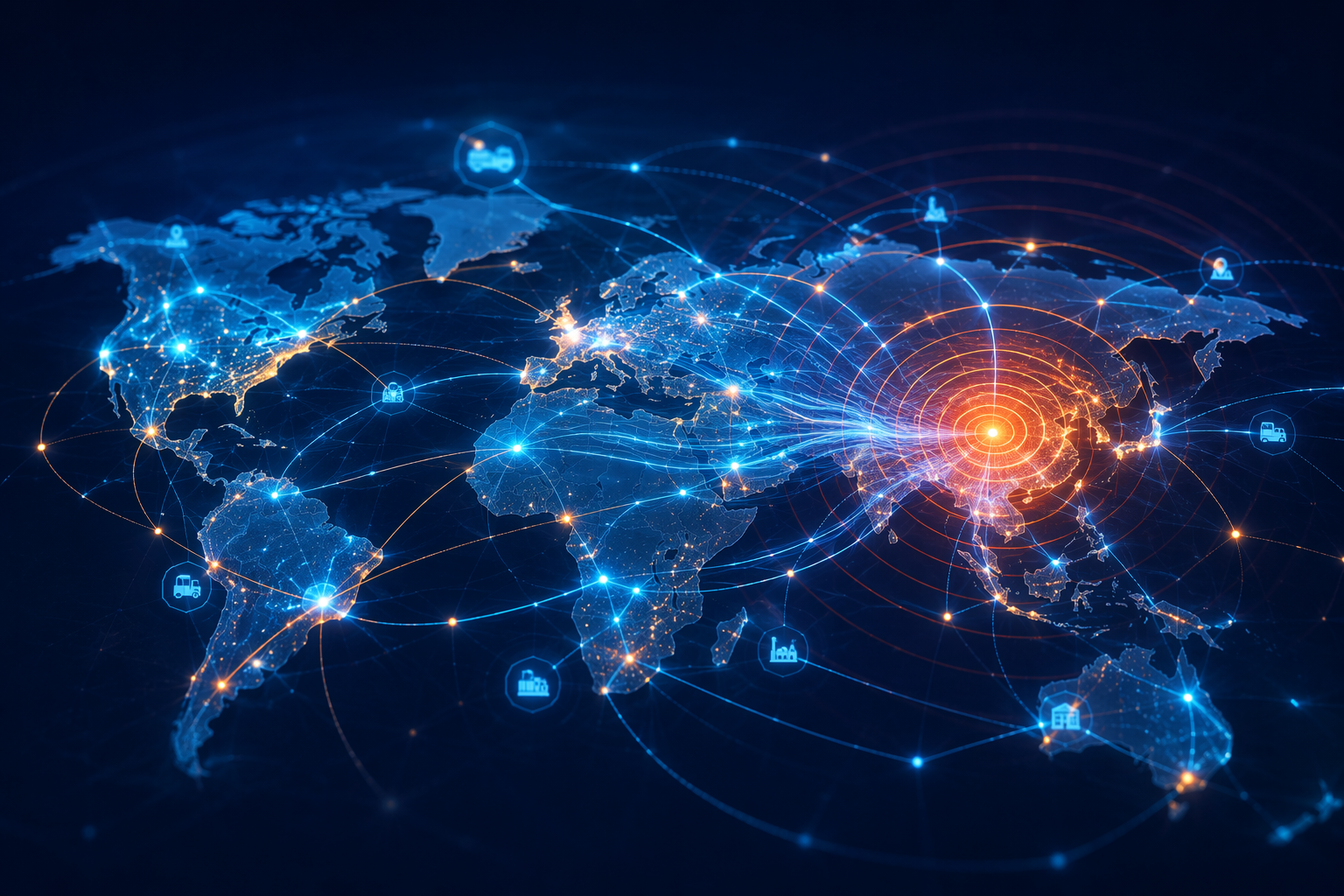
Why Earthquakes Break the Usual Risk Rhythm
A hurricane gives a planner a track, even if the track changes. A labor strike may give warning signs. A port congestion problem builds in queues. Earthquakes compress the first decision window. The event itself is sudden, the damage pattern is uneven, and the supply chain consequences may sit one or two tiers away from the named supplier that procurement sees in the system.
That is why the old crisis workflow ages badly in the first hours. A risk team waits for supplier emails. Procurement asks account managers for status. Planners freeze orders they are not sure they need to freeze. Logistics looks for route advisories. The executive call wants a number before the network has produced one. By the time the first spreadsheet is clean, the best inventory, routing, and allocation choices may already be gone.
AI does not turn earthquakes into normal planning events. The useful version is narrower and more operational: faster aftershock risk signals, wider monitoring of affected regions, better exposure mapping across sub-tiers, faster simulation of feasible recovery options, and controlled automation for actions that do not need to wait for a full command-room cycle.
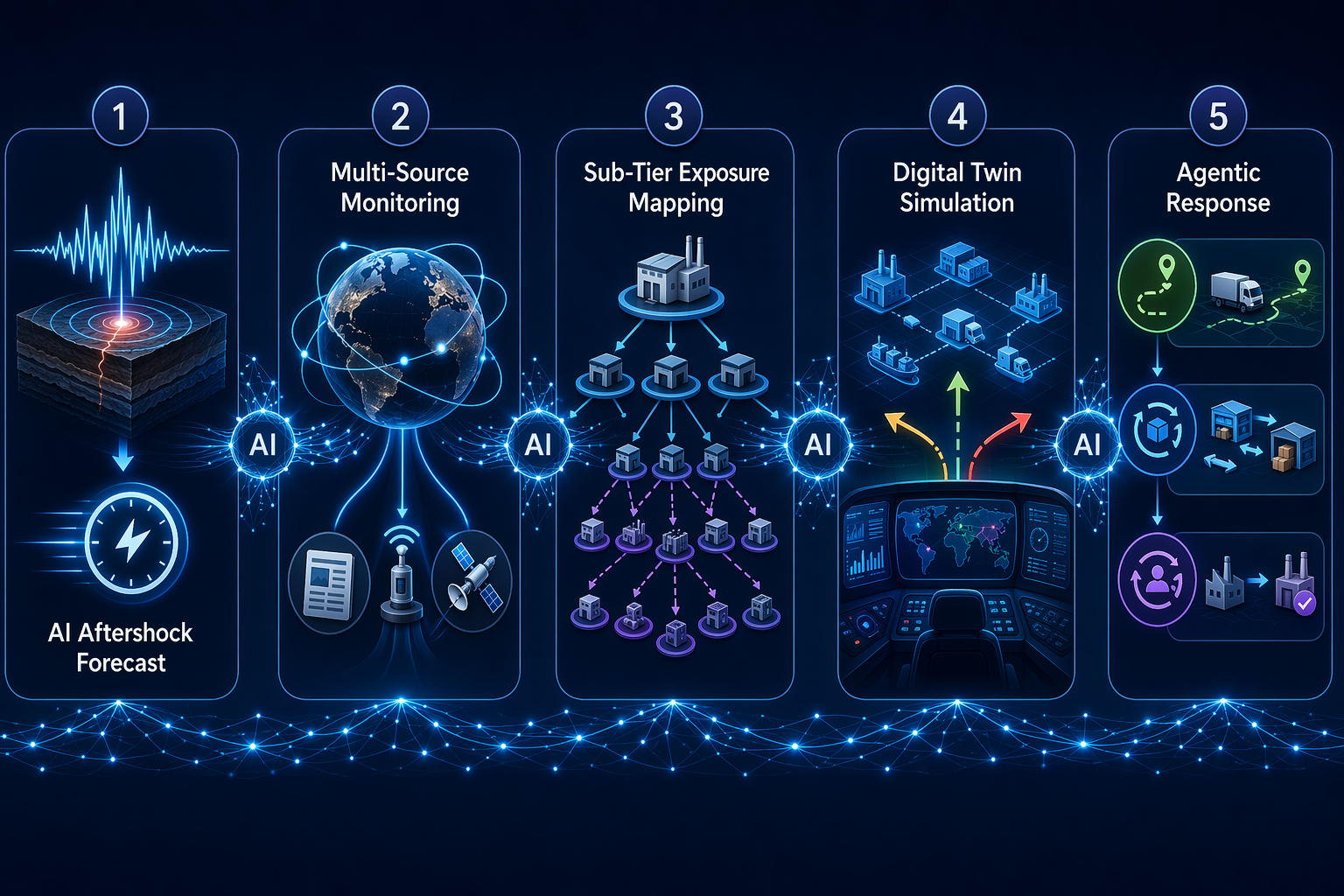
The Workflow That Matters
The earthquake resilience workflow is best judged as a chain. If one link is missing, the AI value usually collapses into another dashboard.
| Decision point | What AI adds | What an operator needs from it |
|---|---|---|
| Aftershock forecasting | Machine learning estimates aftershock risk faster than traditional model runs | A timely signal that changes inspection, staffing, route, or production assumptions |
| Multi-source monitoring | Automated scanning of news, social, government, weather, logistics, and supplier signals | A filtered event view that separates relevant exposure from noise |
| Sub-tier exposure mapping | Entity resolution and trade-data analysis connect suppliers to hidden upstream dependencies | A map of which sites, parts, lanes, and alternates are actually exposed |
| Digital twin simulation | Scenario engines test production, inventory, and logistics options under constrained capacity | Feasible choices with trade-offs, not generic advice |
| Agentic response | Systems recommend or trigger controlled actions such as rerouting, rebalancing, or supplier switching | Auditable execution with thresholds, approvals, and rollback paths |
The sequence matters. A fast aftershock model that is not connected to supplier geography does not tell a planner which work orders to protect. A supplier map without simulation may identify the exposed node but still leave the team arguing over which plant should take the hit. Autonomous action without governance can move inventory into the wrong constraint. The promise is in the integration.
Aftershock Forecasting Gives the First Usable Minutes
The most distinctive seismic capability is speed. Research involving the British Geological Survey and the University of Edinburgh showed that machine learning tools can generate aftershock risk forecasts in seconds, compared with hours for traditional Epidemic-Type Aftershock Sequence models.[4] For civil authorities and seismologists, that is a scientific and emergency-management advance. For supply chains, it becomes valuable only when the forecast is translated into exposure: which facilities, roads, ports, clean rooms, warehouses, utilities, and suppliers sit inside the changed risk area.
Those seconds do not automatically answer whether to stop a line. They can, however, change the order of work. A team can prioritize safety checks at exposed sites, hold shipments that would move into a likely aftershock zone, delay noncritical dispatches, and escalate only the supplier nodes that intersect with the modeled risk. The value is not that the model knows the future. The value is that the planner is no longer waiting hours for the first structured risk estimate while the exception queue fills.
Monitoring Turns the Quake Into a Supply Chain Event
Once the ground has moved, the monitoring problem becomes ugly fast. The relevant facts are scattered across government bulletins, local-language news, supplier notices, port advisories, social posts, logistics feeds, utility updates, and sometimes a blurry photo from an industrial park that no one in headquarters can place. Manual monitoring can catch the obvious items. It struggles with language, volume, duplication, and the dull but essential work of connecting each event to a specific operating node.
Resilinc says its EventWatchAI monitors more than 104 million sources in more than 100 languages across 200 countries.[5] That kind of breadth does not prove response effectiveness by itself, but it addresses a real weakness in earthquake response: the first confirmed disruption may appear in a local source long before it arrives as a formal supplier notification. In electronics and semiconductor networks, where one specialty material, tool, or backend process can constrain a much larger production plan, that earlier signal can be worth more than another polished weekly risk report.
The operator still needs filtering. A useful AI monitoring system should attach an event to coordinates, company names, known sites, product families, purchase orders, lanes, and inventory. It should suppress duplicate reports, preserve source evidence, and show why a supplier or region was flagged. Otherwise, the risk team receives a faster stream of uncertainty rather than a shorter path to action.
The Hidden Single Point of Failure Is Usually Below Tier One
The most uncomfortable discovery after an earthquake is often not that a named supplier is exposed. It is that three “independent” suppliers depend on the same sub-tier region, processor, material source, test house, or logistics corridor. Procurement may have diversified the purchase order. The network may not have diversified the constraint.
Everstream describes using AI to map billions of trade records and reveal hidden single points of failure in quake-prone regions.[6] That is the kind of capability that changes the conversation from “Which direct suppliers are near the epicenter?” to “Which approved parts, alternates, and customer commitments still depend on the same upstream node?” The difference matters because earthquake impact is uneven. A supplier’s headquarters may be fine while a sub-tier plant, port route, chemical supplier, or local utility dependency is impaired.
A mature exposure map should connect at least four operating views:
- Site exposure: supplier plants, warehouses, ports, airports, contract manufacturers, and critical infrastructure inside or near the affected zone.
- Part exposure: components, materials, tooling, and product families tied to those sites.
- Inventory exposure: stock in transit, finished goods, strategic buffers, and inventory that may be physically safe but operationally stranded.
- Dependency exposure: sub-tier suppliers, shared logistics corridors, common utilities, and alternate suppliers that are only alternate on paper.
This is where AI earns its keep in earthquake risk management. The hard work is not merely collecting more facts. It is resolving entities, matching imperfect names, inferring relationships, and presenting a risk graph quickly enough that planners can still do something useful with it.
Digital Twins Move the Argument From Exposure to Options
An exposure map tells the team where the network is fragile. It does not settle what to do. After a major earthquake, the practical choices compete with one another: reserve scarce inventory for high-margin customers, keep a strategic line running at lower volume, pull demand into another plant, reroute around a damaged port, qualify a substitute supplier, or stop production before partially built goods consume constrained parts.
Digital twins help because they let the team test those choices against the actual network rather than against a meeting-room instinct. SCMR reported that Siemens models more than 500 production scenarios daily, with about a 20% downtime reduction and a 14% reduction in logistics cost volatility.[7] Those figures should not be read as a universal earthquake result. They show what becomes possible when production, logistics, constraints, and recovery options are modeled continuously enough that disruption decisions do not start from a blank page.
The best digital-twin question after an earthquake is rarely “What is the optimal plan?” It is more often “Which plans are still feasible if this node is down, this route is delayed, this supplier is uncertain, and this inventory cannot be trusted until inspected?” That framing is less glamorous but more useful. It gives the planner a ranked set of tolerable compromises before the business locks itself into the first loud answer.
Toyota’s resilience hub offers the more pointed lesson for semiconductor exposure. SCMR reported that AI alerted Toyota to semiconductor supplier risk six weeks before disruption.[7] The timing matters because semiconductor constraints do not wait politely at tier one. If a signal arrives early enough, the response can include allocation changes, supplier engagement, buffer positioning, and production sequencing. If it arrives after the disruption is confirmed, the same team is often just rationing pain.
Agentic Response Is Useful Only With Guardrails
Autonomous or agentic AI sounds cleanest in a product demo: the system detects a quake, maps affected suppliers, simulates alternatives, and triggers rerouting or supplier switching. In real operations, the useful version is more controlled. Some actions can be automated. Others should be recommended with evidence and routed to the person who owns the consequence.
Low-regret moves are the natural starting point. A system can create incident records, attach exposed purchase orders, notify supplier owners, flag shipments entering the risk zone, reserve inspection capacity, or recommend inventory holds under predefined thresholds. Higher-impact moves need approval: reallocating constrained components, switching suppliers, changing customer commitments, or stopping a line. The point is not to remove human judgment from earthquake response. It is to keep human judgment from being wasted on clerical assembly while the decision window closes.
Auditability is not a compliance afterthought here. A risk manager needs to know which signal triggered the recommendation, which suppliers and parts were matched, which scenarios were considered, what assumptions were used, who approved the action, and when the system should unwind it. Without that trace, an autonomous response can become another black-box exception that operators must clean up after the crisis.
What the Outcome Claims Actually Support
The measured claims are encouraging, but they need careful boundaries. Gartner’s 2025 Supply Chain Resilience Benchmark found 28% faster response rates and 19% shorter recovery cycles among companies embedding risk-sensitive AI metrics.[8] That is not the same as saying any company that buys an AI risk tool will respond 28% faster after an earthquake. The benchmark points to embedded metrics and operating discipline, not tool ownership alone.
McKinsey has estimated that disruption costs can equal 45% of one year’s profits over a decade, and Everstream cites AI-enabled disruption detection as capable of reducing risk impact by up to 40%, translating to about $500 billion in avoided losses.[6] The useful reading is again conditional. Avoided loss comes from acting earlier on the right exposure, not from predicting that bad things may happen somewhere.
Market-size forecasts and large GDP-at-risk figures can make the category sound inevitable, but they are less useful for an implementation decision unless the original methodology is visible. The stronger evidence sits closer to operations: seconds instead of hours for aftershock risk forecasts, monitoring at global language and source scale, trade-record mapping that exposes sub-tier concentration, daily production scenario modeling, and early supplier-risk alerts tied to semiconductor disruption.
Where AI Still Falls Short
There is a difference between geological aftershock forecasting and enterprise supply chain resilience. The former can produce a faster seismic risk estimate. The latter requires supplier data, location accuracy, part mapping, inventory visibility, logistics constraints, decision rights, and disciplined execution. Many companies are still weak in the middle layers. They know their tier-one suppliers better than their sub-tiers. They know inventory in the ERP better than inventory caught between nodes. They know approved alternates better than actually qualified capacity.
Data quality can also be political. Supplier location data may be incomplete. Sub-tier disclosure may be resisted. A supplier may report “no impact” before its own upstream dependency has reported anything meaningful. AI can flag inconsistency and infer relationships, but it cannot make a fragile governance model strong by itself.
The electronics and semiconductor context has the clearest signal because the exposure is concentrated, the economic stakes are high, and the networks are tiered enough for hidden dependencies to matter. Other industries can use the same pattern, but they may not have the same data maturity, supplier mapping depth, or scenario-modeling discipline. Copying the terminology is easier than copying the operating system behind it.
How to Judge an Earthquake AI Risk System
A practical evaluation should follow the decision latency, not the sales architecture. The central question is whether the system shortens the path from seismic event to auditable action.
- Detection: Does it ingest seismic, government, logistics, supplier, and local-language signals quickly enough to matter?
- Mapping: Can it connect an event to sites, parts, purchase orders, customers, inventory, lanes, and sub-tier dependencies?
- Simulation: Can it test feasible production, sourcing, inventory, and logistics options under real constraints?
- Action: Can it recommend or trigger controlled moves with thresholds, approvals, and rollback rules?
- Traceability: Can a human reconstruct why the system acted, what evidence it used, and who accepted the consequence?
This same evaluation lens applies beyond earthquakes. Natural-disaster AI planning for hurricanes, floods, wildfire, air quality, and tsunami response all depends on connecting early warning to operating decisions, not simply detecting hazards. For adjacent patterns, see AI hurricane disruption planning, AI flood disruption prediction, and AI tsunami supply chain response. The earthquake case is sharper because the warning window is shorter and the sub-tier geography can be brutally unforgiving.
The Practical Judgment
AI does not make earthquake disruption predictable in the ordinary planning sense. It cannot guarantee that a supplier is safe, that an aftershock will not damage a facility, or that a modeled alternate will perform under stress. What it can do, when the workflow is connected, is shorten the interval between seismic signal and supply chain action.
That interval is where most avoidable loss is either prevented or locked in. Aftershock forecasting gives the first risk signal. Monitoring finds the scattered evidence. Supplier mapping exposes the hidden dependencies. Digital twins test the recovery choices. Agentic systems move the low-regret work and escalate the decisions that deserve human ownership. The companies that benefit will be the ones that build the whole operating loop, not the ones that mistake a faster alert for resilience.
References
- Resilinc Reveals the Top 5 Supply Chain Disruptions of 2024, Resilinc
- How AI can strengthen the resilience of supply chains, World Economic Forum
- Supply Chain AI Trends 2026, Dataiku
- Research shows AI earthquake tools forecast aftershock risk in seconds, PreventionWeb
- Taiwan Earthquake: Supply Chain Shockwaves, Resilinc
- How AI Transforms Supplier Risk Management, Everstream Analytics
- How AI and Digital Twins Are Rewriting the Rules of Supply Chain Recovery, Supply Chain Management Review
- Gartner 2025 Supply Chain Resilience Benchmark, Gartner, 2025
Comments
Join the discussion with an anonymous comment.