

The useful question about AI in supply chain management is no longer whether it can predict a late shipment, flag a supplier risk, or populate a control-tower dashboard. Most large supply chain teams already have more signals than they can comfortably absorb. The harder problem is what happens after the signal: who checks the supplier list, who requests the quote, who validates the response, who changes the plan, and who owns the outcome if the system is wrong. That is where agentic AI earns attention. Gartner expects 60% of supply chain disruptions to be resolved without human intervention by 2031 and 15% of daily logistics decisions to be made autonomously by AI agents by 2028; those are forecasts, not current-state facts, but they explain why the conversation has moved from visibility to resolution.[1][2]

Agentic AI is best understood by behavior rather than branding. A genuine agent does not merely summarize an exception or trigger a rule that someone configured months earlier. It senses a condition, reasons through a sequence of options, uses approved systems or tools, takes an action within defined authority, and learns from the result. In supply chain terms, that could mean detecting that a carrier lane is at risk, checking approved alternates, requesting quotes, scoring responses, and moving the recommendation or execution step forward. Predictive analytics tells a planner what may happen. A GenAI assistant may explain it in usable language. RPA may copy fields from one system to another. Agentic AI starts to combine diagnosis, decision logic, and execution across the workflow.
The market numbers are useful as pressure readings, not proof that self-healing supply chains have arrived. BCG estimated that agentic systems accounted for 17% of total AI value in 2025 and projected that share to reach 29% by 2028, while ABI Research found that 94% of supply chain companies planned to use AI or GenAI for decision support within two years.[2] At the same time, Deloitte found that 85% of organizations increased AI investment over the prior 12 months, yet only 6% saw ROI in under a year; most reported satisfactory returns over a two-to-four-year window.[2] That timing matters. An agent that looks impressive in a demo still has to connect to supplier master data, transportation management, procurement workflows, inventory policy, audit logs, and exception queues before it changes the operating economics.
Where Agentic AI Is Already Practical
The more convincing examples are bounded. Dataiku describes a transportation company using AI agents to request quotes autonomously from approved suppliers and rank the responses, and a medical device manufacturer using agents to automate supplier scoring and quote validation so category managers can focus on higher-value decisions.[3] These are not vague claims about an autonomous enterprise. They are narrow workflows with known supplier pools, measurable handoffs, and a human function that still has a clear role. That is also why reorder point optimization is a reasonable on-ramp: it narrows the decision surface, keeps the business consequence visible, and lets teams test whether an agent can recommend or execute replenishment changes without turning every planning decision into an experiment. For a deeper example of that kind of bounded starting point, see autonomous reorder point optimization.
Autonomy Needs Decision Rights, Not Just Confidence Scores
The governance model should be graduated because supply chain decisions do not carry equal risk. Routine replenishment, approved-supplier quoting, and low-value freight adjustments can be candidates for full autonomy once thresholds, data quality, and rollback paths are proven. Exception management, bid validation, and inventory policy changes usually need a human-in-the-loop until the organization trusts both the model and the surrounding process. Strategic sourcing, crisis response, regulated product substitutions, and major customer allocation decisions should remain human-led, with AI preparing options rather than exercising authority. The practical design question is simple: what can the agent touch, when must it escalate, what evidence must it leave behind, and who is accountable when the recommendation becomes an action? Readers building that operating model can go deeper in the graduated autonomy implementation guide.
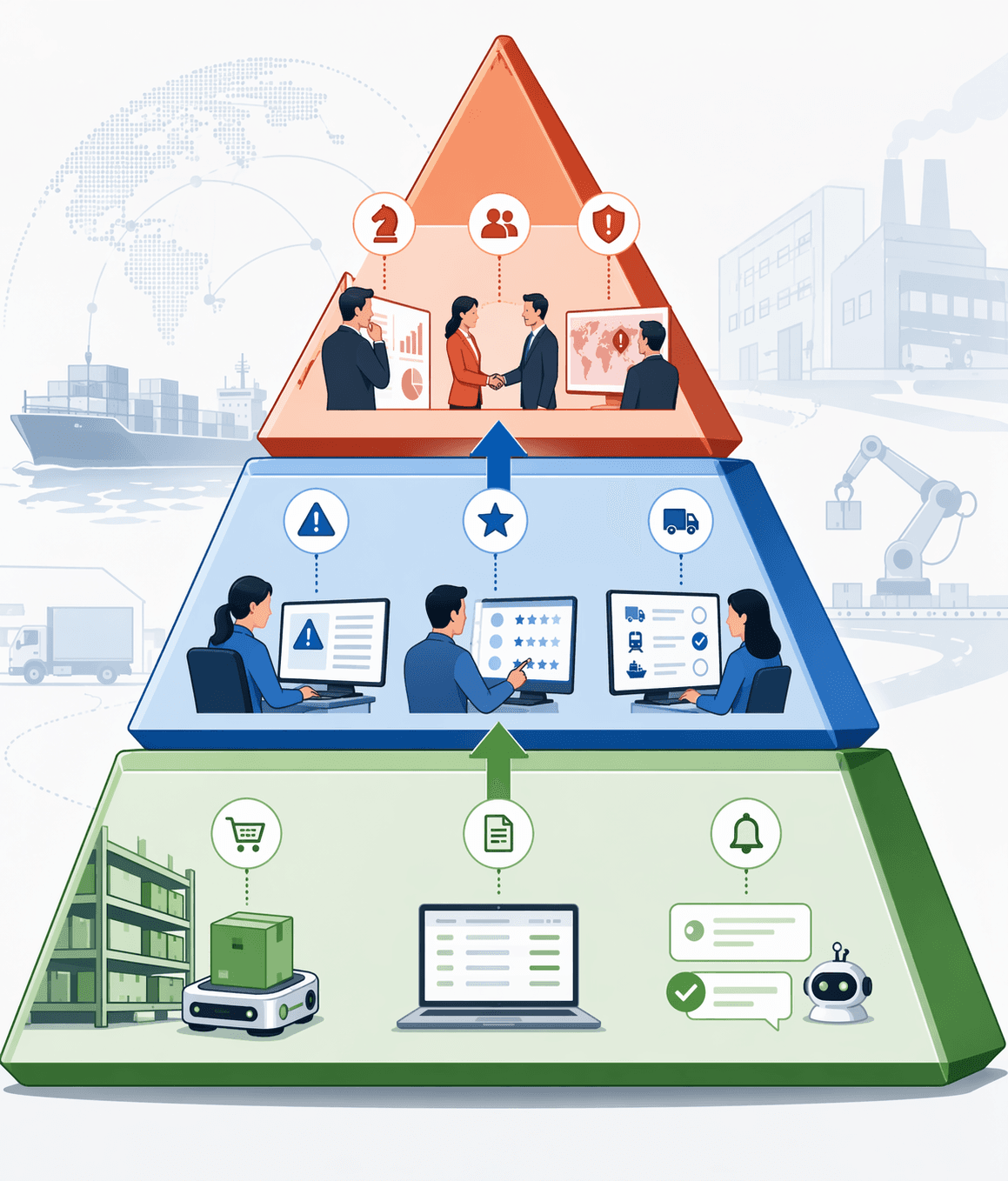
This is also where vendor claims need sharper evaluation. A platform that offers an AI chat interface, workflow automation, or a library of alerts may be valuable without being meaningfully agentic. The test is whether it supports multi-step reasoning, governed tool use, system-level execution, learning from outcomes, and auditability across the workflow. If the agent requests quotes, can it explain why those suppliers were selected? If it ranks bids, can the category manager see the scoring logic and override it? If confidence falls, does the work stop, route, or continue under constrained authority? Those questions are more useful than asking whether a roadmap uses the word “agent.” For platform buyers, a vendor comparison should come after that capability lens is clear; otherwise the evaluation collapses into feature matching. See the enterprise supply chain platform comparison for that next layer of assessment.
The workforce issue is the part that should not be treated as a footnote. Gartner reported in an October 2025 survey that 55% of supply chain leaders expected agentic AI to reduce entry-level hiring needs.[2] That may look attractive against the retirement cliff, especially in teams where experienced planners, buyers, and logistics managers are already carrying too many exceptions. But entry-level roles have traditionally been where people learned the texture of supplier behavior, customer tradeoffs, planning parameters, and operational judgment. If agents absorb too much of that early work without a deliberate transition path, companies may relieve today’s capacity constraint while thinning tomorrow’s bench. The trust problem is not only whether leaders trust unsupervised critical decisions; it is whether they design roles where people can supervise, challenge, and improve autonomous systems without losing the apprenticeship layer that made expert judgment possible. For more on that oversight tension, see the trust paradox in agentic AI. Agentic AI is already useful in constrained supply chain workflows. Its durable advantage will depend less on the ambition of the autonomy claim than on decision rights, audit trails, exception paths, ROI discipline, and workforce transitions designed before scale, not after the first failure.
References
- AI to Resolve 60% of Supply Chain Disruptions by 2031: Gartner — SDC Exec, March 2026
- Supply Chain AI Statistics: 18+ Statistics You Should Know for 2026 — Open Sky Group
- Supply Chain AI Trends 2026: Building Resilient Operations — Dataiku, 2026
Comments
Join the discussion with an anonymous comment.