

The budget problem with machine learning in logistics is not that the returns are imaginary. It is that the phrase is too broad to belong in a capital request. A routing model that cuts miles this quarter, a warehouse robotics layer that raises picks per hour, and a predictive maintenance program that needs cleaner fleet history before it can change maintenance schedules are all sold under the same umbrella. They do not have the same ROI profile.
That distinction matters in 2026 because logistics teams are being asked to fund ML while CFOs are becoming less patient with “AI productivity” claims that never settle into the P&L. One benchmark worth keeping in view: only 6% of organizations see AI ROI in under a year, while most satisfactory returns arrive over a 2–4 year window; integration costs can range from $50,000 to more than $500,000 depending on scope and system complexity.[1]
So the useful question is not whether the machine learning in logistics has attractive ROI. It is which operating line the model touches, how fast the organization can act on its recommendations, and whether the baseline is clean enough for the claimed savings to survive review.
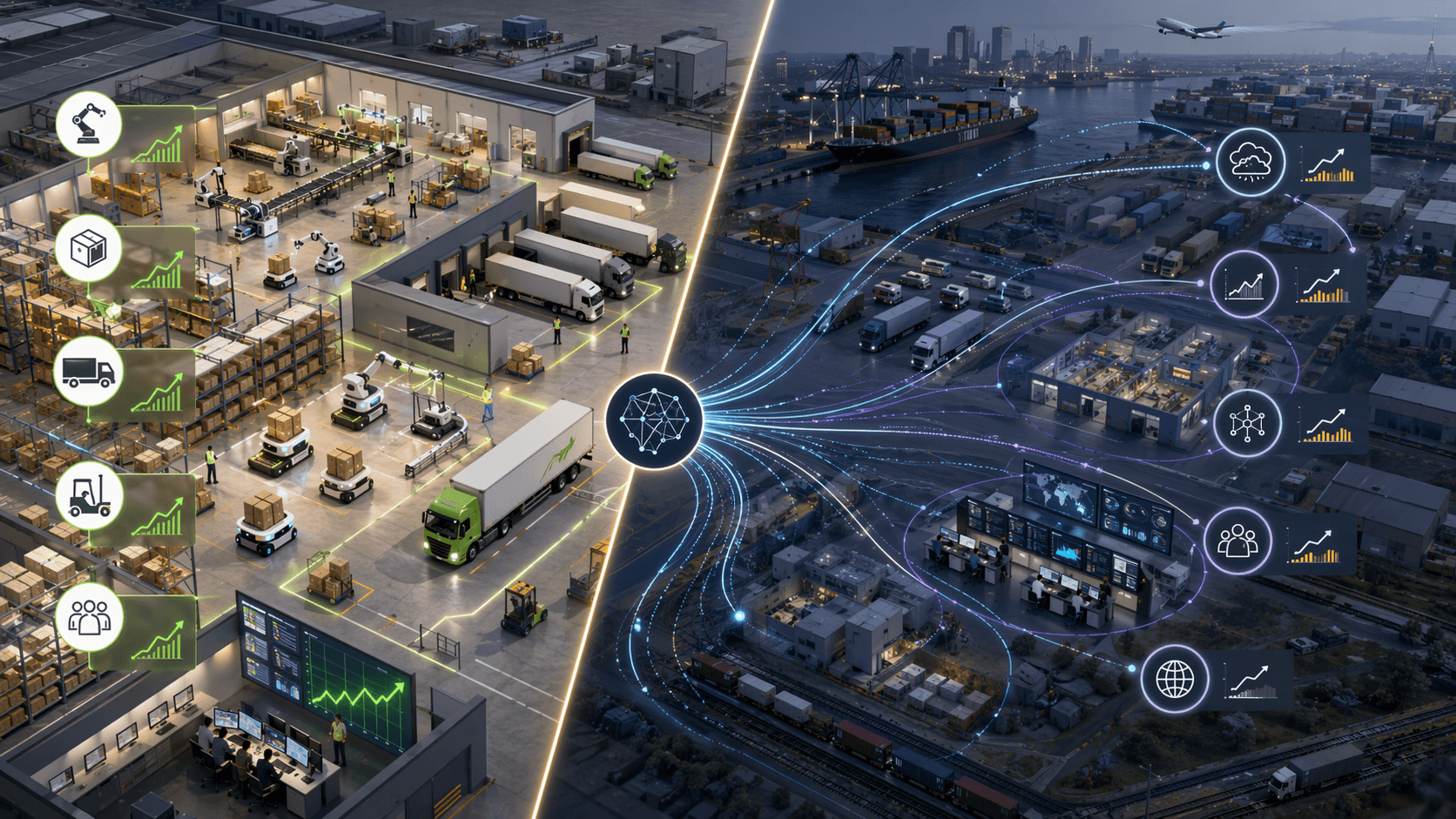
ROI benchmarks across nine logistics ML application areas
The table below is intentionally uneven. Some use cases have named-company evidence and visible operating metrics. Others rely more heavily on commercial software reporting or industry examples. That does not make the weaker evidence useless, but it does change how much confidence a finance team should place in a payback assumption.
| Application area | Reported ROI or cost impact | Payback expectation | What must be true for the ROI to show up | Source caveat |
|---|---|---|---|---|
| Route optimization | 10–30% logistics cost reduction; 15–30% CO₂ reduction. UPS ORION is reported to save $300–400 million annually in fuel, labor, and vehicle wear.[2] | Near-term candidate when dispatch, telematics, and route execution data are usable; often easier to defend than broader orchestration. | Accurate order, stop, constraint, vehicle, driver-hour, fuel, and traffic inputs; dispatchers must actually use the recommendations. | Strong operational logic and named-company evidence, but company-reported case results should not be treated as a universal savings rate. |
| Warehouse automation and robotics | 2–3× picks per hour, 50% cut in order cycle time, and 99.5%+ fulfillment accuracy are reported across warehouse ML and automation use cases; DHL has reported deploying 5,000 warehouse bots with a 50%+ increase in collection efficiency.[3][4] | Near-term to mid-term, depending on facility layout, labor availability, WMS integration, and changeover disruption. | High-enough volume, stable SKU movement patterns, good location data, and operational discipline around exception handling. | Named deployment evidence is useful, but older baselines and site-specific layouts can overstate transferability. |
| Demand forecasting | 8–20% accuracy improvement over traditional methods; Amazon regional forecasting improvement reported at 20%.[3][5] | Mid-term: returns depend on whether forecast gains reduce expediting, stockouts, labor imbalance, or excess inventory. | Clean demand history, promotion and seasonality signals, regional granularity, and a planning process willing to override old rules. | Accuracy improvement is not the same as financial ROI unless planning decisions change. |
| Inventory management | 20–35% inventory reduction and a 35% decrease in excess stock are reported for ML-enabled inventory optimization.[5] | Mid-term: often meaningful for working capital, but payback depends on replenishment authority and service-level constraints. | Reliable inventory records, lead-time data, supplier performance data, SKU segmentation, and agreement on service-level trade-offs. | The financial value is clearer when reductions affect carrying cost and obsolescence, not merely a dashboard metric. |
| Shipment tracking and ETA prediction | AI/ML ETA models are reported to improve ETA accuracy by 32%, reduce dwell times by 30%, and cut late penalties by 25%.[3] | Near-term to mid-term when penalties, detention, appointment failures, or customer-service contacts are material cost lines. | Event-level tracking, carrier updates, geolocation data, yard and facility dwell data, and customer-facing workflow adoption. | Useful operational metrics, but the ROI depends on whether better predictions trigger earlier intervention. |
| Predictive maintenance | Reported reductions include fleet downtime by up to 50% and maintenance costs by 40%.[3] | Longer-payback candidate, often closer to the 2–4 year AI ROI window when sensor coverage and maintenance records are immature.[1] | Consistent asset history, fault codes, work orders, parts usage, mileage or hours, inspection records, and maintenance-process compliance. | High upside, but vendor and consulting claims need baseline scrutiny because savings depend heavily on current maintenance maturity. |
| Dynamic freight pricing | Maersk Spot is reported to have reduced booking rollings to 1.5% versus earlier baselines.[3] | Conditional: can be valuable where price, capacity, and service commitments are actively managed, but less universal than routing or warehouse labor savings. | High-quality lane history, capacity signals, customer segmentation, booking behavior, market-rate data, and commercial governance. | A strong case example does not establish an average ROI range across all freight networks. |
| Fraud detection and billing anomaly detection | Hybrid AI models are reported to reach 93% accuracy in detecting logistics billing and invoicing fraud.[3] | Conditional: ROI is faster where leakage, duplicate billing, accessorial disputes, or invoice complexity are material. | Labeled historical disputes, invoice line-item detail, carrier contracts, accessorial rules, and review workflows. | Accuracy is not equal to recovered cash; false positives and investigation cost must be included. |
| Return logistics | ML classification models are reported to reduce return processing costs and speed triage.[3] | Conditional to longer-term: strongest where return volumes are high and disposition decisions affect resale value, labor, or write-offs. | Reason codes, product condition data, customer history, disposition outcomes, refurbishment rules, and warehouse execution integration. | Evidence is directionally useful but less quantified than route optimization, warehouse automation, or inventory optimization. |
The source quality matters as much as the number. UPS, DHL, Amazon, and Maersk examples help because they attach ML to visible operating outcomes. They still come with transfer risk: a parcel giant’s routing baseline, a global integrator’s warehouse network, or a container carrier’s booking platform is not the same starting point as a regional distributor’s mixed fleet and aging WMS.
Commercial software and consulting sources can be useful for cataloging use cases, especially where independent public audits are thin. They should be treated differently from audited savings or analyst-supported benchmarks. A CFO will usually accept a vendor statistic as a hypothesis to test, not as the final business case.
Why average ROI is the wrong planning unit
The ML-in-logistics market is large enough to explain why boards and executive teams are paying attention. GM Insights values the machine learning in logistics market at $4.3 billion in 2025 and projects a 26.7% CAGR through 2035.[5] That is a narrower scope than broader AI-in-supply-chain market estimates, including a $9.94 billion 2025 figure cited in supply chain AI statistics roundups.[1]
Those two figures can sit in the same market discussion, but not in the same ROI denominator. “AI in supply chain” can include planning copilots, procurement analytics, control tower assistants, supplier risk tools, and generative AI workflows. “ML in logistics” is narrower: routing, warehouse movement, shipment prediction, asset maintenance, freight decisions, inventory flow, returns, and billing anomalies. Mixing the two creates a budget narrative that sounds bigger while becoming less useful.
The same caution applies to ROI averages. A portfolio average hides the fact that route optimization may touch miles and hours quickly, while predictive maintenance may first require sensor coverage, maintenance coding discipline, and enough failure history to train a useful model. If both are described as “AI logistics ROI,” the budget conversation loses the timing risk.
The first candidates: route optimization and warehouse automation
Route optimization usually deserves the first look because the business case has fewer translation steps. If a model reduces miles, idle time, failed delivery sequencing, or unnecessary driver hours, the savings path is visible. Fuel, labor, maintenance, service reliability, and vehicle wear are already in the operating budget.
That is why the UPS ORION example remains so useful despite the usual caution around company-reported results. A reported $300–400 million annual savings figure is not a template for another fleet, but it shows the right kind of cost exposure: many vehicles, many stops, high route density, and enough operational consistency for better sequencing to matter.[2] The percentage range attached to route optimization—10–30% logistics cost reduction—should be tested against those exposure points, not copied into a spreadsheet as a default.[2]
A route optimization business case should therefore start with a few plain questions: how many paid miles are avoidable, how often dispatchers override optimized routes, which constraints are hard rules, and whether the organization can measure the before-and-after by lane, driver, facility, or customer segment. The model is not the entire investment. The investment includes telematics quality, dispatch workflow, driver acceptance, exception management, and the willingness to retire old routing habits.
Warehouse automation has a similarly finance-friendly profile when the facility has the volume to justify it. Picks per hour, order cycle time, fulfillment accuracy, walking distance, overtime, and temporary labor are not abstract benefits. They are operational lines that already have owners.
Reported warehouse automation benchmarks—2–3× picks per hour, a 50% order-cycle-time reduction, and 99.5%+ fulfillment accuracy—are compelling because they connect machine learning, robotics, and execution software to throughput and error reduction.[3] DHL’s deployment of 5,000 warehouse bots and reported 50%+ collection-efficiency improvement adds scale evidence, though facility mix and process baseline matter heavily.[4]
The main underwriting question is not whether robots can move faster than people walking long pick paths. They often can. The question is whether the site has enough repeatable volume, clean location data, slotting discipline, WMS integration, and maintenance support to keep the automation productive after the launch team leaves.
For teams validating these claims against deployment evidence, real company AI supply chain ROI examples are the better next stop than another generic market forecast.
The middle band: strong returns, more conditions
Demand forecasting, inventory management, ETA prediction, and predictive maintenance are not second-tier because they are less important. They are conditional because the savings path usually runs through more systems and more human decisions before it reaches the P&L.
Demand forecasting and inventory management
Forecasting improvements are easy to admire and easy to overvalue. An 8–20% accuracy improvement over traditional methods, or Amazon’s reported 20% improvement in regional forecasting, only becomes ROI if it changes replenishment, labor planning, transportation planning, or customer-service outcomes.[3][5]
A forecast can be statistically better and financially irrelevant if planners continue to pad safety stock, if suppliers cannot respond inside lead times, or if commercial teams override the signal for service reasons. The finance case should therefore identify the decision that changes: fewer expedites, lower overtime, fewer lost sales, less obsolescence, or more stable replenishment.
Inventory optimization has a clearer working-capital hook. Reported 20–35% inventory reductions and a 35% decrease in excess stock can be meaningful, especially where slow-moving SKUs, long lead times, and service-level promises have accumulated into bloated buffers.[5] But inventory reduction is not automatically savings. The organization has to release cash without increasing stockouts or pushing risk upstream to suppliers.
Shipment tracking and ETA prediction
ETA prediction sits between operational convenience and hard-dollar savings. The reported improvements are attractive: 32% better ETA accuracy, 30% lower dwell time, and 25% fewer late penalties.[3] The business case is strongest where the company pays for lateness, detention, failed appointments, customer-service escalation, or missed labor windows.
The important distinction is prediction versus intervention. A dashboard that predicts a late arrival does not save money by itself. Savings appear when the team can rebook a dock appointment, alert a customer before a penalty event, adjust labor, resequence a route, or intervene with a carrier early enough to change the outcome.
Predictive maintenance
Predictive maintenance has one of the more tempting upside stories: reported reductions of fleet downtime by up to 50% and maintenance costs by 40%.[3] The caution is timing. The value depends on asset data, maintenance history, fault-code quality, parts records, mileage or engine-hour data, inspection records, and the discipline to change maintenance schedules when the model signals risk.
A fleet with mature telematics and well-coded work orders can move faster than a fleet where breakdown notes live in free-text fields and shop processes differ by location. In the second case, the first year may look less like AI ROI and more like data remediation, integration, and process standardization. That work may be necessary, but it should not be sold as a quick win.
Readers building CFO-facing timing assumptions can compare these categories against broader AI supply chain ROI timelines and benchmarks before treating a 12-month payback as realistic.
The compact cases: pricing, fraud, and returns
Dynamic freight pricing can be valuable, but it is not a universal first project. It requires enough transaction volume, rate volatility, capacity constraint, and commercial authority to let price recommendations affect behavior. The Maersk Spot example—booking rollings reportedly reduced to 1.5% versus earlier baselines—is useful because it links pricing and capacity commitment to a service outcome.[3] It does not prove that every shipper or broker has the same opportunity.
Fraud and billing anomaly detection is similar. A reported 93% detection accuracy for hybrid AI models sounds strong, but recovered value depends on the size of leakage, the quality of labeled historical disputes, and the cost of investigating false positives.[3] In a network with complex accessorials, duplicate billing risk, and weak invoice controls, the project can be practical. In a cleaner environment, it may be a useful control rather than a major ROI driver.
Return logistics belongs in the benchmark because returns are expensive and time-sensitive, especially where disposition determines resale value. But the public ROI evidence is thinner. ML classification can speed triage and reduce processing cost, yet the business case should stay close to the actual return profile: volume, product condition variability, refurbishment cost, resale windows, and warehouse handling constraints.[3]
Data readiness explains why the same tool produces different paybacks
Two companies can buy the same class of ML tool and report completely different ROI timelines because they are not really buying the same project. One is adding a model to a disciplined operating system. The other is funding data cleanup, master-data reconciliation, legacy integration, workflow redesign, and change management before the model can matter.
The constraint is not theoretical. Logistics leaders cite data quality and legacy integration as major barriers, with 40% pointing to data quality and 56% citing legacy system integration.[1] Those percentages are often the missing explanation behind failed ROI comparisons. A routing model with clean stop data and telematics is a different investment from a routing model that first has to correct addresses, service-time assumptions, fleet availability, and driver constraints.
For a practical business case, each use case should be scored before vendor selection on five readiness questions:
- Is the cost line measurable today, or will the project first need to create the measurement system?
- Does the model affect a decision that operators can change quickly?
- Are the required data fields complete, current, and consistent across sites or lanes?
- Will legacy systems pass recommendations into the workflow, or will users need to copy them manually?
- Who owns the benefit after launch: transportation, warehouse operations, maintenance, planning, finance, or customer service?
If those answers are weak, the benchmark range should be discounted. If they are strong, a logistics team can justify moving faster, especially in routing and warehouse execution where the operating metrics are closer to the model output.
A sequencing view for 2026 budgets
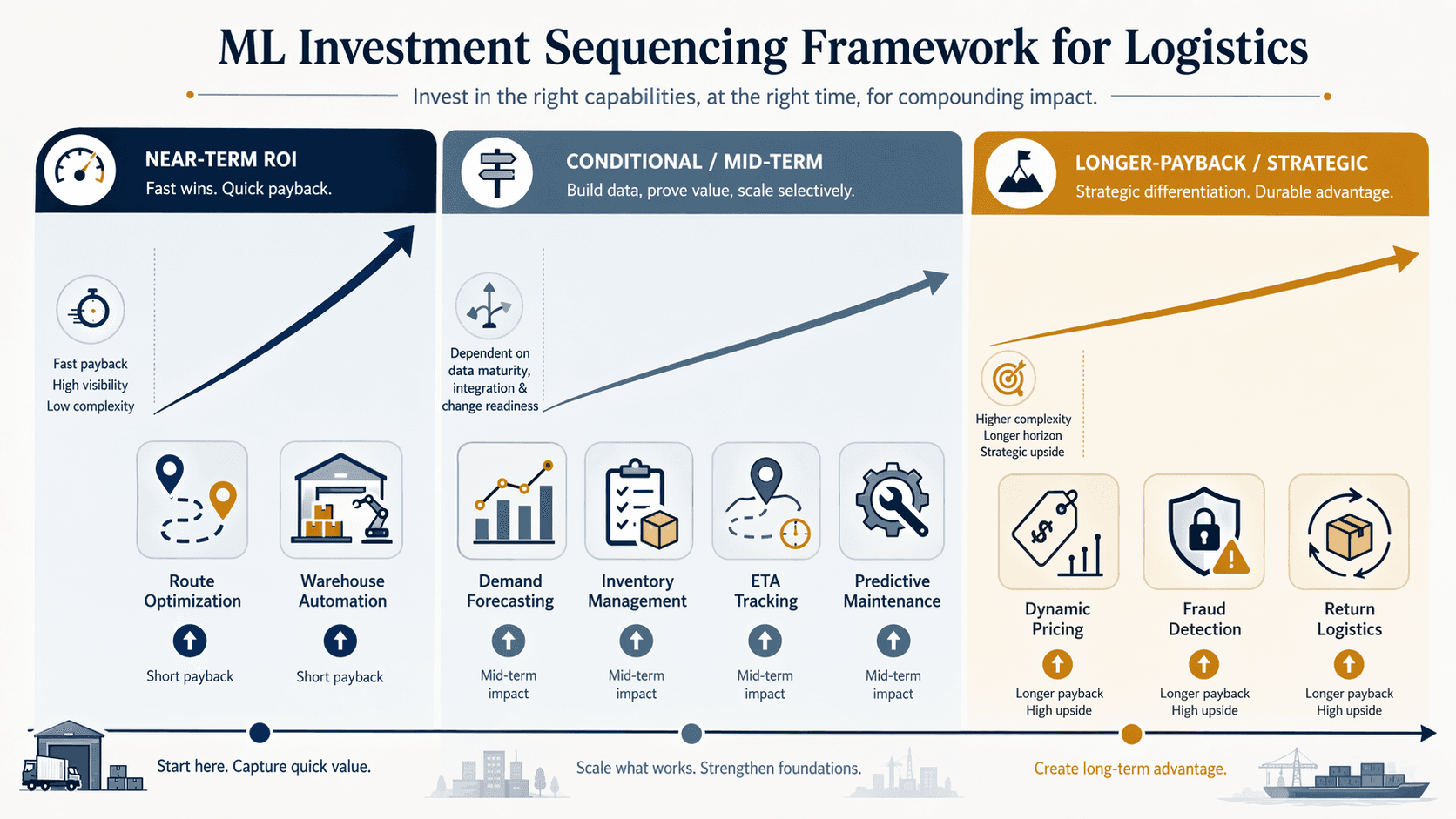
The cleanest sequencing is not the most fashionable one. Start where ML can touch visible cost lines and where the organization can measure the before-and-after without a two-year data program.
| Investment tier | Best-fit use cases | Budget logic |
|---|---|---|
| Near-term ROI candidates | Route optimization; warehouse automation in high-volume facilities | Prioritize when miles, labor hours, picks, cycle time, fuel, and vehicle wear are material and measurable. |
| Conditional mid-term candidates | Demand forecasting; inventory management; ETA and shipment tracking; predictive maintenance in data-ready fleets | Fund when better predictions will change planning, replenishment, intervention, or maintenance behavior. |
| More selective or strategic candidates | Dynamic freight pricing; fraud detection; return logistics; broader supply chain orchestration | Proceed when transaction volume, leakage, return complexity, or network coordination is large enough to justify integration and governance work. |
Route optimization and warehouse automation should usually be tested first when the mandate is near-term ROI. They are not risk-free, but they give finance teams clearer baselines and operators clearer actions. Demand forecasting, inventory, ETA prediction, and predictive maintenance can produce strong returns, yet they need tighter data and stronger process adoption. Dynamic pricing, fraud detection, returns, and orchestration deserve funding when the specific exposure is large enough—not because they sound more strategic.
Once the benchmark case is approved, the work shifts from comparison to execution. A phased plan for data, integration, pilot design, and operating ownership belongs in the implementation roadmap, not in the ROI table. For that next step, use a phased machine learning logistics implementation roadmap before expanding from the first use case into a portfolio.
References
- Supply Chain AI Statistics: 18+ Statistics You Should Know for 2026 — OpenSky Group
- Deploying AI Assistants for Logistics – A 3x ROI Journey — ITMTB
- Machine Learning in Logistics: 9 Real-Life Use Cases — SoftTeco
- How artificial intelligence is transforming logistics — MIT Sloan
- Machine Learning in Logistics Market Size, Growth Trends 2035 — Global Market Insights
- How Machine Learning Will Transform Supply Chain Management — Harvard Business Review, 2024
Comments
Join the discussion with an anonymous comment.