
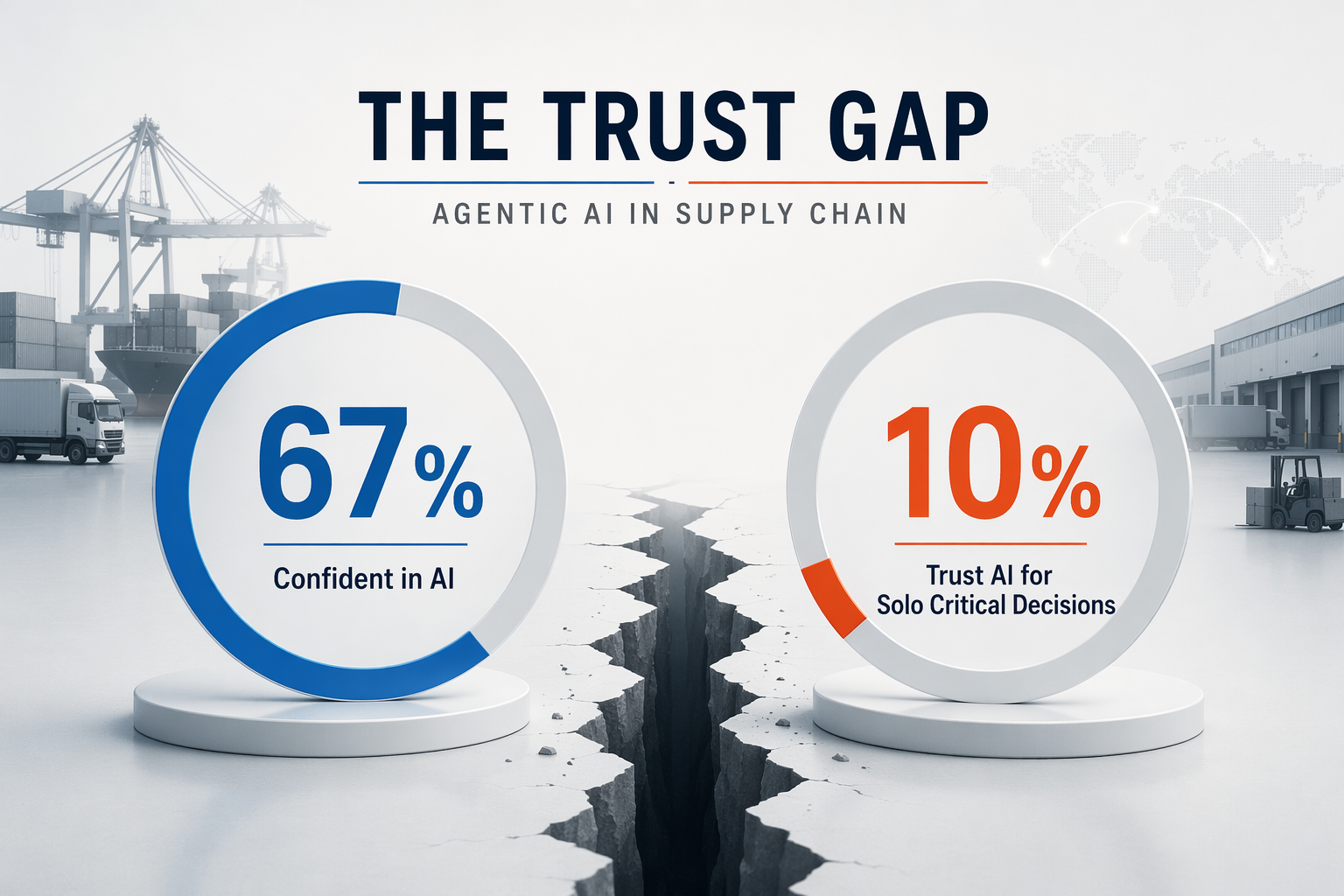
The most useful number in the agentic AI debate is not a market forecast. It is the gap between confidence and permission. In 2026, 67% of supply chain leaders say they are more confident in AI than they were last year, yet only 10% trust AI to make critical decisions without human review. Another 54% prefer a human-in-the-loop model.[1] That is not a footnote to the story of the AI-driven supply chain. It is the operating constraint.
The phrase “digital colleague” can sound inflated until it is tested against that constraint. A colleague does not simply act. A colleague knows the plan, sees the exception, understands the boundary of their authority, and escalates before the cost of being wrong compounds across planning, procurement, transportation, inventory, and customer service. That is the standard agentic AI has to meet if it is going to move from demos into production supply chain work.
The answer, then, is not that AI agents are ready for every critical supply chain decision. They are ready for narrower work: repetitive execution, structured exception handling, and decision preparation inside governed limits. The inflection in 2026 is real, but it is not the arrival of full autonomy. It is the moment when more organizations start treating agents as accountable operating components rather than experimental assistants.
The market is moving faster than the trust model
There is enough market signal to take agentic AI seriously. Gartner, cited by Deloitte, expects 40% of enterprise applications to integrate task-specific AI agents by the end of 2026, up from less than 5% today.[2] Deloitte also reports that over half of surveyed supply chain executives say they are deploying AI agents to automate workflows.[2] Those figures matter because agents are not being discussed only as stand-alone technology; they are being built into the applications where planners, buyers, schedulers, and logistics teams already work.
Investment intent is moving in the same direction. RELEX reports that 71% of supply chain leaders plan to invest in generative AI over the next three to five years, up 12 percentage points from 2025.[3] BCG’s longer-range value case is also substantial: it projects that AI-first supply chains can reduce working capital by up to 30% and lift EBITDA by 2 to 4 percentage points.[4]
Those numbers are useful as directional evidence, not as proof that any given deployment will pay back. Supply chains do not become self-managing because an analyst forecast crosses a threshold. They change when a decision loop gets shorter, a handoff disappears, a bottleneck is surfaced before escalation meetings start, or a buyer can move from supplier comparison to approved award faster without losing control of the decision trail.
That distinction is important because agentic AI is arriving through familiar enterprise channels. A task-specific agent embedded in a planning platform, procurement suite, transportation system, or control tower can look less dramatic than the language around it. The practical question is not whether the agent can “reason.” It is whether the workflow gives it enough context, constraint, and escalation logic to act safely.
What changes when the agent stops waiting to be asked
Traditional dashboards wait for a human to notice. Copilots help when someone asks a question. An agentic system is different because it can monitor a condition, decide that a task should start, assemble inputs, execute a bounded action, and route exceptions to a human reviewer. In supply chain operations, that difference is not cosmetic. It changes who is watching the queue.
A demand planner does not need another screen that confirms a forecast exception after the weekly cycle has already moved on. A procurement team does not need a chatbot that summarizes supplier history if the buyer still has to manually launch every request, chase every response, normalize every quote, and rebuild the comparison pack. A logistics manager does not need autonomy theater; they need a system that identifies a shipment at risk, checks approved mitigation options, and escalates only when the next action exceeds policy or cost tolerance.
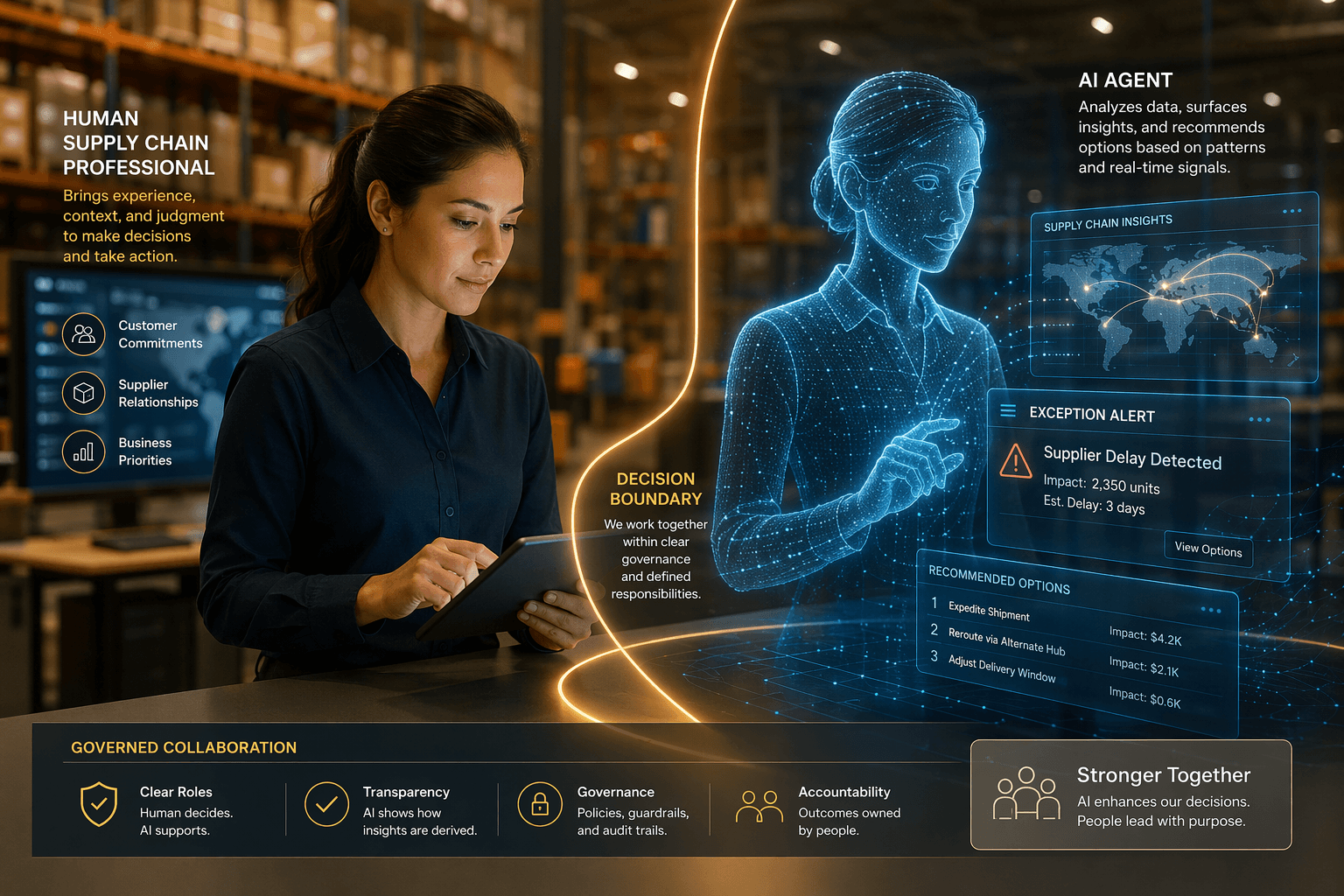
This is where agentic AI earns the “digital colleague” label, if it earns it at all. The agent has to share the operating context, not merely generate text about it. It has to preserve a record of what it saw, what it did, what rule or threshold it applied, and where it stopped. The stopping point is as important as the action.
The procurement case is more persuasive than the forecast
The clearest evidence for agentic AI in supply chain is not a grand prediction about autonomous networks. It is a narrower procurement case. Mathnal Analytics reports an agentic AI procurement deployment in which the RFQ cycle was reduced by 70% and purchase cost was reduced by 6.2%.[5]
That should not be read as an industry benchmark. It is one documented case, and procurement categories, supplier markets, data quality, approval rules, and commercial leverage vary too much to generalize the percentages. But the case is useful because it shows the shape of a plausible agentic workflow: the agent can help prepare or run the RFQ process, structure supplier inputs, compare responses, and support award decisions inside a defined business process.
The operational value is not that the agent replaces procurement judgment. The value is that it compresses the work surrounding judgment. Buyers often lose time before the real decision begins: clarifying requirements, finding eligible suppliers, preparing bid packages, following up on missing responses, formatting comparisons, and documenting why a recommendation is credible. If an agent removes drag from those steps while keeping award authority and exception review with the right human owner, the cycle time improvement is believable in a way that broad autonomy claims often are not.
This is the kind of deployment that fits the 2026 trust reality. The agent does not need permission to decide the commercial future of a supplier relationship on its own. It needs permission to execute parts of the RFQ process, apply preapproved criteria, flag deviations, and produce a clean record for review.
Bounded autonomy is an operating design, not a compromise slogan
The trust gap becomes easier to work with once autonomy is treated as a design choice rather than a binary yes-or-no decision. In supply chain operations, the useful boundary is usually not between “AI” and “human.” It is between actions that are reversible, rule-bound, and low-risk, and decisions that carry strategic, financial, service, safety, or supplier-relationship consequences.
| Work type | Agent role | Human role |
|---|---|---|
| Routine execution | Run approved steps, update records, trigger standard follow-ups | Set policy and review performance |
| Structured exception | Detect threshold breach, prepare options, recommend next action | Approve, reject, or modify the recommendation |
| Critical decision | Gather facts, model scenarios, document trade-offs | Make the decision and remain accountable |
| Unclear or novel situation | Stop, explain uncertainty, escalate with context | Interpret the situation and define the next rule or boundary |
This table is not a maturity model. It is a practical way to avoid putting the wrong work into the wrong permission zone. Many organizations can safely let an agent chase missing supplier documents, draft a carrier exception summary, or prepare replenishment actions for human review before they should let it commit capacity, switch suppliers, allocate constrained inventory, or override a service policy.
Bounded autonomy also changes the implementation conversation. The first question is not “How smart is the model?” It is “What is the agent allowed to do when it is confident, what must it do when it is uncertain, and who owns the result?” If those answers are vague, the remedial work will land on planners, buyers, analysts, and logistics coordinators after the agent has already created noise in the system.
Where agents belong first
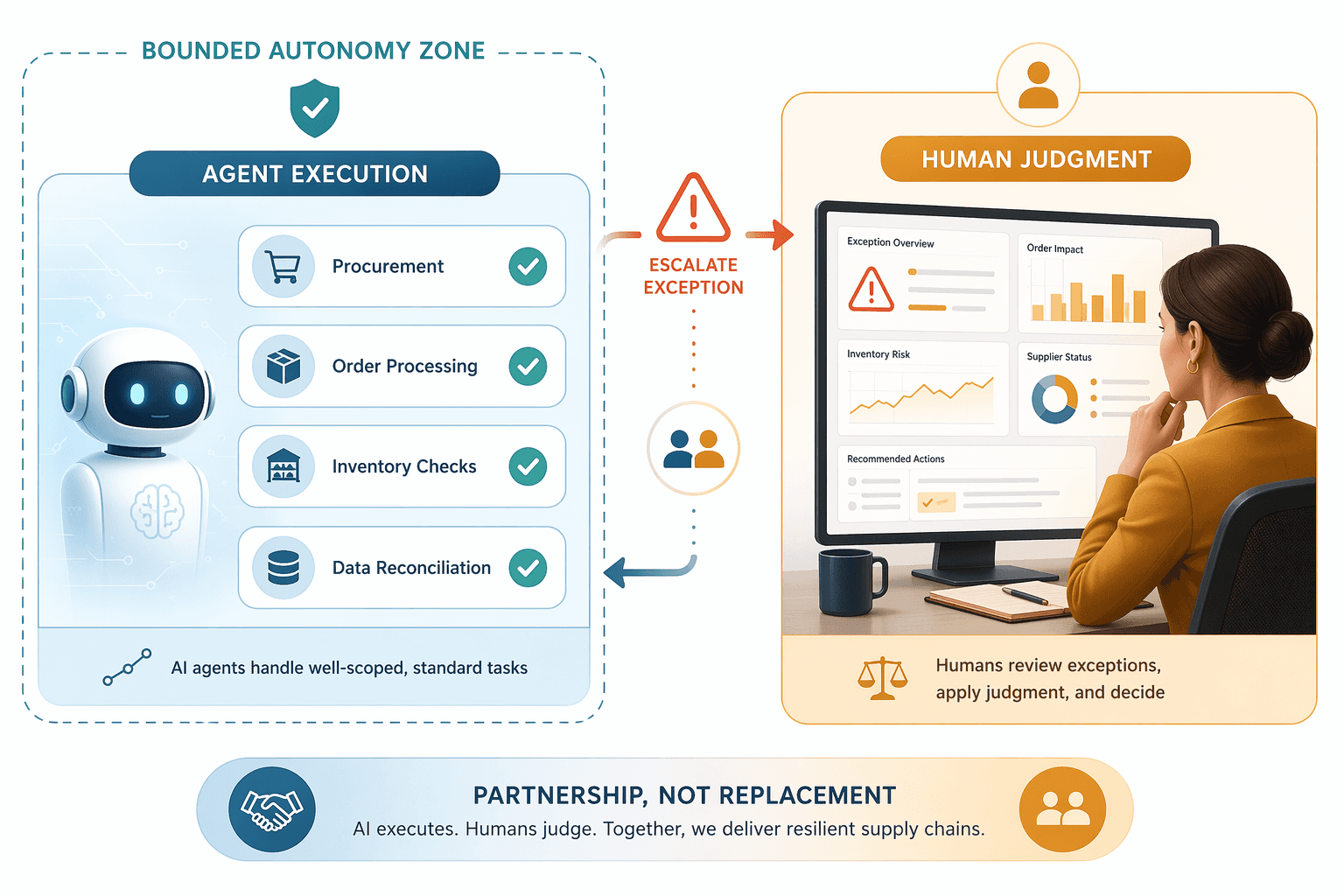
The first production homes for agentic AI should be workflows where the system can act on abundant context, narrow authority, and visible exceptions. That points to areas such as procurement process execution, supplier follow-up, inventory exception triage, logistics disruption preparation, master data cleanup queues, and planning-cycle administration. These domains may be operationally important, but not every step inside them is a critical decision.
Procurement is a natural early candidate because the process contains many structured handoffs before judgment is required. Logistics is another candidate, especially where agents can monitor events, compare them against service or cost thresholds, and prepare mitigation options. Planning can benefit when agents manage the work around the plan: detecting exceptions, assembling causal signals, prompting owner review, and documenting changes.
The wrong starting point is a high-consequence decision with weak data lineage and unclear ownership. If the organization cannot explain which data the agent used, which policy it applied, and why it escalated or did not escalate, it has not created a digital colleague. It has created another opaque dependency for the operations team to police.
For readers looking for the more skeptical use-case filter, the companion analysis on what actually works in agentic AI for supply chain in 2026 is the right counterweight. For teams already designing permission levels, the practitioner’s guide to graduated autonomy goes deeper into governance tiers.
The escalation path is the product
A supply chain agent’s escalation behavior deserves as much design attention as its execution behavior. When an agent finds a late inbound shipment, a supplier quote outside tolerance, a demand spike, or a replenishment conflict, it should not merely notify a channel and hope someone catches it. It should route the issue to the accountable owner with the relevant context: what changed, what options were checked, what policy threshold was crossed, what the likely consequence is, and what decision is now required.
This is also where auditability becomes operational rather than bureaucratic. If a buyer approves an agent-prepared recommendation, the approval record should show the recommendation, the evidence, the alternatives considered, and any override. If a planner rejects an exception proposal, that rejection should become part of the learning record. If the agent acted within policy, the organization should be able to see which policy authorized the action.
Without that trail, accountability becomes theatrical. The organization says the human is in control, but the human is left reconstructing what the system did after the fact. That is exactly the failure mode supply chain teams will not forgive, because they inherit the late shipments, missed buys, excess inventory, service misses, and supplier confusion.
What the long-range predictions do and do not prove
The forward-looking predictions are striking. Gartner predicts that 15% of daily logistics decisions will be made autonomously by 2028.[2] It also expects 50% of cross-functional supply chain management solutions to use intelligent agents to autonomously execute decisions by 2030, and projects that 60% of disruptions will be resolved without human intervention by 2031.[2][3]
Those are trajectory signals, not current-state measurements. They suggest that autonomy will move deeper into logistics, planning, and cross-functional execution over the next several years. They do not prove that today’s organization should hand over critical decision rights before its process controls, data quality, exception taxonomy, and accountability model are ready.
The more useful reading is that the window for design choices is narrowing. If enterprise applications are embedding task-specific agents now, supply chain leaders will soon inherit agent capabilities whether or not they have built a governance model for them. The risk is not only moving too fast. It is also discovering too late that agents are already operating inside workflows with inconsistent rules, unclear escalation paths, and no shared definition of acceptable autonomy.
The 2026 answer: digital colleagues, under supervision
AI agents are ready to become digital colleagues in supply chain operations where the work is scoped, the risk is bounded, and the human accountability chain remains intact. They are not ready to be treated as independent executives of the supply chain. The 67% confidence figure says leaders have seen enough progress to keep investing. The 10% solo-decision trust figure says they still know where the line is.[1]
That line should not be blurred for the sake of sounding advanced. A useful agent can monitor, initiate, compare, recommend, execute approved actions, and escalate. A trusted agent can also explain why it acted, show where it stopped, and leave a record that a human owner can defend. In supply chain, that is not a conservative posture. It is how autonomy survives contact with operations.
So yes, 2026 is an inflection point for agentic AI in supply chain. But the organizations that benefit will not be the ones that announce the broadest autonomy mandate. They will be the ones that give agents real work inside defined decision boundaries, measure the loop they actually shorten, and make escalation a first-class part of the design.
References
- Supply chain AI in 2026: The numbers behind the hype, RELEX.
- Resilient by design: The agentic supply chain, Deloitte, 2026.
- 2026 State of the Supply Chain report, RELEX, 2026.
- How AI Agents Are Transforming Supply Chains, BCG, 2026.
- Supply Chain AI Case Studies — Quantified ROI & Outcomes, Mathnal Analytics.
Comments
Join the discussion with an anonymous comment.