

The practical question around artificial intelligence and procurement is no longer whether an AI tool can draft a supplier email or summarize a contract clause. Procurement teams have had enough copilots to know the limits of assistance that waits for a human prompt, forgets the state of the process, and leaves the next handoff sitting in someone’s inbox. The operating-model shift begins when an agent can hold context, act across systems, complete bounded work, and stop when the exception belongs with a buyer, category lead, AP analyst, or compliance owner.
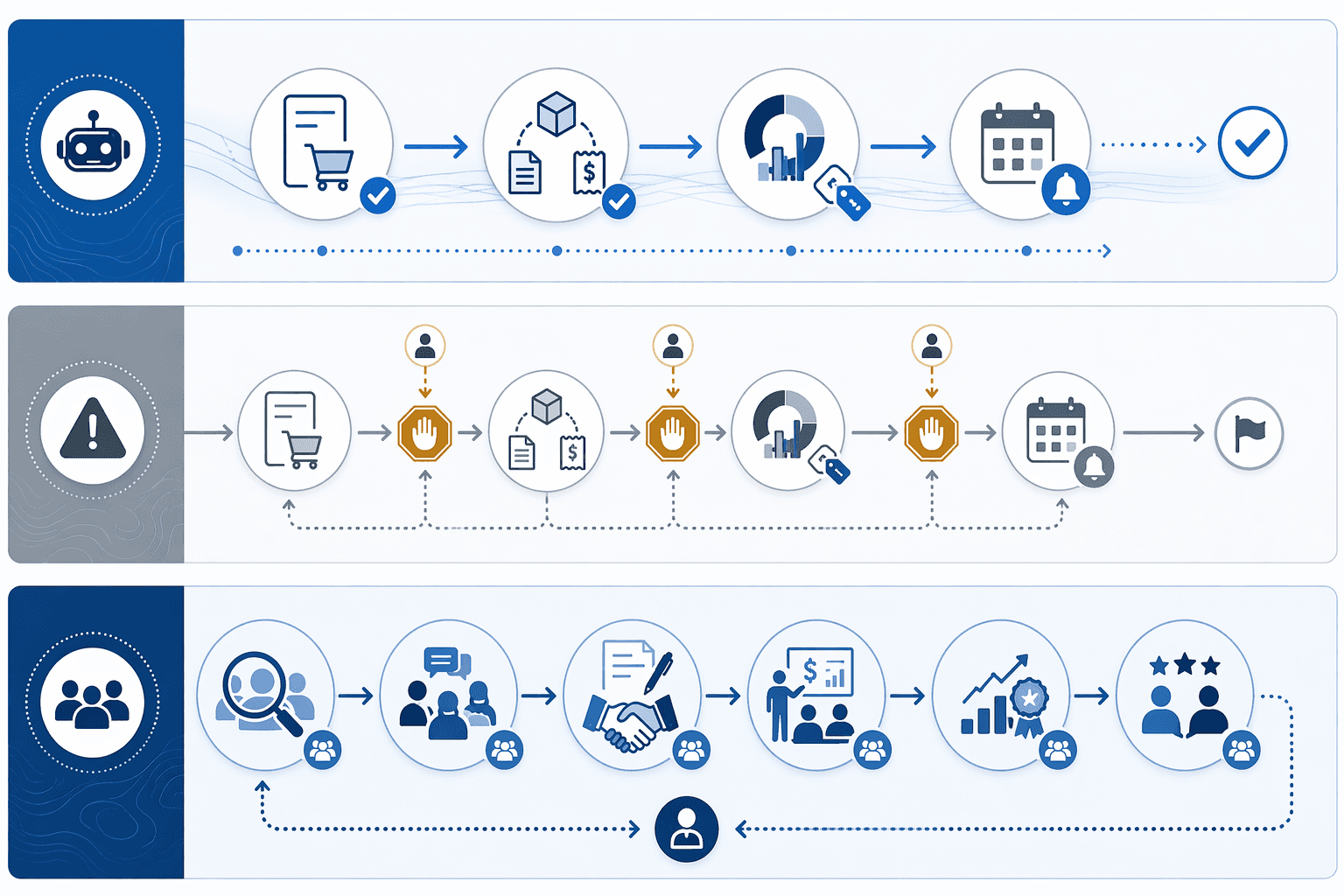
Oliver Wyman’s March 2026 lane-based model is useful because it starts in the right place: not with the agent, but with the work. It separates procurement activities by repeatability, risk, judgment, and exception profile, so leaders can decide which lanes should run autonomously and which should remain gated or human-led. The model places work such as PO creation, three-way matching, spend classification, and contract renewal alerts in standard lanes that can move toward touchless execution, while strategic sourcing, complex negotiations, and supplier relationship management remain human-led or tightly gated. Oliver Wyman reports that global retailers, energy companies, financial services firms, and manufacturers are already seeing measurable and scalable benefits from this kind of lane-based approach.[1]

That distinction matters because adoption statistics can make the market sound more mature than the average procurement operating model actually is. The Hackett Group’s 2026 Key Issues Study says 56% of procurement organizations have deployed agentic AI, but deployment can include a wide range of maturity levels, from controlled pilots to production workflows.[2] A vendor-sponsored Icertis study, cited by Art of Procurement, found that 90% of procurement leaders were implementing or planning AI agents over the next 12 months; that is a strong signal of urgency, but planning, piloting, and granting production autonomy are still different states.[3]
The first design move, then, is to stop treating “autonomous procurement” as one destination. A source-to-pay process contains several kinds of work. Some of it is predictable and policy-bound. Some of it is repetitive until a tolerance breaks. Some of it is commercially sensitive, supplier-facing, or judgment-heavy from the beginning. A lane model makes those differences visible before the program team starts buying platforms, redesigning roles, or promising touchless processing.
The lane model starts with what can safely repeat
Standard lanes are where agentic AI earns the right to be taken seriously. These are not the glamorous parts of procurement, but they are where the function loses an enormous amount of capacity: purchase order creation after an approved requisition, invoice matching within agreed tolerances, supplier reminders for missing documentation, spend classification using established taxonomies, contract renewal alerts, and policy checks against known thresholds.
| Procurement lane | Typical work | Autonomy design |
|---|---|---|
| Standard transactional lane | PO creation, three-way matching, spend classification, renewal alerts | Agent executes within rules and logs action history |
| Exception-gated lane | Price variance, missing receipt, unusual supplier risk signal, policy threshold breach | Agent prepares evidence and routes to a named human gate |
| Strategic or relationship-led lane | Complex sourcing, negotiation strategy, supplier relationship management | Human owns decision; agent supports analysis and follow-through |
A standard lane is not “low value” work. It is work where the value comes from consistency, speed, and clean control. If a PO is generated from an approved requisition, within budget, against a known supplier, under a policy threshold, and with no blocked-risk indicators, the buyer does not add much by manually re-keying or chasing the same fields. The better design is for the agent to create the PO, record the basis for the action, notify the relevant parties, and leave a reviewable trail.
Three-way matching belongs in the same conversation. An AP analyst should not spend the day confirming invoices that match purchase orders and receipts inside defined tolerances. The agent can compare the documents, apply tolerance rules, clear the item, or package the exception. The analyst’s time is better spent on the cases where the quantity does not match, the receipt is missing, the supplier changed banking details, or the policy logic is unclear.
Spend classification is another strong candidate, provided the taxonomy is governed. A stateful agent can classify transactions, remember prior corrections, flag ambiguous categories, and escalate when the classification affects reporting, savings attribution, or compliance obligations. The category manager should not become a passive approver of every line. The category manager should see the items where classification changes a decision.
Human gates should be specific, not symbolic
The weakest version of human-in-the-loop design is a vague promise that “someone will review exceptions.” In procurement, that is not enough. The operating model needs to specify which event creates the exception, who receives it, what evidence the agent must provide, what decision rights the reviewer has, and what happens if the reviewer does not act.
A price variance might route to procurement operations if it sits inside a small tolerance band, to the category manager if it changes negotiated terms, and to finance if it affects accruals or payment timing. A supplier risk alert might be informational at one severity level, block an award at another, and require legal or compliance review at a third. The lane design has to encode those differences before agents begin moving work across ERP, contract lifecycle management, sourcing, supplier risk, and AP systems.
This is where the shift from copilot to agent becomes operationally important. A copilot may draft a recommendation for a buyer. A persistent agent can monitor the requisition, check supplier status, pull contract terms, compare price history, initiate a PO, follow up on missing receipt data, and prepare an exception packet if the invoice fails the match. The gain is not only faster analysis. It is fewer abandoned handoffs.
For broader context on how agentic systems move from pilots to production across the supply chain, see the related discussion of agentic AI in supply chain operations. Procurement, however, has a particular burden: its agents are often acting inside financial controls, supplier commitments, delegated authorities, and audit requirements. That makes the lane boundary as important as the model output.
A glass-box architecture is the control layer
The governance architecture has to be built as a glass box, not a black box with a dashboard attached later. Every agent action should leave an audit trail: what data it used, which policy or threshold it applied, what alternatives it considered if the model supports that visibility, where it escalated, and who approved, overrode, or rejected the recommendation. Without that trail, the saved effort in procurement operations reappears as effort in audit, compliance, supplier dispute management, or finance reconciliation.
SupplyChainBrain and Digicode describe a multi-agent procurement architecture in which a sourcing agent, risk agent, and compliance agent work together with human gateways. The same source projects that by 2028, agents will handle 60% to 70% of end-to-end transactional procurement while humans retain strategic sourcing, complex negotiations, and supplier relationship management.[4] The useful part of that model is not the number of agents. It is the explicit handoff logic: sourcing work does not pass cleanly into execution until risk and compliance conditions are checked, and human review remains attached to defined gateways.
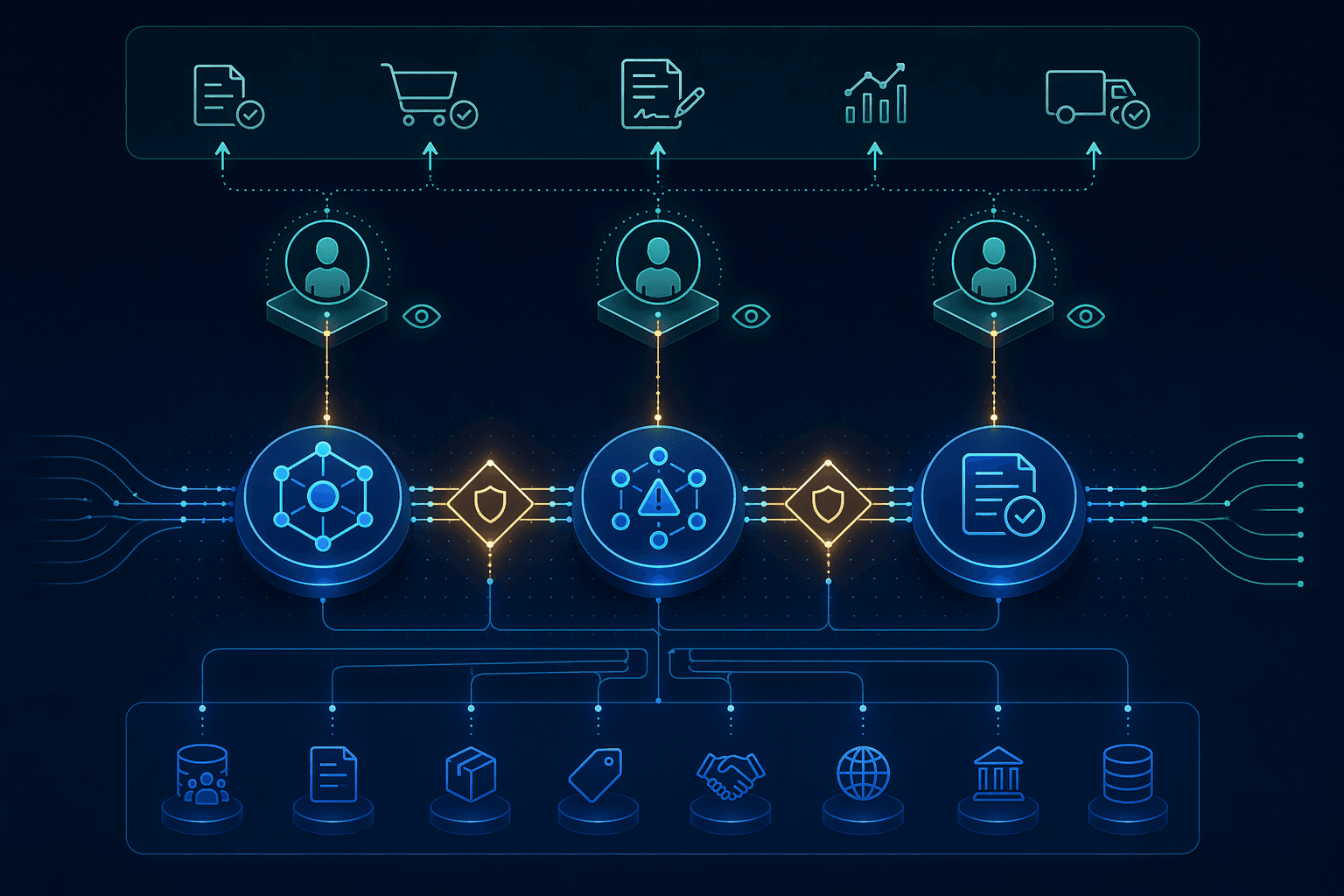
In practice, that might mean a sourcing agent identifies qualified suppliers and prepares an event package. A risk agent checks sanctions, financial health, geography, continuity indicators, or whatever risk feeds the company has approved. A compliance agent tests the proposed action against policy, delegation of authority, contract templates, and required approvals. The category lead sees the recommendation only when the work has been assembled into a decision file, not when the team still has to chase five systems for evidence.
The same pattern applies after award. If an agent recommends moving volume to a supplier, the operating model should show whether that recommendation is informational, requires category approval, requires finance approval, or is blocked until legal review. If a supplier fails to provide documentation, the agent can nudge, remind, and escalate. It should not invent a waiver path because the workflow was designed for speed but not authority.
For teams working through the organizational side of those gates, the related AI procurement change management playbook is a useful companion. The hard part is rarely persuading people that repetitive work should be automated. The harder part is making clear who still owns judgment, escalation, and consequences.
Efficiency estimates are real pressure, not a design substitute
McKinsey has estimated 25% to 40% efficiency improvement through agentic AI in procurement, with 15% to 30% from autonomous category agents specifically.[5] Those ranges are enough to get attention, especially in procurement functions still spending scarce talent on follow-ups, PO corrections, invoice exceptions, and policy policing. They do not tell a CPO which workflow should be touchless next Monday.
The lane model translates efficiency pressure into operating decisions. If a process is high-volume, rules-based, already digitized, and supported by reasonably clean master data, it can move earlier. If the process crosses many systems but has stable decision rules, it may still be a good candidate, provided the integration and audit trail are strong. If the process requires commercial trade-offs, supplier strategy, risk appetite, or negotiation posture, the agent should prepare the work rather than own the decision.
- Move first: repetitive work with clear policy logic, stable data sources, and low downside when the agent follows the rule correctly.
- Gate carefully: work where the agent can detect the issue but a human must decide risk, waiver, timing, or commercial trade-off.
- Keep human-led: supplier strategy, complex negotiation, market-shaping decisions, and relationship management.
- Do not scale yet: workflows where policy is unclear, master data is unreliable, or no one can explain who owns the exception.
This selection discipline also protects the business case. If leaders start with ambiguous work, the agent program becomes a debate about trust. If they start with work that already has clear rules and painful handoffs, the program can prove control, cycle-time reduction, and exception quality before moving into more sensitive lanes.
Build, buy, or partner after the lanes are known
Platform architecture matters, but it should not be the first conversation. A team that has not mapped its source-to-pay lanes will ask software to solve an operating-model problem. Once the lanes are clear, the technology questions become more concrete: which systems must the agent read and write to, which approvals must be enforceable, which actions require explainability, and which audit records must survive the workflow.
The partner option deserves the same discipline. MIT’s 2025 NANDA Initiative found externally partnered AI builds succeed about twice as often as internal builds, but that does not remove the need to define the lanes first.[6] A partner can accelerate integration and deployment; it cannot decide who owns a waiver, an override, or a supplier-facing commitment.
A bolt-on agent may be enough for reminders, document assembly, and low-risk orchestration. A deeper platform integration may be needed when the agent creates POs, changes supplier records, triggers sourcing events, or routes invoice exceptions. The decision is less about whether the tool is labeled agentic and more about whether it can maintain state, honor permissions, expose reasoning, integrate with procurement systems, and stop at the right control point.
For readers comparing architecture choices, the related AI supply chain software comparison goes deeper on platform patterns. In procurement, the shortlist should be tested against lane behavior: can the system execute the standard lane without manual babysitting, package the exception lane with evidence, and leave strategic decisions with the accountable human?
The 2026 to 2028 roadmap is a control sequence
A sensible roadmap does not start with the most impressive demo. It starts with the workflows where the organization can define success and defend the decision trail. Procurement operations, AP-adjacent matching, supplier documentation follow-up, contract renewal alerts, and spend classification often provide better early proof than strategic sourcing autonomy because they expose integration, exception, and audit issues without handing over commercial judgment too early.
| Roadmap phase | Operating-model focus | What must be true before scaling |
|---|---|---|
| Initial production lanes | Standard transactional execution | Rules, thresholds, system access, and audit logs are stable |
| Exception expansion | Human-gated workflows | Escalation rights and decision files are reliable |
| Category support | Analysis, recommendations, renewal signals, supplier options | Category owners can override and explain decisions |
| Scaled agent orchestration | Multi-agent source-to-pay handoffs | Compliance, risk, and finance controls are visible end to end |
Teams that want a more detailed deployment sequence can use a phased implementation roadmap for AI procurement implementation from pilot to scale. The lane model should still remain the organizing logic. A pilot that proves a chatbot can answer policy questions is different from a production lane where an agent creates a PO, updates workflow state, and escalates only when a defined condition breaks.
The final design mandate is straightforward, but not small. Map source-to-pay work into lanes. Move standard, repeatable transactional work toward autonomous execution. Reserve human attention for exceptions, supplier strategy, negotiation, and trade-offs. Build the glass-box controls before scaling agents across systems. Agentic AI does not remove the procurement operating model; it makes the weak parts of that model harder to hide.
References
- How to use agentic AI to boost procurement efficiency, Oliver Wyman, Mar 2026.
- The Hackett Group 2026 Key Issues Study, The Hackett Group.
- State of AI in Procurement in 2026, Art of Procurement.
- Why 2026 Is the Year of AI Agents for Autonomous Procurement, SupplyChainBrain, Apr 2026.
- Making the leap with generative AI in procurement, McKinsey.
- MIT 2025 NANDA Initiative.
Comments
Join the discussion with an anonymous comment.