
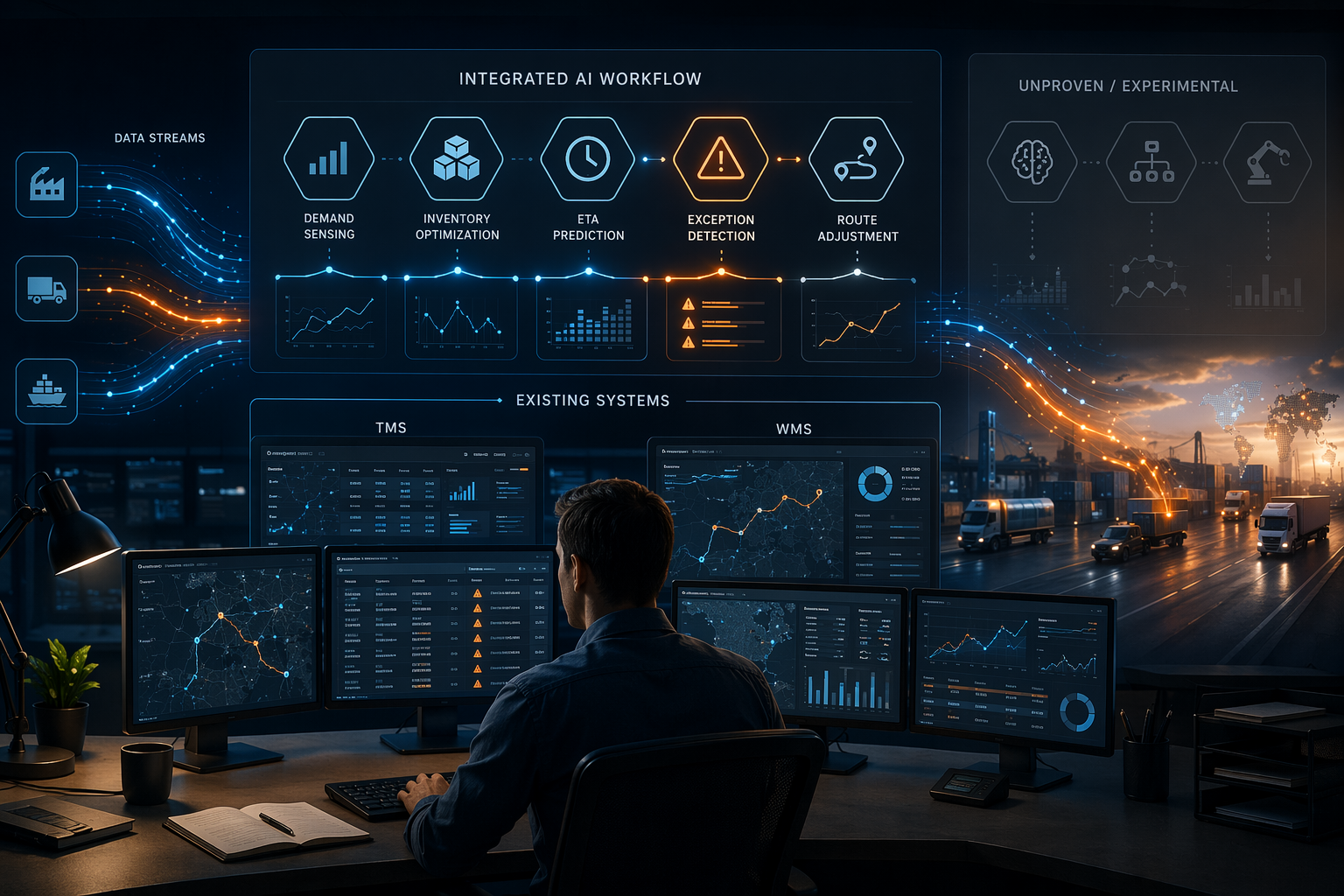
By Q2 2026, the useful question about AI in logistics and supply chain management is no longer whether the technology matters. It is whether a specific application can survive Tuesday afternoon: late tenders, mismatched customs fields, a port delay, a DC short on labor, a planner overriding yesterday’s forecast, and three systems that do not quite agree.
The applications that have held up through 2025–2026 share a plain operating pattern. They refine, flag, match, read, and rebalance inside existing transportation, warehouse, customs, and planning workflows. They do not ask the organization to pretend its master data is clean enough for full autonomy. They make a bounded decision better, then leave a human with the authority to approve, override, or investigate.
That is why the December 2025 ARC Advisory Group / Logistics Viewpoints assessment is a good spine for this discussion. It named five AI applications that actually worked in logistics during 2025 — demand forecast refinement, AI-assisted routing and load matching, document intelligence for customs compliance, exception identification and prioritization, and multi-agent inventory rebalancing — while calling out autonomous forecasting, carrier selection, and autonomous warehouse operations as areas that underdelivered.[1]
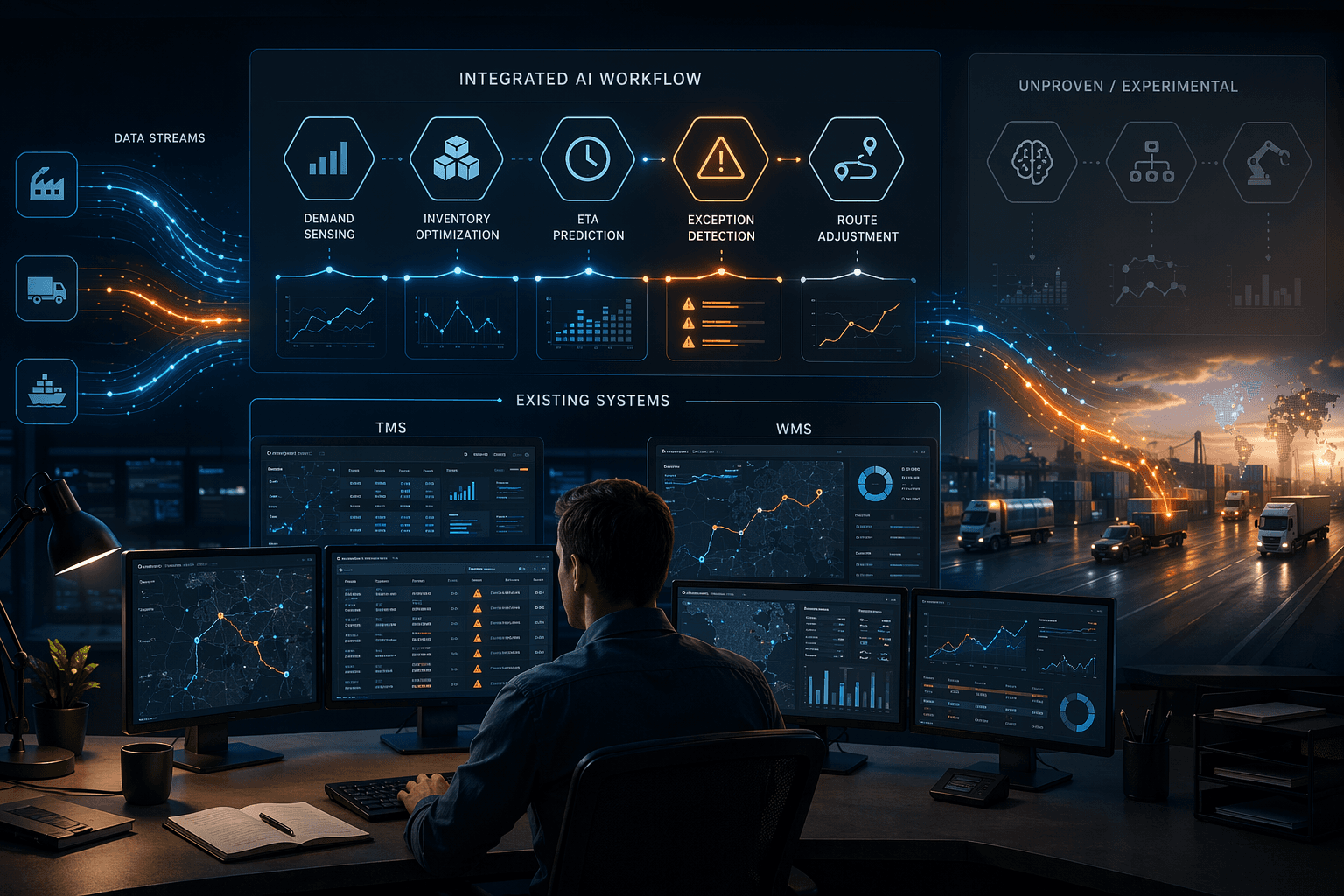
The difference sounds modest until it reaches the floor. A forecast adjustment that prevents one bad purchase order is useful. A route recommendation that moves a late shipment from “buried in the queue” to “review now” is useful. A document model that catches a customs-code mismatch before a broker has to unwind it is useful. The transformation story can wait; fewer ugly handoffs are a better early signal.
The 2026 filter: bounded, embedded, reviewable
A workable evaluation filter is simple enough to use in a sourcing meeting:
- Does the AI improve a decision that already exists in the workflow?
- Does it draw from signals the operation can actually maintain?
- Does it reduce work for the planner, dispatcher, compliance analyst, or inventory team without pushing hidden reconciliation onto someone else?
- Can a human review the recommendation quickly enough for the decision window?
- Can the outcome be measured in service level, cost, inventory, cycle time, error rate, or exception resolution — not just user activity?
The benchmark ranges still used by many evaluators are broad but directionally helpful: McKinsey’s 2024 AI supply chain work has been widely cited for 5–20% logistics cost reduction, 20–30% inventory reduction, 5–15% procurement spend reduction, and 20–50% reductions in demand forecast errors from AI-enabled forecasting.[2] Those are not fresh 2026 guarantees, and they should not be treated as a vendor-specific business case. They are better used as outer rails: if a proposal cannot explain which lever it affects, who changes work, and how savings reach the P&L, the benchmark is decorative.
For readers building that next layer of validation, the deployment evidence in Where AI in Supply Chain Actually Delivers ROI is the natural companion to this prioritization frame.
| AI application | Why it has worked better | Where the human still matters |
|---|---|---|
| Demand forecast refinement | Adds external and behavioral signals to existing planning processes instead of replacing demand planners outright | Approving overrides, explaining exceptions, and deciding when history is no longer a guide |
| AI-assisted routing and load matching | Improves dispatch choices with live constraints, capacity signals, and shipment characteristics | Handling customer promises, carrier relationships, accessorial disputes, and service exceptions |
| Document intelligence for customs compliance | Reads, extracts, checks, and flags trade-document inconsistencies before they become border or broker problems | Resolving ambiguous classifications, compliance risk, and final filing responsibility |
| Exception identification and prioritization | Sorts noisy alerts into work queues based on urgency, impact, and likely resolution path | Choosing the intervention and owning the trade-off |
| Multi-agent inventory rebalancing | Coordinates replenishment, allocation, and transfer options across constrained nodes | Setting policy, approving material moves, and protecting service commitments |
1. Demand forecast refinement works when it stays close to planning
Demand forecasting is where AI discussions often become sloppy. The working version is not “the model owns the forecast.” It is more often a planner-facing layer that improves a baseline forecast by incorporating more signals: recent demand shifts, promotions, weather exposure, market changes, store or channel behavior, and supply constraints. ARC’s 2025 assessment placed demand forecast refinement among the proven applications, not fully autonomous forecasting.[1]
That distinction matters. Forecast refinement helps when the planning team can see what changed, why the model is recommending an adjustment, and which SKUs, lanes, regions, or customers are affected. If the model’s role is to surface a sharper exception list, planners can spend less time hunting for signal and more time judging whether the recommendation makes operational sense.
The evidence supports the narrower claim. McKinsey’s cited range of 20–50% forecast-error reduction is tied to AI-enabled demand forecasting, but that does not mean every organization can hand over forecasting authority to an unsupervised model.[2] A company with stable item hierarchies, usable order history, and disciplined promotion data is in a different position from one that is still reconciling SKU substitutions by spreadsheet.
The better implementations also avoid treating accuracy as the only win. A forecast improvement that reduces expediting, lowers safety stock, or prevents a service miss is operationally visible. A model that improves a statistical metric while confusing replenishment or finance is just a cleaner dashboard. For a deeper look at realistic forecast accuracy expectations, see AI Demand Forecasting Accuracy.
2. Routing and load matching improve when AI narrows the dispatcher’s search
Routing and load matching are good AI territory because the work is full of constraints that are too dynamic for static rules but too consequential for blind automation. A dispatcher is weighing miles, appointment windows, trailer type, carrier availability, cost, service history, facility dwell, consolidation potential, and the customer promise. AI can reduce the search space fast.
ARC identified AI-assisted routing and load matching as one of the applications that worked in 2025.[1] The important word is “assisted.” The strongest use case is not a black-box tendering machine. It is a recommendation layer inside or adjacent to the TMS that proposes better load-route-carrier combinations, explains the constraint pattern, and flags where a human decision is needed.
This is also where adoption data should be read carefully. ActivTrak reported that 72% of logistics employees adopted AI tools in 2024, the highest rate across industries and 14 points above the cross-industry average.[3] That undercuts the lazy claim that logistics teams simply resist AI. But adoption is not the same thing as operational improvement. A route planner can use an AI assistant every day and still fail to reduce empty miles, late loads, detention, or manual escalations.
The evaluation question is therefore concrete: what decision step gets shorter? If AI reduces the time to identify feasible carriers, suggests consolidation opportunities that a planner would otherwise miss, or flags a route likely to break an appointment before the load is tendered, the value has somewhere to land. If it produces a polished recommendation that carrier ops must spend the afternoon reconciling, the demo value has shifted into someone else’s backlog.
Transportation leaders comparing route optimization, warehouse orchestration, and logistics exception use cases may also want the broader risk map in AI in Logistics: Use Cases, ROI, and Implementation Risks.
3. Document intelligence earns its keep before the shipment gets stuck
Cross-border logistics has always punished small mismatches. A product description that does not line up with the tariff code, a missing certificate, a value discrepancy, a consignee field that differs across documents — none of this looks dramatic in a transformation deck. It looks very dramatic when a shipment is waiting and the broker, compliance team, customer service desk, and transportation planner are all working from different fragments of the truth.
Document intelligence works because it attacks a bounded, expensive kind of ambiguity. Models can extract fields from invoices, packing lists, bills of lading, certificates, and customs documents; compare them against expected values; identify missing or inconsistent data; and route the issue to the right reviewer. ARC included document intelligence for cross-border customs compliance among the five proven AI logistics applications in its December 2025 assessment.[1]
The application is also a good test of whether an AI project respects downstream work. If the system simply reads documents faster but cannot show confidence levels, source fields, or exception reasons, compliance inherits a new verification burden. If it creates a clean queue of high-risk discrepancies before filing or handoff, the savings show up as fewer avoidable delays, fewer frantic broker emails, and less manual rekeying.
This is not the same as asking AI to become the customs expert of record. Classification, valuation, origin determination, and restricted-party decisions still carry legal and financial consequences. The useful system reads and compares faster than people can; the accountable people still decide what to file.
4. Exception prioritization is where small AI wins become visible
Exception management is a natural home for AI because logistics systems already produce more alerts than teams can treat equally. A late milestone, a missed scan, a temperature excursion, a capacity shortfall, a late inbound, a stockout risk, a customs hold, a labor constraint — each may be important, but not all are equally urgent, and many are duplicates or symptoms of the same problem.
ARC’s inclusion of exception identification and prioritization is less flashy than autonomous planning, and that is part of its credibility.[1] The application does not need to own the final decision. It needs to identify which exceptions are likely to affect service, cost, compliance, or inventory availability; group related alerts; suppress noise; and push the right work to the right queue.
The operational payoff is often measured in avoided misses rather than a single heroic savings number. A customer-facing shipment gets escalated before the appointment window collapses. A customs document mismatch is handled before freight reaches the border. A replenishment risk is reviewed while inventory can still be transferred. These are the places where AI value first appears as a calmer afternoon.
The trap is alert decoration. If the system adds a severity score that everyone ignores, or if it cannot explain why one exception is ahead of another, teams will revert to their old habits. Good prioritization changes the queue; weak prioritization changes the color of the queue.
5. Multi-agent inventory rebalancing is promising because it coordinates, not because it eliminates judgment
Inventory rebalancing sits one maturity level above the first three use cases. It requires coordination across demand signals, available supply, service commitments, lead times, transportation capacity, warehouse constraints, substitution rules, and cost-to-serve. A simple recommendation engine can help, but multi-agent approaches become interesting when different agents reason over different parts of the problem and negotiate feasible actions within policy boundaries.
ARC identified multi-agent inventory rebalancing as a proven 2025 use case.[1] That does not mean the system gets to move inventory wherever it wants. It means AI can evaluate reallocation options faster than a planner working through disconnected planning, warehouse, and transportation screens. It can suggest whether to transfer stock between nodes, protect scarce inventory for higher-priority demand, or adjust replenishment timing when service risk rises.
This is where the current agentic direction is genuinely useful, provided governance is real. BCG reported that agentic systems accounted for 17% of total AI value in 2025 and projected that share to reach 29% by 2028.[4] Gartner’s June 2025 supply chain survey found that only 23% of organizations had a formal AI strategy, while 94% planned to deploy AI for decision support within two years; Gartner also predicted that 15% of daily logistics decisions would be made autonomously by AI agents by 2028.[5]
Those numbers point to a direction, not a permission slip. Inventory policy is full of trade-offs: service to one customer versus another, markdown risk versus stockout risk, warehouse congestion versus transportation cost, and working capital versus resilience. Multi-agent systems can surface better options. They should not quietly rewrite the operating policy.
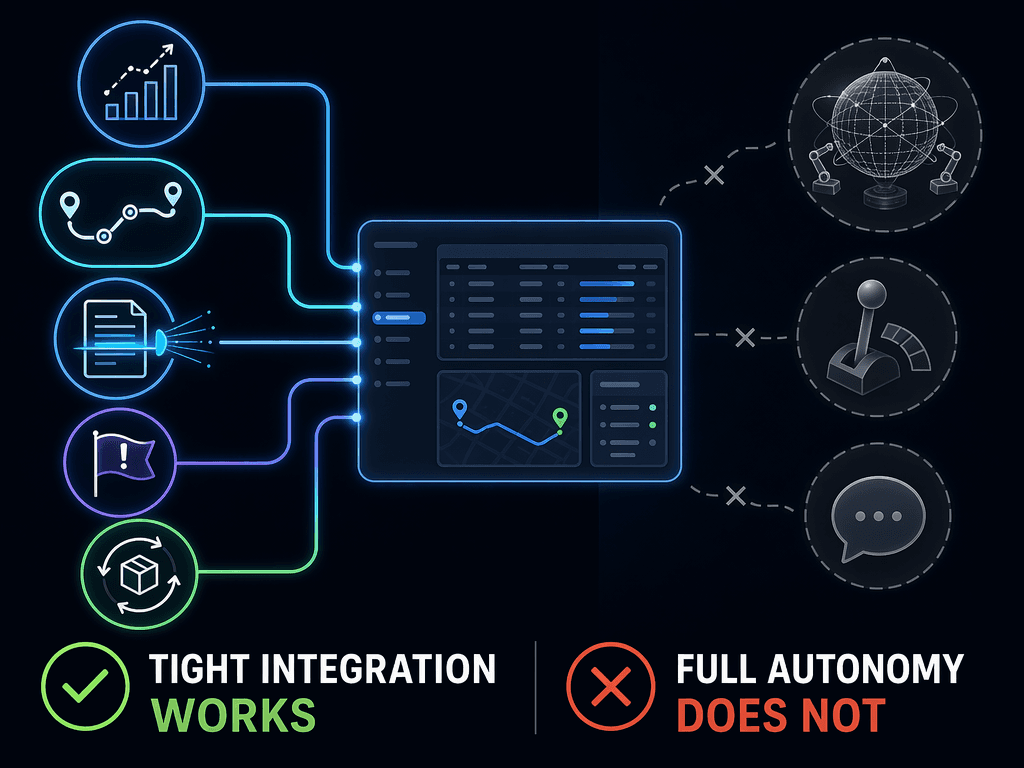
The shared pattern behind the five working applications
The five applications are not identical, but their operating logic is similar. Each one improves a bounded decision inside an existing workflow. Each can be connected to measurable outcomes. Each can tolerate imperfect data better than a fully autonomous system because it narrows uncertainty rather than pretending uncertainty has disappeared.
That last point is important because the data environment is still rough. PwC’s 2026 Digital Trends in Operations Survey found that 89% of operations leaders said technology investments had not fully delivered expected results, 87% cited poor data quality as a barrier, and 73% agreed data does not need to be perfect to drive value.[6] That combination is the 2026 operating reality: data is messy, leaders are frustrated, and waiting for perfect data is not a plan.
RELEX’s 2026 survey adds the trust gap. It found that 67% of supply chain leaders were more confident in AI than the prior year, but only 10% trusted AI for critical unsupervised decisions.[7] That is not a contradiction to be explained away. It is the deployment model. Leaders are more willing to use AI, but they still want humans in the loop where decisions carry service, compliance, inventory, or financial consequences.
This also explains why generic AI maturity statistics are useful only up to a point. ActivTrak’s adoption number shows logistics workers are using the tools.[3] Gartner’s decision-support trajectory shows organizations intend to deploy more of them.[5] PwC and RELEX show why the work still has to be grounded, reviewable, and connected to operational accountability.[6][7]
What underdelivered, and why
The underperforming categories do not need a dramatic takedown. They mostly failed for the same ordinary reasons: inconsistent data, too many edge cases, weak grounding in live operational context, and too much trust placed in systems that could not own the consequences.
Fully autonomous forecasting
Autonomous forecasting underdelivered because the hardest forecast questions are rarely just statistical. Promotions get changed late. Customers pull orders forward. Substitutions distort history. New products lack patterns. Supply constraints suppress demand in ways the model may misread. ARC called out autonomous forecasting as an underperforming area even while identifying forecast refinement as a proven use case.[1]
AI-driven carrier selection
Carrier selection looks tempting because the inputs seem measurable: rate, service, capacity, lane history, claims, tender acceptance. In practice, carrier decisions include relationship context, constrained capacity promises, accessorial disputes, customer preferences, and service recovery commitments that are not always represented cleanly in the TMS. ARC’s 2025 assessment identified carrier selection as an area that underdelivered.[1]
General-purpose Gen AI chatbots for operational decisions
Chatbots helped with access to information, training, summaries, and basic workflow assistance. They were weaker when asked to make or recommend operational decisions without deep grounding in current orders, inventory, shipment status, facility constraints, customer rules, and exception history. A chatbot that cannot see the live operating context will eventually ask a planner, dispatcher, or analyst to verify everything important.
The common failure is not that these ideas are permanently bad. It is that they were often bought as if autonomy were the product, when the organization still needed decision support, data reconciliation, workflow integration, and governance.
Market size is a poor shortcut for prioritization
Market-sizing numbers for AI in logistics and supply chain management vary too widely to be useful for application prioritization. Different sources define the market differently, combining software, services, robotics, analytics, Gen AI, planning tools, execution systems, and automation in ways that do not help a buyer decide what to fund next.
A stronger business case starts from the operational measure: forecast error, inventory, service level, manual touch time, dwell, late shipment risk, document error rate, cost per load, exception aging, working capital, or planner capacity. If the measure cannot be named, the use case is not ready for budget approval.
This is where many teams still lose the thread. Productivity gains appear in the workflow but never reach finance. A planner saves time, but compliance reviews more exceptions. A dispatcher tenders faster, but carrier ops cleans up more disputes. An inventory team gets better recommendations, but transfer costs rise. The measurement gap is often the difference between a good pilot and a funded rollout; Supply Chain AI ROI in 2026 addresses that problem directly.
How to evaluate a 2026 AI supply chain proposal
The best 2026 proposals should be able to show the workflow before and after AI. Not a capability map. Not a platform architecture diagram by itself. The actual working sequence: who receives the signal, what the system recommends, who approves, what data is written back, which exception path changes, and which team no longer has to chase the same issue manually.
- For forecast refinement, ask which signals are added, how overrides are explained, and how forecast changes affect inventory and service outcomes.
- For routing and load matching, ask whether recommendations are embedded in the TMS and whether they reduce late tenders, manual searches, cost, or service failures.
- For document intelligence, ask how the model exposes source fields, confidence, exception reasons, and audit trails.
- For exception prioritization, ask whether the queue changes in a way operators trust and whether low-value alerts are suppressed.
- For multi-agent inventory rebalancing, ask what policies constrain the agents, which moves require approval, and how service, working capital, and transfer cost are measured together.
Timeline expectations should also be specific. Some use cases can show value quickly because they reduce manual work in an existing process. Others require enough planning history, node-level inventory accuracy, systems integration, and governance to make the recommendation trustworthy. For benchmark and timing context, see AI in the Supply Chain: What Realistic ROI Timelines and Benchmarks Look Like in 2026.
The standard for AI in logistics and supply chain management in 2026 should be practical: prioritize AI-native, embedded, human-in-the-loop applications that measurably improve existing TMS, WMS, customs, planning, and inventory workflows. Treat autonomous decision-making as a governed frontier, not a procurement-ready default.
References
- AI in Logistics: What Actually Worked in 2025 and What Will Scale in 2026, Logistics Viewpoints, December 2025.
- The Potential of AI in Supply Chains, McKinsey, 2024.
- 2025 State of the Digital Workspace, ActivTrak, 2025.
- 2025 AI Value Creation Survey, BCG, 2025.
- Gartner press release and survey of 120 supply chain leaders, Gartner, June 2025.
- 2026 Digital Trends in Operations Survey, PwC, 2026.
- 2026 State of the Supply Chain, RELEX, 2026.
Comments
Join the discussion with an anonymous comment.