
Why Investment Sequencing Matters More Than Use Case Coverage
The supply chain AI market is projected to reach $236 billion by 2035, up from $9.94 billion in 2025, according to Precedence Research. That growth trajectory creates a familiar problem for operations leaders: when every vendor promises transformation, how do you decide which application gets the first budget allocation?
The RELEX 2026 State of the Supply Chain report, surveying over 500 supply chain leaders across retail, wholesale, and manufacturing, found that 67% of respondents are more confident in AI than they were a year ago. Only 3% said their confidence decreased. Yet the same survey reveals a critical hesitation: only 10% of leaders trust AI for critical decisions without human review, and 54% prefer a human-in-the-loop approach. The enthusiasm is real, but the operational comfort with autonomous decision-making is not there yet.
This gap between confidence and trust is precisely why investment sequencing matters. Deploying AI into a supply chain operation is not a binary decision. It is a sequence of choices about which function gets the first model, which data pipeline gets built first, and which team absorbs the initial change management burden. Organizations that treat all use cases as equally viable end up spreading budgets thin across pilots that never reach production scale.
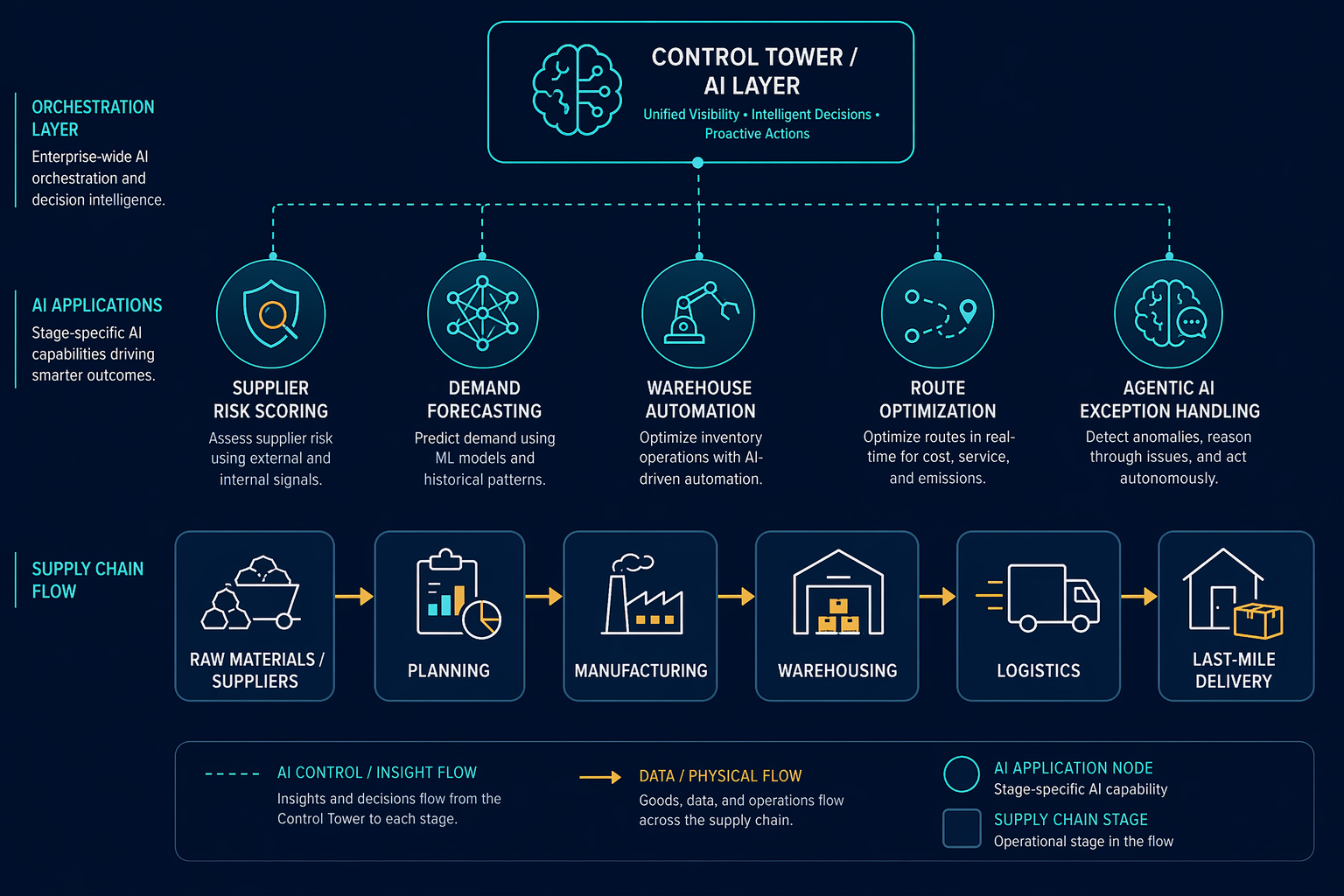
This article provides an explicit prioritization framework. It maps six high-impact AI applications against concrete outcome data, data readiness requirements, and payback windows so that supply chain VPs and procurement directors can decide which use case to fund first, second, and third — not just which ones exist.
The AI Use Case Matrix: Six Applications Ranked by Data Readiness and Payback Window
The following matrix ranks six AI use cases across three dimensions: data readiness (how much clean, accessible data the organization typically needs), implementation timeline (from pilot to production), and expected payback window. The ranking column shows investment priority for a typical mid-to-large enterprise starting its AI journey in 2026.
| Use Case | What It Does | Measured Outcomes | Data Readiness Required | Implementation Timeline | Representative Vendors | Investment Priority |
|---|---|---|---|---|---|---|
| Demand Forecasting | ML models predict future demand using historical sales, promotions, and external signals | 20–50% forecast error reduction (McKinsey) | High: 2+ years of clean sales data, promotion calendars, external demand signals | 3–6 months pilot; 6–12 months production | Blue Yonder, o9 Solutions, Kinaxis, RELEX | 1st |
| Document Intelligence | GenAI extracts, classifies, and validates data from contracts, customs docs, invoices | 40% improvement in customs clearance turnaround; 99% data accuracy (Metro Shipping) | Low: digitized documents, basic OCR pipeline | 1–3 months pilot; 3–6 months production | Hyperscience, ABBYY, SAP AI Core | 2nd |
| Inventory Optimization | AI optimizes reorder points, safety stock, and multi-echelon inventory levels | 20–30% inventory reduction (McKinsey 2024) | Medium: inventory transaction data, lead time history, demand variability data | 4–8 months pilot; 6–18 months production | RELEX, E2open, John Galt Solutions | 3rd |
| Route Optimization | AI optimizes delivery routes considering traffic, weather, time windows, and fuel costs | 5–20% logistics cost reduction (McKinsey 2024) | Medium: transportation data, GPS feeds, customer location data | 3–6 months pilot; 6–12 months production | OptimoRoute, Descartes, Trimble, ORTEC | 4th |
| Warehouse Automation | AI-powered robotics and computer vision automate picking, packing, and inventory counting | 30–50% warehouse throughput gains (U.S. distribution companies) | High: WMS integration, IoT sensor data, facility layout data | 6–12 months pilot; 12–24 months production | GreyOrange, Locus Robotics, Symbotic, AutoStore | 5th |
| Supplier Risk Scoring | AI analyzes supplier performance, financial health, geopolitical risk, and ESG data | 30% reduction in supply-driven stockouts (Fortune 500 manufacturer) | High: supplier performance history, financial data, third-party risk feeds | 6–12 months pilot; 12–24 months production | Everstream Analytics, Resilinc, Altana AI | 6th |
Comments
Join the discussion with an anonymous comment.