
The Gap Between Market Hype and Operational Reality
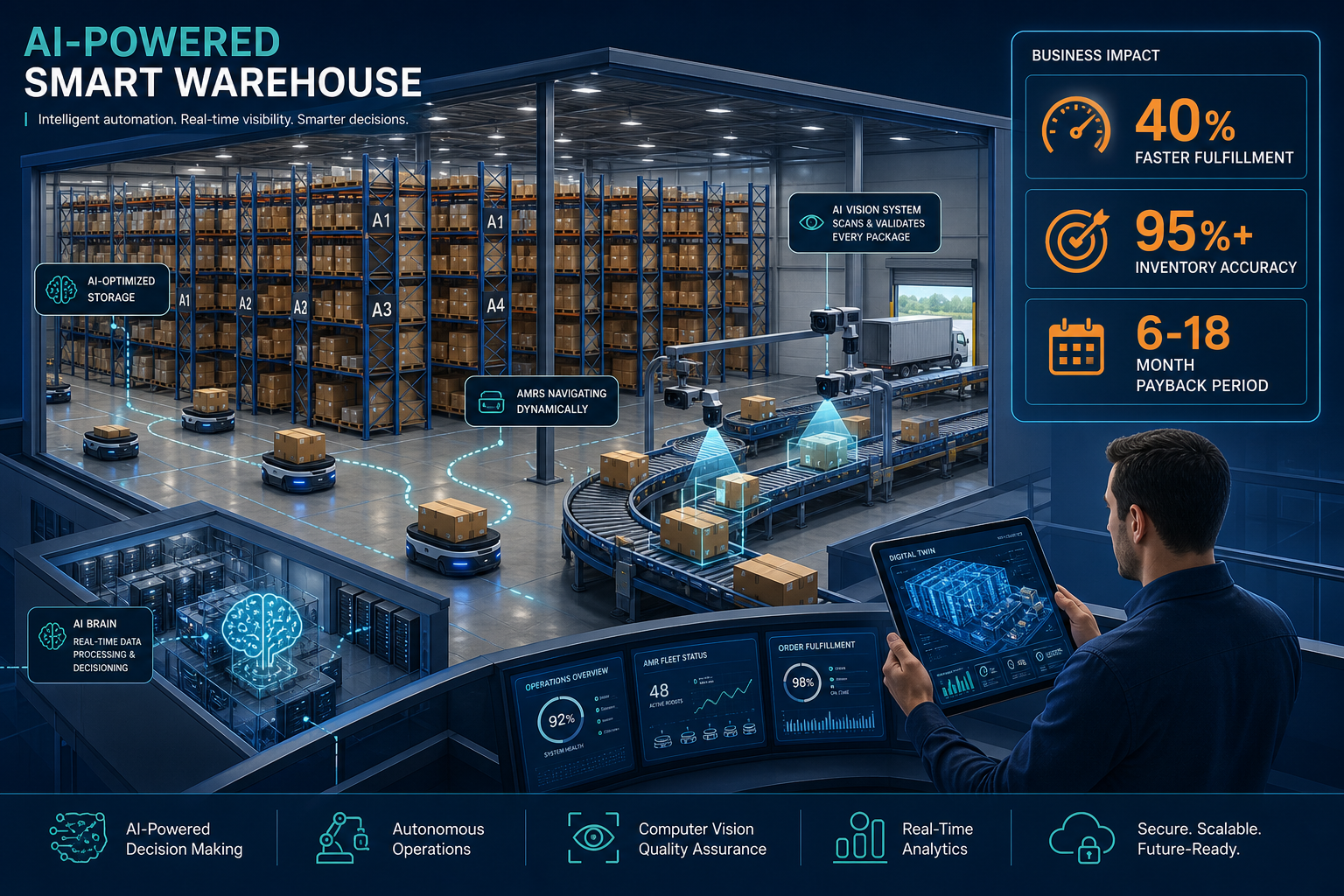
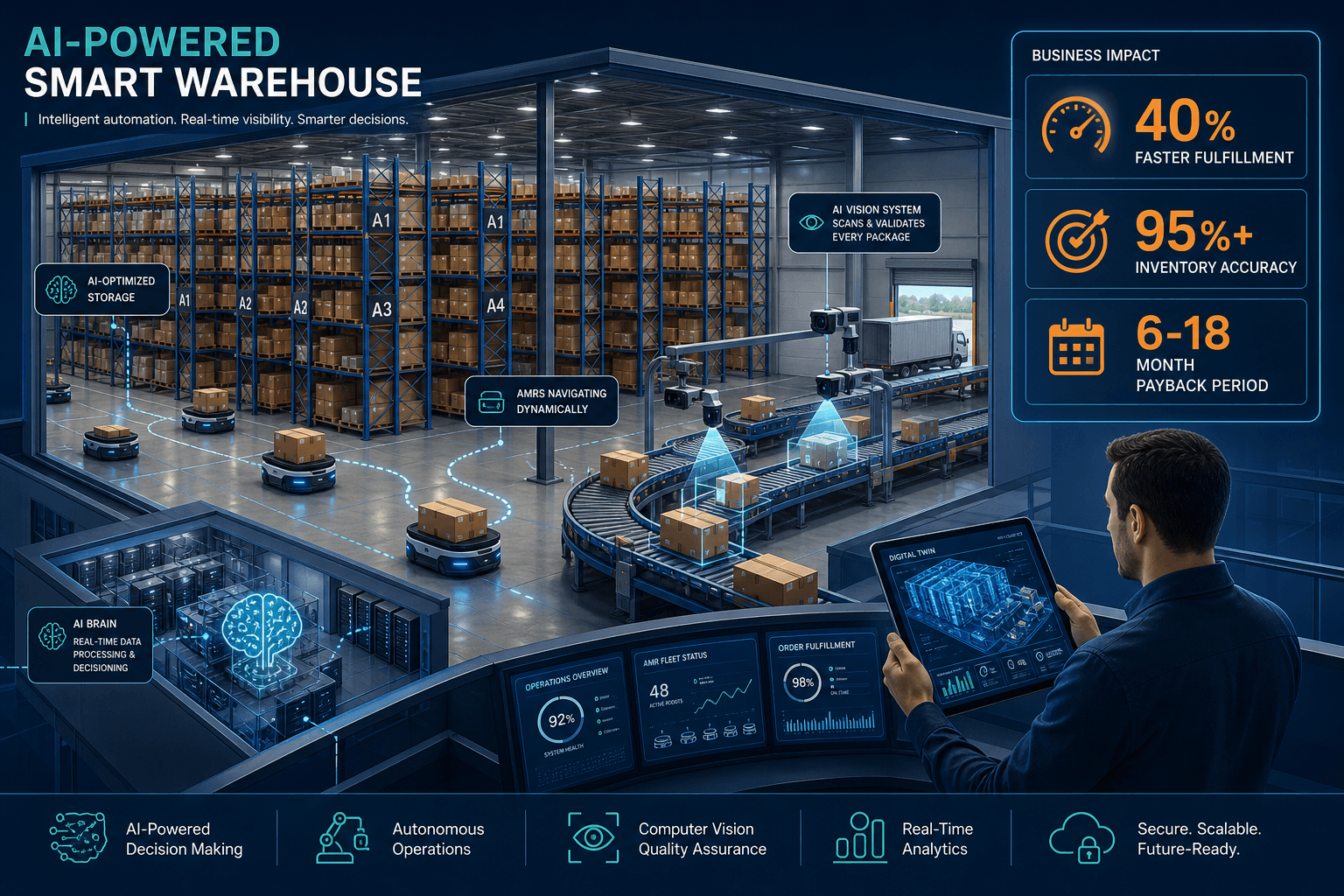
The numbers are staggering. The global AI in warehousing market was valued at $15.78 billion in 2026 and is projected to reach $83.42 billion by 2034, growing at a compound annual rate of 23.1%, according to Fortune Business Insights. Vendor conferences, industry reports, and trade publications paint a picture of a sector in rapid transformation, where autonomous mobile robots glide through aisles, computer vision systems inspect every inbound pallet, and digital twins simulate operations before a single box moves.
The operational reality is far more modest. Despite the investment surge, an estimated 80% of warehouses globally remain manually operated. Only 25% have deployed any form of automation, and just 10% use what could be classified as advanced automation, per data compiled by The Network Installers. The gap between what the market is selling and what most facilities can actually absorb is the single largest source of failed AI warehouse projects.
This article is written for the skeptical decision-maker — the supply chain director, VP of operations, or CFO who has seen vendor ROI projections that assume perfect conditions. The thesis is straightforward: when AI warehouse projects fail, the technology is rarely the culprit. The failures come from six underappreciated prerequisites that most vendor proposals either minimize or omit entirely. Understanding these failure modes before signing a contract is what separates deployments that deliver on their promise from those that become expensive case studies in what went wrong.
Failure Mode #1: Network Infrastructure Inadequacy
The most common reason AI warehouse projects stall or fail has nothing to do with the AI itself. It is the network. Autonomous mobile robots, real-time inventory sensors, computer vision cameras, and handheld devices for pickers all depend on reliable, low-latency wireless coverage across every square foot of the facility. Most warehouses were never built with this density of connected devices in mind.
Upgrading a facility's network infrastructure to support AI-driven operations typically costs between $30,000 and $150,000 per facility, according to data from The Network Installers. These costs cover additional access points, upgraded switches, cabling, site surveys, and ongoing monitoring. They are rarely included in the initial vendor quote for automation equipment, which means they surface as a surprise line item midway through the project — often after budgets have been approved and timelines set.
The scale of the problem is worse than most operators realize. Less than 10% of mobile device issues on the warehouse floor are ever reported to IT. Workers find workarounds — moving to a spot with better signal, rebooting devices repeatedly, or simply accepting slower performance. The actual network failure rate is approximately ten times what the dashboards show. By the time IT sees a problem, it has been degrading operations for weeks or months.
For a deeper examination of why network readiness is the gatekeeper for warehouse AI adoption, including specific upgrade timelines and cost breakdowns, see our companion piece: The Hidden Infrastructure Tax: Why 80% of Warehouses Still Haven't Deployed ML.
Failure Mode #2: Data Quality and Silos
AI models are voracious consumers of clean, structured, integrated data. A warehouse AI system that promises to optimize slotting, predict labor requirements, or automate putaway decisions needs to draw from the warehouse management system, the enterprise resource planning platform, Internet of Things sensors, and often external data sources like carrier tracking feeds. In most facilities, these systems were never designed to talk to each other.
The typical warehouse operates with fragmented data: inventory accuracy that drifts between physical counts, SKU master records with inconsistent naming conventions, order data that lives in a separate system from inventory data, and labor tracking that is still done on paper or spreadsheets. Feeding this into an AI model produces outputs that are, at best, unreliable and, at worst, actively misleading.
The consequences of poor data quality in AI deployments are well documented. As noted in KNAPP's 2026 trends analysis, high data quality is an essential prerequisite for AI's full potential. Without it, organizations find themselves spending more time cleaning and reconciling data than actually using the AI system to improve operations.
- Inventory accuracy below 95% will cause AI-driven replenishment models to generate incorrect order quantities.
- Inconsistent SKU naming across systems prevents AI from learning product affinity patterns for slotting optimization.
- Missing or inaccurate lead time data in the ERP undermines predictive labor planning models.
- Manual data entry errors compound when fed into machine learning models, producing outputs that operators learn to distrust.
For a detailed exploration of how data readiness gaps cause AI projects to fail — and how to fix them before deployment — see our analysis: Why 70% of Supply Chain AI Projects Fail — and How Data-First Implementation Fixes It.
Failure Mode #3: Integration Complexity with Legacy Systems
The warehouse management system is the operational backbone of any facility. It controls inventory tracking, order release, wave planning, and shipping documentation. Adding an AI layer on top of or alongside an existing WMS introduces integration complexity that is consistently underestimated.
Consider a concrete scenario: a WMS that was designed to handle 1,000 orders per hour during peak season. The AI system optimizes picking routes, dynamically allocates labor, and coordinates autonomous mobile robots. In doing so, it increases throughput capacity to 2,500 orders per hour. The WMS, which was never designed for that volume, begins to exhibit cascading failures — transaction timeouts, allocation errors, and synchronization delays between the WMS and the AI orchestration layer. The bottleneck shifts from the physical operation to the software that controls it.
Integration failures are the most common cause of extended go-live timelines, often pushing deployments back by months. The technical complexity of connecting AI middleware to legacy WMS and ERP platforms requires specialized integration expertise that most warehouse operators do not have in-house. Vendor-provided integration services are often scoped narrowly, covering only the connection between the AI platform and the WMS, not the broader ecosystem of carrier systems, labor management tools, and reporting platforms.
Failure Mode #4: Workforce Resistance and Change Management
The human dimension of AI warehouse implementation is where many projects quietly unravel. According to data from The Network Installers, 60% of warehouse employees express concern about job security when their employer announces an automation initiative. This anxiety does not dissipate on its own. It manifests as resistance to training, passive non-compliance with new processes, and increased turnover among the experienced workers whose institutional knowledge is critical to smooth operations.
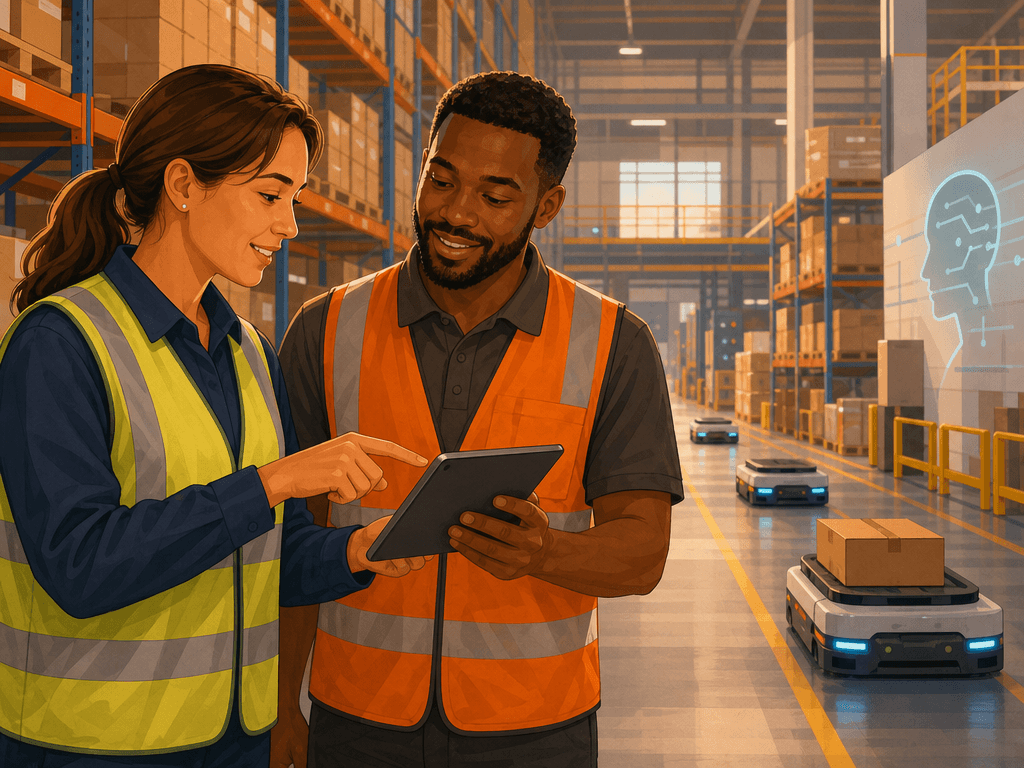
The financial case for investing in workforce transition is strong. Labor costs account for 50% to 70% of total warehousing budgets, and wages in the sector climbed 7% to 9% year over year in 2024. AI systems that reduce labor dependency by automating sorting, counting, and quality inspection can deliver significant savings — but only if the remaining workforce is trained, motivated, and aligned with the new operational model.
- Conduct a skills gap assessment before selecting automation technology, not after.
- Involve warehouse supervisors and lead pickers in the vendor evaluation process.
- Budget for retraining programs that cover both the AI system and the new workflows it enables.
- Establish clear career progression paths for workers whose roles shift from manual tasks to system oversight.
- Communicate the automation roadmap early and update it frequently — uncertainty is worse than bad news.
For a broader perspective on organizational readiness and the patterns that distinguish successful AI adopters from the rest, see: Why Most Supply Chain AI Initiatives Fail — and What the 4% of Leaders Do Differently.
Failure Mode #5: Unaccounted Recurring Costs
Vendor proposals excel at presenting the upfront equipment cost. They are far less transparent about what happens after year one. The most significant hidden recurring cost is equipment maintenance, which runs 15% to 20% of the initial equipment cost annually, according to data from The Network Installers. For a facility investing $2 million in autonomous mobile robots, that translates to $300,000 to $400,000 per year in maintenance — a figure that is frequently excluded from the initial budget model.
Beyond hardware maintenance, there are software licensing fees for the AI platform, cloud infrastructure costs for data storage and model inference, and the cost of specialized personnel to manage and monitor the system. Many organizations underestimate the need for dedicated data engineers and AI operations staff, assuming the vendor's support team will handle ongoing model tuning and troubleshooting.
| Cost Category | Typical Annual Cost | Commonly Included in Vendor Quote? |
|---|---|---|
| Equipment maintenance (hardware) | 15–20% of initial equipment cost | Rarely |
| Software licensing / SaaS fees | Varies by vendor; often 15–25% of software cost annually | Sometimes (year 1 only) |
| Cloud infrastructure (compute, storage) | $20k–$100k+ depending on data volume | Rarely |
| Dedicated AI operations personnel | $100k–$180k per FTE | Never |
| Network maintenance and monitoring | $5k–$15k per facility | Rarely |
| Training and change management | $50k–$200k per deployment | Sometimes (initial only) |
Building a total cost of ownership model that accounts for these recurring expenses is essential before signing any contract. For a structured framework on how to build that model — including ROI benchmarks and payback period calculations — see our guide: How to Build a Business Case for AI in Warehouse Management: ROI Benchmarks, Payback Periods, and Cost Modeling.
Failure Mode #6: Cybersecurity Exposure
An automated warehouse is a connected warehouse, and a connected warehouse is a more attractive target for cyberattacks. Every autonomous mobile robot, every IoT sensor, every computer vision camera, and every cloud-connected AI inference endpoint represents a potential entry point into the corporate network. The average cost of a data breach in 2023 was $4.45 million, according to IBM Security data cited by The Network Installers.
The attack surface expansion is not theoretical. AI systems require real-time data feeds from multiple sources, which means opening network ports, establishing API connections between the warehouse floor and cloud platforms, and deploying edge computing devices that process data locally. Each of these connections must be secured, monitored, and patched — a set of responsibilities that often falls between the gaps of the IT team, the OT team, and the vendor.
Mitigation Strategies and Vendor Due Diligence Checklist
The six failure modes described above are not reasons to avoid AI warehouse investment. They are reasons to approach it with eyes open and a structured due diligence process. The organizations that succeed treat the pre-contract phase as the most important phase of the project. They ask hard questions, demand evidence, and build budget models that account for the full cost of deployment — not just the vendor's quoted price.
Below is a practical checklist to use during vendor evaluation and site readiness assessment. Each item corresponds to one of the six failure modes and includes specific questions to ask and evidence to request.
| Failure Mode | Due Diligence Questions | Evidence to Request |
|---|---|---|
| Network infrastructure | What are the wireless coverage requirements? Have you conducted a site survey? What is the minimum latency and bandwidth needed? | Site survey report; reference deployments in facilities of similar size and construction type |
| Data quality and silos | What data sources does the AI system require? What is the minimum data quality threshold? How is data cleansing handled? | Data integration specification; examples of data quality remediation from other deployments |
| Integration complexity | Which WMS and ERP platforms have you integrated with? What is the integration architecture? How is throughput scaling tested? | Integration case studies; reference calls with customers using the same WMS; throughput test results |
| Workforce resistance | What change management support do you provide? What training materials and programs are included? | Change management plan; training curriculum; metrics from past deployments on adoption rates |
| Recurring costs | What is the total cost of ownership over 3, 5, and 7 years? What maintenance is included vs. extra? What are the cloud infrastructure costs? | TCO model with all cost categories itemized; maintenance contract terms; cloud cost estimates |
| Cybersecurity exposure | What security certifications do you hold? How is data encrypted in transit and at rest? What is the incident response process? | SOC 2 Type II report; penetration test results; incident response plan; network architecture diagram |
A critical part of the due diligence process is understanding the vendor landscape. Not all AI warehouse platforms are built for the same facility type, throughput level, or integration complexity. For a structured comparison of the major vendors, their core methodologies, and their capability gaps, see our AI Warehouse Management Systems: Vendor Landscape Snapshot Q2 2026.
For authoritative industry context on adoption rates and investment trends, the MHI 2025 Annual Industry Report provides benchmark data that can help calibrate your organization's readiness against industry peers.
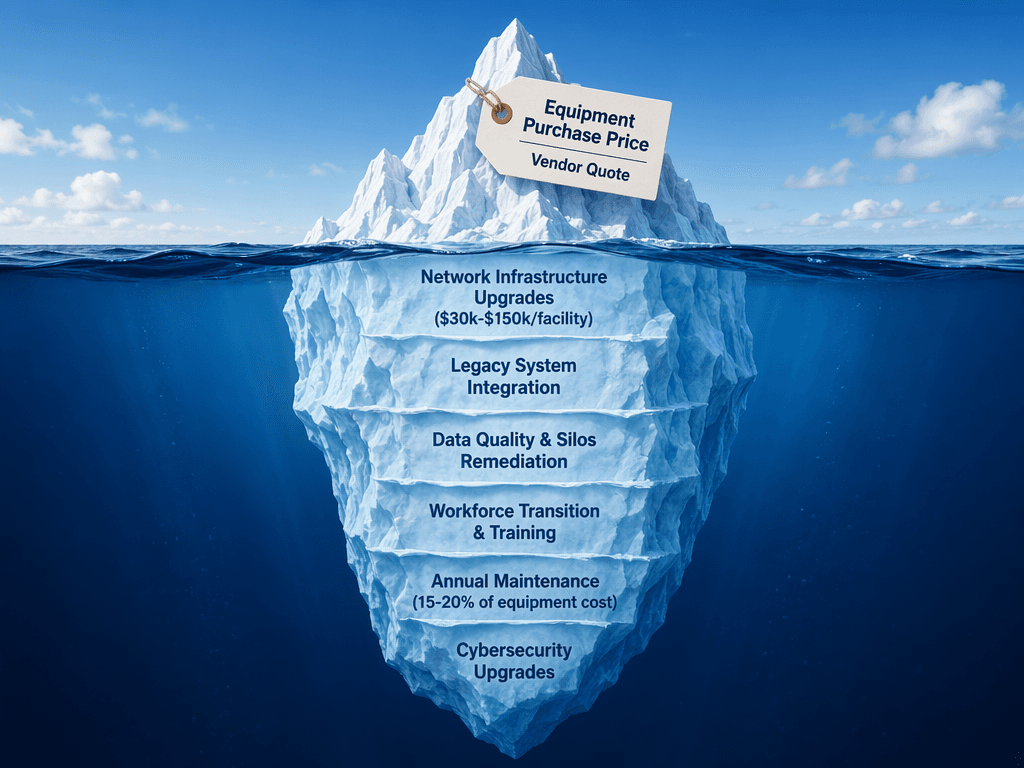
The organizations that will succeed with AI in warehouse management are not necessarily the ones with the largest budgets or the most advanced technology. They are the ones that go into the process with a clear-eyed understanding of what it actually takes — the network upgrades, the data cleanup, the integration work, the workforce transition, the recurring costs, and the security hardening. They ask the hard questions before they sign, not after.
Comments
Join the discussion with an anonymous comment.